
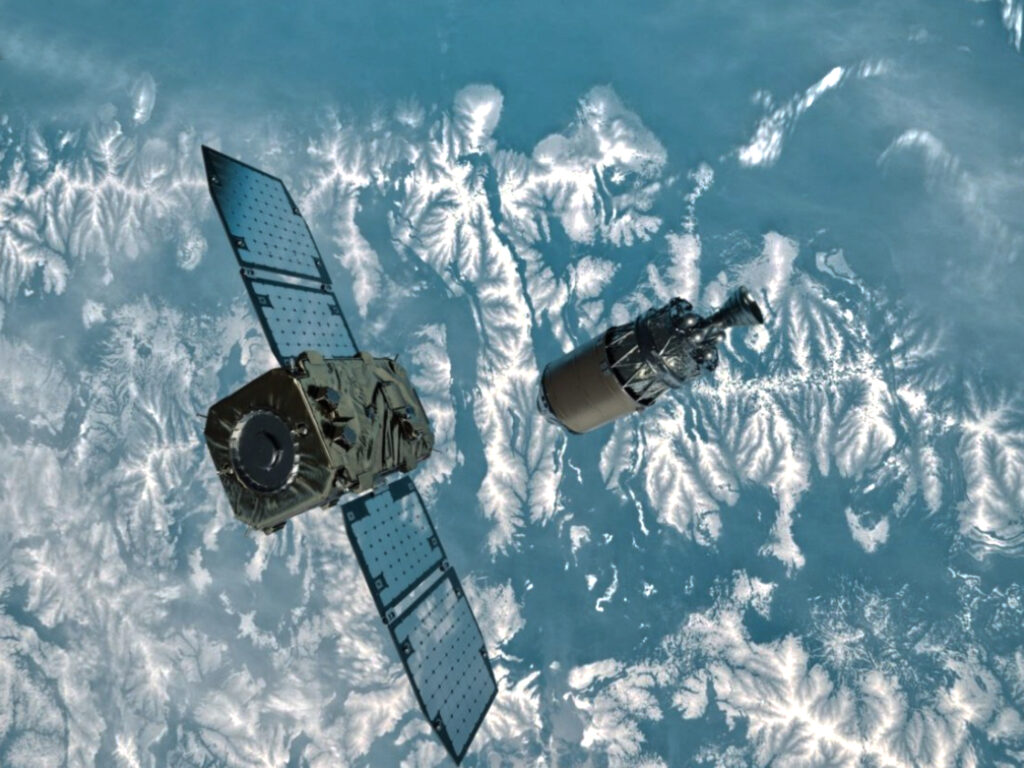

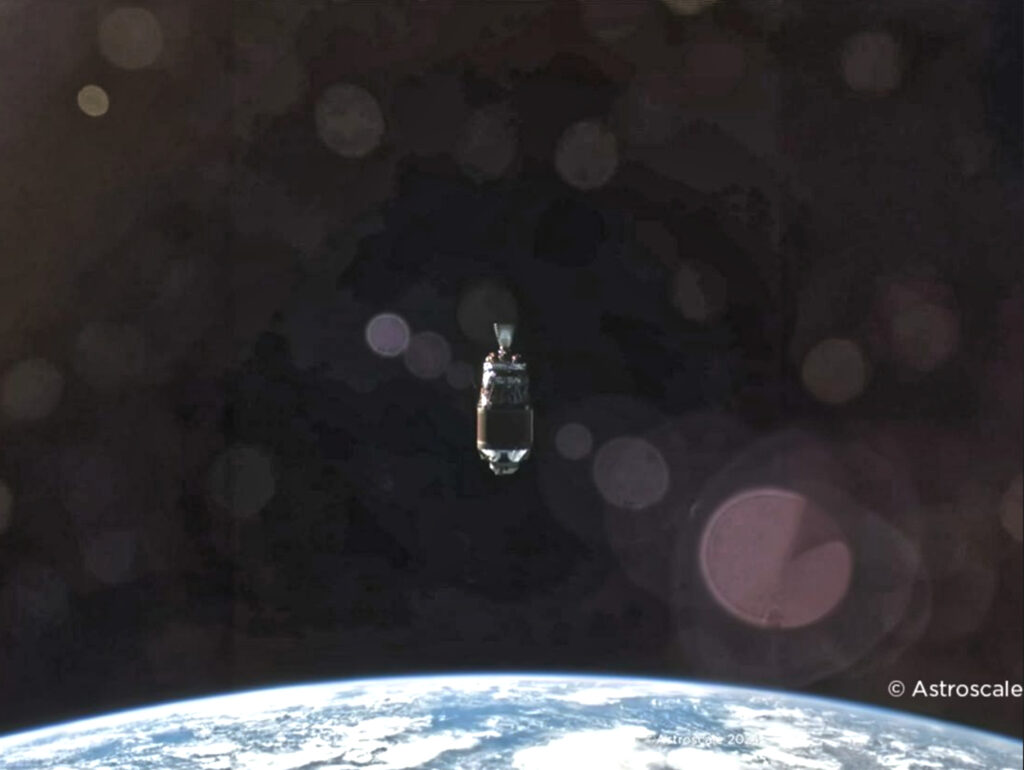
Astroscale Japan Inc. has announced that the firm’s commercial debris inspection demonstration satellite, Active Debris Removal by Astroscale-Japan (ADRAS-J), successfully approached a large piece of space debris — a rocket upper stage — to approximately 15 meters — this is the closest approach ever achieved by a commercial company to space debris through Rendezvous and Proximity Operations (RPO).
ADRAS-J was selected by the Japan Aerospace Exploration Agency (JAXA) for Phase I of its Commercial Removal of Debris Demonstration. This latest approach, however, was an ambitious goal independently designed by Astroscale, in addition to JAXA’s baseline mission requirements. The objective was to demonstrate highly precise and complex close-range RPO capabilities by advancing to the Capture Initiation Point (CIP), where future debris removal missions start robotic capture operations.
When ADRAS-J was 50 meters behind the upper stage the spacecraft reduced the gap in a straight-line approach then maneuvered to approximately 15 meters below the Payload Attach Fitting (PAF) — the planned capture point for the follow-on ADRAS-J2 mission — aligning the spacecraft’s relative speed, distance, and attitude.
ADRAS-J successfully maintained this position until an autonomous abort was triggered by the onboard collision avoidance system due to an unexpected relative attitude anomaly with the upper stage. The spacecraft safely maneuvered away from the debris as designed before reaching the CIP. Astroscale Japan is currently investigating the cause of the abort.
While ADRAS-J did not reach its intended final distance, the mission demonstrated the robustness of its safety measures during simulated capture operations. The onboard Fault-Detection, Isolation, and Recovery system has ensured the spacecraft’s safety during all close-proximity operations, including the successful response and abort maneuver during the first fly-around observation attempt in July.
In addition to achieving the historic 15-meter approach, ADRAS-J successfully completed all observations of the debris required by the JAXA mission, including two fly-around operations that confirmed no major damage to the PAF and a third fly-around from a new angle of the upper stage. These accomplishments have provided critical data to inform the follow-on ADRAS-J2 debris removal mission, further advanced Astroscale’s heritage RPO and inspection capabilities for a wide range of on-orbit services and set a new benchmark for space sustainability.
Key ADRAS-J mission milestones since launch:
- Feb. 18: launch and start of in-orbit operations.
- Feb. 22: start of rendezvous phase.
- Apr. 9: start of Angles Only Navigation and proximity approach from several hundred kilometers.
- Apr. 16: start of Model Matching Navigation relative navigation techniques.
- Apr. 17: approach to the upper stage within several hundred meters.
- May 23: approach to the upper stage within 50 meters and first fixed-point observation completed.
- Jun. 17: second fixed-point observation completed.
- Jun. 19: start of fly-around operation and validation of collision avoidance system.
- Jul. 14: approach to the upper stage within 50 meters. Third fixed-point observation completed.
- Jul. 15: first successful fly-around observation.
- Jul. 16: second successful fly-around observation.
- Jul. 17: first final approach attempt, successfully reaching 20 meters.
- Aug. 13: third successful fly-around observation.
- Nov. 30: final approach, successfully reaching 15 meters.