

In a landmark moment for the Kingdom of Bahrain, the National Space Science Agency (NSSA) has successfully launched Al Munther, the nation’s first domestically designed and built satellite—the satellite was launched aboard a SpaceX Falcon 9 rocket as part of the Transporter-13 mission from Vandenberg Space Force Base in California, USA, on Saturday, March 15, 2025.
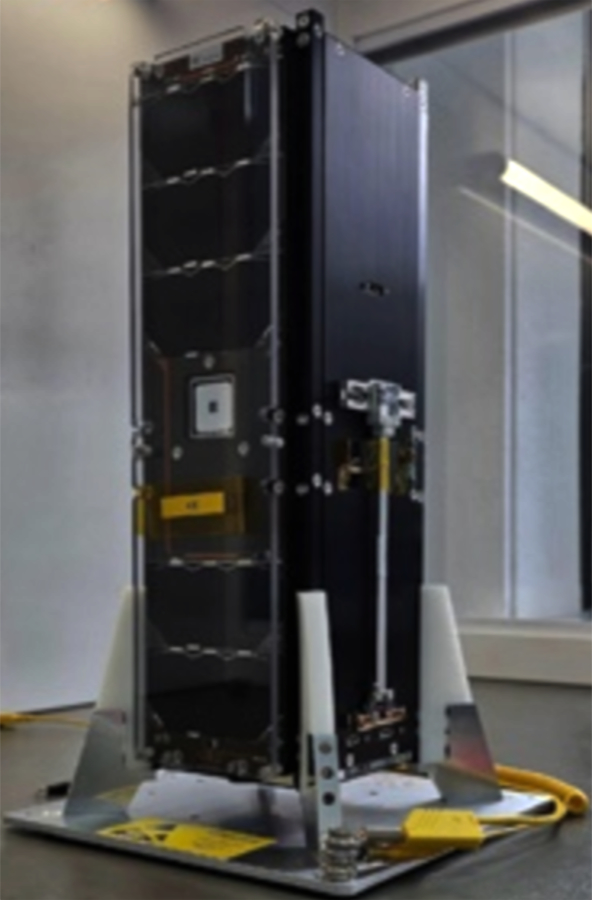
Al Munther nanosatellite.
This historic achievement marks a significant milestone in Bahrain’s journey towards becoming a regional leader in space technology and innovation. The launch of Al Munther underscores the Kingdom’s commitment to advancing its capabilities in space science and technology, while showcasing the expertise of Bahraini engineers and scientists.
The Al Munther satellite was successfully deployed into its designated orbit at an altitude of 550 km above sea level. The satellite will now undergo a series of orbital tests to ensure its operational readiness before commencing full-scale operations.
The satellite is equipped with advanced technological payloads, including a medium-resolution space camera (20 meters/pixel) designed to capture high-quality images of Bahrain and its territorial waters, an artificial intelligence (AI) system capable of real-time image analysis, making Al Munther the first nanosatellite in the region to incorporate such advanced AI capabilities, a cybersecurity payload featuring advanced encryption technologies to safeguard the satellite’s data from unauthorized access or tampering, and a radio broadcast payload that will transmit the Bahraini national anthem and a special message from His Majesty King Hamad bin Isa Al Khalifa, King of Bahrain, to radio enthusiasts worldwide.
One of the most distinctive features of Al Munther is its ability to broadcast the Bahraini national anthem and a royal message via digital signals. These transmissions can be received by amateur radio operators and space enthusiasts around the globe using simple equipment. This initiative aims to promote Bahrain’s space achievements and enhance its international presence in the field of space exploration.
The “Al Munther” project has provided a unique opportunity for a team of young Bahraini engineers to gain hands-on experience in developing advanced space systems. From mission concept development and engineering requirements to system design, software development, and environmental testing, the project has enabled Bahraini talent to contribute to every stage of the satellite’s development.
The National Space Science Agency (NSSA) is responsible for advancing Bahrain’s space sector and fostering innovation in space science and technology. The agency works to develop national capabilities in space exploration, satellite technology, and space applications, contributing to Bahrain’s sustainable development and economic diversification.

Article source: Bahrain News Agency