Image credit to Philipp Werner
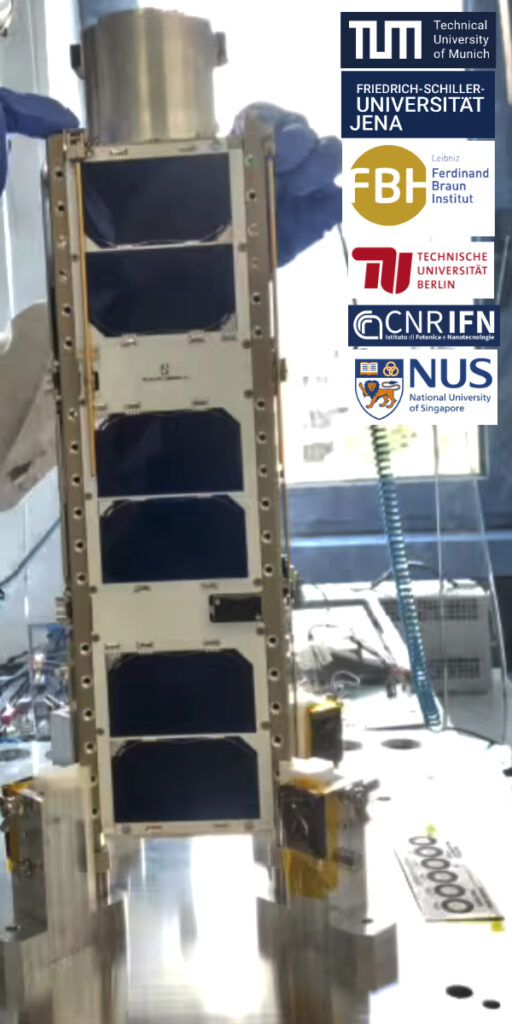
The goal of TUM‘s QUICK³ is to make fast and secure communication possible. The QUICK³ nano satellite will test components for use in future quantum satellite systems.
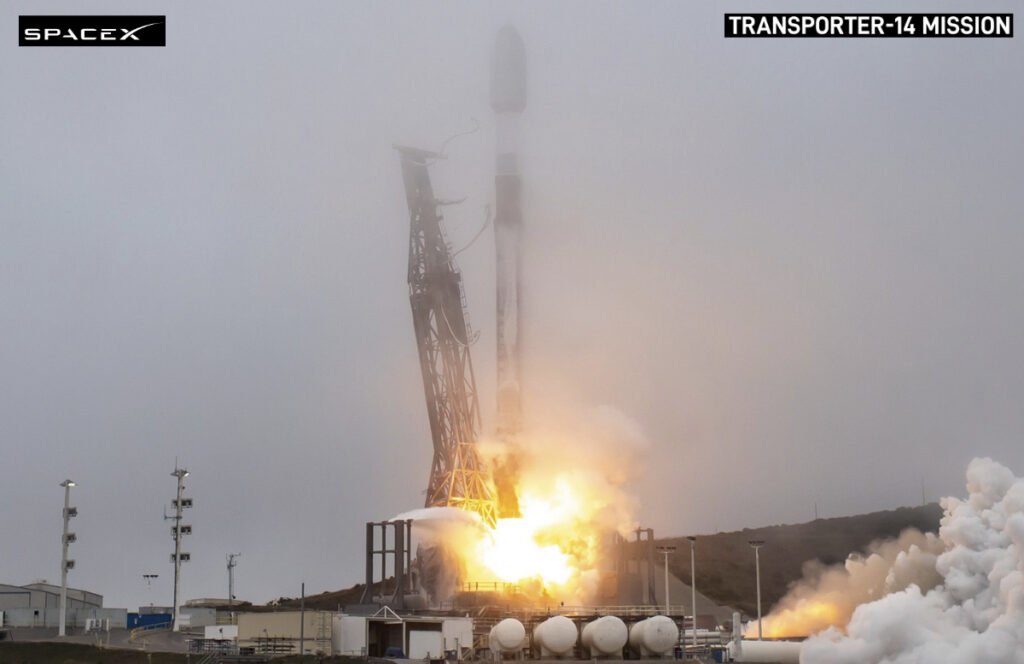
The satellite, developed by a research consortium headed by TUM professor Tobias Vogl, was launched into orbit with a booster rocket from Vandenberg Space Force Base in California on Monday, June 23rd. The mission is expected to deliver its first results by the end of this year.
The QUICK³ satellite is no bigger than a shoebox and weighs around 4kg and it is to test quantum communication components that will achieve fully secure data transmissions from the sender to the receiver.
Unlike conventional communications through fiber-optic cables, the information transmitted by a quantum communication satellite is not contained in light pulses comprised of many photons, but rather in individual, precisely defined photons. These photons have quantum states that make the transmission absolutely secure.
As any attempt to intercept the message will change the state of the photons,such actions will be immediately detected. The individual photons can neither be copied nor amplified. This limits their range in fiber-optic cables to a few hundred kilometers. Satellite-based quantum communication use the special characteristics of the atmosphere. In the upper atmospheric layers, there is minimal scattering or absorption of light. This results in ideal conditions for secure data transmissions over long distances.
The second goal of the mission is to test the Born probability interpretation of the wave function under zero gravity conditions. The function describes the probability of finding a quantum particle in a measurement at a specific location—a central concept of quantum mechanics. The question of whether this rule also applies universally, even in outer space, has never been experimentally verified.
To make quantum communication an everyday reality, a globe-spanning network of several hundred satellites will be needed. Before that, however, the QUICK³ mission aims to demonstrate that the individual components of the nano satellite can withstand conditions in space and successfully interact. The QUICK³ smallsat uses single photon source instead of laser beams
In addition to the researchers from the Technical University of Munich (TUM), the QUICK³ satellite was developed, primarily, by scientists at Friedrich Schiller University Jena (FSU), the Ferdinand-Braun-Institut, Leibniz-Institut für Höchstfrequenztechnik (FBH) and Technical University Berlin (TUB) along with international partners at the Institute for Photonics and Nanotechnologies (CNR-IFN) in Italy and the National University of Singapore (NUS).
In this mission we are testing single photon technology for nano satellites for the first time,” said Tobias Vogl, Professor of Quantum Communication System Engineering at TUM and leader of the project. “At present there is no comparable project anywhere in the world. Either the satellites are much heavier and therefore more expensive or they operate with lasers, which greatly reduces the data transmission rate. The transmission speed is a key advantage of our system, but the satellites have only a few minutes of line-of-sight contact with ground stations on each orbit.”