

CNES has awarded €31 million in strategic funding to UNIVITY—formerly Constellation Technologies & Operations— as part of a France 2030 call for projects operated by CNES—this support marks a decisive step in the development of space-based 5G made in France and in the realization of UNIVITY’s industrial ambition.

While American and Chinese giants dominate the race for satellite connectivity, a French startup is changing the game with a bold vision rooted in innovation and industrial sovereignty.
Selected under the France 2030 space program following a competitive bidding process, UNIVITY—together with TDF—will carry out a groundbreaking demonstration of satellite-based 5G connectivity. Through real-world use cases, this experiment will validate the relevance of a fully integrated 5G NTN solution, designed and built in France, combining very Low Earth Orbit (vLEO) satellites with terrestrial infrastructure.
TDF will play a central role in the project’s operational implementation, managing the hosting, installation, operation, and maintenance of three gateway stations—two in mainland France and one overseas. These gateways will be essential to ensure seamless interoperability between the satellite system and telecom operators’ terrestrial networks.
With €31 million in funding from CNES and additional industrial co-financing from UNIVITY, the contract amounts to a total of €44 million and reflects a proactive commitment to technological sovereignty. As a true accelerator for the space industry, France 2030 supports the development of critical technologies for France’s economy and Europe’s technological independence. The selected project aims to validate this technology in real-world operational conditions.
The France 2030 co-funded project, with 30% industrial contribution, will unfold through to 2028 in two phases:
- Phase 1 (July 2025 – April 2026): technical specification and use case studies.
- Phase 2 (April 2026 – February 2028): assembly, integration, testing, launch, and in-orbit operation of two VLEO 5G satellites communicating with gateways and ground terminals to demonstrate high-throughput, low-latency services.
Backed by CNES, this funding underscores the credibility of the project while validating the technological and business choices made by UNIVITY and TDF. It also acts as a powerful industrial accelerator.
UNIVITY is not just another technological evolution, it is a strategic solution arriving at a historic moment in the telecom sector, marked by the convergence of terrestrial and space networks. As a future global provider of space-based internet services, the French company is developing a VLEO constellation leveraging operators’ own 5G mmWave spectrum to deliver high-speed, low-latency connectivity – just as they do today with terrestrial networks. This breakthrough opens new possibilities for connecting rural, remote, and underserved regions without requiring massive infrastructure investments.
This €44 million program consolidates UNIVITY’s ambitious trajectory. Less than six months after raising €9.3 million, the company successfully launched in June 2025 its first regenerative 5G mmWave payload for space telecommunications. It has also signed strategic agreements with TDF and with ESA. Next milestones include the launch of two prototype satellites in 2027, followed by the gradual deployment of the constellation between 2028 and 2030.
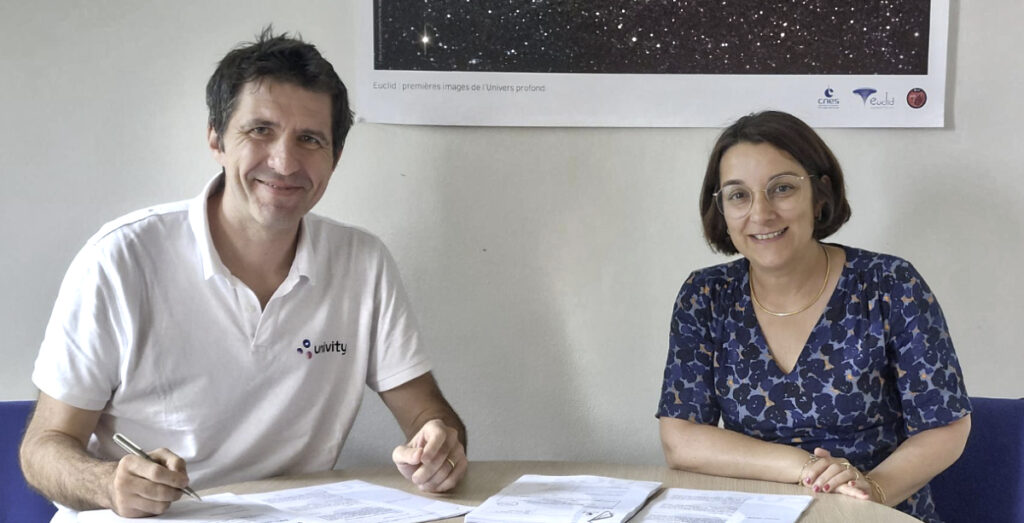
Thanks to France 2030 funding, CNES is supporting UNIVITY in preparing, through the in-orbit demonstration ‘uniShape,’ a satellite-based 5G-NTN service designed to meet the needs of terrestrial operators. UNIVITY’s ‘uniSky’ constellation aims to deliver a distinctive French solution for high-speed space-based 5G-NTN connectivity, serving both consumer and professional users, built on innovative concepts and breakthrough technologies,” said Caroline Laurent, Director of Orbital Systems and Applications, CNES.
We are proud to have the support of France 2030 for this project, which represents a true strategic milestone for us. This recognition validates both our expertise and our vision of converging terrestrial and space networks. Our entire team is fully committed to this challenge, ready to deliver with enthusiasm, ambition, and determination,” said Véronique Bonnet, Program Director at UNIVITY.
This project is a key milestone for TDF, underscoring our ability to integrate the space dimension into our telecom infrastructure offering. By combining our field expertise, local presence, and technological know-how, we are actively contributing to the emergence of a hybrid, resilient, and sovereign connectivity model driven by French players,” said Jean-Louis Mounier, Managing Director of TDF’s TowerCo Business Unit.
Space is the new frontier for telecommunications,” said Charles Delfieux, President of UNIVITY.