
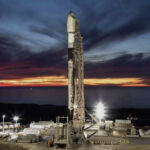

The SpaceX Transporter-15 rideshare mission successfully launched on Friday, November 28, 2025, from Vandenberg Space Force Base in California, carrying 140 small satellites into a sun-synchronous orbit.
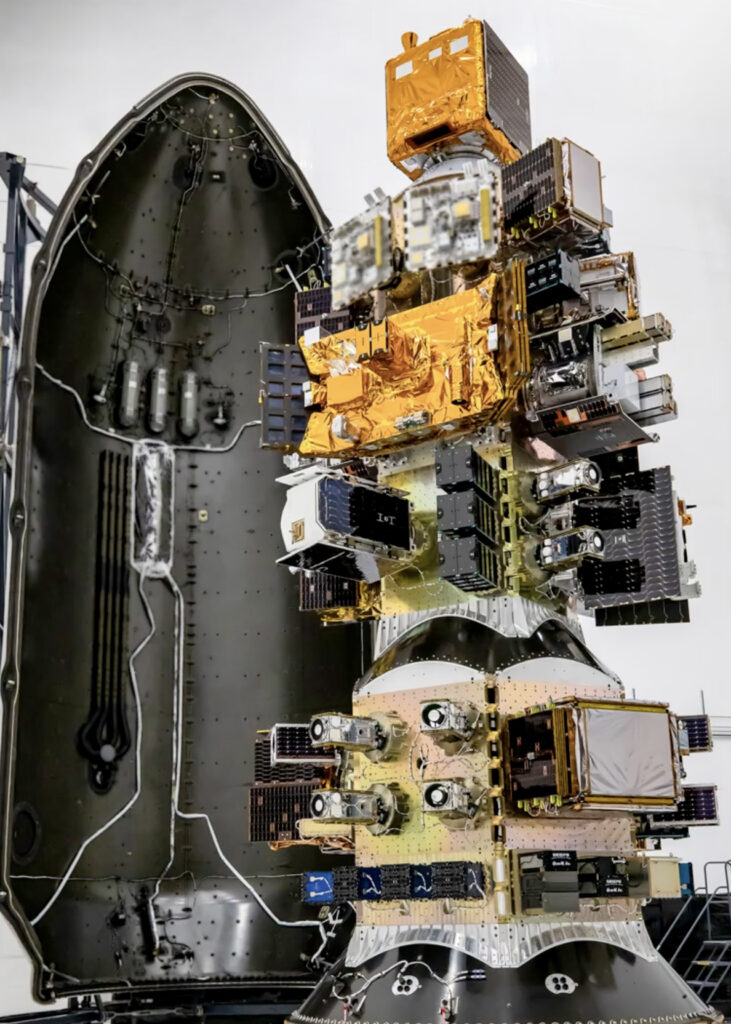
The mission, the 19th dedicated smallsat rideshare flight for SpaceX, deployed a diverse manifest of 140 payloads for a global customer base, making it one of the largest small-satellite deployments ever. Payloads included:
- Earth Observation Satellites:
- Environmental Monitoring: Satellites were deployed for monitoring Earth’s water cycle and other environmental factors.
- Scientific and Commercial Payloads:
- Integrators: Key payload integration providers included Exolaunch, which managed the deployment of 59 satellites, and SEOPS Space, which deployed 11 spacecraft.
The Falcon 9 rocket lifted off at 10:44 a.m. PST (1:44 p.m. EST / 18:44 UTC) on November 28, 2025, from Space Launch Complex 4E (SLC-4E) at Vandenberg Space Force Base, California.
A flight-proven Falcon 9 first stage booster (B1071) completed its 30th flight before landing successfully on the “Of Course I Still Love You” droneship in the Pacific Ocean.
Payloads included Taiwan’s Formosat-8A, the first in a planned eight-satellite remote-sensing constellation. Planet Labs also deployed multiple Flock 4H satellites for Earth imaging.
In addition to Formosat-8A and the Planet Labs satellites, the SpaceX Transporter-15 mission carried a diverse manifest of other notable scientific and commercial payloads, including:
- Mauve: A commercial astronomy satellite developed by UK startup Blue Skies Space, carrying a small ultraviolet telescope to study stellar flares and young stars hosting exoplanets.
- Varda Space Industries’ Winnebago-5 (W-5): A re-entry capsule designed to process pharmaceuticals in microgravity and return them to Earth, using a NASA-developed C-PICA thermal protection system.
- D-Orbit’s ION Satellite Carriers: The mission deployed two Orbital Transfer Vehicles (OTVs), named Galactic Georgius and Stellar Stephanus, which carried multiple customer satellites and hosted payloads, including the Italian optical intersatellite link (OISL) mission for the European Space Agency (ESA).
- NASA-funded CubeSats: These included the R5-S7, a technology demonstration satellite from NASA’s Johnson Space Center for rapid, low-cost technology prototyping, and the 3UCubed-A satellite, a collaboration between multiple universities to measure precipitating electrons and UV emissions in Earth’s auroral regions.
- CTC-1: Three satellites built by Space Telecommunications Inc. to test “Spacecoin,” a communications protocol that uses blockchain technologies for secure communications.
- Black Kite-1 (RIoT-1): An 8U satellite from Taiwan’s Rapidtek, part of a project to establish a prototype constellation for global IoT (Internet of Things) communications.
- Umbra-11: Another synthetic aperture radar (SAR) spacecraft for Umbra, an Earth imaging company providing high-resolution radar data.
- ESA’s WISDOM mission: Supported by ESA’s NAVISP program, this 6U satellite will demonstrate collision avoidance and safe deorbiting capabilities by separating into two smaller CubeSats in orbit.
The successful mission underscores the efficiency and high cadence of SpaceX’s rideshare program, offering affordable and flexible access to space for numerous organizations worldwide. For further information on the mission and SpaceX’s launch services, please visit the SpaceX website.
Images via SpaceX