
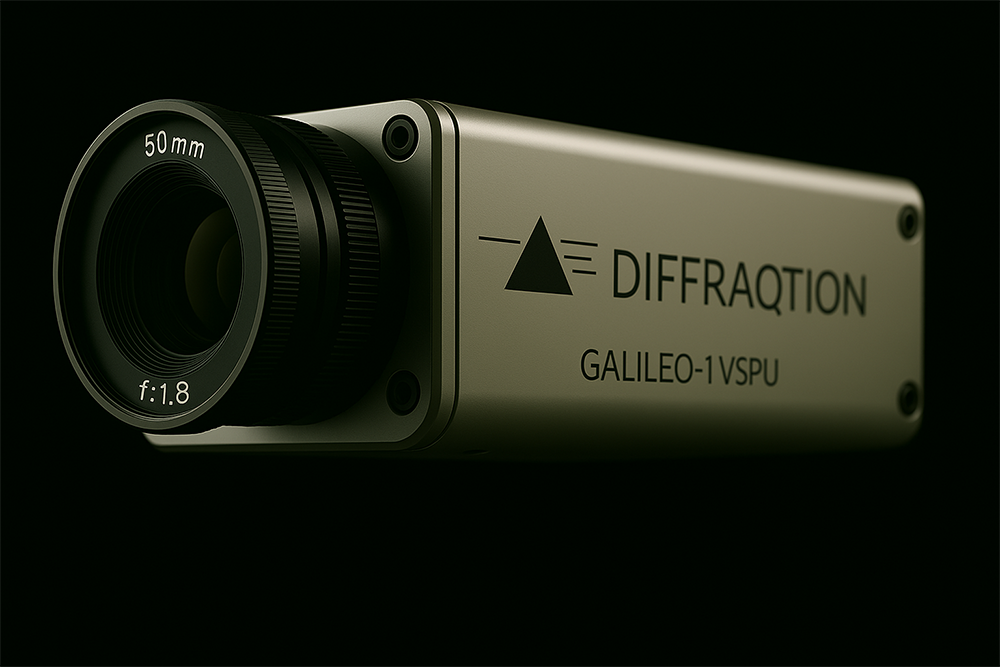
SOMERVILLE, Mass. — Quantum imaging startup Diffraqtion has secured $4.2 million in pre-seed funding to deploy satellite constellations equipped with proprietary “quantum cameras” designed to bypass traditional optical limits.
The round, announced Jan. 13, was led by QDNL Participations, with additional backing from milemark•capital, Aether VC, ADIN, and Offline Ventures. The total capital includes a non-dilutive DARPA Small Business Innovation Research (SBIR) Direct-to-Phase 2 contract focused on space situational awareness (SSA).
Breaking the Diffraction Limit Diffraqtion’s payload targets the physical “diffraction limit” that restricts the resolution of conventional optical systems based on aperture size. The company’s technology utilizes photon-counting sensors and AI-driven processing to extract higher-fidelity data from incoming light. According to the company, the system offers up to 20 times the resolution and 1,000 times the processing speed of standard cameras.
This architecture is designed to enable small satellites to capture imagery comparable to much larger, heavier telescope systems. The technology aims to support both commercial Earth observation and defense applications, including orbital debris tracking and intelligence gathering.
Leadership and Heritage Spun out of MIT and the University of Maryland, Diffraqtion was co-founded by CEO Johannes Galatsanos, CTO Christine Wang, and Chief Scientific Advisor Saikat Guha. Guha, a professor at the University of Maryland, previously led research with NASA and DARPA that forms the basis of the company’s intellectual property.
The leadership team also includes Head of Product Mark Michael, the former CTO and co-founder of Kepler Communications, who brings operational experience from deploying low Earth orbit (LEO) constellations.
Operational Timeline Diffraqtion is currently refining its hardware as part of the U.S. Space Force Apollo Accelerator. The company plans to conduct “on-sky” demonstrations using ground-based telescopes at the University of California Observatories in early 2026. These tests will validate the sensor’s performance through atmospheric turbulence before the technology is integrated into a space-based platform for orbital demonstration.
The company stated the technology is also being integrated into military defense architectures in collaboration with Space Systems Command.