
On February 4, 2026, Muon Space announced a major transition from executing discrete satellite missions to the sustained deployment of multi-mission constellations.
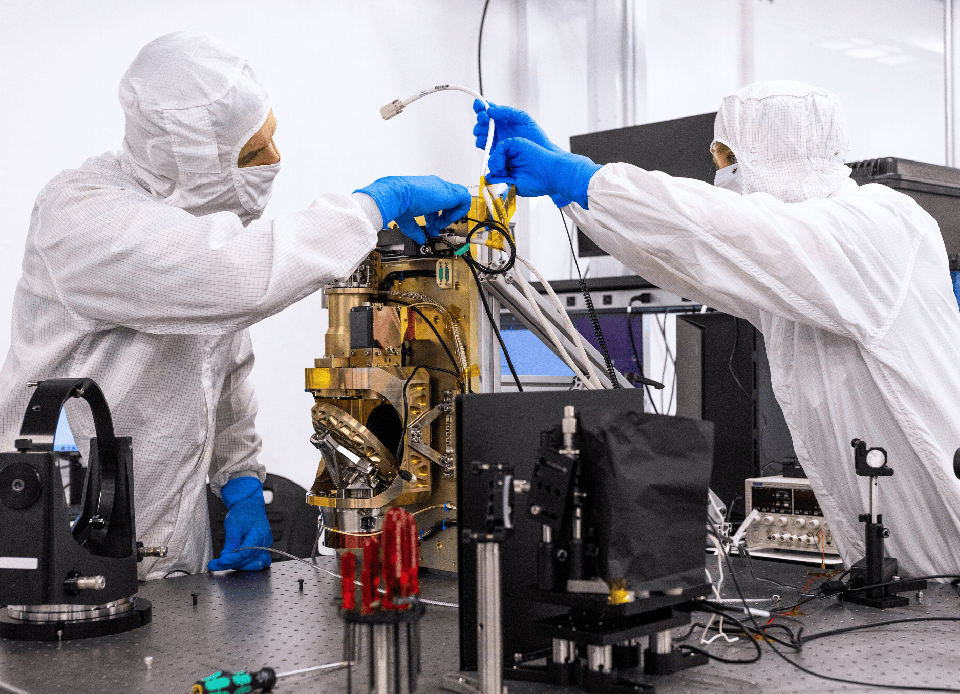
This strategic shift follows a period of rapid growth for the Silicon Valley startup, which reported a 100 percent year-over-year revenue increase for the second consecutive year. To support this operational scale-up, Muon Space has expanded its production capacity by ten times, now capable of manufacturing up to 500 satellites per year at its 130,000-square-foot facility in San Jose.
Multi-Mission Strategy and Government Contracts
The company is moving away from one-off missions toward a “Mission Foundry” model, providing end-to-end satellite solutions that prioritize operational outcomes over hardware delivery. This approach has proven successful in securing high-value government agreements.
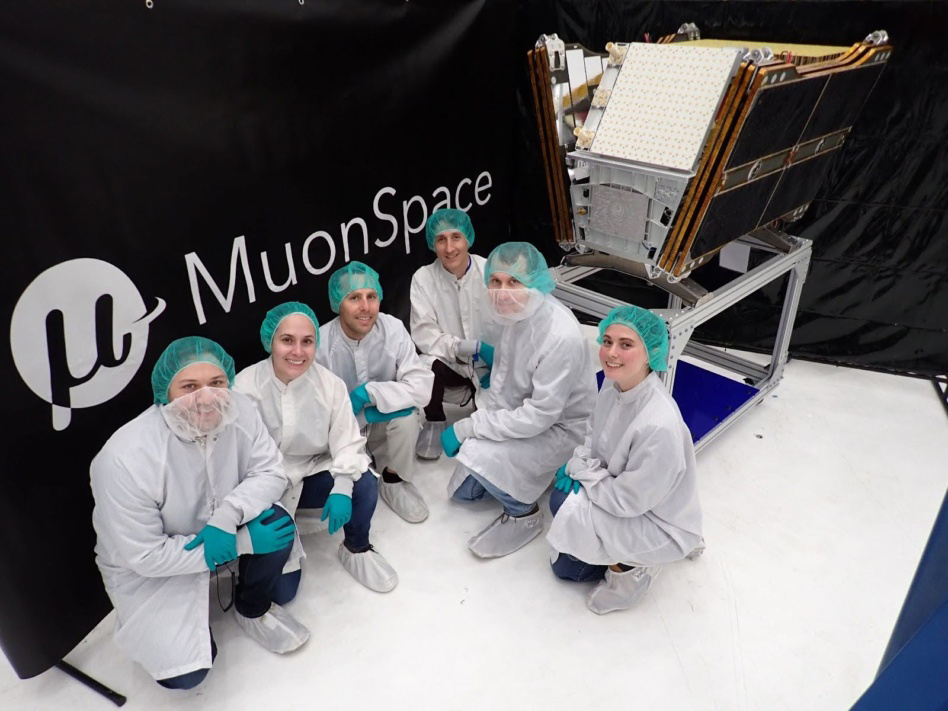
Muon secured a $44.6 million SBIR Phase III contract from U.S. Space Force to develop a dual-use space-based environmental monitoring (SBEM) capability. This project involves a three-satellite prototype demonstration focused on cloud characterization and theater weather imagery to support military planning in contested environments.
National Reconnaissance Office (NRO): The company was awarded Stage II of an National Reconnaissance Office (NRO) contract in 2025 to advance commercial electro-optical capabilities, providing multispectral data for national security assessment.
Missile Defense Agency (MDA): Muon was selected for the SHIELD IDIQ program, from the Missile Defense Agency (MDA), which has a massive $151 billion ceiling, contributing commercial space-based sensing to next-generation missile defense architectures.
Vertical Integration and Technological Milestones
Muon Space is aggressively pursuing vertical integration to reduce costs and accelerate deployment speeds. A key part of this strategy was the acquisition of propulsion startup Starlight Engines, which brings in-house zinc-based thruster technology designed for improved stability and lower costs compared to traditional xenon systems. Additionally, Muon recently closed a $146 million Series B financing round, led by Congruent Ventures and Activate Capital, to fuel its infrastructure expansion and staff growth.
Technologically, the company has launched its new XL spacecraft platform to accommodate larger payloads and higher-performance sensors. In an industry-first move, Muon also signed an agreement with SpaceX to integrate Starlink mini laser terminals onto its satellites. This integration, scheduled to begin in the third quarter of 2026, will enable persistent optical connectivity in orbit, significantly enhancing real-time data delivery across its global constellations.
Upcoming Launch Manifest
Over the next 20 months, Muon Space has 20 satellites manifested for launch, including:
- SNC Vindlér 2.0: Deployment of the first three satellites for Sierra Nevada Corporation’s RF collection and analytics constellation in Q1 2026.
- Earth Fire Alliance: Three additional FireSats are scheduled for mid-2026 to enhance global wildfire detection and monitoring.
- Commercial Awards: New missions for 2026 will span hyperspectral mapping, radio frequency sensing, and thermal infrared sensing for a variety of logistics and agricultural customers.