
By Abbey White, Staff Writer, SatNews
Dispatch from SmallSat Symposium. Coverage and analysis from across the conference, tracking the forces shaping the next phase of the SmallSat market.
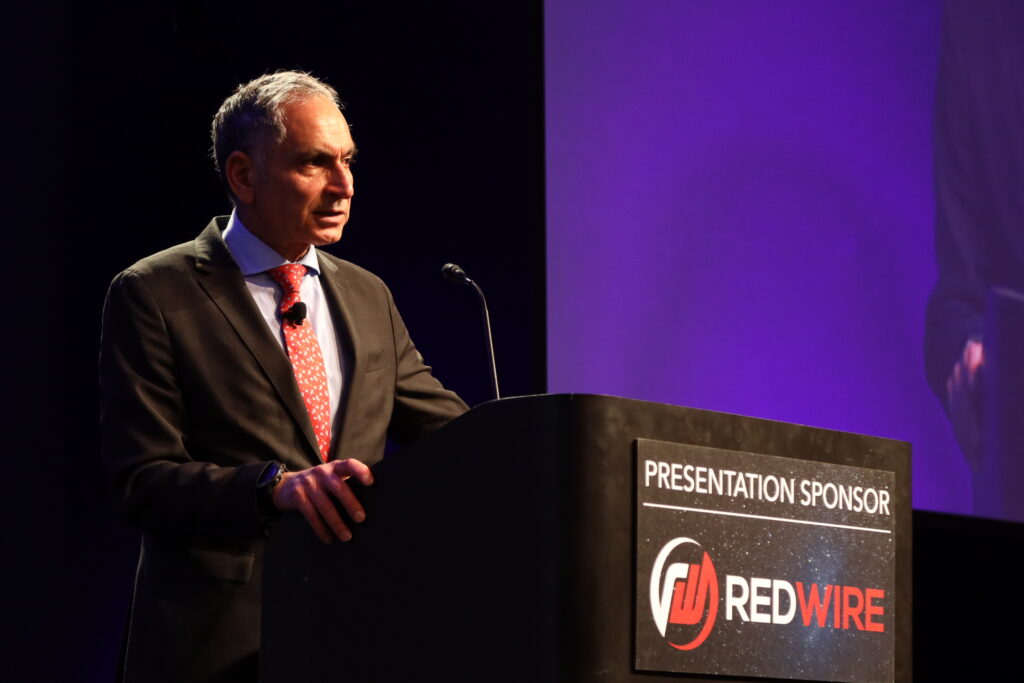
MOUNTAIN VIEW. The age of PowerPoint architecture has passed. For five years, the Space Development Agency operated as the Pentagon’s rebellious startup, promising to deliver a Proliferated Warfighter Space Architecture faster than the establishment could draft a requirements document. At the SmallSat Symposium, however, no celebratory mood pervaded the SDA Vision: Pacing Evolving Threats session. Instead, a sober atmosphere prevailed as SDA’s ambitions met the friction of reality.
Dr. GP Sandhoo, the agency’s Acting Director, took the stage at a precarious moment. He leads an organization recovering from a leadership decapitation following Derek Tournear’s departure and simultaneously facing a blistering Government Accountability Office report released just days ago. The report questioned the agency’s handle on technical risk. Consequently, Sandhoo arrived in Mountain View not to sell a vision, but to explain why the “Fight Tonight” mentality is harder to execute than it looks on a whiteboard.
The End of the Commodity Myth
The morning’s most striking admission was the demise of the easy satellite bus. The core thesis of the New Space revolution and the SDA’s acquisition strategy relied on the assumption that commercial satellite buses were commoditized goods, ready to be bought off the shelf like dependable pickup trucks. Sandhoo dismantled this belief with brutal transparency regarding the agency’s Tranche 0 demonstration.
“The biggest challenge we had with Tranche 0 was the buses—spacecraft buses—which were supposed to be a commodity . . . and none of them were,” Sandhoo admitted.
This represents a stark correction for an industry that prides itself on standardization. The Acting Director noted that while the exotic payloads (optical cross-links and Link-16 terminals) performed well, the basic infrastructure failed. He described the “onesie-twosies” failures that plagued the early deployment: “GNC [Guidance, Navigation, and Control] is not working, the thermal is not right.”
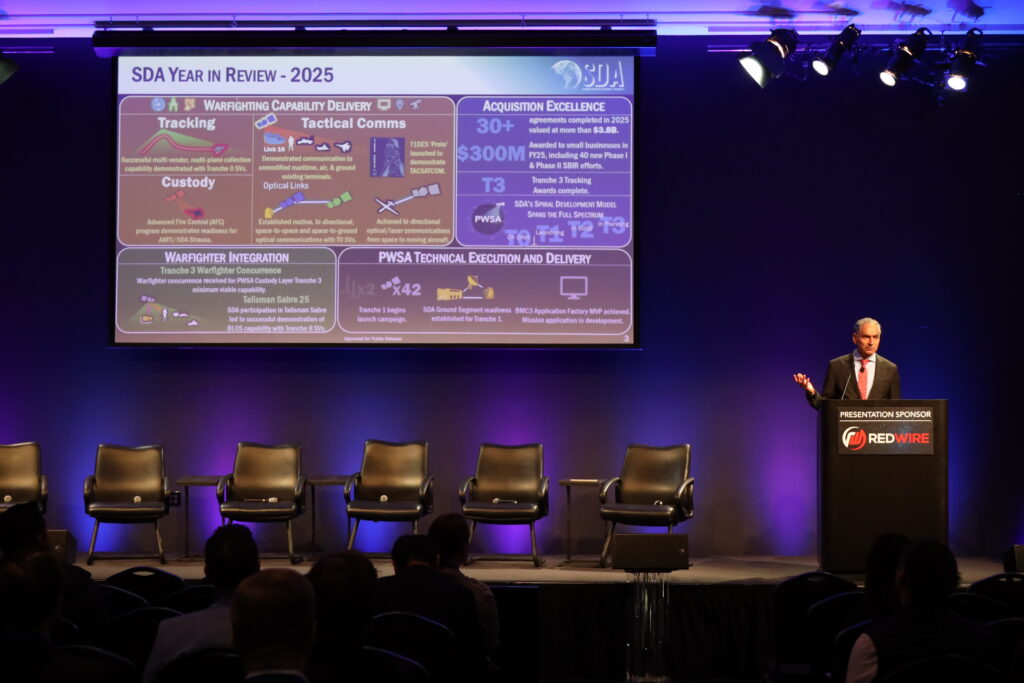
The implications for the supply chain are severe. Instead of theoretical speed, the SDA is enforcing rigor. Sandhoo noted that for the currently launching Tranche 1, the agency is behind schedule on checkouts precisely because they are forcing prime contractors to prove their buses work before they fly. “It’s one thing to launch a couple of satellites and kind of go through the whole checkout, it’s another thing to launch 21 at the same time,” Sandhoo said.
The Fire Control Pivot
While bus manufacturers face a reckoning, the SDA’s strategic scope has expanded dangerously close to the nuclear threshold. The conversation’s focus has shifted from warning (seeing a missile launch) to fire control (guiding an interceptor to kill it).
Sandhoo detailed the massive Tranche 3 awards made in December, which split the architecture into two distinct classes. The first is standard missile tracking. The second is the Golden Dome fully realized: a sensor specifically designed to close the fire control loop on hypersonic glide vehicles.
The Acting Director explained the distinction with engineer-like precision: “When you see MW/MT/MD, that takes a step further. That is, you can detect the missile, you can track the missile, but you can also come up with a fire control quality solution on board the spacecraft.”
That sequence presents the strategic edge in action, to which the Pentagon has committed roughly $3.5 billion, awarding contracts to Lockheed Martin and, in a major graduation moment, Rocket Lab for high-fidelity sensors. By trusting Rocket Lab with the defense mission rather than just the tracking mission, the SDA has officially elevated the company from a launch provider to a prime defense contractor capable of handling the DoD’s most sensitive data.
The Commercial Reserve Fleet
Sandhoo also addressed a subtle but critical shift: the enclave strategy. The SDA originally envisioned a self-contained intranet in the sky, but such an isolationist model has become defunct. Now the agency is actively looking to route military data through commercial constellations like Amazon’s Kuiper or the optical meshes of Kepler and Telesat, creating a hybrid space architecture that provides resilience through redundancy.
Using a domestic utility analogy to describe this pivot, Sandhoo stated, “When you have Verizon and Xfinity come to your doorstep, you should start using some of that stuff too to make sure you leverage all those things.”
This hybrid enclave architecture effectively deputizes the commercial sector. By publishing optical and networking standards, the SDA has created a market where commercial operators become reserve nodes for the Joint Force. If a Chinese ASAT weapon takes out a Lockheed satellite, the data could theoretically reroute through a commercial bird.
The Shadow of the GAO
Looming over the technical discussion was the shadow of the recent GAO report, which criticized the SDA for schedule optimism and for buying Tranche 3 satellites before Tranche 1 has proven its technology works. Although Sandhoo did not address the report by name, he noted the acting nature of his role and the budget’s palpable uncertainty.
Sandhoo acknowledged that the speed of acquisition is colliding with the reality of production throughput. “It’s one thing to have a technically ready thing; it is another thing to make 150 of those,” he said.
The Gamma variant of Tranche 2, critical for the advanced fire control mission, remains delayed following the Viasat protest and the subsequent leadership turmoil that ousted Dr. Tournear. Sandhoo nonetheless projected confidence in face of the undeniable friction, observing that due to competitive pricing, Tranche 3 proposals allowed SDA to buy 72 satellites instead of the planned 54.
The Verdict
The startup phase is over. The SDA is now a utility provider for the Combatant Commands. As Sandhoo put it, the goal is no longer simply to disrupt, but to pace the threat.
For attendees at the SmallSat Symposium, the message was clear. The government checkbook is still open, but the days of selling beta-test hardware are over. If you cannot build a bus that reliably handles thermal loads, or an optical terminal that instantly locks in a hostile environment, do not bid. The Golden Dome is being built, but the SDA is done laying bricks that crumble under pressure.