
By Abbey White, Staff Writer, SatNews
Dispatch from SmallSat Symposium. Coverage and analysis from across the conference, tracking the forces shaping the next phase of the SmallSat market.
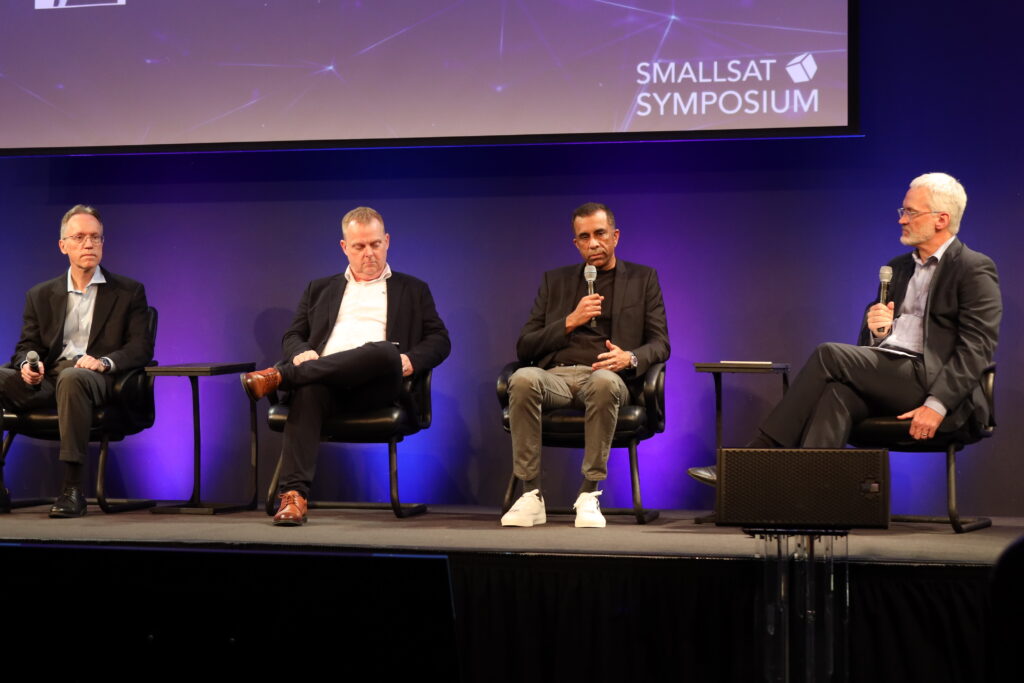
MOUNTAIN VIEW. The free drinks at SmallSat Symposium usually signal a celebration, but this year they feel more like a necessity. If 2024 was the year of the press release, early 2026 is the year of the hangover. Breathless promises of ubiquitous, high-speed connectivity from space have collided with a formidable wall of physics, finance, and federal regulation.
The mood inside the Computer History Museum is no longer defined by the novelty of connecting a smartphone to a satellite. That magic trick has been performed. Now, as the industry gathers for the session Cracking the D2D Code: Engineering Solutions to Power, Doppler & Spectrum Locks, the conversation shifts to a brutal realization. Making it work once is science, but making it pay is a nightmare.
Presiding over this reality check was Dr. Tim Farrar of TMF Associates, the industry’s designated contrarian. The panel’s title promised engineering solutions, but the subtext was an admission that the easy part (sending a text message) is done. The hard part (voice and broadband) is stuck in what engineers call a spectrum lock and what investors might soon call a money pit.
The Space Heater Problem
The central tension in the room is the battle between proprietary systems like Starlink, which attempt to muscle through terrestrial spectrum, and standards-based players like Iridium and Skylo who advocate for playing by the rules of physics.
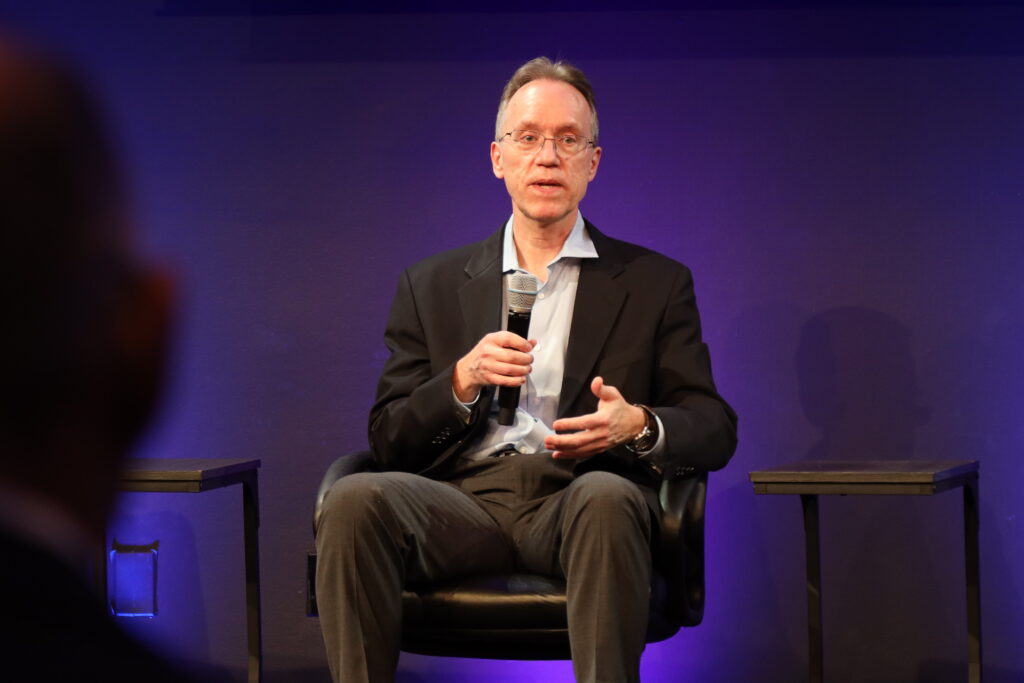
Greg Pelton, CTO of Iridium, did not mince words about the inefficiency of trying to deliver service without dedicated global spectrum. He described the absurdity of Low Earth Orbit (LEO) satellites flying over countries where they lack landing rights, effectively turning expensive hardware into orbiting junk for half their orbit.
“You’ve got this massive space heater running across the sky,” Pelton said. “Now I’m over this piece of land for 15 or 30 minutes, I can offer service. Then I’m shut off again.”
It was a stark illustration of the regulatory handcuffs that bind so-called supplemental coverage strategies. If you cannot clear the spectrum globally, you cannot scale the business globally.
The Meat Filter
Beyond the regulatory headaches, the panel exposed the raw physical limitations of trying to close a link budget with a device that was never designed for space. The unmodified phone is the holy grail of the direct-to-device (D2D) market. To an RF engineer, however, it is a disaster.
Pelton highlighted the Power Lock facing the sector. He noted that while LEO satellites provide better look angles than their geostationary ancestors, they cannot change the fact that consumer hardware is inept at shouting 500 kilometers upwards.
“The antennas on cell phones are terrible,” Pelton argued. “And the ones on watches are even worse.”
He described the interference caused by the human body itself (the user holding the phone) as “a big meat filter” that the signal is going through. This biological barrier, combined with the lack of gain on standard smartphone antennas, suggests that the dream of high-bandwidth data might require hardware upgrades that consumers aren’t ready to buy.
The Billion-Dollar Question
This physical pushback leads inevitably to financial friction. The industry has spent billions launching constellations on the premise of a trillion-dollar connectivity market, yet the panelists were hesitant to validate those spreadsheets.
When pressed on the actual market size, responses were sobering. The days of forecasting infinite growth are over.
“Is it a $1 billion market globally, is it a $100 billion market globally?” Pelton asked. “We don’t know that yet, and we’re not going to know for a few more years.”
Farrar, never one to let a valuation bubble float by unpopped, twisted the knife. He pointed out the fundamental disconnect between the utility of the service and the willingness of the customer to pay for it. Emergency SOS, though valuable, is rarely monetizable as a standalone subscription.
“I love the fact that if I fall over and break my leg when I’m out hiking, I know I can get some help,” Farrar said. “But I’m not paying anything for it either.”
The Intel Inside Moment
Despite the gloom regarding consumer broadband, a quiet revolution is occurring in the supply chain. The merger of Cobham Satcom and Gatehouse Satcom represents a shift toward industrialization of the sector, moving away from bespoke science project architectures toward standardized infrastructure.
Jesper Noer, representing the newly merged entity, emphasized that the engineering solutions to Doppler shifts and timing advances are now commercial products (NodeBs in the sky) rather than proprietary secrets. But even he conceded that the industry needs to stop fighting over proprietary stacks.
“A dream scenario for me would if people stopped doing their proprietary technologies on top and really join forces on the standardization efforts,” Noer said.
The Verdict
The session concluded not with a roadmap to 5G broadband from space but with a pivot toward the unsexy reliability of Narrowband IoT (NB-IoT). Vijay Krishnan of Skylo pointed to the 13 million devices already on their network as proof that the dam has in some ways already burst for low-bandwidth messaging and asset tracking.
But for the blue ocean consumer who wants to watch Netflix in the middle of the Pacific? That ship hasn’t just sailed; it likely never existed.
As the panelists left the stage, Farrar offered a final, sarcastic reality check regarding the seamless roaming that billionaires like Elon Musk have promised. When Noer suggested that roaming partners were just a marketing term that needed to be solved technically, Farrar didn’t miss the beat.
“I’ll let you go and tell Elon Musk that tomorrow then,” Farrar deadpanned.
The laughter in the room was genuine, but it was the nervous laughter of an industry realizing that the laws of physics, unlike the FCC, cannot be lobbied.