
By Abbey White, Staff Writer, SatNews
Dispatch from SmallSat Symposium. Coverage and analysis from across the conference, tracking the forces shaping the next phase of the SmallSat market.
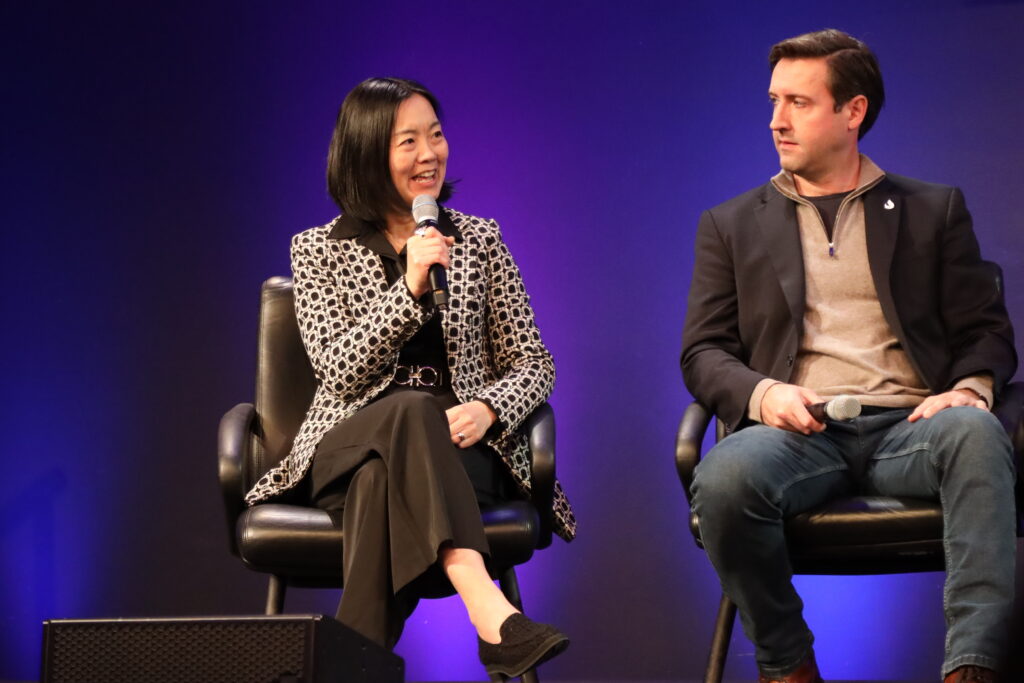
MOUNTAIN VIEW. The era of cheap, plentiful, and diverse access to space was supposed to be here by now. Instead, the industry arrived at the 2026 SmallSat Symposium only to find itself trapped in a bottleneck of its own making.
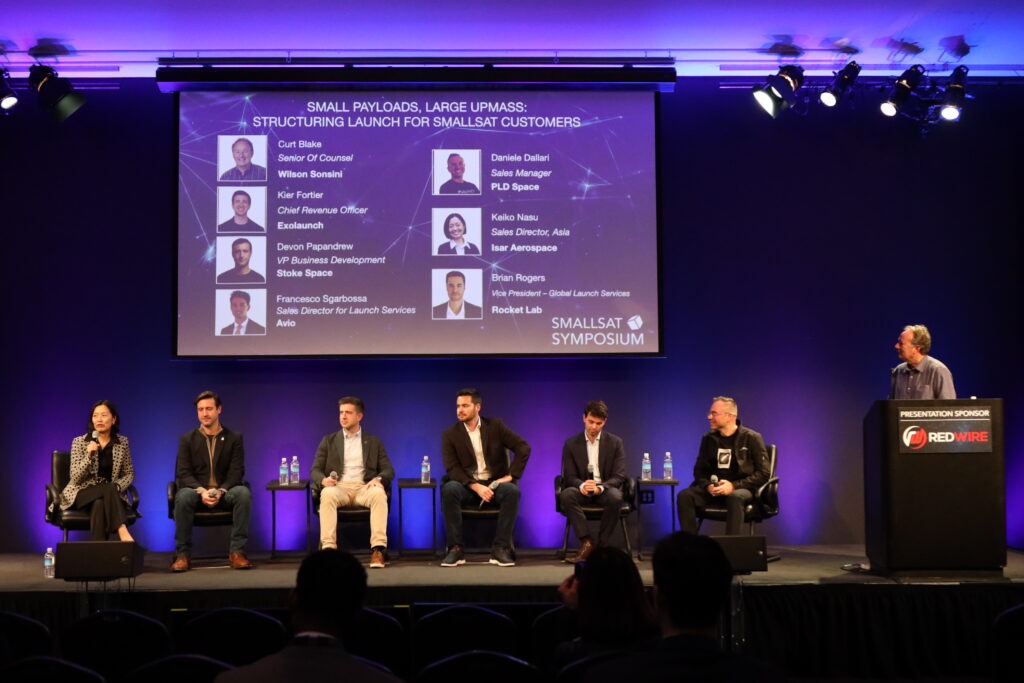
During the Small Payloads, Large Upmass session, the polite veneer of industry camaraderie barely concealed the tension in the room. The narrative of a vibrant, multi-provider marketplace has collapsed. In its place sits a single, dominant provider, SpaceX, flanked by a long line of customers paying premium rates to stand in line. While panelists from Rocket Lab, Stoke Space, and European challengers like Isar Aerospace and PLD Space offered visions of a diverse future, the audience is living in a present defined by scarcity.
The Aggregator is the New Gatekeeper
The most telling dynamic onstage was not between the rocket builders but rather centered on the empty chair left by the neutral broker. With the dissolution of Spaceflight Inc.’s independent brokerage model, Exolaunch has emerged as the primary funnel for the industry’s volume.
Kier Fortier, Chief Revenue Officer at Exolaunch, did not shy away from the congestion defining the current market. The days of simply booking a slot and flying are over; operators must now plan for delays as a fundamental business condition.
Fortier stated, “I do think rebooking now is just the baseline expectation to salvage your launch budget.”
This admission signals a profound shift. Launch is no longer a commodity you buy, but a probability you manage. The consolidation of demand onto SpaceX Transporter missions has created waitlists. Fortier noted that despite the high flight rates, “There are folks eager to get up on orbit, and there is some scarcity there.”
The Paper Rocket Problem
This scarcity stems from the simple fact that the challengers are late. Rocket Lab’s Neutron was originally promised for 2024, yet it is now targeting mid-to-late 2026. Brian Rogers, Rocket Lab’s Vice President of Global Launch Services, framed this delay as a necessary hurdle of scaling.
Rogers argued, “Building your first rocket is ridiculously hard. Building your next 10 at rate is actually way harder.”
While Rogers is correct, the market is unforgiving. Every month Neutron remains on the ground is a month where mega-constellations sign long-term contracts with SpaceX’s Falcon 9. The session moderator, Curt Blake, former CEO of Spaceflight, pressed the panel on the risks of a monopoly trap.
Devon Papandrew, VP of Business Development at Stoke Space, addressed the monopoly question head-on. He dismissed the idea that SpaceX’s dominance is accidental or unfair, attributing it instead to technical superiority that others failed to match in time.
“Why is SpaceX a monopoly today?” Papandrew asked, then answered, “They created a step change in capability that unlocked higher cadence and lower cost.”
Stoke Space is betting $510 million that partial reusability is a dead end. Papandrew contended that the only way to break the current pricing floor, now rising toward $6,500/kg, is full reusability.
“If you look what SpaceX has done with Falcon, it’s amazing,” Papandrew said. “But if you ask them what constrains their flight rate, it’s production of the upper stage.”
The Sovereign Illusion
For the European representatives, the challenge is existential. Isar Aerospace, PLD Space, and Avio are fighting for a slice of the market that isn’t captive to U.S. dominance. Yet their value proposition relies heavily on the sovereignty premium—the idea that European institutions will pay more to fly European.
Francesco Sgarbossa, Sales Director for Avio, was refreshingly blunt about the limitations of European cadence compared to the American juggernaut.
“We are aiming at six, which sounds like a very low number when you think about it when you see SpaceX launching 160 times,” Sgarbossa admitted. “But even going from four to six is a 50% increase and that requires huge investments.”
This is the cold math of the 2026 launch market. A 50% increase for Avio is a rounding error for SpaceX. Daniele Dallari of PLD Space tried to reframe the conversation away from mass commoditization, questioning the industry’s obsession with replicating the SpaceX Transporter model.
Dallari asked, “Do we need another Transporter program? Does the market really need another Transporter program?”
The market’s answer, evidenced by the rising prices and full manifests on Falcon 9, appears to be yes. Operators want reliability and low cost. They are less concerned with the bespoke orbital insertions Dallari’s Miura 5 might offer if the price tag is double that of a rideshare slot.
The Ancient Game of Launch Chicken
The friction between satellite readiness and rocket availability remains the industry’s favorite scapegoat. Brian Rogers described the constant shuffling of manifests as a necessary evil.
“We’re no strangers to the ancient game of launch chicken,” Rogers said. “Spacecraft can be late. And that can be a problem when you’re trying to plan a manifest.”
But in 2026, the chicken has come home to roost. The delays are no longer just about spacecraft. The launch vehicles themselves are the bottleneck. The regulatory environment has tightened, and the FAA licensing backlog is real. The flexible slotting discussed by the panel is merely a band-aid for a lack of capacity.
“You got to launch”
The dream of a dozen thriving small launch providers competing on price has faded. The reality is a barbell market: a massive, efficient monopoly on one end, and a collection of hopeful, delayed challengers on the other.
Until Neutron flies, Stoke reaches orbit, and the European launchers prove they can hit a cadence higher than single digits, the SmallSat customer has no real leverage. They will pay the $6,500/kg, they will sign the multi-launch agreements, and they will thank Exolaunch for the privilege of a slot.
As the session concluded, the applause felt less like a celebration of innovation and more like relief that the status quo, however expensive, is at least a known and predictable factor. Curt Blake ended the panel by asking about the challenge to survive. Brian Rogers offered the only advice that matters in an industry choked by promises.
“You got to launch.”