
By Nick David, Editorial Lead, SatNews
Day 1 of SmallSat Europe 2026 left the sovereignty debate exactly where European procurement had left it: four definitions chasing one budget line. Day 3 was the venue that gave the debate working answers, and they came from three different rooms. Spain produced one from the closing keynote, Poland produced a different one from the interview stage, and the on-orbit servicing panel produced a third, a commercial veto that says the sovereign-only frame runs into structural limits at the European liability-regime level no matter which national agency picks it up.
Three operating answers, and they do not converge on the same thing. What Day 3 surfaced was which definitions of sovereignty got operationalised by which constituency, and which got left on the floor.
Day 3 Sovereignty · By the Numbers
85%
Public-origin share of Spanish space investment
4.8%
Polish defence spending as share of GDP, highest in NATO
22
EDF secure-waveform companies across 12 member states
500
Kilogram payload class for Miura 5 first flight, French Guiana, end of 2026
5
Billion euros in the Eutelsat refinancing closed in March
Dec
ESA Ministerial decision window, six months from Day 3
“Our main objective is to achieve the strategic autonomy. And in this sense, what we are doing is basically developing capabilities.” Juan Carlos Cortés Pulido, Director, Spanish Space Agency
The Spanish answer: capability ownership
Juan Carlos Cortés Pulido, Director of the Spanish Space Agency, delivered the conference’s closing keynote on the SpaceNews Defense Stage. Sovereignty in his frame reads as capability ownership.
The Spanish agency is overseen by the Ministry of Science, Innovation and Universities and by the Ministry of Defense, and by law it coordinates the space programs of the Ministry of Defense while supporting it on technology evaluation, selection, and program launch. Eighty-five per cent of the investment in the Spanish space domain has a public origin, and that ratio is the operative answer Day 1 left open. Spain is buying the architecture.
The buying covers the full stack. Miura 5, the small launcher, makes its first flight from French Guiana at the end of this year with a 500-kilogram payload. The Atlantic Constellation, launched with Portugal, carries the Earth observation play. Indra Mind, a domestic alternative to Palantir, sits as the AI processing layer. “What we are pursuing with this is two — first of all to achieve a real-time coverage,” Cortés Pulido told the room.
What the Spanish answer requires is that Spain fund its own stack and let partners buy in on Spain’s terms. It sidesteps a single European definition of sovereignty, sidesteps IRIS² classified secure on its first generation, and sidesteps harmonised liability law across member states. The Atlantic Constellation is open, “this program is open to other members to be part of this constellation, providing assets and sharing the data,” and the architecture is Spanish.
The schedule is the closing point. Decisions get made at the ESA Ministerial in December. “We in Europe has a quite relevant sector, but we need to take decision in the coming future in order to maintain our competences and our leadership.” A six-month window.
The Polish answer: diversity of sources
Col. Marcin Mazur, Vice President of the Polish Space Agency (POLSA), sat for an interview with Mark Holmes, Senior Editorial Director at Access Intelligence, the same morning. Mazur is a serving military officer assigned to the civilian agency, and Polish defense spending now runs at almost five per cent of GDP, the highest in NATO. Holmes asked the question Day 1 left open. What does sovereign space actually mean from where Poland sits?
“From Polish perspective to sovereignty, we understand the diversity of resources. It means that it’s important to have access to several different data sources.” Col. Marcin Mazur, Vice President, Polish Space Agency (POLSA)
The Polish working definition lands somewhere different from Spain’s. Where Cortés Pulido frames the question as capability ownership, Mazur frames it as portfolio diversification: own the national assets you must own, and supplement them with bilateral, federated, and commercial sources. The CAMILA constellation, five micro-satellites POLSA will operate, with an MoD radar ISR constellation already on orbit and a new electro-optical constellation in procurement, makes up the national-asset layer. Everything else is sourcing.
“We understood that capitals cannot rely on one source of data,” Mazur told Holmes, framing the Ukraine lesson in procurement terms. “It’s important to have access to different solutions… access to different bilateral federated, or commercial sources, which supplement the information for our needs.”
That is the operational answer Day 1 never reached. Mazur is using “sovereignty” to mean single-source dependency is the failure mode, and the fix is a portfolio that survives any one supplier walking away.
Three Operating Definitions of Sovereignty
SPAIN
CORTÉS PULIDO
Sovereignty is capability ownership.
- Build the full national stack: launcher, constellation, AI layer, ground.
- 85% of investment is public.
- Atlantic Constellation is open, but the architecture is Spanish.
National stack wins funding fight.
POLAND
MAZUR
Sovereignty is diversity of sources.
- Own what you must, supplement everything else.
- CAMILA, radar and EO national assets, the rest bilateral/federated/commercial.
- Single-source dependency is the failure mode.
- Defence spending 4.8% of GDP, highest in NATO.
Portfolio wins operational fight.
COMMERCIAL VETO
GRAZIANO · GMV
Sovereign-only runs into limits.
- “Commercially there’s no space for everybody.”
- European liability regime makes a 300-servicer market unworkable.
- EU Space Act has not consolidated national regimes yet.
- Constraint binds every cross-border program.
Veto sets the architectural ceiling.
The commercial veto: sovereign-only runs into structural limits
Twenty-five minutes into the on-orbit servicing panel on the Defense Stage, moderated by Jeff Foust, Senior Staff Writer at SpaceNews, the word “sovereignty” had not been said once. Chris Blackerby, Chief Operating Officer of Astroscale Holdings, flagged it. “Nobody has said the word sovereignty on this stage. So we’ve got to sovereignty 25 minutes into the presentation. So we have to say sovereignty before we finish any of these panels.”
The moment landed because of what came next. Mariella Graziano, Director of Strategy and BD of Science, Exploration and Transportation at GMV, took the question of European market fragmentation and produced the commercial counterargument the agencies on the other panels never had to address.
“Commercially there’s no space for everybody… It’s even impossible from a legislation viewpoint, regulations. We are far away from a story of liability. Europe is very complex also from the liability.” Mariella Graziano, Director of Strategy and BD of Science, Exploration and Transportation, GMV
GMV is a 41-year-old European mid-cap with offices in twelve countries that built ground segments for the second-largest commercial telco fleet in Europe and has been injecting passive servicing interfaces into Copernicus satellites for fifteen years. When Graziano said the European servicing market cannot accommodate “300 service guys and blah blah blah” because the liability regime makes it impossible, she was describing the operating constraint neither the Spanish nor the Polish answer addresses.
The point is precise. A sovereign-capability stack works at the national level for Earth observation, navigation, and SST. It works less cleanly for in-orbit logistics, where the liability and regulatory regime any servicing operator has to navigate is fragmented at the EU level. The EU Space Act is supposed to consolidate the national regimes, and it has not yet.
The veto is that sovereign-only faces structural limits for any segment of the European industry that depends on cross-border operations, and on-orbit servicing happens to be the segment that exposes the gap fastest.
The IRIS² frame: the S is for security
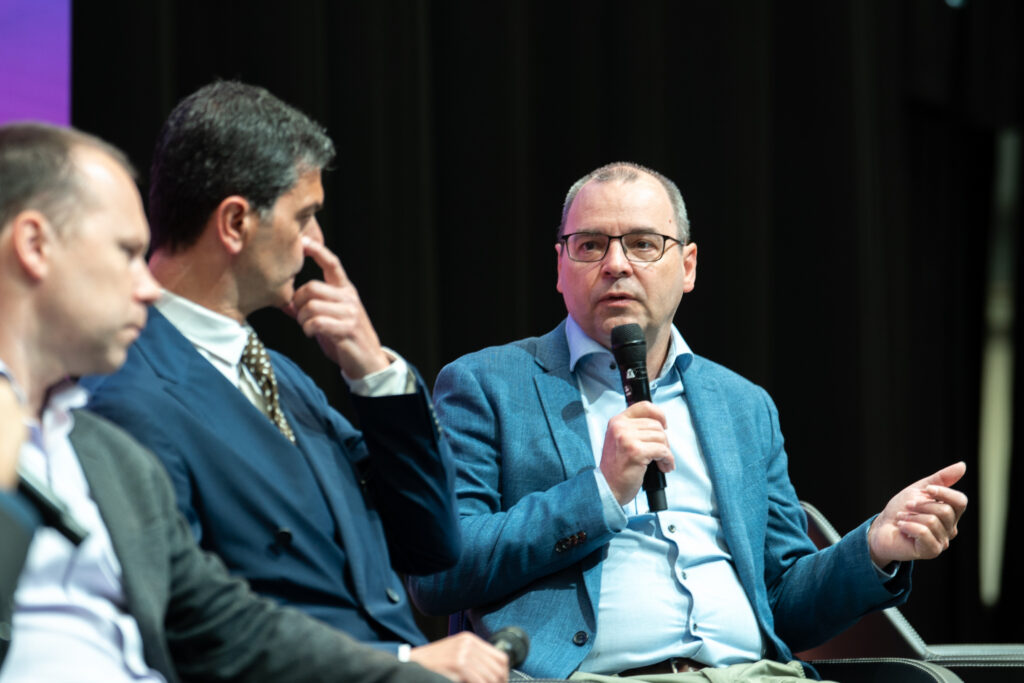
Koen Willems, VP, EU/NATO Programs & Government Relations at ST Engineering iDirect Europe, gave the conference’s most quotable reframe of what IRIS² is doing inside the sovereignty argument. The IRIS² Ground Game panel, moderated by Ahsun Murad of Optimal Satcom, kept landing on the architecture question, and Domenico Mignolo, Head of the Technology and Products Division at ESA, set up the frame in agency vocabulary, calling IRIS² “a backbone or a data relay to connect with other constellations.”
Willems sharpened it. “In IRIS² it is an S for security. And I think that’s one of the key elements — one is for government purpose, government end users, but given the fact that the geopolitical context and what we see around us, security becomes more important.”
The implication of that one letter doubles as the architectural answer to the sovereignty fight. IRIS² is a government-grade backbone the military community is pushing to make tactical-grade, rather than the closed, classified, secure-by-default constellation the military operators want. The European Defence Fund’s secure waveform program, twenty-two companies across twelve member states, is the workaround that bolts military capability onto IRIS² without classifying the whole constellation. The S is doing the work the four Day-1 definitions were each reaching for, and it is doing it in the procurement language IRIS² was actually written in.
The financial frame and the fragmentation tax
Wim Steenbakkers, Managing Director, Global Lead Technology at ING, sat for a fireside with Dara Panahy, Partner at Milbank LLP, on the Business Stage. The Eutelsat refinancing, five billion euros across a senior facility, export-credit financing for OneWeb satellite procurement, an EIB amendment, and a 1.5-billion-euro dual-tranche unsecured note, closed in March. Panahy asked what changed between the near-distress conversations of sixteen months ago and the deal that closed.
“I think you’ve realized that there’s actually a requirement to have these types of networks and constellations under European control and not have our cake eaten by the Americans.” Wim Steenbakkers, Managing Director, Global Lead Technology, ING
That is the financial frame’s definition of sovereignty: European control. The Eutelsat deal closed because the geopolitical case made the credit case.
Sabrina Alam, Space Lead at the SnT Technology Transfer Office at the University of Luxembourg, sat on the resilience panel and gave the day’s sharpest diagnostic. “We’re seeing a lot of fragmentation today because we’re seeing a lot of lack of understanding of this concept or what the sovereignty actually means.”
For Alam, fragmentation is the cost of letting four definitions of sovereignty share one funding stream. Agencies use the word to mean capability ownership, bankers to mean European control, architects to mean classified-by-default, and operators to mean liability you can carry. When the same word does four jobs, the budget gets allocated against the loudest definition in the room, and the next round of programs inherits the ambiguity. That is the fragmentation tax, and it is what Day 1 said the EU Space Act has roughly eighteen months to address.
The verdict from Day 3
The procurement language is leading the architecture conversation, with IRIS² as what gets built and the secure waveform program as what gets bolted on. The Polish definition is leading the operational conversation: diversity of sources is what every defense ministry in the room is actually buying. The Spanish definition leads the political-funding conversation, because capability ownership is what national parliaments understand and fund. The commercial veto is the constraint that shapes which of the three definitions any cross-border program can actually deliver against.
The through-line Day 3 surfaced is that Europe will settle sovereignty by letting the four definitions operate at four different layers, Spain at the national stack, Poland at the portfolio, IRIS² at the architecture, ING at the finance, and absorbing the cost of the gaps between them. Whether Europe can afford to pay the fragmentation tax is what the December ESA Ministerial decides.
Key Takeaway
Day 3 produced four working definitions of sovereignty at four different layers. Spain (Cortés Pulido) buys the national stack. Poland (Mazur) buys the diversified portfolio. IRIS² (Willems, Mignolo) is the architectural backbone with a secure waveform bolted on. ING (Steenbakkers) underwrites the European-control credit case. The commercial veto (Graziano) is that sovereign-only runs into structural limits at the European liability-regime level. Alam named the cost: fragmentation is what happens when one word does four jobs. The December ESA Ministerial is the decision point.
About the Author
A storyteller at heart, Nick David covers space policy, satellite markets, defense, and the technologies reshaping how humanity operates beyond Earth. With a background in creative direction, brand strategy, and editorial storytelling, he brings a modern lens to complex subjects and a relentless curiosity about what comes next.