• Skip to main content
  • Skip to primary sidebar
  • Home
  • News
  • Featured
  • More News ⌄
    • SatNews
    • SatMagazine
    • MilSatMagazine
  • Events ⌄
    • MilSat Symposium
    • SmallSat Symposium
    • Satellite Innovation
  • Contacts
  • SUBSCRIPTION

SmallSat News

You are here: Home / 2026 / Archives for June 2026

Archives for June 2026

Analyst Projects Massive Subscription Growth for Starlink Ahead of Imminent SpaceX IPO

June 5, 2026 by donmcgee

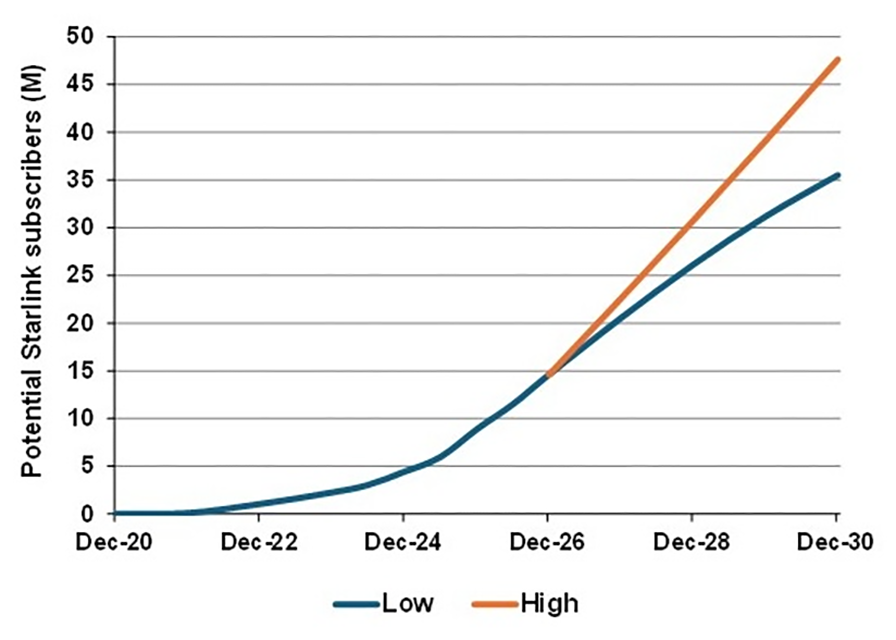
Professor Tim Farrar of TMF Associates has released a comprehensive new analysis detailing the consumer business prospects for Starlink. Published on June 5, 2026, the report arrives at a critical juncture for the commercial space sector as the industry braces for the highly anticipated SpaceX initial public offering.

The deep dive provides the first detailed geographical breakdown of Starlink’s global customer distribution, utilizing meticulous weekly monitoring of active satellite terminals to project future subscriber bases and revenues across various countries and regions.

Historic Growth and Future Trajectory

The historical data presented in the report summary illustrates a staggering pace of customer acquisition. Starlink’s global subscriber count has experienced explosive year-over-year growth, climbing from 2.3 million in 2023 to 4.4 million in 2024. The network then doubled again to reach 8.9 million users in 2025. As of the end of the first quarter in March 2026, the active subscriber base has surged to 10.3 million users.

Looking forward, the report’s headline forecast suggests that this momentum is far from slowing down. Farrar outlines a “Bull case” scenario in which Starlink could capture more than 45 million subscribers by the year 2030. Even the more pessimistic “Bear case” projection estimates that the satellite internet provider will secure a massive customer count exceeding 35 million by the end of the decade. Analysts note that Starlink may even target a doubling of its subscriber base to reach 18 million global users by the end of 2026.

Navigating Terrestrial Competition and Capacity Limits

Despite the bullish projections, the report carefully outlines the potential limitations to Starlink’s future growth. A primary challenge will be how successfully the satellite operator can compete against established terrestrial alternatives in densely populated or highly developed countries. To maintain its rapid cadence of growth, particularly in mature markets like the United States, Starlink will need to increasingly capture market share from traditional telecommunications and cable internet providers, potentially utilizing aggressive pricing strategies as a lever to attract new consumer demographics.

Furthermore, the physical limitations of orbital infrastructure remain a crucial factor. Starlink currently possesses a network capacity capable of supporting approximately 20 million broadband subscribers. Scaling beyond this threshold to reach the 40 million mark will necessitate the continued mass deployment of V2 Mini satellites utilizing the Falcon 9 launch vehicle, alongside the successful introduction of next-generation hardware architectures.

Assessing the Threat from Amazon LEO

The analysis also dedicates significant attention to the looming competitive threat posed by Amazon’s Low Earth Orbit constellation. By comparing the underlying technologies and deployment timelines of both networks, the report assesses whether there is any realistic prospect of Amazon making significant inroads into Starlink’s market dominance in the coming years.

While Amazon possesses a formidable retail presence and vast financial resources, its initial constellation of 700 satellites is projected to only support around 1.5 million broadband subscribers. This stark contrast in immediate network capacity suggests that Starlink will likely maintain a comfortable lead in subscriber acquisition, forcing emerging competitors to aggressively scale their launch cadences and orbital infrastructure if they hope to capture a meaningful share of the booming satellite broadband market.

Filed Under: Featured, Uncategorized

KSAT and iQPS Expand Strategic Alliance to Accelerate High-Frequency SAR Constellation

June 4, 2026 by donmcgee

Kongsberg Satellite Services, a premier global provider of integrated mission operations, and the Institute for Q-shu Pioneers of Space, an innovative Japanese aerospace company, have officially announced a significant expansion of their long-term strategic partnership.

Advancing Near-Real-Time Earth Observation

Revealed on June 3, 2026, this deepened alliance is strictly focused on accelerating the development and deployment of the ambitious QPS-SAR project. The ultimate goal of this comprehensive collaboration is to establish a massive, high-resolution Synthetic Aperture Radar small satellite constellation that will deliver near-real-time Earth observation data services to commercial and government customers worldwide. Unlike traditional optical sensors that are often hindered by nighttime conditions or thick cloud cover, synthetic aperture radar technology provides persistent, all-weather visibility, making it an indispensable tool for time-critical remote sensing operations.

Scaling the QPS-SAR Constellation

The Institute for Q-shu Pioneers of Space, commonly known as iQPS, has been systematically expanding its orbital footprint, with nine commercial satellites currently operational. The aggressive expansion plan targets scaling the active constellation to 24 satellites by late May 2028, ultimately culminating in a fully realized 36-satellite constellation by the year 2030.

Once fully deployed across multiple orbital planes, the comprehensive 36-satellite architecture will effectively allow the company to observe almost any selected location on the Earth’s surface at an unprecedented average interval of just ten minutes. This incredible revisit rate is designed to track rapidly evolving scenarios on the ground, allowing operators to monitor moving objects such as vehicles and maritime vessels with exceptional precision.

Leveraging Automated Ground Segment Infrastructure

To ensure the successful operational deployment of this massive scaling effort, iQPS has selected KSATlite to serve as the backbone for its future constellation expansion. Developed by Kongsberg Satellite Services, KSATlite is a fully automated Ground Segment-as-a-Service infrastructure specifically designed to accommodate the unique logistical demands of small satellites and sprawling mega-constellations.

Since the successful deployment of iQPS’s second satellite, KSAT has provided crucial Launch and Early Orbit Phase support alongside resilient global ground network coverage for mission-critical operations. Kenneth Olafsson, Head of KSAT Asia, emphasized that KSAT is deeply honored to continue supporting this rapidly scaling project, highlighting the shared vision of providing purpose-driven space capabilities that offer practical societal and strategic value.

Driving Data Convergence and Economic Value

This expanded partnership perfectly encapsulates the broader commercial space industry’s ongoing shift toward ground segment cloudification and information technology convergence. By relying on an established Ground Segment-as-a-Service model, iQPS can seamlessly scale its operations and reduce operational overhead, bypassing the enormous capital expenditures associated with building and maintaining proprietary global antenna networks.

The high-frequency data gathered by the QPS-SAR constellation possesses the potential to fundamentally revolutionize multiple industries. By efficiently delivering ultra-low-latency geospatial intelligence through KSAT’s global network, iQPS aims to unlock entirely new economic value streams. The resulting data will directly enhance urban safety, streamline global disaster response, and provide predictive analytics for agriculture and regional markets when intelligently integrated with overarching weather and economic datasets.

Instant Insight: SAR Satellites for Near Real-Time Disaster Monitoring

This above link to the video offers an excellent overview of how iQPS utilizes small SAR satellites to provide near-real-time monitoring for disaster mitigation and rapid response operations.

Filed Under: Uncategorized

Beyond Gravity Launches Advanced Propulsion Pointing Mechanism for LEO Constellations

June 3, 2026 by donmcgee

Beyond Gravity has introduced a new two-axis electric propulsion pointing mechanism, designated as the APPMAX2-XS, designed specifically to meet the rigorous demands of the small satellite market operating in Low Earth Orbit.

Targeting the Small Satellite Market

Unveiled on June 3 at the Space Tech Expo USA in Anaheim, California, this latest addition to the company’s proven Advanced Electric Propulsion Pointing Mechanism family directly addresses critical industry needs for reduced mass, cost efficiency, and accelerated delivery timelines for constellation operators.

Key Technical and Operational Advantages

The APPMAX2-XS delivers several distinct operational advantages by utilizing commercial off-the-shelf components and highly industrialized production processes to ensure scalability, which guarantees a remarkably short lead time from order to delivery of less than six months. Weighing less than seven kilograms, this ultra-lightweight mechanism allows for precise two-axis thrust vectoring of small spacecraft and optical payload pointing.

This dynamic maneuverability significantly minimizes the amount of propellant wasted during attitude control maneuvers when compared to traditional fixed-mounted thrusters, ultimately optimizing fuel consumption and extending a satellite’s operational lifetime by up to two years.

Market Availability and Strategic Impact

Wolfgang Pawlinetz, Vice President of Thermal & Mechanisms at Beyond Gravity, emphasized that this low-cost, short-lead-time solution maintains full flexibility across a wide range of electric propulsion systems while delivering an exceptionally compact design. Scheduled to become available for delivery in 2027, the APPMAX2-XS is well-positioned to support the surging demand for agile, highly maneuverable small satellite constellations across both European and United States markets.

In a statement, Dominik Inschlag, director of Marketing & Sales for Beyond Gravity, said, “Our new mechanism is true a New Space enabler. We see a lot of potential for our new mechanism especially in Europe and the United States. Fast availability, low mass, and competitive cost are critical factors for constellation operators. This mechanism directly addresses those priorities,”

Filed Under: Uncategorized

Amazon Leo Constellation Surpasses 330 Satellites Following Latest Atlas V Launch

June 1, 2026 by donmcgee

Amazon has successfully expanded its low Earth orbit broadband network, recently rebranded as Amazon Leo, surpassing a total of 330 satellites currently in orbit. This latest milestone was achieved following a successful deployment mission utilizing a United Launch Alliance Atlas V rocket.

Scaling Up the Mega-Constellation

The mission injected the satellites at an initial altitude of roughly 289 miles before flight control teams took over to perform health checks and gradually raise the spacecraft to their operational altitude of 392 miles. This launch marks a steady continuation of Amazon’s aggressive deployment schedule, cementing the network as the third-largest commercial satellite constellation currently operating in orbit.

Racing Against Regulatory Deadlines

The rapid cadence of these launches is driven by both commercial competition and strict regulatory requirements. Under its authorization from the Federal Communications Commission, Amazon is mandated to deploy at least half of its planned 3,236-satellite constellation by July 2026. To meet this aggressive target, the company has secured over one hundred launches across multiple heavy-lift providers, including United Launch Alliance, Arianespace, and SpaceX. ‘

While the company faced early delays due to bottlenecks in heavy-lift vehicle availability, the recent string of successful missions indicates that Amazon is rapidly accelerating its production and launch cadence to ensure compliance and avoid losing its valuable spectrum licenses.

Expanding Commercial Reach

Originally known as Project Kuiper, the newly rebranded Amazon Leo initiative is designed to provide high-speed, low-latency broadband internet to unserved and underserved communities globally, directly competing with SpaceX’s Starlink. As the constellation grows denser, Amazon is actively shifting its focus toward commercial rollout and enterprise partnerships.

The company recently unveiled new gigabit-speed antennas tailored for commercial aviation and has already secured major in-flight Wi-Fi contracts with airlines such as Delta and JetBlue. With continuous heavy-lift launches planned throughout the year, Amazon expects to begin rolling out preliminary broadband services to commercial customers in select latitudes before expanding globally.

Filed Under: Featured, Uncategorized

Primary Sidebar

WEEKLY NEWSLETTER

Archives

  • June 2026
  • May 2026
  • April 2026
  • March 2026
  • February 2026
  • January 2026
  • December 2025
  • November 2025
  • October 2025
  • September 2025
  • August 2025
  • July 2025
  • June 2025
  • May 2025
  • April 2025
  • March 2025
  • February 2025
  • January 2025
  • December 2024
  • November 2024
  • October 2024
  • September 2024
  • August 2024
  • July 2024
  • June 2024
  • May 2024
  • April 2024
  • March 2024
  • February 2024
  • January 2024
  • December 2023
  • November 2023
  • October 2023
  • September 2023
  • August 2023
  • July 2023
  • June 2023
  • May 2023
  • April 2023
  • March 2023
  • February 2023
  • January 2023
  • December 2022
  • November 2022
  • October 2022
  • September 2022
  • August 2022
  • July 2022
  • June 2022
  • May 2022
  • April 2022
  • March 2022
  • February 2022
  • January 2022
  • December 2021
  • November 2021
  • October 2021
  • September 2021
  • August 2021
  • July 2021
  • June 2021
  • May 2021
  • April 2021
  • March 2021
  • February 2021
  • January 2021
  • December 2020
  • November 2020
  • October 2020
  • September 2020
  • August 2020
  • July 2020
  • June 2020
  • May 2020
  • April 2020
  • March 2020
  • February 2020
  • January 2020
  • December 2019
  • November 2019
  • October 2019

© 2019–2026 SatNews

Insert/edit link

Enter the destination URL

Or link to existing content

    No search term specified. Showing recent items. Search or use up and down arrow keys to select an item.
      x
      Sign Up Now!

      Enjoy a free weekly newsletter with recent headlines from the global SmallSat industry.

      Invalid email address
      We promise not to spam you. You can unsubscribe at any time.
      Thanks for subscribing! You will now receive weekly SmallSat News updates.
      We love our advertisers.
      And you will too!

      Please disable Ad Blocker to continue... We promise to keep it unobtrusive.
      We promise not to spam you. You can unsubscribe at any time.
      Invalid email address
      Thanks for subscribing!