
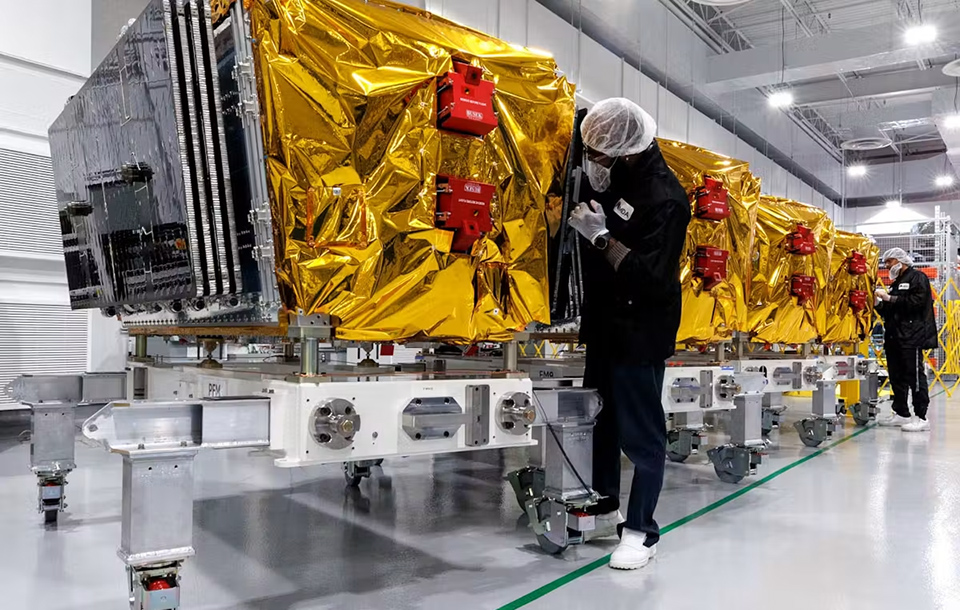
On August 16, 2026, Rocket Lab confirmed the successful orbital deployment of eight 500-kilogram satellite platforms manufactured for MDA Space, marking a major operational milestone in the replenishment of Globalstar’s low Earth orbit constellation.
The mission underscores an asset-light aerospace strategy by Apple Inc., which commands the vast majority of the network’s operational capacity without directly owning, manufacturing, or launching spacecraft hardware.
Capital Allocation and Supply Chain Structure
Rather than absorbing the high capital expenditure, regulatory oversight, and technical liabilities of constructing a proprietary space architecture, Apple has deployed targeted financial commitments to secure direct-to-device (D2D) capabilities for its hardware ecosystem.
Apple’s multi-tiered funding model operates across several commercial layers:
- Financial Prepayments: Apple executed a total potential funding structure of up to $1.58 billion in high-power infrastructure prepayments, alongside acquiring a 20 percent passive equity stake in Globalstar’s operating subsidiary.
- Network Capacity Reservation: Under long-term wholesale capacity agreements, Apple secures 85 percent of Globalstar’s constellation bandwidth to power emergency SOS, text, and satellite messaging features across iPhone and Apple Watch models.
- Subcontracted Hardware Manufacturing: Globalstar utilized Apple’s capital infrastructure to award a $1.1 billion prime contract to MDA Space for constellation construction. MDA Space subsequently subcontracted Rocket Lab to build 17 satellite platforms under a $143 million agreement.
Capital Efficiency Versus Proprietary Infrastructure
By outsourcing orbital operations to established aerospace vendors, Apple insulates its core business from launch failure risks, orbital debris mitigation compliance, and complex international spectrum licensing through the Federal Communications Commission (FCC) and International Telecommunication Union (ITU).
While competitors invest tens of billions in proprietary launch systems and satellite constellations, Apple’s strategy isolates hardware liability while ensuring strict operational control over user-facing software interfaces, ground station integration, and service availability.
Strategic Resilience Amid the Pending Amazon Integration
The strength of this capital-light approach was demonstrated following Amazon’s April 14, 2026 agreement to acquire Globalstar for $11.57 billion. The acquisition provides Amazon with Globalstar’s harmonized S-band and L-band Mobile Satellite Services (MSS) spectrum to accelerate the direct-to-device capabilities of its Amazon Leo broadband constellation.
Concurrent with the merger announcement, Amazon signed a long-term agreement with Apple guaranteeing uninterrupted and expanded access to Globalstar’s network and spectrum assets for present and future iOS devices.
Through this tripartite arrangement, Apple maintains seamless access to space-based communications supported by Rocket Lab’s manufacturing, MDA Space’s systems integration, Globalstar’s licensed spectrum, and Amazon’s multi-billion dollar satellite constellation architecture.