
On October 5, 2026, space infrastructure company Meridian Space and satellite manufacturer Kongsberg NanoAvionics announced the successful initial activation of Meridian’s First Customer Link (FCL) communications payload in low Earth orbit.
Launched aboard SpaceX’s Transporter-18 rideshare mission from Vandenberg Space Force Base on October 1, the deployment marks the orbital debut of Meridian’s proprietary reflectarray antenna technology following a five-year engineering and qualification cycle.
Constellation Architecture and Contract Heritage
The spacecraft serves as the initial unit delivered under a 122.5 million EUR ($140 million) contract awarded to Kongsberg NanoAvionics to manufacture 280 constellation-optimized satellites. The FCL mission follows Meridian’s recent corporate spin-out to operate as an independent entity focused on marketing dedicated, customer-owned low Earth orbit (LEO) constellations. This business model allows sovereign governments and commercial entities to retain full control over their network infrastructure, data routing, and prioritization, rather than leasing bandwidth from third-party satellite operators.
Spacecraft Specifications and Operational Status
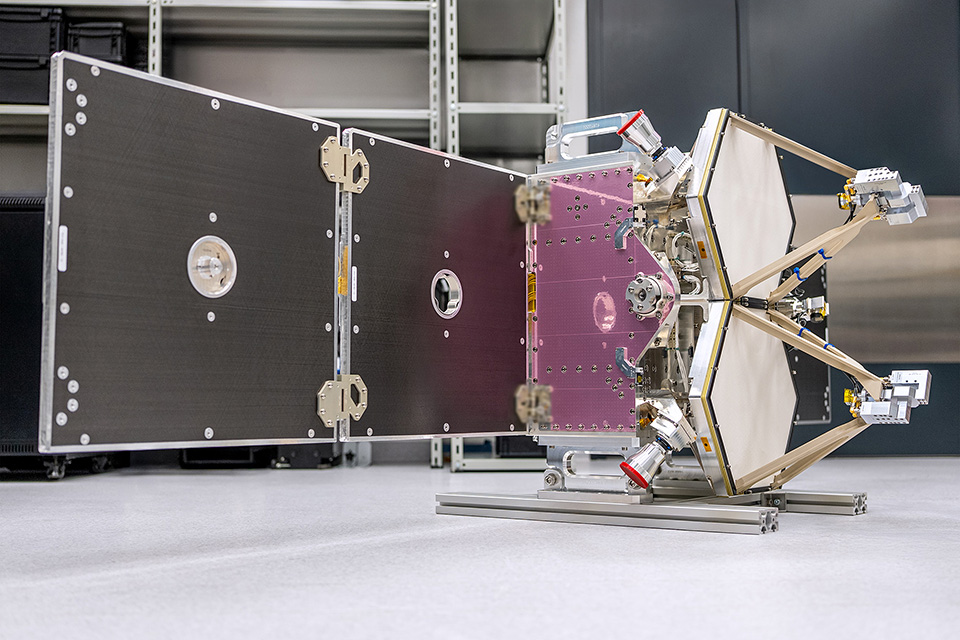
The FCL payload is integrated into a Kongsberg NanoAvionics MP42 microsatellite bus. The core payload architecture relies on a lightweight, electronically reconfigurable reflectarray antenna. This hardware is engineered to lower satellite mass, reduce thermal dissipation, and decrease overall power requirements while maintaining high-throughput broadband performance.
During the first available ground station pass, telemetry confirmed all primary subsystems and the communications payload successfully powered on and remained responsive. Kongsberg NanoAvionics completed the initial satellite build, payload integration, and orbital deployment in just over 12 months from the program’s kickoff.
Executive Perspective
“Seeing our technology successfully deployed and powered on in orbit is a tremendous achievement for Meridian and our team,” said Massimiliano Ladovaz, Chief Executive Officer of Meridian Space. “We’re building a fundamentally different model for satellite connectivity, one where customers own their networks rather than lease capacity from someone else. FCL brings us one step closer to making that vision a commercial reality.”
Timeline to Commercial Rollout
The telemetry and operational data gathered from the FCL demonstrator will validate the reflectarray hardware in the space environment ahead of the Meridian Express program. Meridian expects to begin delivering standardized, rapidly deployable satellite architectures for secure defense and commercial applications starting in 2027. To support the constellation’s scaling phase, Kongsberg NanoAvionics will transition manufacturing to its serial production facility, which is designed to produce hundreds of custom satellite buses annually.