• Skip to main content
  • Skip to primary sidebar
  • Home
  • News
  • Featured
  • More News ⌄
    • SatNews
    • SatMagazine
    • MilSatMagazine
  • Events ⌄
    • MilSat Symposium
    • SmallSat Symposium
    • Satellite Innovation
  • Contacts
  • SUBSCRIPTION

SmallSat News

You are here: Home / Archives for News

News

SAIT and WORK Microwave’s CubeSats and SmallSats High-Performance Test

November 18, 2019 by editorial


WORK Microwave AR-80 wideband demodulator

Recently, WORK Microwave and SAIT partnered to complete a communication transmission test between WORK Microwave‘s AR-80 wideband demodulator and SAIT’s space qualified transceiver, to prove that their combined solution is ready to power space, commercial, government, and science missions. 

Seamless integration between SAIT‘s space transceiver and WORK Microwave’s AR-80 wideband demodulator ensures that satellite downlink operations run smoothly. WORK Microwave’s AR-80 demodulator offers high performance at low price points for specialized satellite downlink receivers. 

SAIT’s transmitter portfolio supports everything from CubeSats to large satellites and deep space spacecraft, offering up to 10 years’ design life. The company’s downlink transmitters feature high throughput, state-of-the-art adaptive error correction coding and modulation, flexible interface options, and small size, weight, and power. 

There will be a live demo of the combined solution will be shown at Space Tech Expo Europe 2019 in Bremen, Germany, November 19-22, at the SAIT booth #1014, Hall 4. 

Andrew Kuzmenko, CTO at SAIT said that performance is an important metric of satellite communications equipment, especially for space missions. Teaming up with WORK Microwave, they are able to provide an extremely powerful and reliable solution for space-born missions and satellite Earth observation. 

Joerg Rockstroh, director of digital products, WORK Microwave added that from a technology perspective, SAIT and WORK Microwave are very compatible, each bringing distinct expertise to the satellite communications domain. Their AR-80 demodulator supports SAIT with efficient downlinks from their CubeSat transmitters, featuring 1+Gbps throughput to address the needs of mission customers. 


For all involved in the satellite and space industry and the various market segments that enhance these dynamic environments, the 2020 SmallSat Symposium is invaluable.

The 2020 SmallSat Symposium begins on February 3, 2020, with workshops on the first day. Then the Conference continues from February 4 to 6 at the Computer History Museum in Mountain View, California, in the heart of Silicon Valley.

The SmallSat Symposium is hosted by Satnews Publishers which, since 1983, has been a provider of satellite news, media and events. This information packed forum enables you and your company to secure a larger portion of market share as well as to take a step into the next stage of your company’s, or organization’s, growth.

The personal connections at the SmallSat Symposium enable attendees to network with established organizations, subject-matter experts as well as ‘New Space’ entrants.

The SmallSat Symposium will focus on the daily changes in new technologies and the business environment that is shaping the implementation of SmallSat constellations, SmallSat launchers, the challenges facing the SmallSat developer and actors as well as the enormous benefits of these advanced technologies that will benefit our world.

This event attracts more than 100 diverse speakers, all of whom possess deep industry experience. Additionally, numerous opportunities exist to mingle and network with peers while enjoying exceptional, complimentary meals and refreshment breakfast.

Learn more at this direct link…

Filed Under: News

ISIS Plans Multi-Spectral Optical EO Mission 

November 18, 2019 by editorial

ISIS – Innovative Solutions in Space (ISISpace) has selected Simera Sense to provide them with a multi-spectral optical payload — the MultiScape 100 imagery, developed by Simera Sense, for an upcoming cubesat mission. This will be ISISpace’s primary payload on a 6U cubesat Earth Observation (EO) mission.

As a result of the close collaboration between ISISpace and Simera Sense, they can deliver turnkey EPO solutions for a range of remote sensing applications. ISISpace is providing complete satellite missions, satellites and services for a broad range of applications and sees a strong increase in the need for responsive remote sensing solutions using small satellites. 

Simera Sense’s xScape100 product range is introducing the highest EO performance in the most compact form factor for smallsats. The large aperture and long focal length enable a compelling spatial resolution of below 5m GSD in up to 7 bands in the visible and near-IR range.

Johann du Toit, CEO of Simera Sense, said the company is on a mission to increase the resolution that can be sensed with smaller Earth Observation satellites. The company is excited to work with such an experienced new space actor in the development of turnkey Earth observation missions. Together, the companies can respond quickly to customer needs in a more cost-effective manner.

Jeroen Rotteveel, CEO of ISISpace, added that the company offers turn-key space mission solutions and satellite-as-a-service offerings to a broad range of customers with varying needs.

Filed Under: News

Tyvak Lands NASA Contract

November 18, 2019 by editorial

Tyvak has been selected by NASA to participate in the Commercial Lunar Payload Services (CLPS) program.

Tyvak’s offering provides NASA with a lander option to host payloads and perform science investigations on the lunar surface, paving the way to return to the Moon. With a long-standing history of fulfilling government mission needs, Tyvak will leverage flight-proven technologies and expertise from its smallsat portfolio for its lunar lander development.

The company intends to provide end-to-end commercial payload delivery solutions spanning payload integration, launch services and operations to land on the Moon’s surface.

The Tyvak lander initially aims to deliver small payloads, but through modularity and the significant flexibility of its architecture, can evolve the design to deliver larger payloads.

Marco Villa, Tyvak’s COO, noted that this is an exciting time in space. Performing these lunar payload deliveries is the next natural step of commercial space efforts supporting government initiatives.


Filed Under: News

Lessons Learned by Exos Aerospace with SARGE

November 14, 2019 by editorial

On Saturday, October 26th, Exos Aerospace launched their SARGE-SRLV at Spaceport America.  Launch initiation was at 11:39 MST.  

While the company bested SpaceX to a fourth flight, the firm will likely not surpass them to a fourth recovery, given the loss of the SARGE-SRLV vehicle at T+48 seconds. Exos Aerospace is still in the process of evaluating video and telemetry data; however, it appears a structural failure resulted in an abort and deployment of the recovery system at speeds far beyond its design capability. Exos recovered the vehicle within the flight hazard area and the retrieved hardware confirms that the safety systems performed flawlessly.


Liftoff of the SARGE rocket.

Photo is courtesy of Exos Aerospace.

This event presents an opportunity to implement the lessons learned from the first three launches of SARGE – S1.  Much has changed in the Industry and supplier base since the company completed the design of this vehicle.

While it may take a little longer to implement the lessons learned and return to flight, the firm’s change management will include numerous upgrades that are low risk – high impact. The company will work closely with the FAA and AST on the return to flight plan and relevant submission on the planned vehicle upgrades.

On flights 1-3, Exos Aerospace learned a great deal about the dynamics of the control system along with the complex operations required to launch a reusable liquid-fueled sounding rocket successfully.  Flight 4 confirmed that substantial improvements in the GNC software were incorporated and the new IMU performed as designed.  From observing the air to ground telemetry, indications are good that the vehicle was going to continue to fly well.

Though the company has plans to launch SARGE – S2 in early 2020, the firm will have to beat the onset of high winds in April/May. This event will not impact the transition to LEO and the development of the JAGUAR smallsat launcher that will also benefit from the latest lessons learned.

The company stated they are extremely proud of the team of 12 who flew the same vehicle four times. In that respect, Exos Aerospace stands among two giants in the Industry, SpaceX and Blue Origin.

Filed Under: News

$50 Million from Intelsat to BlackSky

November 13, 2019 by editorial

A $50 million senior secured loan from Intelsat (NYSE: I) has certainly enhanced BlackSky and has created a strategic relationship that pairs Earth Observation (EO) with a global comms infrastructure.

This infusion of new capital will allow BlackSky to augment existing assets and alliances. According to the firm, this influx of capital will ensure the company remains a leader in delivering actionable Earth intelligence faster, with greater accuracy and more affordably than others in this market segment.
Over time, BlackSky could incorporate access to Intelsat’s global communications infrastructure, delivering EO insights to customers no matter where in the world they are located.

With an established manufacturing capability, mission operations center and sales channels in place, BlackSky is in the process of expanding their constellation of smallsats to deliver the highest revisit rate in the industry. The company is also fusing AI/ML-powered computer vision, high revisit rate imagery from orbital assets and open-source intelligence to provide customers with comprehensive insights about the global locations of interest to them.


Artistic rendition of BlackSky smallsats on-orbit.

BlackSky currently has four, 1 meter smallsats on-orbit with another four slated for launch in early 2020 — the firm plans to have 16 satellites in their constellation by early 2021.

Brian E. O’Toole, President and CEO of BlackSky, stated that the company is enabling an entirely new level of global intelligence by leveraging the economics of small satellites in order for customers to always be the first to know… it takes a lot of expertise, engineering and capital to make smallsats viable; BlackSky is the first company to overcome these challenges with proven economies of scale. This latest partnership is a vote of confidence in BlackSky’s ability to deliver industry leading insights to our customers from one of the biggest players in the market.

Intelsat CEO Stephen Spengler added that BlackSky is well positioned to be a significant player in the expanding Earth Observation sector, which Intelsat believes benefits from accelerating trends that include cloud computing, change detection, predictive analytics and machine learning.  The company believes a significant number of commercial and government sector customers will increasingly rely on geospatial intelligence. This investment will be used to fund enhancements to the current BlackSky infrastructure and will serve as a springboard for a commercial alliance with Intelsat and the company’s Intelsat General government subsidiary.

For this transaction, Evercore acted as a financial advisor to BlackSky and PJT Partners acted as financial advisor to Intelsat.

Filed Under: Featured, News

China’s Double Launches: ExPace Rocket Shifts Smallsat Trio to Orbit + Five Ningxia-1 Satellites Head to Space

November 13, 2019 by editorial


File photo of a Kuaizhou-1A rocket as it lifted off on January 9, 2017, from the Gobi Desert.

Andrew Jones, journalist for GB Times, is reporting that a trio of smallsats have been launched by the Chinese firm ExPace aboard a Kuaizhou-1A (KZ-1A) solid-fueled rocket — ExPace Technology Co., Ltd., is a subsidiary of the China Aerospace Science and Industry Corporation (CASIC), the nation’s state-run, main, missile maker.

The KZ-1A lifted off from a mobile launch platform at the Jiuquan Satellite Launch Center in the Gobi Desert at 12:11 local time (04:11 UTC) and successfully placed the payloads into their orbits. The KZ-1A is a 1.4 meter diameter, three-stage rocket developed from the nation’s long-range missile technology to provide on-demand access to space, allowing a rapid response to damage to or loss of satellites in orbit.


A model of Kuaizhou-1A rocket on display.

Photo is courtesy of ExPace.

ExPace stated the company aims to provide low cost launches of smallsats for domestic and foreign customers and claims to have already received orders for 10 launches. ExPace also expects the first flight of their larger Kuaizhou-11 launch vehicle this year. That rocket will be be capable of lofting 1000 kg. to 700 km. SSO, as compared to 200 kg. for the KZ-1A.

The main payload for Monday’s launch was the Jilin-1 (03) video satellite, or Jilin Forestry 1, which was developed by the Chang Guang Satellite Technology Co. belonging to the Changchun Institute of Optics, Fine Mechanics and Physics (CIOMP) under the Chinese Academy of Sciences (CAS), which is establishing a satellite constellation to fill the void of remote sensing for civil use in China.


The Jilin-1 — photo is courtesy of Weibo User zygjjgtgw.

CGST, which confirmed success (Chinese) shortly after launch, states that satellite will comprehensively improve the remote sensing information available for forestry, provide forest fire early warning and assist in areas such as wildlife protection, desertification control, wetland protection and monitoring and more. The satellite is expected to orbit at an altitude of 535 km., providing panchromatic video with a resolution of better than 1 meter. The first launch of Jilin-1 satellites in 2015 included the test Lingqiao video satellites.

The launch also involved 2U cubesats developed separately. XY-S1 and Caton-1 are experimental satellites designed to test technologies for low-orbit, narrow-band communication and VHF Data Exchange System (VDES) respectively, according to Chinese media.


Journalist
Andrew Jones.

To read the entire article, please access this direct GB Times infolink…

ExPace (ExPace Technology Corporation) is also known as
the CASIC Rocket Technology Company.


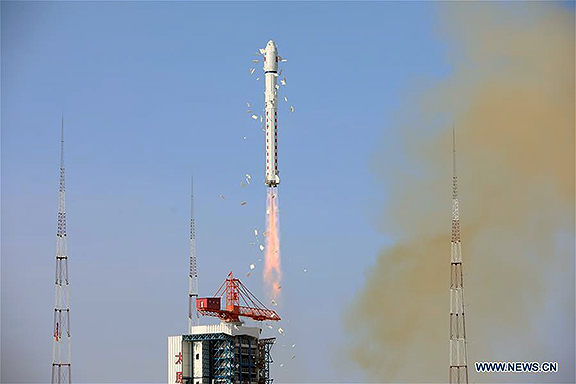
Adding to their space asset conglomeration, China also launched five new remote-sensing satellites into orbit from the Taiyuan Satellite Launch Center in north China’s Shanxi Province Wednesday.


The five, new, remote-sensing Ningxia-1 satellites are launched by a Long March-6 carrier rocket from the Taiyuan Satellite Launch Center in north China’s Shanxi Province on Nov. 13, 2019.

Photo is courtesy of Xinhua.

The five Ningxia-1 satellites were launched by a Long March-6 carrier rocket at 2:35 p.m. (Beijing Time). These satellites are part of a commercial satellite project invested by the Ningxia Jingui Information Technology Co., Ltd, and will be mainly used for remote sensing detection.

The satellites and carrier rocket were developed by the DFH Satellite Co., Ltd. and the Shanghai Academy of Spaceflight Technology. Wednesday’s launch was the 318th mission for the Long March series carrier rockets.

Filed Under: News

NRO’s Smallsats Launched

November 13, 2019 by editorial


Photo of Northrop Grumman’s Cygnus-12 arriving at ISS.

Image is courtesy of NASA.

Two National Reconnaissance Office (NRO) research and development cubesats were successfully launched via rideshare aboard an Antares rocket as part of the Northrop Grumman-12 (NG-12) Cygnus cargo resupply mission from NASA Wallops Space Flight Facility, Wallops Island, Virginia, on November 2, 2019.

Led by NRO’s Advanced Systems and Technology (AS&T) directorate, the two cubesats are part of the NRO’s IMPACT project – an R&D effort to provide early evaluation of new technologies in space.

Manifested as AeroCube 14, the two, 3U IMPACT cubesats launched use the Aerospace Corporation’s AeroCube for bus and integration support and host 14 technology demonstrations that range from new materials, such as structural materials and thermal straps, to solar cells, star tracker experiments and on-board processors.

These smallsats will first travel to the International Space Station (ISS) as part of the cargo resupply and will deploy in about two months from the ISS to their final orbit.

To assist with the NRO’s research and development goal of rapid technology infusion, the IMPACT program offers a regular launch cadence for technology demonstrations; provides an adaptable bus that enables easy onboarding and off-boarding of those technologies, and serves as the front end of the technology for NRO future capabilities.


The AeroCube-14 CubeSats in the lab prior to launch integration.

Photo is courtesy of Aerospace Corporation.

Four of the experiments that were launched are also part of NRO’s new Greenlighting program, which leverages and evaluates the performance and space survivability of new technologies developed by non-traditional commercial partners in a streamlined fashion on a rapid timeline.


The unclassified Greenlighting program focuses on technology development, not satellite development, by giving vendors supporting NRO’s mission goals the ability to focus on maturation of technologies without having to worry about the logistics of getting to space.

By using a standard circuit board interface on which to host small module technology experiments, the Greenlighting program drives miniaturization of technologies and keeps costs low — all while giving these projects access to space testing that might not be available through traditional means.

Dr. Susan Durham, Director, AS&T, said that with IMPACT, the goal is to take the pioneering research areas being explored to test their survivability and performance in space. The launch of the IMPACT cubesats along with the NRO’s new Greenlighting program represents the best of the agency’s collaboration with commercial research and launch partners.

Filed Under: News

‘Rosie’ Rocks Rocket Lab

November 13, 2019 by editorial

Rocket Lab has introduced ‘Rosie’ the rocket-building-robot to the company’s manufacturing line, speeding up the production of Electron launch vehicles by more than 400 hours.

Until recently, Rocket Lab had been producing an Electron launch vehicle every 30 days. ‘Rosie’ the Robot will help bring Rocket Lab towards its goal of one Electron built and launched every seven days.


Rocket Lab’s ‘Rosie’ robotic manufacturing system.

Photo is courtesy of Rocket Lab.

The newly installed, custom-built, 140 sq/meter robot enables the precision machining of Electron’s carbon composite structures, including stage 1, stage 2, and the fairing. In only 12 hours, all marking, cutting, drilling, milling, and sanding, is completed on a full vehicle. ‘Rosie’ comprises a 3.5 meter by 16 meter 5-axis machining window coupled with a custom-built sixth rotary axis. The entire unit is large enough to house a bus, with room to spare, so it comfortably machines an entire 12m carbon-composite Electron first stage.

‘Rosie’ is the latest in a series of production, licensing, and infrastructure upgrades all targeted at boosting Electron production rates to meet a weekly launch cadence. In the past month, Rocket Lab has completed the installation of the launch mount and strongback at Launch Complex 2, Rocket Lab’s second orbital launch site, which will enable the first Electron launch from U.S soil in 2020. A new Range Control Facility has also been built at Launch Complex 1 to streamline mission operations, and the FAA has recently issued Rocket Lab with a 5 year Launch Operator License, enabling Rocket Lab to expedite pre-launch regulatory paperwork. 

Work toward a reusable first stage for Electron is also underway, with Rocket Lab’s next mission featuring an upgraded booster to support recovery efforts. The launch window for the next mission, named ‘Running Out Of Fingers,’ is scheduled to open on November 25 and the mission features a first stage block upgrade.


The Electron launch of Rocket Lab’s “As the Crow Flies” mission.

Photo is courtesy of Sam Toms and Simon Moffatt.

Electron’s booster will include guidance and navigation hardware, including S-band telemetry and onboard flight computer systems, to gather data during the first stage’s atmospheric re-entry. The stage is also equipped with a reaction control system to orient the booster during its re-entry descent.

These new measures have been implemented with one goal in mind – frequent, reliable, and responsive launch for small satellites.

‘Rosie’ is automating machining tasks; however, human hands are still in high demand on the manufacturing teams at Rocket Lab’s Huntington Beach Headquarters and the company’s Production Complex in Auckland, New Zealand. More than 100 roles across manufacturing, test, and design are being recruited into the company over the next 12 months.

Rocket Lab’s Director of Production, Jamie France, said Rosie is the latest in a string of manufacturing upgrades designed to take the company from an Electron build every 30 days to one every seven days. A machine like this didn’t exist in the market, so Rocket Lab custom-built one that’s big enough for a bus to be parked within — this means building a rocket stage takes hours, not weeks or months.


Filed Under: News

Kepler and Cobham SATCOM Partner Offering ‘User Terminal-as-a-Service’

November 13, 2019 by editorial


An artistic view of Kipp, Kepler’s first Ku-band LEO satellite.
Photo Credit: Kepler

Two companies have partnered to combine their assets offering a dynamic service. The companies and their new service was announced to eliminate barriers to widespread adoption of high capacity data services over Kepler Communication’s Low Earth Orbit (LEO) network.

Kepler Communications and Cobham SATCOM’s new partnership translates that under the new arrangement, organizations that evaluate Kepler’s ability to cost-effectively move multiple gigabytes of data per day around the globe can experience a fully managed trial of the service anywhere with no upfront CAPEX spend, no lengthy service commitment, and certified installation and support executed through Cobham SATCOM’s global Technical Service Partner network.   

The ‘User Terminal-as-a-Service’ (UTaaS), the Kepler-Cobham partnership centers on three core principles:

  • shifting equipment costs to a monthly operational fee from a more traditional one-time capital expense
  • embedding installation, technical support, terminal maintenance, warehousing, and transport services into the monthly fees with future capabilities for add-on services
  • exchanging technical know-how to improve the delivery of LEO wideband services going forward.


To further validate the effectiveness of the new UTaaS partnership, recently the two firms confirmed that Cobham’s full range of SAILOR and Sea Tel antenna systems, used in the maritime communications segment, are both fully capable of tracking LEO satellites on land and at sea. 

As an example, Kepler and Cobham successfully deployed their system recently utilizing two augmented Sea Tel antennas aboard the Polarstern research vessel. Currently, the network is delivering services in the central Arctic well beyond the range of traditional geostationary satellites and has demonstrated up to 40 Mbps downlink and 120 Mbps uplink. 

Kepler’s Global Data Service (GDS), which is currently enabled by Kepler’s first two satellites in orbit, is a high-capacity worldwide data communication service that enables the movement of Gigabytes of data to and from the user’s location at economic rates. The store-and-forward nature of the solution makes it suitable for delay-tolerable data such as large multimedia files, high-resolution videos and imagery, and other bandwidth-intensive data within the maritime, oil & gas, tourism, and scientific communities.

Jeffrey Osborne, Co-founder and VP of Business Development at Kepler and Matt Galston, Sr. Director Global Market Strategy and Development, Cobham SATCOM concluded with comments that include;

Jeffrey Osborne, Co-founder and VP of Business Development at Kepler said that proven, reliable ground segment is a critical piece for delivering wideband services from LEO. The cost of today’s tracking antennas as well as the complexity of coordinating setup, installation, and support are understandable roadblocks for those wishing to test drive their Global Data Service. At Kepler, their goal is to deliver the most frictionless customer experience possible so that anyone with a potential use case for this groundbreaking capability can simply say ‘yes’ and keep their focus on the really important elements of their application. Their partnership with Cobham enables them to create precisely that experience where they can scaleably execute demonstrations anywhere on the planet all for a manageable monthly OPEX fee that includes hardware, setup, support, and airtime. 

Matt Galston, Sr. Director Global Market Strategy & Development, Cobham SATCOM commented that Kepler’s approach is unique for their industry. By starting with a small number of satellites in operation, they focus more directly on solving problems for the end-user. Their collaboration demonstrates how some solutions come through partnerships, new commercial models, and a shared goal of delighting end-users while being able to scale that delight to many more in time. It’s exciting to be a part of this journey, and they are confident Kepler’s future is very bright.


For all involved in the satellite and space industry and the various market segments that enhance these dynamic environments, the 2020 SmallSat Symposium is invaluable.

The 2020 SmallSat Symposium begins on February 3, 2020, with workshops on the first day. Then the Conference continues from February 4 to 6 at the Computer History Museum in Mountain View, California, in the heart of Silicon Valley.

The SmallSat Symposium is hosted by Satnews Publishers which, since 1983, has been a provider of satellite news, media and events. This information packed forum enables you and your company to secure a larger portion of market share as well as to take a step into the next stage of your company’s, or organization’s, growth.

The personal connections at the SmallSat Symposium enable attendees to network with established organizations, subject-matter experts as well as ‘New Space’ entrants.

The SmallSat Symposium will focus on the daily changes in new technologies and the business environment that is shaping the implementation of SmallSat constellations, SmallSat launchers, the challenges facing the SmallSat developer and actors as well as the enormous benefits of these advanced technologies that will benefit our world.

This event attracts more than 100 diverse speakers, all of whom possess deep industry experience. Additionally, numerous opportunities exist to mingle and network with peers while enjoying exceptional, complimentary meals and refreshment breakfast.

Learn more at this direct link…

Filed Under: News

Loft Orbital’s $13 Million Funds Operations

November 13, 2019 by editorial

Developing a “Satellite-as-a-Service” business is the driving force behind Loft Orbital, based in San Francisco.

The company has their Series A funding with a collection of $13 million to support operations in Boulder, Colorado, and Toulouse, France, as the company builds smallsats with initial launches scheduled for 2020.

Five customers have signed on for Loft’s first satellite and they include Eutelsat, the UAE Government flying an imager and SpaceChain. The company stated they have also signed on customers for the second and third satellites, as well. The firm’s business model has customers schedule milestone payments and then participate in a subscription service once the satellite is operational on-orbit.

Filed Under: News

  • « Go to Previous Page
  • Go to page 1
  • Interim pages omitted …
  • Go to page 324
  • Go to page 325
  • Go to page 326
  • Go to page 327
  • Go to page 328
  • Interim pages omitted …
  • Go to page 332
  • Go to Next Page »

Primary Sidebar

WEEKLY NEWSLETTER

Archives

  • December 2025
  • November 2025
  • October 2025
  • September 2025
  • August 2025
  • July 2025
  • June 2025
  • May 2025
  • April 2025
  • March 2025
  • February 2025
  • January 2025
  • December 2024
  • November 2024
  • October 2024
  • September 2024
  • August 2024
  • July 2024
  • June 2024
  • May 2024
  • April 2024
  • March 2024
  • February 2024
  • January 2024
  • December 2023
  • November 2023
  • October 2023
  • September 2023
  • August 2023
  • July 2023
  • June 2023
  • May 2023
  • April 2023
  • March 2023
  • February 2023
  • January 2023
  • December 2022
  • November 2022
  • October 2022
  • September 2022
  • August 2022
  • July 2022
  • June 2022
  • May 2022
  • April 2022
  • March 2022
  • February 2022
  • January 2022
  • December 2021
  • November 2021
  • October 2021
  • September 2021
  • August 2021
  • July 2021
  • June 2021
  • May 2021
  • April 2021
  • March 2021
  • February 2021
  • January 2021
  • December 2020
  • November 2020
  • October 2020
  • September 2020
  • August 2020
  • July 2020
  • June 2020
  • May 2020
  • April 2020
  • March 2020
  • February 2020
  • January 2020
  • December 2019
  • November 2019
  • October 2019

© 2019–2025 SatNews

Insert/edit link

Enter the destination URL

Or link to existing content

    No search term specified. Showing recent items. Search or use up and down arrow keys to select an item.
      x
      Sign Up Now!

      Enjoy a free weekly newsletter with recent headlines from the global SmallSat industry.

      Invalid email address
      We promise not to spam you. You can unsubscribe at any time.
      Thanks for subscribing! You will now receive weekly SmallSat News updates.
      We love our advertisers.
      And you will too!

      Please disable Ad Blocker to continue... We promise to keep it unobtrusive.
      We promise not to spam you. You can unsubscribe at any time.
      Invalid email address
      Thanks for subscribing! Please check your email for further instructions.