• Skip to main content
  • Skip to primary sidebar
  • Home
  • News
  • Featured
  • More News ⌄
    • SatNews
    • SatMagazine
    • MilSatMagazine
  • Events ⌄
    • MilSat Symposium
    • SmallSat Symposium
    • Satellite Innovation
  • Contacts
  • SUBSCRIPTION

SmallSat News

You are here: Home / Archives for 2021

Archives for 2021

PLD Space To Exhibit Spain’s First Privately-Developed Rocket For Smallsat Launches

November 17, 2021 by editorial

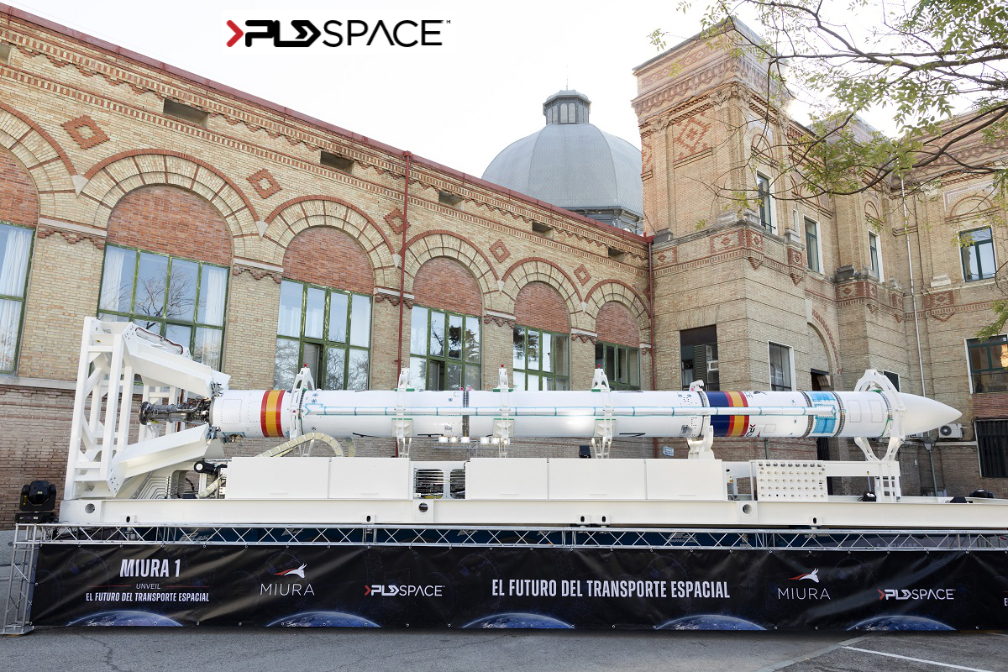
PLD Space has achieved a new milestone with their official presentation in Madrid of the company’s MIURA 1 rocket that has been exhibited fully assembled for the first time in the capital’s National Museum of Natural Science — this suborbital vehicle is a key step in launch vehicle development, a pathfinder for MIURA 5 development.
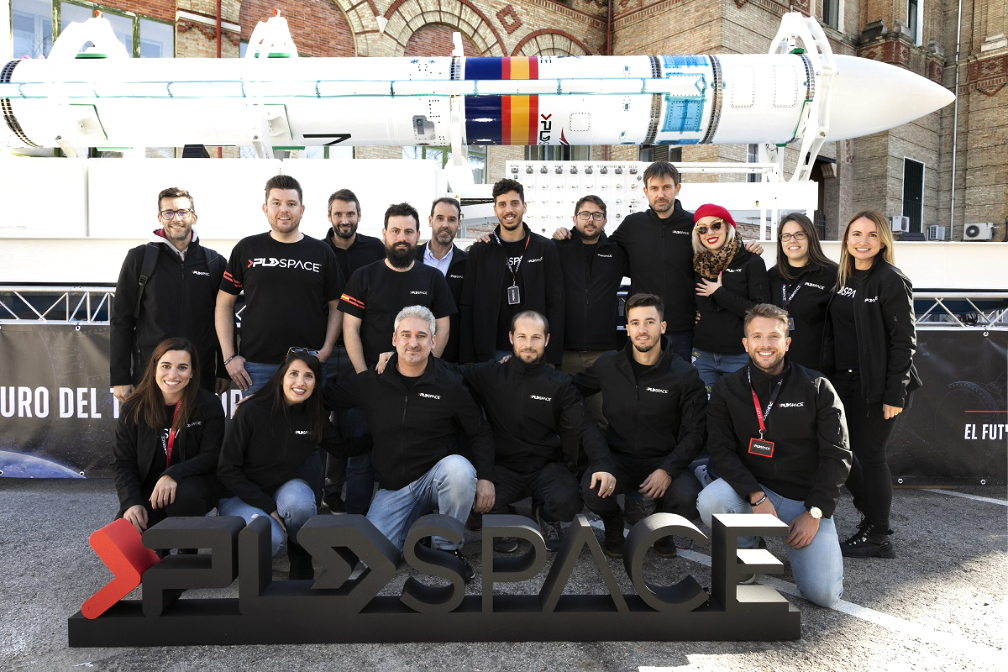
The PLD Space team.

From the start, the objective of PLD Space has been to become the European Microlauncher Company, a reference within the sector through the use of reusable rockets dedicated to the launch of smallsats. This vision has been maintained through the different stages of the project and is now being achieved, as Raúl Torres, CEO and Cofounder, has demonstrated during the official inauguration of MIURA 1. He said, “We have always being clear that we wanted to take advantage of the business opportunities in the space sector and contribute to its democratization, paving the way for new players in this increasingly thriving industry that will play a key role in the coming years.”

Raúl Verdú, COO and Co-founder of PLD Space, has underlined the support shown by numerous investors, in both public and private institutions, that have come together to make a “Made-in-Spain” space project a reality. “The support of institutions such as CDTI, ENISA, and the IVF, has been key; they have co-financed the last 10 years of development along with our private investors. We are proud to have financed the first private space launch service enterprise within our country.”

Ezequiel Sánchez, Executive President of PLD Space, highlighted the “strategic advantage for Spain to become the fourteenth country with access to space, as this select group of nations will play a crucial geostrategic role for Europe”. He has also underlined the effect it will have on Spain from an industrial perspective, because “our business model integrated throughout the value chain will allow us to have an autonomy that will be crucial in order to address the future of science and national industry”. “This without a team of passionate people would not have been possible. It is clear that we have grown with the right team. And now, we have the right team.”

MIURA 1 will return to the PLD Space base at Teruel Airport to carry out combined qualification testing at stage level, including full-mission duration hot test of the complete stage. After these tests, the stage will be shipped to the launch base to perform a combined test with all the ground segment and ground infrastructure, before launch.
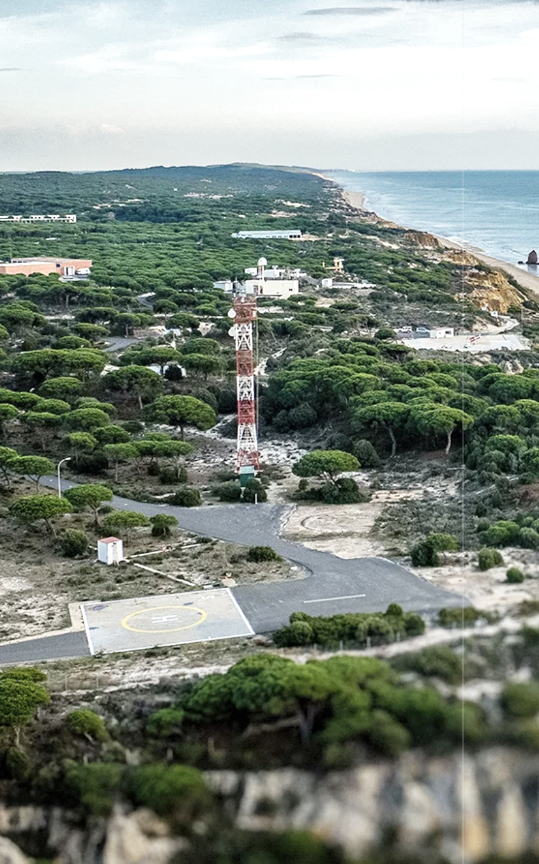
The historic El Arenosillo test range is located near Huelva, in south-west Spain.

MIURA 1 launch is expected for the second half of 2022, which it will be the first launch mission of a European rocket in history, designed to reach a maximum altitude of 150 km and with the capacity to carry a payload of up to 100 kg.

PLD Space is also working on its first MIURA 5 reusable orbital rocket, which is expected to be ready to carry out its first mission in July of 2024 and which will mark the start of the firm’s commercial satellite launches.

The first launch vehicle to fly will be MIURA 5 block 1.0, a fully expendable version that will comprise the first two launches. After those flights, the company will introduce a reusable version for the subsequent flights, paving the way for a commercial reusable booster in Europe. This stage will implement all lesson learned from ESA´s Future Launchers Preparatory Program (FLPP) contracts, called Liquid Propulsion Stage Recovery (LPSR) 1 and LPSR2.

PLD Space is a pioneering Spanish company in the aerospace sector and a reference within Europe in the development of reusable rockets, with a recognized prestige in the sector and a solid project that has become a reality through its launch vehicles: the MIURA 1 suborbital and MIURA 5 orbital rockets, which will place Spain among the few countries with the capacity to successfully send small satellites to space. With a decade of history, PLD Space plans to launch its MIURA 1 prototype in the second half of 2022 and tackle its first real space transport mission with MIURA 5 in 2024. The firm, based in Elche (Alicante) and with technical facilities in Teruel, Huelva and French Guiana, has already achieved more than €36 million of investment to drive forward its project in the space sector.

Filed Under: Featured, News

Universal Docking Device Debuts From Astroscale

November 16, 2021 by editorial

Astroscale Holdings Inc. (“Astroscale”) has revealed a universal docking device the company hopes will become a standard fitment on all, future, LEO satellites.

There are an unprecedented number of satellites due to launch over the next decade, the majority into LEO, (250 to 2000 km above Earth). The U.S. Federal Communications Commission has approved 16,447 satellites within constellations to date and has applications pending for an additional 64,816 satellites. The potential for high-velocity, high impact collisions is likely to increase unless disposal of satellites becomes part of everyday space operations.

Astroscale’s Docking Plate can be compared to a car ‘tow hook’ — a standardized interface that enables future servicing. Docking plates are designed to be discrete during satellite operations but robust and reliable if required. They’re customizable for different satellite designs and will enable both robotic or magnetic capture mechanisms to securely attach a servicer to a satellite.

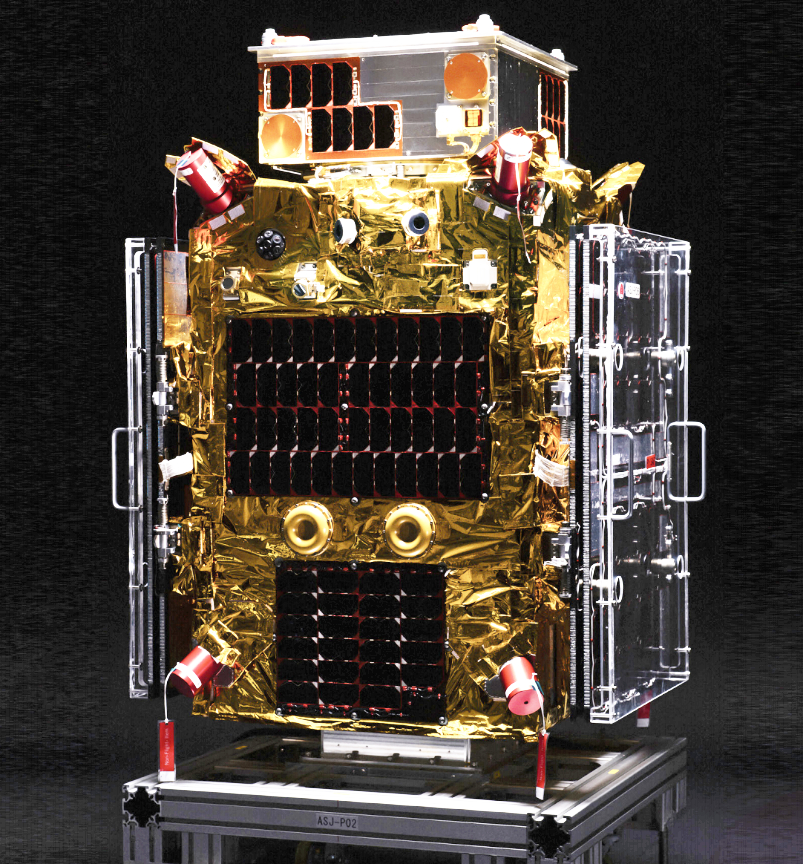
The End-of-Life Services by Astroscale-demonstration (ELSA-d), currently undergoing testing in LEO, is the first spacecraft servicer of its kind to demonstrate the technology and commercial viability of removing defunct satellites. The ELSA-d mission uses the first prototype of the new docking mechanism, preparing the way for this first commercially available Astroscale Docking Plate for all satellite operators in LEO.

Astroscale’s ELSA-d.

Astroscale’s universal docking technology will keep orbital highways clear and safe by enabling future debris removal and will also support the development of a dynamic, on-orbit ecosystem, powered by the emerging on-orbit services and manufacturing market.

Key features include:

  • Discrete: designed to be lightweight, compact and minimally intrusive
  • Low-cost: a price that can be integrated into your satellite development costs
  • Reliable: components are mechanically secured to be failsafe with no structural adhesive degradation issues
  • Robust: undergone qualification testing for the space environment
  • Durable: designed for an in-space lifetime of over 15 years

Technical features

  • Fiducial markers and retroreflectors: act as docking aids to guide navigation
  • Knurled reinforced rim: enables robotic grappling technology. The plate is compatible with a variety of capture mechanisms including magnetic and robotic
  • Simple 3 bolt solution: makes it easy to install and can be assembled from the outside
  • Truss legs with 3 size options: customizable to suit any satellite design
  • Flush mount option: can be integrated into an existing structure
“Over the last 6 decades more than 12,000 satellites have been launched, and this number could more than quadruple in a single decade,” said Nobu Okada, Founder and CEO of Astroscale. “This phenomenal growth shows how important space has become — to our economies, our way of life and to our fight against the climate change crisis. We urge the space community to demonstrate real commitment to protect the space environment by preparing satellites with a Docking Plate for future removal.”

“The Astroscale Docking Plate is designed to be lightweight and easy to fit onto low Earth orbit satellites,” said John Auburn, Managing Director of Astroscale Ltd. “As a low-cost solution it enables satellites to be captured and removed from space, keeping our orbital highways clear. We all value satellite communications supporting our global connectivity and economy, and monitoring our environment on Earth. By preparing our spacecraft today we will ensure space is sustainable tomorrow, for future generations.”

Filed Under: News

RFA and Lúnasa’s MoU Will Provide Flexible Cost-Effective In-Orbit Services

November 16, 2021 by editorial

These two companies are consolidating their partnership in the field of space logistics to offer small satellite customers flexible and cost-effective launch services.

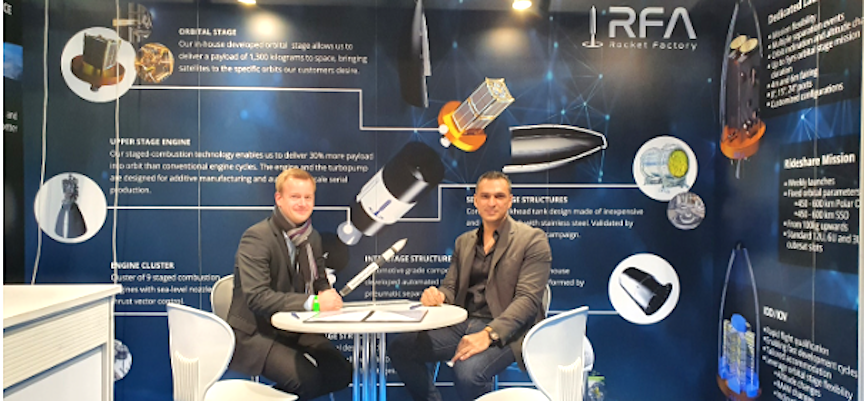
Lúnasa Ltd. and Rocket Factory Augsburg AG (RFA) have jointly signed a memorandum of understanding. The two companies are consolidating their partnership in the field of space logistics to offer small satellite customers flexible and cost-effective launch services. As a result they mutually benefit from each other’s experience, methods and networks. 

The common goal of both companies is to provide small satellite operators with flexible and cost-effective access to space. The MoU reflects a mutual desire to work closely together to facilitate the launch of small satellites into their final operational orbit. The RFA ONE launch vehicle, developed by RFA, will be used to deliver the reusable orbital transfer vehicle (OTV) “VIA” to near-Earth orbit as well as provide resupply flights.

The agreement was finalized in early October, and now will be announced at the Space Tech Expo Europe in Bremen, Germany.

“From the beginning, we designed our RFA ONE to be compatible with other transfer vehicles. Lúnasa’s reusable “VIA” are optimal complements to our own launch vehicle technology and allow us to offer our launch services in an even more diversified and tailored way,” says Dr. Stefan Tweraser, Chief Executive Officer of RFA.

Jörn Spurmann, Chief Commercial Officer of RFA, adds, “The compatibility of our rocket with a wide range of OTV’s is a key element of our business case and goes hand in hand with our vision of making space accessible to everyone – easily, quickly and with low cost.”  

“Lúnasa and RFA’s objectives are well aligned in the desire to enable SMEs, universities and other entities to innovate and provide services and technologies otherwise dominated by larger companies due to prohibitive cost of access to space. We believe this will remove some of the barriers to entry and stimulate the space market with even more competitive and cutting edge products whilst creating more jobs,” says Amin Chabi, Founder and Chief Executive Officer of Lúnasa.


Filed Under: News

Milestone Met By Syrlinks — 1K Products Delivered To Airbus OneWeb Satellites

November 16, 2021 by editorial

Syrlinks has reached the milestone of 1,000 products delivered to Airbus OneWeb Satellites for the OneWeb constellation.

The supply of 1,000 equipment parts underscores Syrlinks’ ability to meet an industrial challenge: the production of space radio communication equipment at a rapid pace.

Syrlinks has substantially evolved its manufacturing capability from producing around ten products a year to a weekly turnout of several dozen TT&C transceivers and low noise amplifiers for the constellation. Syrlinks has changed its manufacturing processes to move toward a serial production model meeting the reliability and quality requirements of the space market.

With the opening of the space market to private players, the number of smallsat constellations has augmented considerably in recent years. Manufacturing costs, as well as lead times, have been greatly reduced, requiring the sector to adapt. Syrlinks, now has the means of volume production allowing it to respond to new opportunities in Europe and around the world. The company is continuing to grow and applies this new series production model to other radiofrequency products of its range.

“This milestone of 1,000 equipment manufactured and delivered to Airbus OneWeb Satellites is the result of a fruitful collaboration between Airbus OneWeb Satellites and their suppliers. This new manufacturing rate required flexibility at all levels of production, and everybody was able to act in response successfully. We are only halfway through, but we can’t wait to see this ambitious project become 100% operational,” said Johan Lepissier, project manager at Syrlinks.

Filed Under: News

AAC Names New Company CSO As Well As A New CEO For Subsidiary SpaceQuest

November 16, 2021 by editorial

AAC Clyde Space has named Chris Fauquier, currently the COO at the firm’s subsidiary, SpaceQuest, as CEO for the U.S. subsidiary — this move follows Dr. Dino Lorenzini‘s transition to the role of Group Chief Science Officer (CSO) of AAC Clyde Space. Dr. Lorenzini is the founder of SpaceQuest and was, until now, their CEO.

Dr. Lorenzini founded SpaceQuest in 1994 and has been instrumental in building the company’s technological, scientific and business track record. In his new role, Dino will work with all companies in the Group to head up its scientific development, a key area in the rapidly evolving smallsat field.

Chris Fauquier joined SpaceQuest in 2017 as COO and has worked closely with Dino ever since. Chris is an experienced global executive with strong leadership skills. He has held numerous senior management roles establishing, growing and leading aerospace and energy business units for US and European Fortune 100 companies.

“I look forward to assuming a global role as CSO as we gear up to really make an impact within the small satellite field and feel very glad that I am handing over the leadership at SpaceQuest to Chris, who has worked closely with me for the last four years. I strongly believe that AAC has just started its journey and my commitment to the Group – both professional and as an investor – is long term,” said CSO Dino Lorenzini.

“These are exciting times in the space industry and I look forward to leading SpaceQuest in its continued expansion while working closely with the great global team at AAC”, said SpaceQuest Ltd. CEO, Chris Fauquier.

“We are delighted to have Dino join the executive team as CSO and leverage his experience throughout the Group, while also promoting Chris to the top role in the US. I welcome them both to their new roles,” aid AAC Clyde Space CEO, Luis Gomes.

Filed Under: News

Equatorial Space Systems’ New Senior Personnel And Global Expansion

November 16, 2021 by editorial

Singapore’s rocket company, Equatorial Space welcomes three new senior engineers to its growing team.

Dr Carlos O. Maidana is the Company’s new Head of Payload Services and Thai office. Marcelo Martinez has taken the position of Head of Flight Dynamics, and David Broadbent is the new Director of the Company’s Australian wholly-owned subsidiary.

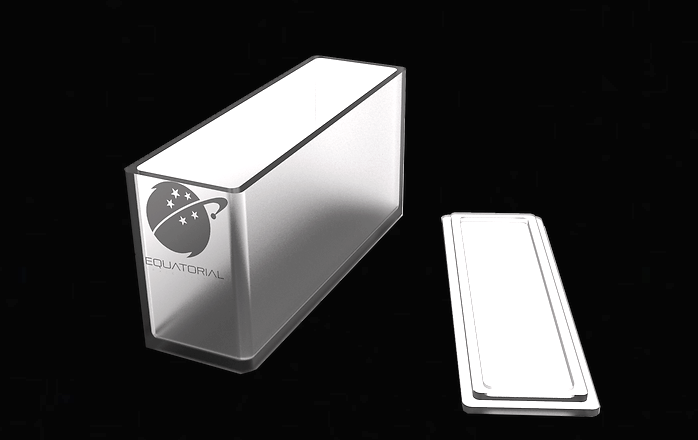
At the same time, Equatorial Space expands its outreach towards provision of payload products, with in-house manufactured cubesats as well as scientific experiment platform known as MicroLab™ in the pipeline.

MicroLab™

“Our growing, international crew proves that our value proposition, core technology and overall strategy is increasingly attractive to seasoned industry experts across the globe,” says Simon Gwozdz, the Company’s founder and CEO, “Our in-house capabilities, originally focused on propulsion development, now includes structural systems and aerodynamic analysis that we can provide not just for our internal development projects, but also to third parties.”

Dr Carlos O. Maidana has been in the industry for 15 years.

“I met Jamie Anderson several months back and was interested in working together right away. My work in the United States and here in Thailand spans both payload development as well as ground qualification of hardware and I saw the immense potential joining forces when offered to bring the MicroLab platform under the Equatorial wings.”

Mr Marcelo Martinez’s career in Argentina spans four decades and a number of sounding rocket and UAV projects both in the country and internationally.

“I was interested in hybrid propulsion for some time now, and saw the benefits of the HRF-1 solid fuel immediately. After a year as an advisor, I am delighted to be joining the Singapore team as a full-time, senior engineer.”

Mr David Broadbent has worked globally for many Tier 1 Companies across a wide range of engineering fields for over 50 years, with one of the key highlights of his career to date, taking him overseas to perform structural testing on a newly designed, 9 engine powered, 1.2m diameter carbon-composite rocket’s engine frame.

“Our Company has an extremely strong Australian connection and heritage — the core technology originates from an Australian engineer and we are beyond proud to be bringing our International capabilities for the benefit of Australia’s growing space tech ecosystem.”

Equatorial Space was first founded in 2017 to deliver low-cost, high-reliability launch services to clients worldwide.

With its proprietary solid fuel composition, the HRF-1, Equatorial Space develops hybrid rocket propulsion systems with specifications competitive of that of liquid and solid rockets, without the complexity or explosive risk associated with rocket propulsion.

The Company has previously launched the very first commercially built proof-of-concept rocket carrying its proprietary solid fuel — the Low Altitude Demonstrator, which was also the first commercially built prototype rocket to be launched in Southeast Asia.

Earlier this year, Equatorial Space qualified for a U.S. Space Force and AF Research Lab-backed accelerator program in Albuquerque, New Mexico. Its upcoming qualification mission, the Mid-Altitude DEemon.

Filed Under: News

GomSpace Contracted By Politecnico di Milano To Support H.E.R.M.E.S. Mission

November 15, 2021 by editorial

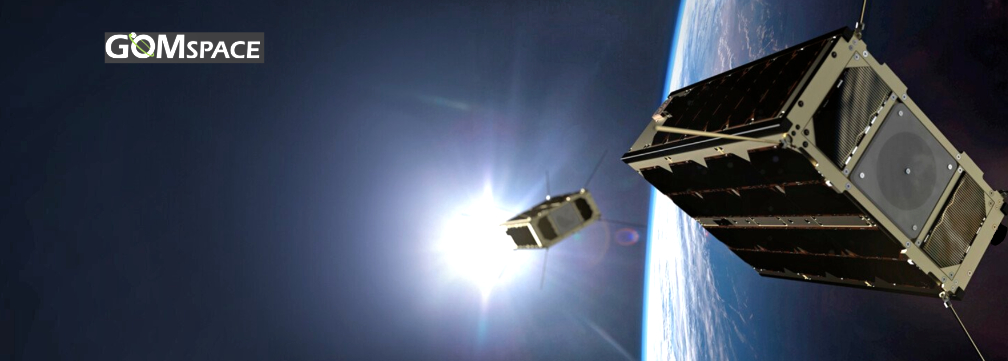
GomSpace has signed a contract with Politecnico di Milano that includes a large quantity of GomSpace space qualified products for the H.E.R.M.E.S. mission with a value of 5.8 MSEK.

The contract deliveries will take place in 2021/2022 and GomSpace will support the technology activities of the university with products and knowledge.

The main goal of the High Energy Rapid Modular Ensemble of Satellites (H.E.R.M.E.S.) mission is the accurate and prompt localization of bright hard X-ray/soft gamma-ray transients, such as Gamma-Ray Bursts (GRBs), with a distribution of sensors on a 6 cubesat constellation.

The concept is based on miniaturized, innovative high energy emission detectors developed by Italian National Institute of Astrophysics (INAF) and hosted by a constellation of 6 smallsats to be launched into LEO, designed and implemented at the Politecnico di Milano labs.

The H.E.R.M.E.S. program is carried out via a collaboration between Politecnico di Milano and INAF, together with many other national and international entities active in the Space sector, and is financed by the Italian Ministry of University and Research (MUR), the Italian Space Agency (ASI) and the European Commission’s Horizon 2020 research and innovation program.

“We are glad to support Politecnico di Milano and we put a great honor in supporting university missions, share our knowledge and help building up academic space capabilities,” said Niels Buus, CEO of GomSpace.

Filed Under: News

Fifty-Three Additional SpaceX Starlink Smallsats Sent To Space

November 13, 2021 by editorial

On Saturday, November 13, at 7:19 a.m., EST, a SpaceX Falcon 9 launched 53 Starlink satellites to orbit from Space Launch Complex 40 (SLC-40) at Cape Canaveral Space Force Station in Florida.

This was the ninth launch of this Falcon 9 first stage booster, which previously launched Crew Demo-2, ANASIS-11, CRS-21, Transporter-1, and now has five Starlink missions completed, fairing extremely well.

The company also managed another 1st stage landing. This Falcon 9 rocket has now been successfully launched on nine missions. The initial launch had been scheduled for November 12; however, uncooperative weather at the launch site required a 24 hour delay.

Filed Under: News

GomSpace Contracted By Politecnico di Milano To Support H.E.R.M.E.S. Mission

November 12, 2021 by editorial

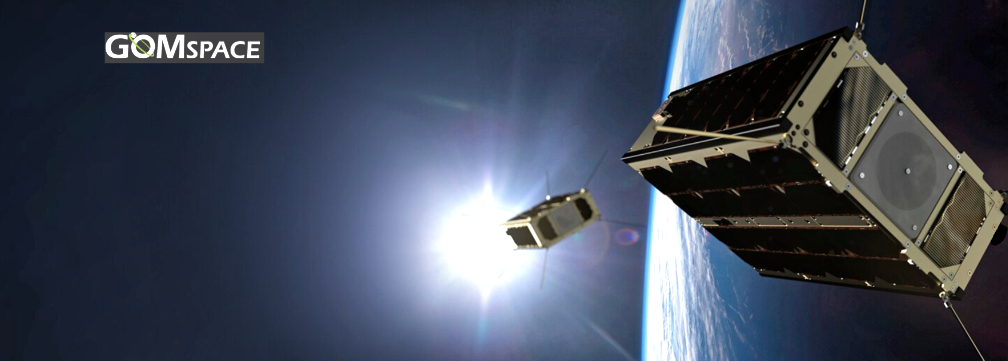
GomSpace has signed a contract with Politecnico di Milano that includes a large quantity of GomSpace space qualified products for the H.E.R.M.E.S. mission with a value of 5.8 MSEK.

The contract deliveries will take place in 2021/2022 and GomSpace will support the technology activities of the university with products and knowledge.

The main goal of the High Energy Rapid Modular Ensemble of Satellites (H.E.R.M.E.S.) mission is the accurate and prompt localization of bright hard X-ray/soft gamma-ray transients, such as Gamma-Ray Bursts (GRBs), with a distribution of sensors on a 6 cubesat constellation.

The concept is based on miniaturized, innovative high energy emission detectors developed by Italian National Institute of Astrophysics (INAF) and hosted by a constellation of 6 smallsats to be launched into LEO, designed and implemented at the Politecnico di Milano labs.

The H.E.R.M.E.S. program is carried out via a collaboration between Politecnico di Milano and INAF, together with many other national and international entities active in the Space sector, and is financed by the Italian Ministry of University and Research (MUR), the Italian Space Agency (ASI) and the European Commission’s Horizon 2020 research and innovation program.

“We are glad to support Politecnico di Milano and we put a great honor in supporting university missions, share our knowledge and help building up academic space capabilities,” said Niels Buus, CEO of GomSpace.

Filed Under: News

Astroscale Signs MoU With New Zealand Regarding Space Safety + Sustainability

November 12, 2021 by editorial

Astroscale Holdings Inc. (“Astroscale”) has signed a Memorandum of Understanding (MoU) with New Zealand’s Ministry of Business Innovation & Employment (“MBIE”) to cooperate on areas of space safety and sustainability, including debris mitigation and remediation as well as on-orbit servicing.

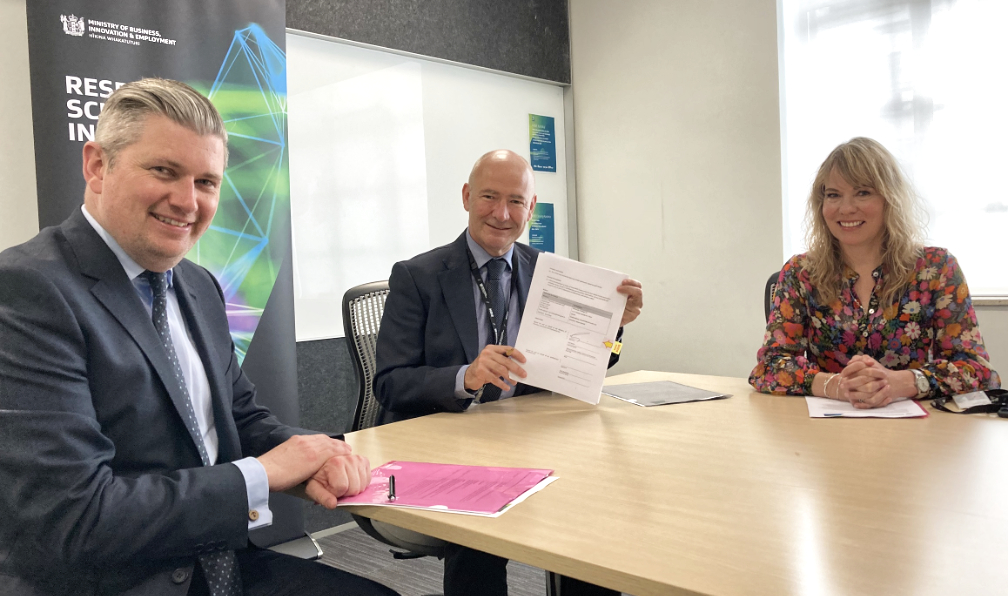
L-R: Joe McKay, Manager, Strategic Partnership, Paul Stocks, Deputy Secretary Labour, Science and Enterprise, Kjesten Wiig, Director Innovative Partnerships, after the signing of the MoU. Photo is courtesy of Astroscale.

The collaboration is focused on partnership in projects and activities that support long-term space sustainability, including joint technology development and research. To initiate these efforts, Astroscale and MBIE have identified an initial project in collaboration with Rocket Lab and Te Pūnaha Ātea–Auckland Space Institute, which will define the engineering requirements, policy challenges and associated costs for multi-active debris removal missions with clients that require direct re-entry due to survivability of components. 

The project will assess the mitigation strategy for up to three large debris objects with a single servicer in LEO and will aim to further demonstrate the viability of commercial debris removal while advancing the state of orbital sustainability. 

"Space sustainability is a global concern that requires international collaboration between industry and government. This partnership with the Government of New Zealand underscores the potential to advance the technical, regulatory and business case solutions needed to solve this challenging problem,” said Chris Blackerby, Group COO of Astroscale. “Astroscale and the Government of New Zealand share a vision for improved space situational awareness and developing on-orbit servicing. We prioritize safety and collaboration in support of the rapidly growing orbital economy and are thrilled to join forces to explore new opportunities for sustainable growth." 
“Astroscale’s cutting-edge technology, combined with their approach to space sustainability matches perfectly with our values as a nation. For New Zealand this creates new commercial opportunities, and builds the skills and capability of our people,” said Paul Stocks, Deputy Secretary Labour, Science and Enterprise of MBIE. “This partnership underlines our approach to the use of space – partnering with the best firms and researchers, to solve big global challenges and enable ground-breaking research and development. We look forward to working with Astroscale to develop and expand the New Zealand space industry, and continue to explore new opportunities for collaboration.” 

Filed Under: News

  • « Go to Previous Page
  • Page 1
  • Interim pages omitted …
  • Page 4
  • Page 5
  • Page 6
  • Page 7
  • Page 8
  • Interim pages omitted …
  • Page 65
  • Go to Next Page »

Primary Sidebar

WEEKLY NEWSLETTER

Archives

  • April 2026
  • March 2026
  • February 2026
  • January 2026
  • December 2025
  • November 2025
  • October 2025
  • September 2025
  • August 2025
  • July 2025
  • June 2025
  • May 2025
  • April 2025
  • March 2025
  • February 2025
  • January 2025
  • December 2024
  • November 2024
  • October 2024
  • September 2024
  • August 2024
  • July 2024
  • June 2024
  • May 2024
  • April 2024
  • March 2024
  • February 2024
  • January 2024
  • December 2023
  • November 2023
  • October 2023
  • September 2023
  • August 2023
  • July 2023
  • June 2023
  • May 2023
  • April 2023
  • March 2023
  • February 2023
  • January 2023
  • December 2022
  • November 2022
  • October 2022
  • September 2022
  • August 2022
  • July 2022
  • June 2022
  • May 2022
  • April 2022
  • March 2022
  • February 2022
  • January 2022
  • December 2021
  • November 2021
  • October 2021
  • September 2021
  • August 2021
  • July 2021
  • June 2021
  • May 2021
  • April 2021
  • March 2021
  • February 2021
  • January 2021
  • December 2020
  • November 2020
  • October 2020
  • September 2020
  • August 2020
  • July 2020
  • June 2020
  • May 2020
  • April 2020
  • March 2020
  • February 2020
  • January 2020
  • December 2019
  • November 2019
  • October 2019

© 2019–2026 SatNews

Insert/edit link

Enter the destination URL

Or link to existing content

    No search term specified. Showing recent items. Search or use up and down arrow keys to select an item.
      x
      Sign Up Now!

      Enjoy a free weekly newsletter with recent headlines from the global SmallSat industry.

      Invalid email address
      We promise not to spam you. You can unsubscribe at any time.
      Thanks for subscribing! You will now receive weekly SmallSat News updates.
      We love our advertisers.
      And you will too!

      Please disable Ad Blocker to continue... We promise to keep it unobtrusive.
      We promise not to spam you. You can unsubscribe at any time.
      Invalid email address
      Thanks for subscribing!