

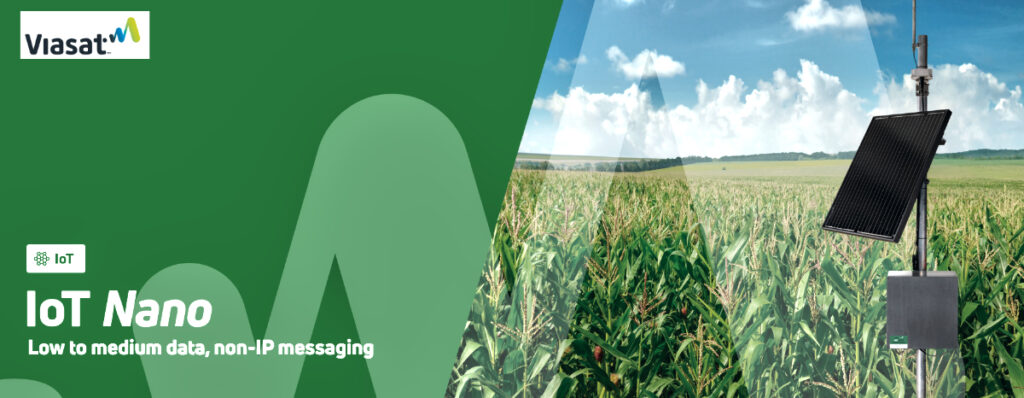
Viasat, Inc. (NASDAQ: VSAT) announced that its Enterprise business, part of the company’s Communication Services segment, launched its next generation IoT Nano connectivity service to deliver powerful, two-way messaging connectivity across the globe.
IoT Nano is designed to meet growing global demand for cost-effective, low-data, low-power, Internet of Things (IoT) services across remote and challenging environments where mobile connectivity is often required. With IoT Nano, businesses can effectively monitor and control fixed and mobile assets across industries like agriculture, transport, utilities, mining, and environmental monitoring—all with ultra-reliable satellite coverage through Viasat’s global L-band network.

IoT Nano is powered by ORBCOMM’s next-generation satellite IoT service, OGx, an evolution of the IDP (IsatData Pro) service that offers faster message delivery speeds, larger message sizes, and new hardware options relative to its predecessor. This new service expands Viasat’s diverse portfolio of IoT connectivity services, which range from ultra-low data rate narrowband IoT services to static VSAT IoT offerings.

IoT Nano delivers near real-time visibility and situational awareness, as well as richer, more actionable data for end customers. The new service will continue to support IDP mode, both preserving existing customer investments in IDP while also enhancing capabilities for reduced power consumption, larger messages, and faster speeds to enable new higher value use cases in OGx mode.
Viasat’s IoT Nano service will help lower costs in some cases by optimizing power usage, resulting in smaller and cheaper solar panels, batteries, and enclosures. The service also offers new capabilities for OEMs and solution providers looking to build their own terminals and devices using embedded third-party modules. This approach will allow OEMs and IoT solution providers to develop hardware that will support a wide variety of IoT applications with a range of data requirements. Viasat offers full development resources through its ELEVATE partner program. Additionally, the service supports a range of ORBCOMM terminals and modules.
Andy Kessler, Vice President, Enterprise and Land Mobile, Viasat, said, “The IoT Nano service represents a significant advancement in providing flexible, scalable, and energy-efficient IoT connectivity to businesses operating in the most remote corners of the world. By leveraging the enhanced capabilities of the ORBCOMM OGx service and equipping our partner ecosystem with new low-cost modules and service capabilities, we are empowering customers with access to smarter data, more frequently, in more places, at a lower cost.”
“OGx delivers faster speeds, larger messages, and lower power usage, all backed by ORBCOMM’s proven terminals, network, and field support,” said Dave Roscoe, President of Satellite IoT at ORBCOMM. “We are excited to partner with Viasat to enable solution providers to build and scale IoT applications across industries including agriculture, transportation, maritime, oil and gas, heavy equipment, and mining. By lowering the cost and increasing the effectiveness of satellite connectivity, OGx makes it possible for our partners to enter new markets, expand use cases, and drive incremental growth.”