
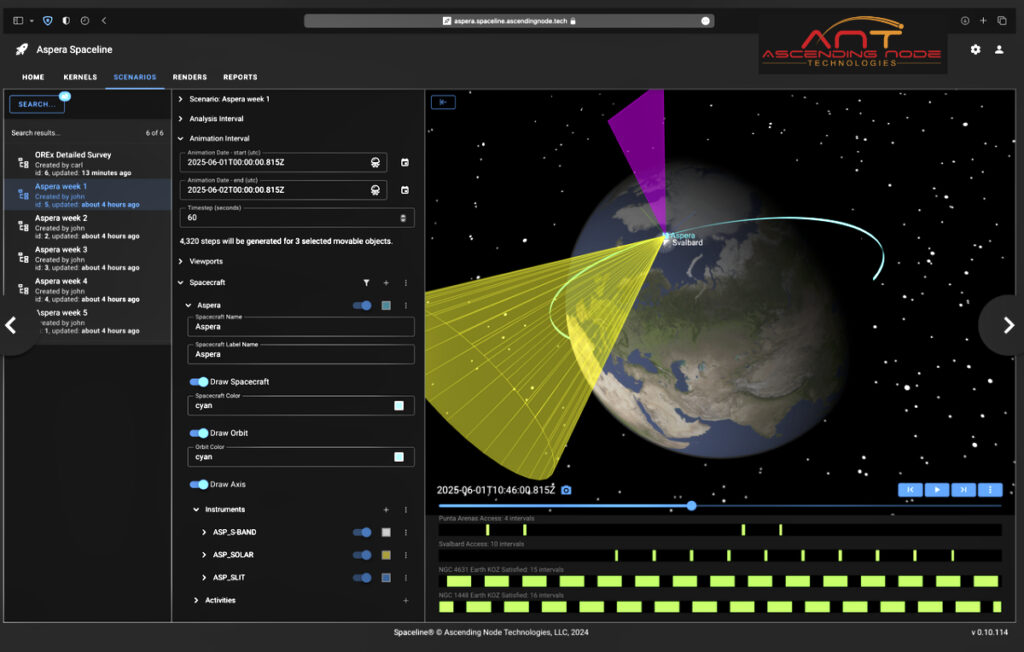
Ascending Node Technologies (ANT) has unveiled the company’s Spaceline® constellation design tool that enables startups and established operators to collectively plot, create, and simulate systems tailormade to their mission plans and operations.
This first-of-its-kind, collaborative design tool allows project engineers and developers to plug mission specs and requirements into ANT’s Spaceline visualization software platform, which does the math and provides an accurate blueprint for new and expanding constellations.
Spaceline enables operators to clearly see how their constellations will perform in the future and helps to ensure they deploy the right number of spacecraft and deliver the necessary coverage and services, such as Earth and orbital debris observation.
The new constellation design tool joins the affordable web-based Spaceline suite of data analysis and visualization capabilities developed to help today’s dispersed mission teams effectively collaborate in real time during every mission phase, from design through live operations and post-mission review.
Spaceline is a relatively small investment that enables multi-million-dollar missions to dramatically boost operational accuracy, efficiency, and productivity by automating and streamlining many of the manual, cumbersome calculations and processes still in use today.
NASA is relying on Spaceline and the Ascending Node Technologies team as a critical asset of its $20 million Aspera small-sat UV astrophysics mission set to explore nearby galaxies from LEO beginning next year.
NASA and the University of Arizona space team are leveraging Spaceline to help solve the mysteries surrounding how galaxies evolve and obtain fuel for the formation of stars.
Spaceline was born from NASA’s historic and complex OSIRIS-REx (Origins, Spectral Interpretation, Resource Identification, and Security – Regolith Explorer) asteroid sample collection mission that traveled to the near-Earth asteroid Bennu to retrieve rock and dust samples as part of a seven-year exploration.
By the time asteroid samples were delivered to Earth in 2023, a trio of OSIRIS-REx engineers and scientists had founded Ascending Node Technologies and revolutionized the space industry’s slow, siloed, costly, and often manual data processing practices.
Multiple NASA Small Business Innovation Research (SBIR) contracts have funded next-generation Spaceline visualization apps and enhancements to the Spaceline visualization software platform.
The industry continues to underestimate the complexity of space, so our web-based Spaceline architecture and new design tool allow teams to collaborate, develop ideas, create and operate a simulated constellation long before the first spacecraft is launched,” said John Kidd, Chief Aerospace Engineer for Ascending Node Technologies. “The ability to effectively plug-in specific mission data and automatically create constellations of spacecraft to meet specific objectives allows startups to build a compelling case for venture funding and big operators to grow with accuracy and confidence.”