
Astroscale Holdings Inc. (“Astroscale”), late last month, announced a major step forward: the issuance of U.S. Patent No. 12,234,043 B2 for the company’s “Method and System for Multi-Object Space Debris Removal.”
This patented innovation offers a sustainable and cost-effective distributed architecture approach to active debris removal (ADR), allowing for scalable, repeatable ADR operations and controlled reentry of multiple debris objects.
When safely reentering a multi-ton debris object from orbit, traditional ADR methods face significant limitations — they’re expensive, not sufficiently agile, and unable to carry enough fuel for multi-client missions. Astroscale’s distributed, reusable system overcomes these barriers while uniquely enabling the optionality of controlled reentry, ensuring that any surviving fragments from larger debris objects do not pose risks to populated areas or critical infrastructure on the ground, addressing a growing public safety concern and aligning with international best practices.
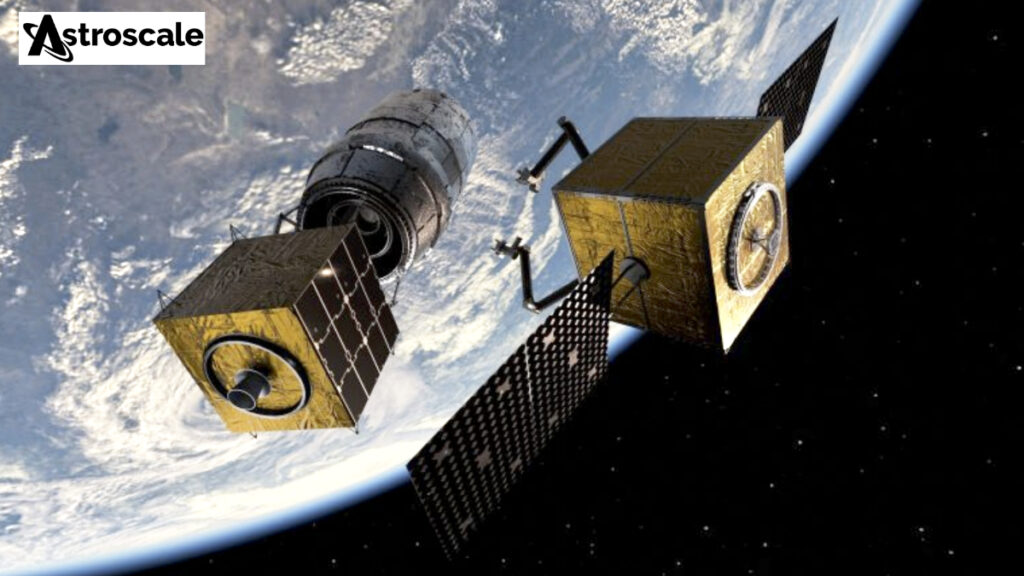
Under this new patented method, the servicer docks with a debris object (the “client”) and transfers it to a reentry shepherd vehicle in a lower orbit. Once the client is docked with the shepherd, the servicer separates and proceeds to engage a new client, while the shepherd safely guides the initial client into Earth’s atmosphere for reentry. This process repeats, allowing the servicer to remove multiple large debris objects over the course of its mission.
Astroscale’s architecture also supports flexible mission profiles: the shepherd can remain docked through reentry, undocked after performing reentry insertion and returned to orbit, or in some cases, missions can proceed without a shepherd vehicle at all. This adaptability is essential in addressing the diverse size and risk profile of objects on-orbit.
This new patent builds on Astroscale’s multi-removal approach for debris. Astroscale’s ELSA-M, set to launch in 2026, is capable of removing several “prepared” inactive satellites in a single mission, meaning satellites designed with technologies such as an interface that will enable docking and removal. By contrast, the newly patented method is designed for large, unprepared objects such as rocket bodies and legacy satellites that were not built to be serviced, and require a safe, guided descent through the Earth’s atmosphere.

This new patent further strengthens Astroscale’s intellectual property portfolio and reinforces its leadership in developing practical and innovative on-orbit servicing solutions that support the secure and sustainable use of space for future generations.
Our distributed architecture solves a key challenge in orbital debris removal by enabling the deorbit and reentry of multiple large debris objects sustainably and economically,” said Mike Lindsay, CTO at Astroscale. “This approach allows us to reuse our advanced servicers, capable of capturing and detumbling multi-ton objects, instead of burning them up with the debris upon reentry. This not only saves cost but also reduces the amount of potentially harmful material released into the Earth’s upper atmosphere.”