
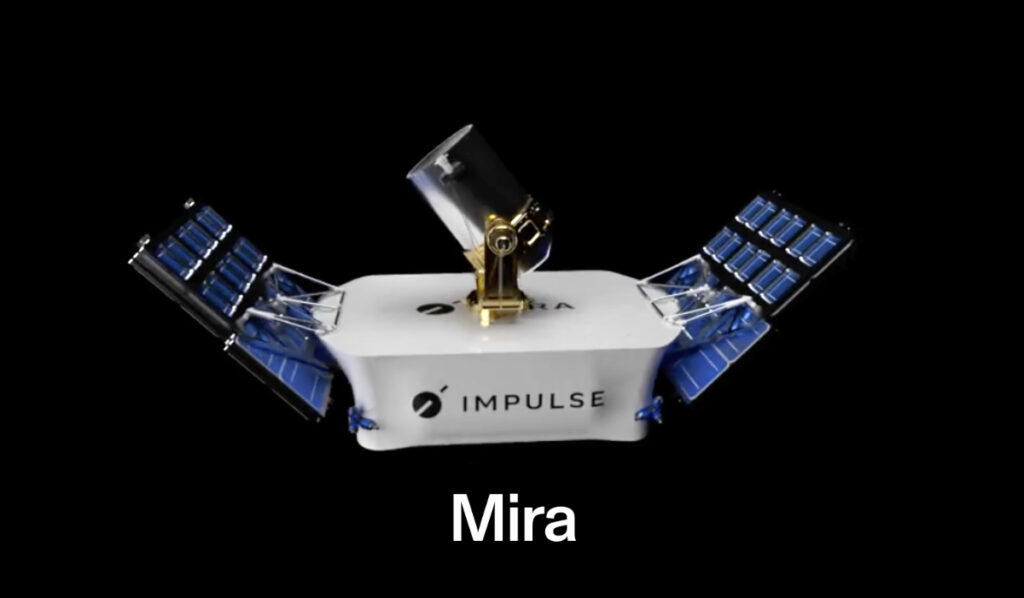
Impulse Space earlier this month upgraded Mira—the company’s high-thrust, highly maneuverable spacecraft for payload hosting and deployment that already has two successful missions.
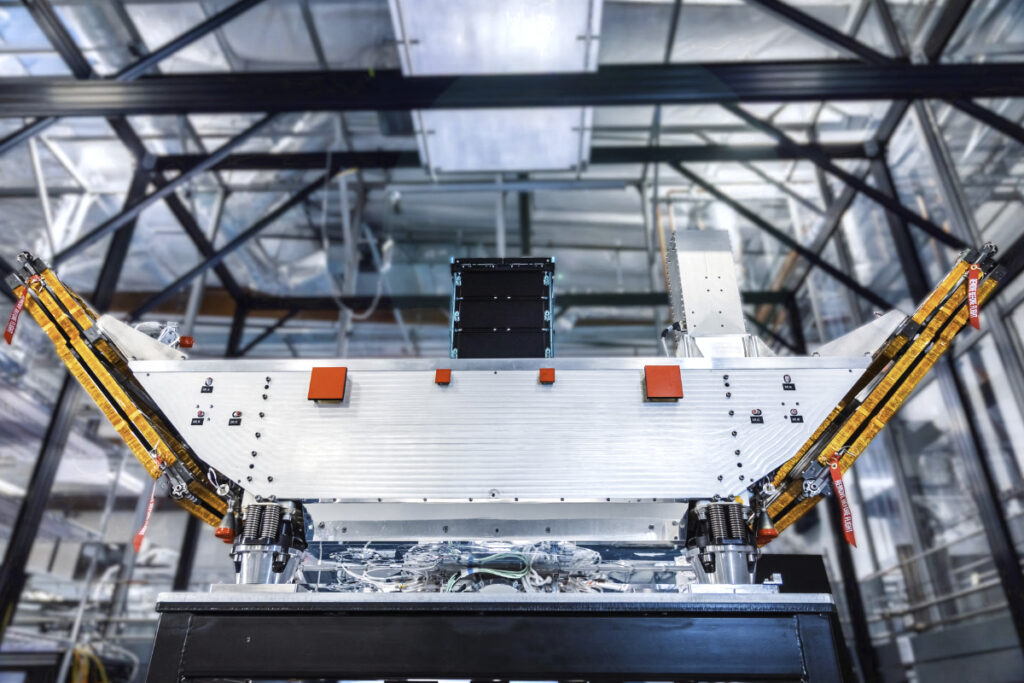
Mira has showcased responsive, record-setting maneuverability in Low Earth Orbit (LEO). The upgraded design delivers higher performance for even more challenging orbital regimes, including Medium Earth Orbit (MEO), Geostationary Orbit (GEO), cislunar space and beyond.
In addition to being optimized for higher energy orbits, the next-generation Mira vehicle provides increased delta-v, greater power for payloads, more payload capacity, and expanded autonomy to support diverse mission profiles. Its first flight, LEO Express 3, is fully manifested and scheduled to launch later this year.
Key Technical Enhancements
- Ready for GEO Missions—Mira now has enhanced radiation-tolerant avionics, upgraded radios and antennas, and onboard reaction wheels. These upgrades will support Mira’s operations in higher orbits, like MEO or GEO.
- More Power for Payloads—Instead of fixed solar arrays, the upgraded Mira now features deployable arrays that can also be articulated, to better track the sun. Payload hosting is a key use case for Mira, and with these changes, Mira offers customers more than double the power for their missions.
- More Delta-V—The Saiph thrusters that powered Mira’s record-setting burns in LEO have been upgraded from 5 lbf to 6 lbf. With eight thrusters per vehicle, that’s 20% more thrust. Additionally, the upgraded Mira can now carry more propellant; altogether, this amounts to a 25% increase in delta-v, with Mira capable of achieving 900 m/s of delta-v for a 100 kg payload.
- Upgraded Software Capabilities—Building on a legacy of autonomous space operations, Mira’s upgraded software stack pushes performance even further by supporting dynamic, software-defined mission reconfigurations directly on orbit. Mira’s software is designed to further increase its “hands-off” operations, bringing even more autonomous functionality to tasks like executing payload ops, maintaining station, and downlinking data.
- Cybersecure for Sensitive Missions – The design upgrade for Mira integrates NSA Type 1 cryptographic solutions to protect mission data and command links; Mira also complies with CNSSP-12 requirements to ensure end-to-end security for classified information.
- More Flexibility for Rideshare and Payloads—Mira’s form factor has been redesigned to provide customers with maximum flexibility for their payloads and missions. The new single bay design is compatible off-the-shelf with Helios and optimized to maximize customer payload volume for rideshare missions.
- Enhanced Pointing and Control—Mira now features four reaction wheels and four star trackers, all designed and built by Impulse. These upgrades enable even lower pointing error in any attitude, supporting precise maneuverability and complex operations for missions such as SDA and Earth observation.
The upgraded Mira will debut on LEO Express 3 later this year, where it is slated to perform several significant and rapid maneuvers. Additional upcoming missions include VICTUS SURGO and VICTUS SALO, where Mira’s mobility and precision will support tactically responsive space (TacRS) capabilities for the Department of Defense.
The upgraded Mira builds on a foundation of successful flight heritage, taking proven capabilities and expanding them through innovative new designs. Impulse’s team of expert engineers builds and tests the majority of systems in-house—from avionics to GNC to batteries.
As part of the design upgrade, Impulse will also increase the production rate for Mira vehicles. This will enable support for proliferated architectures and rapid replenishment requirements, among other use cases.
This upgraded Mira extends our core capabilities into higher orbits, with the same emphasis on responsiveness, maneuverability, and precision,” said Drew Damon, Vice President of Spacecraft Programs at Impulse Space. “We’ve now assembled and tested the first full vehicle, complete with customer payloads. We’re excited to put it in orbit later this year.”
To achieve a thriving space economy and reach a true space age, we need to dramatically improve in-space mobility from where it currently stands,” said Tom Mueller, founder and CEO of Impulse Space. “With its first two missions, Mira has already proven to be a strong step in the right direction, and we’re confident that this updated design will further accelerate opportunities across the commercial, civil, and defense sectors.”