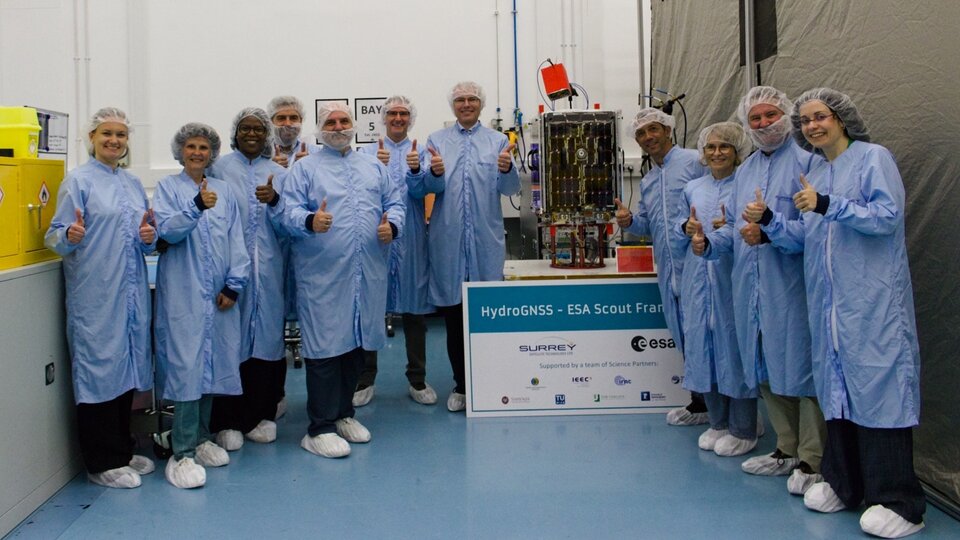
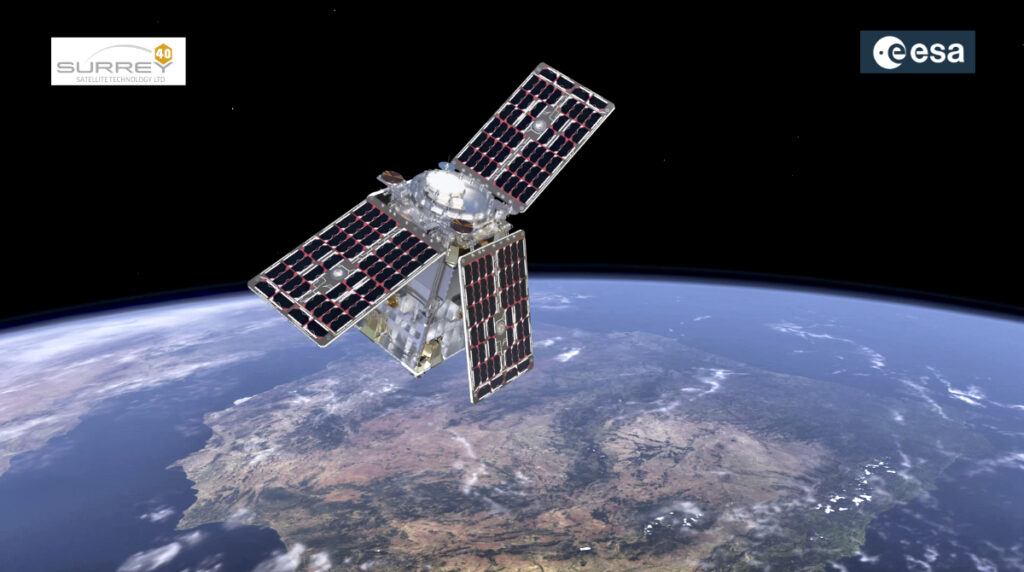
The European Space Agency’s (ESA’s) HydroGNSS mission, which will investigate the Earth’s water cycle, has landed in California and is ready to start preparations for launch.
Changes in the global water cycle pose a threat to our environment and to communities around the world. HydroGNSS, part of ESA’s FutureEO program, delivers observations on four hydrological parameters that are Essential Climate Variables (ECVs) or closely related to ECVs:
- soil moisture
- inundation or wetlands
- freeze/thaw state
- above-ground biomass

ECVs, which are defined by the global climate observing system (GCOS), measure physical, chemical, or biological characteristics that provide empirical evidence to assess climate risks. These parameters are used in many applications and areas of science: from weather forecasting and flood prediction, to understanding wetlands, as well as data on permafrost and forest carbon stocks. HydroGNSS will also measure wind speed over the ocean and sea-ice extent as secondary products.
By providing valuable data on the Earth’s water cycle, HydroGNSS will ensure there are no data gaps when missions such as ESA’s SMOS and NASA’s SMAP come to an end.
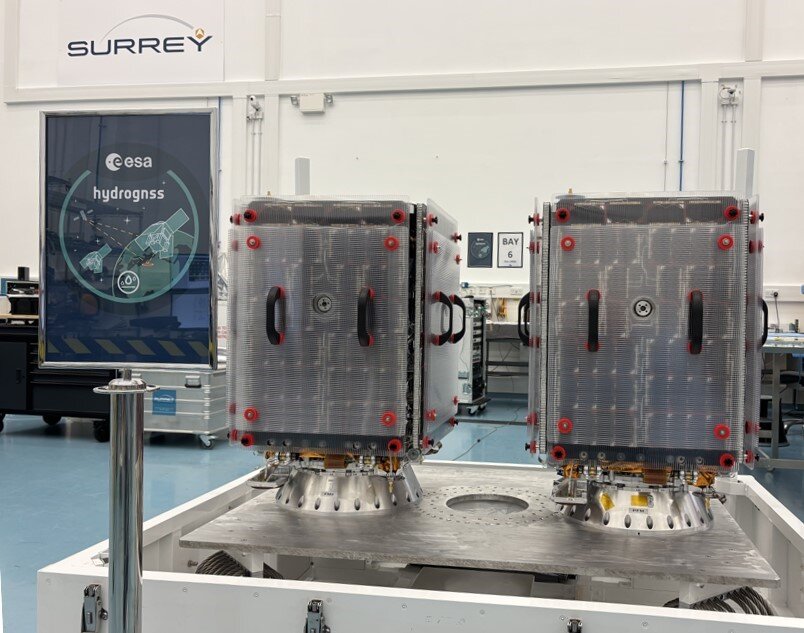
The mission will provide measurements on these water-related indicators using a technique called Global Navigation Satellite System (GNSS) reflectometry.
This technique involves the signals from systems such as Galileo and GPS, which are part of the GNSS. These navigation satellites work by continually transmitting low-power L-band microwave navigation signals toward Earth. Their primary purpose is to provide global positioning, navigation, and timing services, such as the navigation systems in cars and mobile devices.
However, when the GNSS signal reflects off Earth’s surface, it is altered by the physical properties of terrain, ice, oceans or vegetation. The HydroGNSS mission obtains scientific data on the Earth’s water cycle by comparing this altered signal with the direct signals from the GNSS satellites.
The mission consists of two microsatellites, both of which carry a GNSS reflectometry instrument in an orbit of 500-600 km, 180 degrees apart.
ESA’s Scout Project Manager, Jean-Pascal Lejault, explained that the technique of GNSS-reflectometry may be the only future affordable and sustainable means of taking global soil moisture measurements at a resolution of better than 25 km. “The hope is that HydroGNSS will pave the way for this type of mission for the future.”
Jean-Pascal added, “For now we are extremely excited to see the satellite arrive in California. I would like to thank our colleagues at Surrey Satellite Technology for their expertise and dedication in developing HydroGNSS and delivering the satellites ready for launch preparations.”
HydroGNSS has been developed by Surrey Satellite Technology Ltd (SSTL) for ESA’s Scout framework, part of the agency’s FutureEO program. The potential of GNSS reflectometry for land sensing was demonstrated by two missions: TechDemoSAT-1 (an ESA and UK Space Agency mission) and the CYGNSS constellation (a NASA mission). SSTL was also involved in both demonstration missions.
This new family of small ‘Scout’ satellites are developed within short timeframes and deliver science data, either by miniaturizing existing space technologies or by demonstrating new observing techniques.
HydroGNSS is the first of three Scout missions, which pave the way to innovative science in a quick and adaptable way, complementing ESA’s Earth Explorer research missions.
Launch is expected later this year on a SpaceX Falcon 9 rocket.