
• Skip to main content
  • Skip to primary sidebar
  • Home
  • News
  • Featured
  • More News ⌄
    • SatNews
    • SatMagazine
    • MilSatMagazine
  • Events ⌄
    • MilSat Symposium
    • SmallSat Symposium
    • Satellite Innovation
  • Contacts
  • SUBSCRIPTION

SmallSat News

You are here: Home / News / UC Davis + Proteus Space to launch 1st dynamic digital twin into space

UC Davis + Proteus Space to launch 1st dynamic digital twin into space

October 28, 2025 by editorial

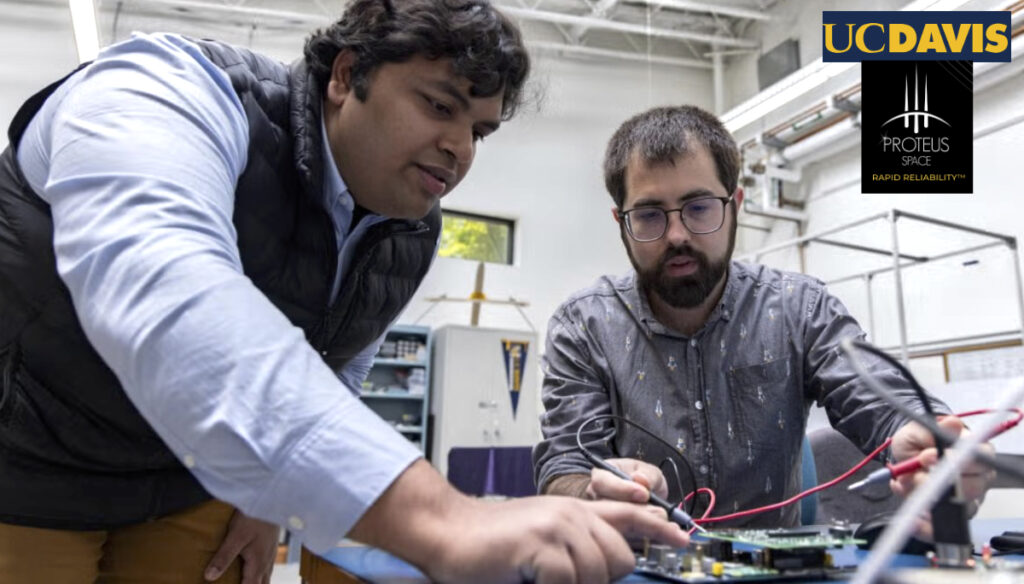
UC Davis graduate students Ayush Patnaik (left) and Adam Zufall (right) working on a payload that will travel into space this fall. The payload is a digital twin that will use AI software to measure the activity and predict the future state of the battery. Developed at the UC Davis Center for Space Exploration Research, it is a step towards fully autonomous spacecraft. The project is in collaboration with a company, Proteus Space. (Mario Rodriguez/UC Davis)
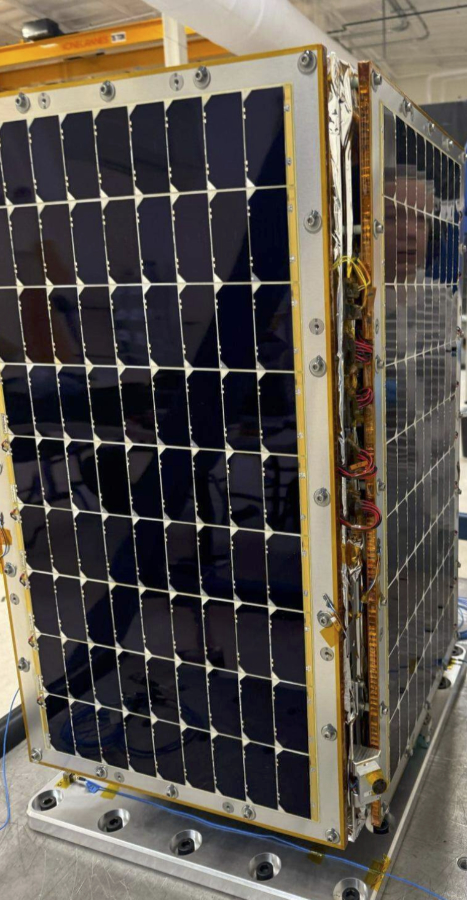
Photo of the smallsat is courtesy of The Sacramento Bee

The Center for Space Exploration Research at the University of California, Davis, has partnered with Proteus Space to launch a U.S. government-sponsored satellite into space with a custom, AI-enabled payload in a brand-new, first-ever, rapid design-to-deployment small satellite.

The team will launch the satellite and payload in October of 2025 from Vandenberg, California. From the time the project was fully approved, the design and launch will occur within 13 months.

The UC Davis-designed payload was developed by Professor of Mechanical and Aerospace Engineering Stephen Robinson’s Human/Robotics/Vehicle Integration and Performance Laboratory, or HRVIP Lab.

Dr. Robinson

This is a dynamic digital twin that models the current condition and predicts the future condition of the spacecraft’s power system. The novel aspect of this payload is that the system-state model is running in real time onboard the spacecraft, instead of in ground-based mission control.

The satellite, which includes multiple commercial and research payloads, will monitor its own health in space using sensors that assess voltage and measurements of the batteries it is running on. The digital twin software will continually analyze the health and charge capacity of the battery. Using artificial intelligence, the digital twin will be aware of its own state and learn to predict its future state.

Xinfan Lin

In addition to the team at Proteus, Zufall and Robinson are working with Associate Professor of Mechanical and Aerospace Engineering Xinfan Lin, whose research specializes in intelligent battery management systems. The team also includes mechanical and aerospace engineering Ph.D. students Jackson Fogelquist and Ayush Patnaik, and Ansha Prashanth, a master’s student in computer science.

The satellite will settle into LEO and operate for up to 12 months. After three years, the satellite will naturally fall back to Earth, burning up in the atmosphere.

The spacecraft itself can let us know how it’s doing, which is all done by humans now,” said Adam Zufall, a graduate student in the HRVIP Lab who is overseeing the UC Davis side of the project.

It should get smarter as it goes,” said Robinson, “and be able to predict how it’s going to perform in the near future. Current satellites do not have this capability.”

Story by by Jessica Heath, UC David

Filed Under: News

Primary Sidebar

WEEKLY NEWSLETTER

Archives

  • November 2025
  • October 2025
  • September 2025
  • August 2025
  • July 2025
  • June 2025
  • May 2025
  • April 2025
  • March 2025
  • February 2025
  • January 2025
  • December 2024
  • November 2024
  • October 2024
  • September 2024
  • August 2024
  • July 2024
  • June 2024
  • May 2024
  • April 2024
  • March 2024
  • February 2024
  • January 2024
  • December 2023
  • November 2023
  • October 2023
  • September 2023
  • August 2023
  • July 2023
  • June 2023
  • May 2023
  • April 2023
  • March 2023
  • February 2023
  • January 2023
  • December 2022
  • November 2022
  • October 2022
  • September 2022
  • August 2022
  • July 2022
  • June 2022
  • May 2022
  • April 2022
  • March 2022
  • February 2022
  • January 2022
  • December 2021
  • November 2021
  • October 2021
  • September 2021
  • August 2021
  • July 2021
  • June 2021
  • May 2021
  • April 2021
  • March 2021
  • February 2021
  • January 2021
  • December 2020
  • November 2020
  • October 2020
  • September 2020
  • August 2020
  • July 2020
  • June 2020
  • May 2020
  • April 2020
  • March 2020
  • February 2020
  • January 2020
  • December 2019
  • November 2019
  • October 2019

© 2019–2025 SatNews

Insert/edit link

Enter the destination URL

Or link to existing content

    No search term specified. Showing recent items. Search or use up and down arrow keys to select an item.
      x
      Sign Up Now!

      Enjoy a free weekly newsletter with recent headlines from the global SmallSat industry.

      Invalid email address
      We promise not to spam you. You can unsubscribe at any time.
      Thanks for subscribing! You will now receive weekly SmallSat News updates.
      We love our advertisers.
      And you will too!

      Please disable Ad Blocker to continue... We promise to keep it unobtrusive.
      We promise not to spam you. You can unsubscribe at any time.
      Invalid email address
      Thanks for subscribing! Please check your email for further instructions.