
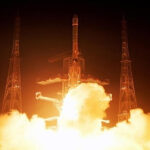
SpaceX successfully initiated its 2026 flight manifest with the deployment of 29 Starlink satellites, marking a rapid start to a year defined by high-cadence orbital operations.

This mission, launched from Space Launch Complex 40 at Cape Canaveral Space Force Station, serves as a technical precursor to a significant week in the launch sector. While SpaceX continues the internal expansion of its low-Earth orbit constellation, the company is also preparing for a collaborative rideshare window that aligns with the upcoming Indian Space Research Organisation (ISRO) mission scheduled for Monday, Jan. 12.
The upcoming ISRO mission, designated PSLV-C62, will carry the EOS-N1 Earth observation satellite alongside 18 secondary payloads from the Satish Dhawan Space Centre. This flight follows a period of organizational transition for the Indian agency, now led by Chairman V. Narayanan, who assumed the role in early 2025 to oversee the expansion of India’s commercial launch services. The PSLV-C62 mission is notable for its use of the PS4 fourth stage as an orbital platform, which will host the Kestrel Initial Demonstrator capsule, a technology developed in partnership with Spanish startup Orbital Paradigm.
Historical Context of SmallSat Rideshare Growth
SpaceX and ISRO have increasingly found common ground in the Sun-Synchronous Orbit (SSO) market, where the demand for precise Earth observation windows has created a backlog of smallsat customers. To address this, SpaceX has maintained its Transporter series, most recently highlighted by the success of Transporter-12 in early 2025, which deployed 131 payloads.
The current coordination between these two entities illustrates a shift toward a globalized rideshare infrastructure where commercial customers can choose between the high-volume capacity of the Falcon 9 and the cost-effective, dedicated orbit-insertion capabilities of the Polar Satellite Launch Vehicle (PSLV).
Technical Specifications for SSO Missions
The technical advantages of SSO remain the primary driver for these concurrent missions. By placing satellites in an orbit where they pass over any given point of the Earth’s surface at the same local solar time, operators of Earth observation and meteorological constellations can maintain consistent lighting conditions for imagery and data collection.
The Starlink satellites launched on Jan. 4 utilize this orbital characteristic to optimize their laser cross-link efficiency, ensuring that the network maintains high throughput even as the constellation grows toward its second-generation capacity of over 9,000 active units.
Rationale Behind Strategic Cooperation
Strategic competition and cooperation in the launch sector have intensified as ISRO moves to privatize its Small Satellite Launch Vehicle (SSLV) and PSLV production lines. This effort to increase launch frequency is a direct response to the “Musk Stack” model, where SpaceX dominates the vertical integration of launch and satellite manufacturing. Under the management of President Gwynne Shotwell,
SpaceX has leveraged its reusable booster technology to lower the price floor for SSO access, forcing international competitors to innovate in both propulsion and payload integration. The ISRO PSLV-C62 mission serves as a counterpoint, offering a proven, reliable track record that dates back to historic successes like the PSLV-C58 mission, which demonstrated India’s ability to support complex scientific payloads alongside commercial rideshares.
Looking forward to the remainder of January 2026, the industry anticipates a sustained surge in activity. Following the Jan. 12 ISRO launch, SpaceX is expected to conduct two additional Falcon 9 missions within the same seven-day window, further populating the Starlink v2-mini shells. These operations are critical for maintaining the bandwidth requirements of global defense and civil contracts. As both agencies refine their rideshare protocols, the availability of frequent, predictable access to SSO is expected to reduce the time-to-orbit for emerging space startups in the Asian and North American markets.