


HERNDON, Va. — On Thursday, January 15, 2026, TrustPoint announced the first successful demonstration of its Low Earth Orbit Navigation System (LEONS), transmitting time-transfer and tracking signals from a compact ground node to an orbiting spacecraft.
This milestone marks a significant step in the company’s mission to provide a commercial, GPS-independent positioning, navigation, and timing (PNT) capability for satellite operators.
Ground-to-Space Validation via SpaceWERX
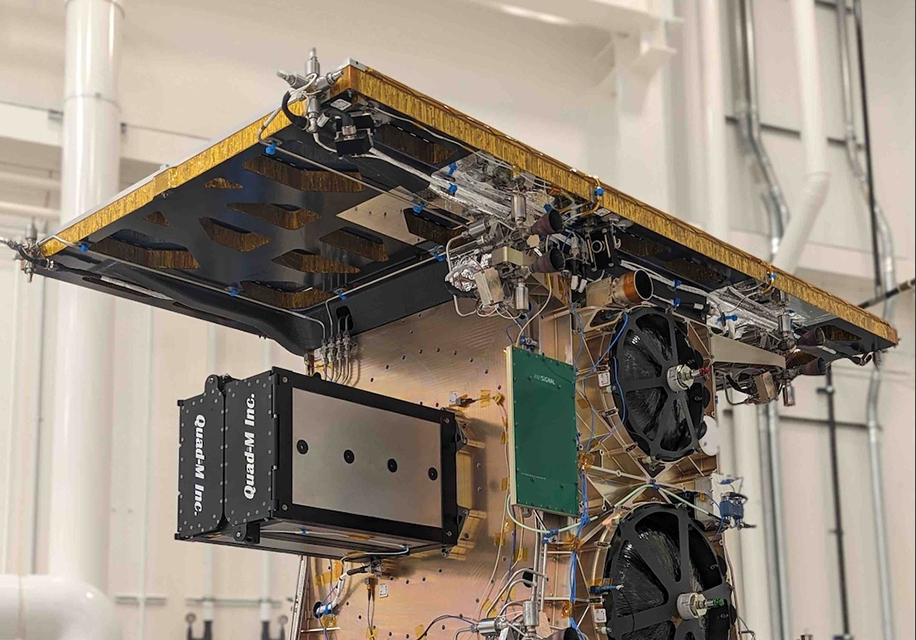
The demonstration was conducted as part of the SpaceWERX AltPNT Challenge, a program designed to rapidly field resilient alternatives to legacy Global Navigation Satellite Systems (GNSS). TrustPoint was previously awarded two Direct-to-Phase II contracts by SpaceWERX to accelerate the transition of its C-band LEO architecture from concept to operational deployment. The successful signal transmission validates the “LEONS” ground infrastructure, which is designed to be a rapidly deployable and scalable solution for global PNT coverage.
Addressing Orbital Vulnerabilities
Most Low Earth Orbit (LEO) spacecraft currently rely on GPS or other Medium Earth Orbit (MEO) signals for orbital state and timing data. However, the increasing prevalence of jamming and electronic interference in LEO has created a critical vulnerability, often degrading or completely denying these essential links. TrustPoint’s architecture aims to eliminate this single point of failure by providing an independent, high-performance PNT layer that remains operational in contested environments. This development follows the company’s successful launch and contact with its third satellite in 2023, which served as the primary testbed for these core technologies.
Leadership on Resilient Capabilities
“With the pace of modern threats accelerating, the difference between concepts and capabilities matters,” said Nicole Hilliard, Director of Government Programs at TrustPoint. “This milestone demonstrates that commercial partners can field resilient, GPS-independent PNT capabilities that strengthen national security architectures and justify continued investment in companies that deliver.”
Commercial and Defense Implications
The transition to a GPS-independent architecture is a priority for the U.S. Space Force as it seeks to operationalize the “Proliferated Warfighter” concept. TrustPoint’s C-band service is designed to provide secure, high-precision timing that is less susceptible to the vulnerabilities of heritage L-band signals. Beyond defense applications, the technology is targeted at the emerging autonomous navigation and smart infrastructure markets, where sub-meter precision and high availability are mandatory requirements.
Scaling Toward a 300-Satellite Constellation
Following this successful ground-to-space transmission, TrustPoint plans to scale its LEONS infrastructure to support other LEO operators seeking resilient timing. The company is currently moving out of its internal R&D phase and into broader operational testing with both government and commercial partners. Long-term, TrustPoint aims to deploy a constellation of approximately 300 spacecraft to provide global, commercial GPS-equivalent services with improved security and lower latency.