
• Skip to main content
  • Skip to primary sidebar
  • Home
  • News
  • Featured
  • More News ⌄
    • SatNews
    • SatMagazine
    • MilSatMagazine
  • Events ⌄
    • MilSat Symposium
    • SmallSat Symposium
    • Satellite Innovation
  • Contacts
  • SUBSCRIPTION

SmallSat News

You are here: Home / Archives for Featured

Featured

Marlink delivers secure digital enablement for Alpha Adriatic with upgrade to Sealink NextGen

February 20, 2025 by editorial

Marlink will upgrade the hybrid network onboard the fleet of Alpha Adriatic, including cutting edge cyber security tools.

Alpha Adriatic will benefit from Sealink NextGen’s combination of VSAT and LEO internet, together with robust back-up and Marlink’s Advanced Threat Detection, Unified Threat Management and Endpoint Detection cyber tools.

Marlink will once again leverage its experience as a managed services provider to upgrade the hybrid network solution onboard, integrating Starlink to enhance options available for business applications and improving connectivity available to crews.

The solution provides Alpha Adriatic with several benefits, including:

  • High bandwidth, low latency communications via Sealink NextGen to support smarter, digitalised fleet operations
  • Enhanced cyber security to provide compliance with industry certification standards and reflect tighter regulation for vessel operators
  • Hybrid solution offers improved uptime and reliability with secure communications and data transfer

Headquartered in Pula, Croatia, and listed on the Zagreb Stock Exchange, Alpha Adriatic operates in the dry bulk and tanker sectors, offering full ship management services to third parties. The Group holds ownership interests in one oil/chemical tanker and three bulk carriers, while also providing third-party ship management services for an additional bulk carrier and three oil/chemical tankers.

Alpha Adriatic is committed to being a modern and innovative company, focused on the high-quality growth of its fleet and the enhancement of services provided to our partners and clients. We rely on the extensive knowledge, experience, and adaptability of our teams both onboard and ashore to ensure safe, efficient, and sustainable operations.Vojko Braut, Technical Director at Alpha Adriatic. 

Marlink added to its cyber capabilities in 2024 with the acquisition of Croatia’s Diverto and then Port-IT, to enhance the breadth of cyber solutions available to remote maritime users. By combining this expertise with a hybrid network solution we can deliver smarter vessel operations to Alpha Adriatic.Tore Morten Olsen, President, Maritime, Marlink.

About Marlink
For companies operating in the world’s most challenging environments – from merchant vessels to offshore and onshore energy operations, from humanitarian organisations to cruise ships and superyachts – Marlink creates and delivers possibilities, anywhere. Marlink is a managed service provider and global leader in remote ICT solutions with annual revenues surpassing $800 million and 1,500 employees operating in more than 30 countries. Wherever our customers are in the world, we deliver them possibilities to work smarter and to operate more effectively, more safely, more sustainably – without the limitations of technology. With our possibility platform, we enable a comprehensive suite of end-to-end managed solutions (Connectivity, Network, Cyber Security, Cloud & IT, IoT & Apps), supported by professional services, unmatched global operations and delivery capabilities and local support teams.

Filed Under: Featured, News

SuperSharp + NanoAvionics to partner on a disruptive Thermal InfraRed (TIR) imaging satellite

February 18, 2025 by editorial

NanoAvionics will also supply an additional two MP42 microsatellite platforms for Satlantis’s new generation
sub-meter resolution Earth Observation satellites.

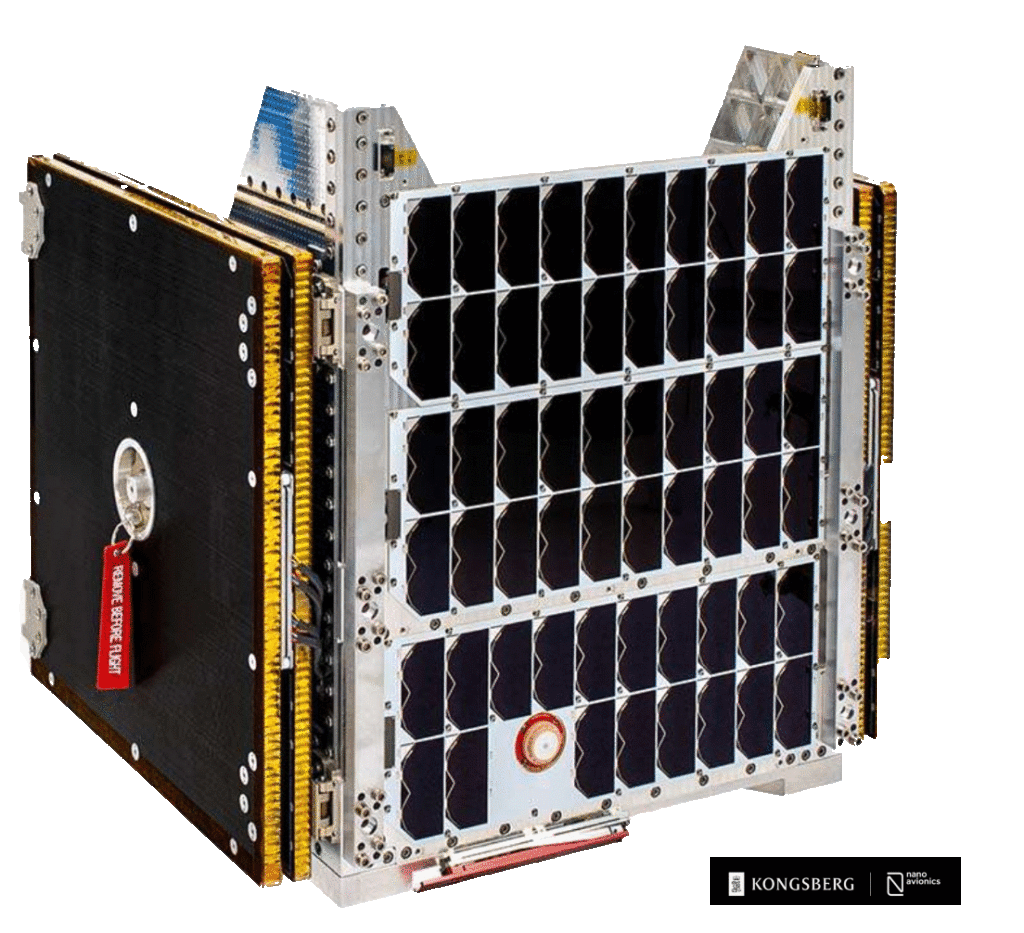
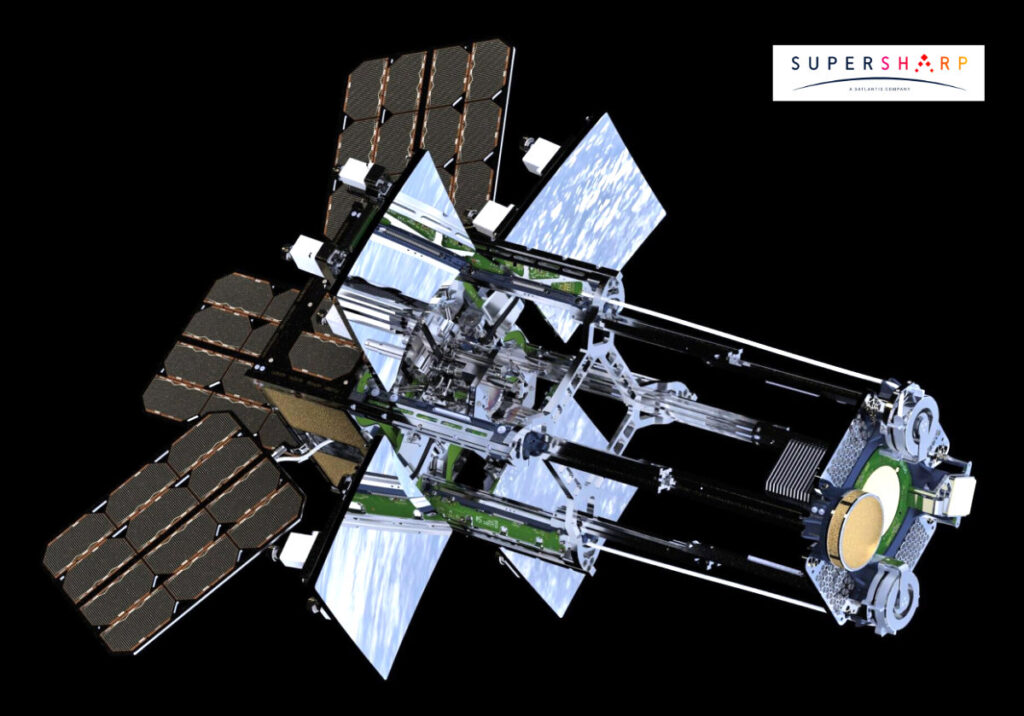
SuperSharp, part of the Satlantis group, has selected Kongsberg NanoAvionics’s (NanoAvionics) MP42 microsatellite platform for a first-of-its-kind, Thermal InfraRed (TIR) mission called Blue Moon.

The mission will embark SuperSharp’s flagship instrument HIBISCUS, an 80 kg payload, onboard NanoAvionics’ flight-proven MP42 satellite bus. The launch is scheduled for the second half of 2026 onboard a SpaceX’s Transporter rideshare service.

The capabilities of Blue Moon will extend beyond that of conventional EO satellites as the instrument is designed to acquire images day and night.

The disruption of SuperSharps‘ innovation, however, lies in its proprietary unfolding payload technology, capable of delivering 4x higher resolution per unit cost. 

HIBISCUS can capture Long-Wave InfraRed (LWIR) imagery at a spatial resolution of three meters. The data generated by this category-defining satellite will support applications in the field of climate resilience, such as urban heat monitoring, as well as those in the domain of national security. It aims also to enable new applications in these fields. 

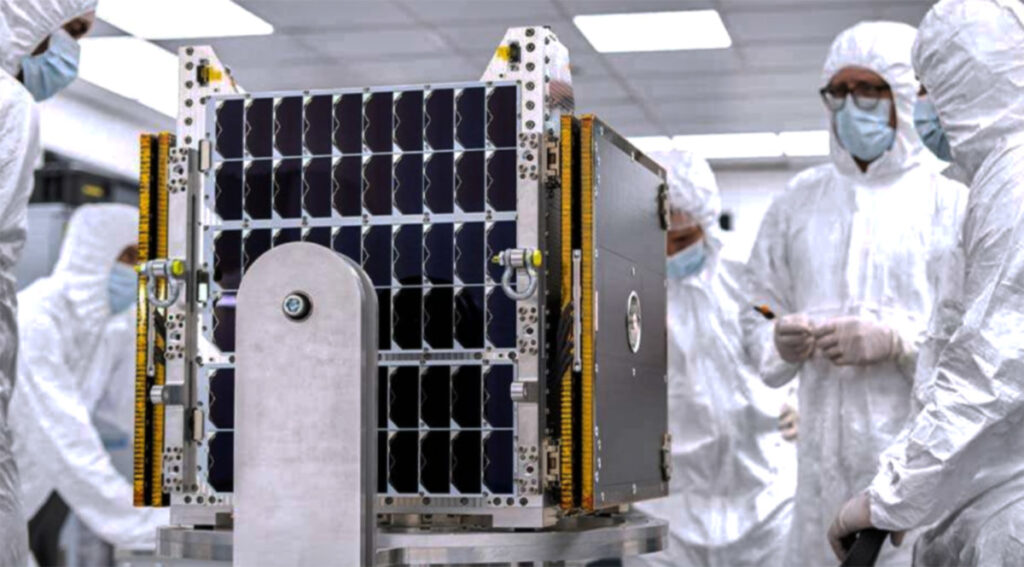
Engineers at Kongsberg NanoAvionics engaged in satellite assembly, photo courtesy of the company.

In parallel to this agreement, NanoAvionics will also supply an additional two MP42 microsatellite platforms to Satlantis for its new generation of sub-meter resolution Earth Observation satellites.

Powered by a team of more than 30 engineers SuperSharp is a University of Cambridge spin-out founded in 2017 and part of the Satlantis group since 2023. The company specializes in the design and manufacture of very high-resolution Thermal InfraRed (TIR) imaging satellites. 

The company’s first satellite mission will be carried out in partnership with small satellite manufacturer NanoAvionics, subsidiary of the Kongsberg group.

Marco Gomez-Jenkins, co-founder and CEO of SuperSharp, said, “We are delighted to partner with NanoAvionics on this mission to unlock the value of ultra-high resolution thermal imaging from space. The combination of our HIBISCUS telescope and their MP42 satellite platform will enable new applications in this domain, from climate change mitigation to security and defence. This mission would not be possible without the ongoing support of institutional actors, in particular the UK Space Agency.”

Atle Wøllo, CEO of Kongsberg NanoAvionics, said, “Satlantis has been one of our earliest commercial Earth observation customers, and we’re excited to build on the legacy of the first three nanosatellites we launched with them. These three new missions highlight how NanoAvionics evolves alongside our customers and their growing needs. By helping SuperSharp and Satlantis deliver industry-leading 3-meter thermal imaging and submeter visible to near-infrared capabilities, we’re setting a new benchmark for our standard MP42 microsatellite platform, supporting larger, more advanced payloads than ever before.” 

Juan Tomas Hernani, co-founder and CEO of Satlantis, said, “The race to space is more and more about partnerships. The breakthrough offered by SuperSharp with its 3 m resolution in TIR in a joint mission with NanoAvionics makes us very proud to lead the global strategy for this. It also gives us an opportunity to fuse TIR as an extended channel into our next missions.”

Filed Under: Featured, News

Trans Lunar Injection completed by Firefly Aerospace’s Blue Ghost + imagery captures

February 13, 2025 by editorial

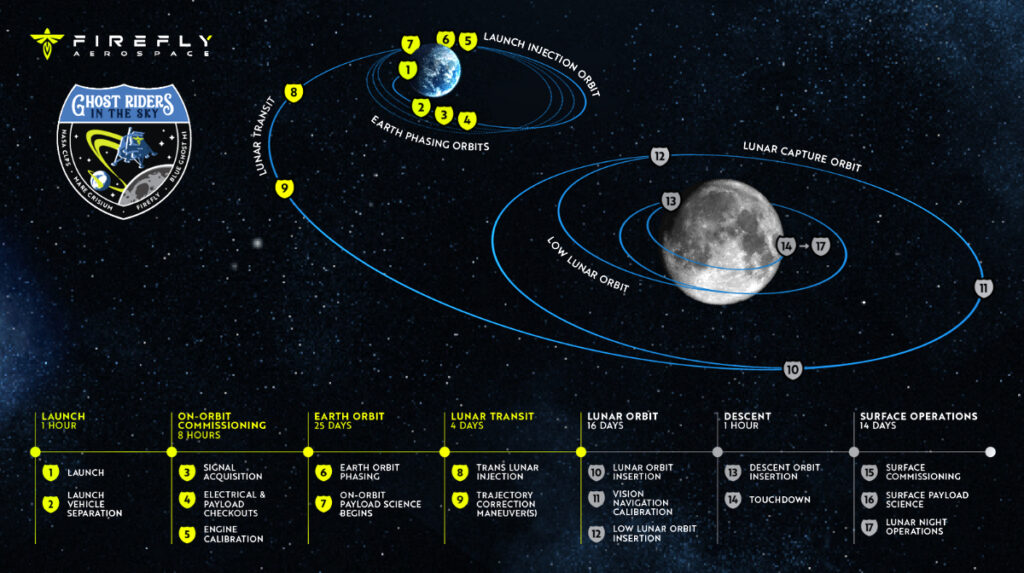
Firefly Aerospace is now four weeks into their first mission to the Moon—Blue Ghost recently completed its Trans Lunar Injection (TLI) to escape Earth’s orbit and is now in transit to the Moon.

Shortly after TLI, Blue Ghost captured two new incredible shots—one of Earth with the Moon in the distance and one of Earth reflecting off the Blue Ghost’s solar panel with the Moon on the horizon. These images can be found on Firefly’s Live Blog and follow along for regular mission updates.   

Shortly after Trans Lunar Injection, Firefly’s Blue Ghost lunar lander captured image of Earth with the Moon below in the distance. Credit: Firefly Aerospace

Next Steps…

  • Transit: Within the next two days, Blue Ghost will perform a Lunar Orbit Insertion, a 4-minute burn to enter the Moon’s orbit and will then spend 16 days in lunar orbit before descent. This gives us plenty of time to calibrate our navigation system and continue payload science operations for NASA.
  • Descent: Blue Ghost’s final autonomous descent will take approximately an hour, starting with a Descent Orbit Insertion burn that will place Blue Ghost on its descent trajectory on March 2. 
  • Surface Operations: Upon touchdown, Blue Ghost will operate 10 NASA instruments for a complete lunar day (about 14 Earth days).
  • Total Eclipse: On March 14, Blue Ghost will capture HD imagery of a total eclipse from the Moon where the Earth blocks the sun.
  • Lunar Night: Blue Ghost will then capture the lunar sunset on March 16 before operating several hours into the lunar night.
Firefly’s Blue Ghost lander captures image of Earth reflecting off the solar panel with the Moon on the horizon above Earth. Firefly’s X-band antenna and NASA’s LEXI payload are also shown on the top deck of the lander. Credit: Firefly Aerospace

Filed Under: Featured, News

NASA awards launch service task order for the Pandora mission  

February 10, 2025 by editorial

NASA has selected SpaceX of Starbase, Texas, to provide the launch service for the agency’s Pandora mission, which will study at least 20 known exoplanets and their host stars to find out how changes in stars affect our observations of exoplanet atmospheres.

The selection is part of NASA’s Venture-Class Acquisition of Dedicated and Rideshare (VADR) launch services contract. This contract allows the agency to make fixed-price indefinite-delivery/indefinite-quantity awards during VADR’s five-year ordering period, with a maximum total value of $300 million across all contracts.

During its one-year primary mission, Pandora will observe each exoplanet 10 times, observing for 24 hours each visit. It will capture critical data about the planet and its host star during transits, an event where a planet crosses in front of the star it orbits.

The satellite will use an innovative 17-inch (45-centimeter)-wide all-aluminum telescope to simultaneously measure the visible and near-infrared brightness of the host star and obtain near-infrared spectra of the transiting planet. This will allow scientists to cleanly separate star and planetary signals, knowledge that will enhance observations from NASA’s James Webb Space Telescope and future missions searching for habitable worlds, like the agency’s Habitable Worlds Observatory.

Pandora is a joint effort between NASA’s Goddard Space Flight Center in Greenbelt, Maryland, and Lawrence Livermore National Laboratory in California. The Astrophysics Pioneers program, from the Astrophysics Division at NASA Headquarters in Washington, funds Pandora and other astrophysics science missions using smaller, lower cost hardware and payloads. NASA’s Launch Services Program, based at the agency’s Kennedy Space Center in Florida, manages the VADR contract.

Filed Under: Featured, News

SmallSats: “Sell better, and sell the right thing”

February 4, 2025 by editorial

By Chris Forrester

The 2025 SmallSat Symposium opened on February 4 with a session which looked at the Risks, Realities and Regulations which shape the SmallSat market. Moderated by Janna Lewis (SVP/Policy & General Counsel, Astroscale US) the panel of acknowledged experts examined the challenges and agreed that a core truth was that the industry had to constantly navigate the challenges which inevitably could directly affect a business. She explained that it was generally accepted that the sector was enjoying a 30% CAGR. 

Dr. Abhishek Tripathi, Director of Mission Operations, UC Berkeley, Space Sciences Lab., agreed that growth would continue and that the new Trump administration would be favourable although the risks were that the product market fit – and their product fit – was key. “Are there cheaper large sats coming onto the market, and this is a risk”. 

Robert Cleave, COO, Neo Space Group, agreed with the sector’s prospects. But he cautioned that almost every proposal once suggested ended up by changing the parameters of their intentions.  He said he believed that space was a unifier, and keen to share risk. He said the Kingdom of Saudi Arabia, where he was based, was very much looking at the sharing of risk to ensure a success to its investment plans. 

Drew Svor, partner with Sheppard Mullin, suggested that the risks, whether commercial or technical, or regulatory and geo-political meant that players had to be very flexible, and be aware of those risks and challenges. He said that the new Trump administration would need some time to make their demands known. He warned that SmallSat manufacturers needed to be aware of Cyber security demands. He also hoped that some of the current congestion in some of the frequency bands needed to be addressed although was hopeful that regulators were aware of this congestion and the need to solve the problems. He also forecast the new administration would be open to foreign cash coming in. 

Stewart Marsh, Head of Aerospace, Cambridge Consultants, explained that risks came down to choices and trade-offs. There are manufacturers out there who know their business very well, but SmallSat operators had to be aware that changing the model, for any reason, meant risk and knowing how to mitigate those risks was crucial. Mr Marsh also said that standards-based developments, such as Direct-To-Device services, were extremely important and frequently a partner would be needed to help with the adjacent opportunities. This included AI in networks, and the AI problems were a greater magnitude of challenge in space but AI could definitely help in spectrum, for example. 

Sita Sonty, Partner & MD, Alix Partners, and very interested in the investment opportunities. She argued that the cynic in her saw technical mitigation being less important. “I am not at all sure that the SmallSat market must look closely at commercial conversion. They must sell better – and sell the right thing, and listen more to what the market wants. People also need to talk to the government more, and in particular what it wants in space.”  She also stressed that AI had to be recognised as likely to have a growing importance. 

Dr. Tripathi said he felt that government, based on previous experience, was often fragmented in its procurement. The military and NASA wanted dedicated bespoke satellites, “but in our sector our SmallSat developers cannot put all their efforts into one satellite version. There are solutions, and a commercial company can then supply a more flexible architecture and make some money.”

Filed Under: Featured, News

Rocket Lab to launch global wildfire detection and monitoring mission for OroraTech

January 23, 2025 by editorial

Rocket Lab USA, Inc. (Nasdaq: RKLB) has signed a contract for a responsive launch on Electron with Orora Technologies (OroraTech), a German company developing a satellite constellation to monitor wildfires and alert first responders to danger. 

Launching from Rocket Lab Launch Complex 1 in New Zealand, the dedicated mission on Electron will deploy eight satellites to a 550 km orbit within just four months from launch contract signing, enabling OroraTech to meet the season-sensitive requirements of its wildfire detection mission. The rapid turnaround is just the latest demonstration of Rocket Lab’s responsive launch capabilities for satellite operators needing urgent access to space.

View of Rocket Lab’s Launch Complex 1

OroraTech is developing a constellation of satellites with thermal infrared cameras that can provide 24/7 monitoring of wildfires globally, supporting better and faster wildfire response to protect forests, people, and infrastructure worldwide. The mission will deploy its latest plane of satellites called OTC-P1 to their current constellation, further expanding OroraTech’s capabilities to first responders, governments, and industry partners. The company will expand their constellation with up to 100 satellites in total by 2028. 

Rocket Lab founder and CEO, Sir Peter Beck, said: “This launch is a showcase of all the benefits of flying dedicated on Electron: control over schedule, agility and ability to meet tight deadlines and mission requirements, and the reliability of launching on the world’s most frequently launched small orbital rocket. Knowing that time is of the essence to get these satellites in space, we’re proud to be rising to the challenge and supporting the OroraTech mission to better monitor for and protect against these devastating natural disasters globally.” 

The mission is the latest launch to be announced in a packed 2025 launch manifest for Rocket Lab that includes the continuation of multi-launch contracts with constellation operators Synspective, Kineis, and BlackSky; a responsive space mission for the U.S. Space Force that will see Rocket Lab build a spacecraft, then launch it on Electron with 24-hours’ notice; and the debut launch of Rocket Lab’s new medium-lift reusable rocket, Neutron.


Filed Under: Featured, News

Exolaunch delivers 34 satellites to orbit during the Transporter-12 Rideshare Mission with SpaceX

January 17, 2025 by editorial

Exolaunch successfully delivered 34 satellites for its global customers across 17 countries.
Artistic rendition of the smallsats on-orbit is courtesy of SpaceX.

Exolaunch has successfully delivered 34 satellites into orbit during the Transporter-12 rideshare mission with SpaceX which launched from Vandenberg Space Force Base in California on January 14, 2025 at 11:09 am PT.

This event marks Exolaunch’s first launch of 2025 and the company’s 32nd mission overall, continuing the company’s track record of providing reliable and precise satellite integration and deployment services.

Exolaunch’s satellites on the mission included 20 cubesats and 14 microsats for its customers across 17 countries. These satellites represent a wide range of missions, including Earth observation, climate monitoring, connectivity, and scientific research.

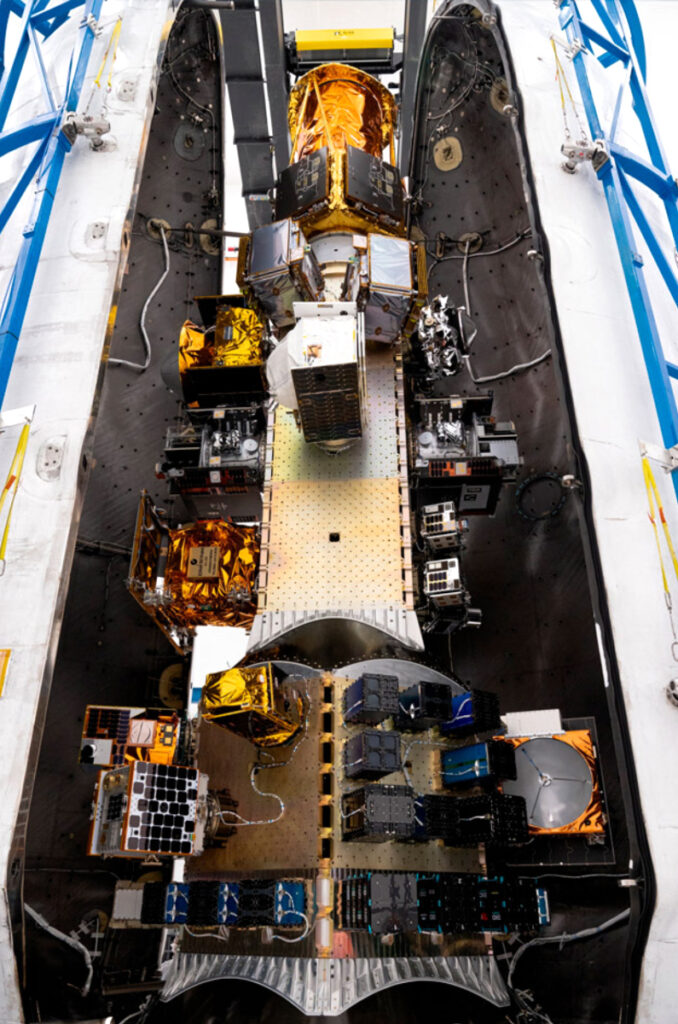
Using its flight-proven CarboNIX separation rings and EXOpod Nova deployers, Exolaunch successfully deployed over 1,500 kg of satellite mass into orbit, each on a mission to improve life on Earth. Additionally, multiple other deployments are planned in the weeks following launch.

Photo is courtesy of SpaceX

“Our first mission of 2025 sets the stage for another active year at Exolaunch,” said Jeanne Allarie, chief commercial officer at Exolaunch.

“Transporter-12 is a testament to the trust our customers place in us and the strength of our partnership with SpaceX. We are proud to support the success of such a diverse group of missions.”

Payload positions

Exolaunch provided its end-to-end services in launch procurement, mission management, global shipping and logistics, integration, and hardware to the following customers:

  • AlainSat-1 (United Arab Emirates University)
  • Balkan-1 (EnduroSat)
  • BRO-16 (Unseenlabs)
  • BUZZZER-1 (Unseenlabs)
  • constellr SkyBee 1 (Constellr)
  • EDISON-1 (Space Inventor)
  • Firefly-1, Firefly-2, Firefly-3 (Pixxel)
  • Fledgling Veery “Barb” (Care Weather)
  • GARAI-A (Satlantis)
  • GESat GEN1 (Kongsberg NanoAvionics, Absolut Sensing)
  • HCT-SAT1 (Mohammed Bin Rashid Space Centre)
  • ICEYE 2 (ICEYE)
  • ICEYE 3 (ICEYE)
  • ICEYE 4 (ICEYE)
  • InnoCube (TU Berlin)
  • IRIS-F2, IRIS-F3 (Satoro)
  • LEMUR 2 WILSON, LEMUR 2 ALISIA, LEMUR 2 ROUNDTRIPPER, LEMUR 2 MYNAMEISJEFF (Spire)
  • OroraTech FOREST-3 (Ororatech)
  • SCOT (OrbAstro)
  • TROLL (TRL Space)

In addition, Exolaunch provided hardware and integration services for the following satellites:

  • FGN-100-d1 (Fergani)
  • HEO-01 (Argotec)
  • NewSat-45 (Satellogic)
  • Pelican-1.5 (Planet)
  • SIGI (Reflex Aerospace)
  • TATO, BlueBon (via Impulse Space’s Orbital Transfer Vehicle)
Photo of the EXOpod deployers aboard the Transporter-12 mission. Photo is courtesy of SpaceX.

Transporter-12 continues Exolaunch’s long-standing collaboration with SpaceX, with the company launching on every Transporter mission since the program’s inception.

With its first mission of the year successfully completed, Exolaunch is poised to deliver multiple launches in 2025, further advancing its mission to enable access to space for a wide range of customers worldwide.

Filed Under: Featured, News

Forrester’s Digest: UAE’s Space42 wants to build LEO constellation

January 14, 2025 by editorial

Artistic rendition of Space42’s Thuraya 4 satellite on-orbit.

Space42 is the newly-established combination of Abu Dhabi’s Al Yah (YahSat) and Bayanat AI, which operates the Thuraya fleet of satellites. Its latest, Thuraya 4, was launched on January 3rd into its transfer orbit and is on its way to a location at 44 degrees East. The company says that Thuraya 4 has a firm backlog of $799 million the company states they are looking to launch Direct-to-Device services with a new LEO constellation.

Space42 will enjoy an overall commitment from the UAE government worth almost $800 million
over a 15-year period.

The new craft will replace Thuraya 2 which was launched in 2003 and still remains in service. However, Thuraya 3, launched in 2008, suffered a power anomaly which has meant lower revenues from the craft.

Ali Al Hashemi, chief executive of Space42’s Yahsat Space Services division, said the company’s ambition is to become a global, non-terrestrial leader and to establish direct-to-device and IoT connections.

Initially these services would be simple Text and short-message services using the company’s geostationary satellites, and tap into 20 MHz of spectrum for D2D. Al Hashemi has said Space42 will move cautiously into the market but is convinced the business case is valid.

Filed Under: Featured, News

Rocket Lab on track in development of spacecraft constellation for SDA

January 10, 2025 by editorial

Rocket Lab National Security LLC has successfully completed the company’s Preliminary Design Review (PDR) for the Space Development Agency’s (SDA) Tranche 2 Transport Layer-Beta (T2TL-Beta) program — this milestone marks a critical step in Rocket Lab’s mission as a prime contractor to deliver 18 advanced, data transport satellites for the U.S. Department of Defense’s Proliferated Warfighter Space Architecture (PWSA).

The milestone positions Rocket Lab to move into the detailed design phase of the $515 million firm-fixed-price contract awarded in early 2024. Under this agreement, Rocket Lab will design, integrate, test, and commission the 18 T2TL-Beta satellites. Rocket Lab leads a capable team of payload providers to provide vital capacity to the PWSA, a cutting-edge low-Earth orbit (LEO) satellite constellation designed to provide secure, low-latency communications and missile tracking to the warfighter.

The PDR is a comprehensive multi-day milestone that ensures the satellite design meets rigorous mission requirements and establishes a solid foundation for production, testing, and operations. The review covered the mission architecture, the space vehicle, launch, operations, and ground systems, along with planned integration and test activities, requirements, technology maturity plans, and overall operational concept.

All 18 satellites will use Rocket Lab’s vertically integrated subsystems and components, including solar panels, composite structures, star trackers, reaction wheels, radios, flight & ground software, avionics, launch dispensers, and more. This high degree of vertical integration gives Rocket Lab a unique level of control over its supply chain, enabling efficiencies and certainty on cost, schedule, and quality.

“This milestone underscores Rocket Lab’s commitment to delivering world-class satellite solutions for national defense,” said President and CEO of Rocket Lab National Security, Brad Clevenger. “Our vertically integrated approach and innovative technologies enable us to meet demanding requirements with precision and efficiency. With this achievement, we are one step closer to deploying advanced satellite systems that will strengthen U.S. defense capabilities in space.”

Filed Under: Featured, News

Planet: Satellite imagery of the Los Angeles County wildfire disasters

January 9, 2025 by editorial

Some of the initial Planet imagery of the Palisades and Eaton fires in Los Angeles County are published below, courtesy of Planet Labs PBC.

  • 50 cm resolution SkySat imagery of the Palisades fire, dated January 8, 2025.
Full SkySat collect over the Palisades Fire in Los Angeles County, California.
SkySat image of area impacted by Palisades Fire in Los Angeles County, California.
  • 3m resolution PlanetScope imagery of the Eaton fire, dated January 6 and 8, 2025. Processed in false color NIR. 
False color (Near-infrared, red, green) image of the Eaton Fire in Los Angeles County, California.
False color (Near-infrared, red, green) image of the eastern part of the Eaton Fire in Los Angeles County, California

Filed Under: Featured, News

  • « Go to Previous Page
  • Go to page 1
  • Interim pages omitted …
  • Go to page 7
  • Go to page 8
  • Go to page 9
  • Go to page 10
  • Go to page 11
  • Interim pages omitted …
  • Go to page 58
  • Go to Next Page »

Primary Sidebar

WEEKLY NEWSLETTER

Archives

  • February 2026
  • January 2026
  • December 2025
  • November 2025
  • October 2025
  • September 2025
  • August 2025
  • July 2025
  • June 2025
  • May 2025
  • April 2025
  • March 2025
  • February 2025
  • January 2025
  • December 2024
  • November 2024
  • October 2024
  • September 2024
  • August 2024
  • July 2024
  • June 2024
  • May 2024
  • April 2024
  • March 2024
  • February 2024
  • January 2024
  • December 2023
  • November 2023
  • October 2023
  • September 2023
  • August 2023
  • July 2023
  • June 2023
  • May 2023
  • April 2023
  • March 2023
  • February 2023
  • January 2023
  • December 2022
  • November 2022
  • October 2022
  • September 2022
  • August 2022
  • July 2022
  • June 2022
  • May 2022
  • April 2022
  • March 2022
  • February 2022
  • January 2022
  • December 2021
  • November 2021
  • October 2021
  • September 2021
  • August 2021
  • July 2021
  • June 2021
  • May 2021
  • April 2021
  • March 2021
  • February 2021
  • January 2021
  • December 2020
  • November 2020
  • October 2020
  • September 2020
  • August 2020
  • July 2020
  • June 2020
  • May 2020
  • April 2020
  • March 2020
  • February 2020
  • January 2020
  • December 2019
  • November 2019
  • October 2019

© 2019–2026 SatNews

Insert/edit link

Enter the destination URL

Or link to existing content

    No search term specified. Showing recent items. Search or use up and down arrow keys to select an item.
      x
      Sign Up Now!

      Enjoy a free weekly newsletter with recent headlines from the global SmallSat industry.

      Invalid email address
      We promise not to spam you. You can unsubscribe at any time.
      Thanks for subscribing! You will now receive weekly SmallSat News updates.
      We love our advertisers.
      And you will too!

      Please disable Ad Blocker to continue... We promise to keep it unobtrusive.
      We promise not to spam you. You can unsubscribe at any time.
      Invalid email address
      Thanks for subscribing! Please check your email for further instructions.