• Skip to main content
  • Skip to primary sidebar
  • Home
  • News
  • Featured
  • More News ⌄
    • SatNews
    • SatMagazine
    • MilSatMagazine
  • Events ⌄
    • MilSat Symposium
    • SmallSat Symposium
    • Satellite Innovation
  • Contacts
  • SUBSCRIPTION

SmallSat News

You are here: Home / Archives for News

News

‘Rosie’ Rocks Rocket Lab

November 13, 2019 by editorial

Rocket Lab has introduced ‘Rosie’ the rocket-building-robot to the company’s manufacturing line, speeding up the production of Electron launch vehicles by more than 400 hours.

Until recently, Rocket Lab had been producing an Electron launch vehicle every 30 days. ‘Rosie’ the Robot will help bring Rocket Lab towards its goal of one Electron built and launched every seven days.


Rocket Lab’s ‘Rosie’ robotic manufacturing system.

Photo is courtesy of Rocket Lab.

The newly installed, custom-built, 140 sq/meter robot enables the precision machining of Electron’s carbon composite structures, including stage 1, stage 2, and the fairing. In only 12 hours, all marking, cutting, drilling, milling, and sanding, is completed on a full vehicle. ‘Rosie’ comprises a 3.5 meter by 16 meter 5-axis machining window coupled with a custom-built sixth rotary axis. The entire unit is large enough to house a bus, with room to spare, so it comfortably machines an entire 12m carbon-composite Electron first stage.

‘Rosie’ is the latest in a series of production, licensing, and infrastructure upgrades all targeted at boosting Electron production rates to meet a weekly launch cadence. In the past month, Rocket Lab has completed the installation of the launch mount and strongback at Launch Complex 2, Rocket Lab’s second orbital launch site, which will enable the first Electron launch from U.S soil in 2020. A new Range Control Facility has also been built at Launch Complex 1 to streamline mission operations, and the FAA has recently issued Rocket Lab with a 5 year Launch Operator License, enabling Rocket Lab to expedite pre-launch regulatory paperwork. 

Work toward a reusable first stage for Electron is also underway, with Rocket Lab’s next mission featuring an upgraded booster to support recovery efforts. The launch window for the next mission, named ‘Running Out Of Fingers,’ is scheduled to open on November 25 and the mission features a first stage block upgrade.


The Electron launch of Rocket Lab’s “As the Crow Flies” mission.

Photo is courtesy of Sam Toms and Simon Moffatt.

Electron’s booster will include guidance and navigation hardware, including S-band telemetry and onboard flight computer systems, to gather data during the first stage’s atmospheric re-entry. The stage is also equipped with a reaction control system to orient the booster during its re-entry descent.

These new measures have been implemented with one goal in mind – frequent, reliable, and responsive launch for small satellites.

‘Rosie’ is automating machining tasks; however, human hands are still in high demand on the manufacturing teams at Rocket Lab’s Huntington Beach Headquarters and the company’s Production Complex in Auckland, New Zealand. More than 100 roles across manufacturing, test, and design are being recruited into the company over the next 12 months.

Rocket Lab’s Director of Production, Jamie France, said Rosie is the latest in a string of manufacturing upgrades designed to take the company from an Electron build every 30 days to one every seven days. A machine like this didn’t exist in the market, so Rocket Lab custom-built one that’s big enough for a bus to be parked within — this means building a rocket stage takes hours, not weeks or months.




Filed Under: News

Kepler and Cobham SATCOM Partner Offering ‘User Terminal-as-a-Service’

November 13, 2019 by editorial


An artistic view of Kipp, Kepler’s first Ku-band LEO satellite.
Photo Credit: Kepler

Two companies have partnered to combine their assets offering a dynamic service. The companies and their new service was announced to eliminate barriers to widespread adoption of high capacity data services over Kepler Communication’s Low Earth Orbit (LEO) network.

Kepler Communications and Cobham SATCOM’s new partnership translates that under the new arrangement, organizations that evaluate Kepler’s ability to cost-effectively move multiple gigabytes of data per day around the globe can experience a fully managed trial of the service anywhere with no upfront CAPEX spend, no lengthy service commitment, and certified installation and support executed through Cobham SATCOM’s global Technical Service Partner network.   

The ‘User Terminal-as-a-Service’ (UTaaS), the Kepler-Cobham partnership centers on three core principles:

  • shifting equipment costs to a monthly operational fee from a more traditional one-time capital expense
  • embedding installation, technical support, terminal maintenance, warehousing, and transport services into the monthly fees with future capabilities for add-on services
  • exchanging technical know-how to improve the delivery of LEO wideband services going forward.


To further validate the effectiveness of the new UTaaS partnership, recently the two firms confirmed that Cobham’s full range of SAILOR and Sea Tel antenna systems, used in the maritime communications segment, are both fully capable of tracking LEO satellites on land and at sea. 

As an example, Kepler and Cobham successfully deployed their system recently utilizing two augmented Sea Tel antennas aboard the Polarstern research vessel. Currently, the network is delivering services in the central Arctic well beyond the range of traditional geostationary satellites and has demonstrated up to 40 Mbps downlink and 120 Mbps uplink. 

Kepler’s Global Data Service (GDS), which is currently enabled by Kepler’s first two satellites in orbit, is a high-capacity worldwide data communication service that enables the movement of Gigabytes of data to and from the user’s location at economic rates. The store-and-forward nature of the solution makes it suitable for delay-tolerable data such as large multimedia files, high-resolution videos and imagery, and other bandwidth-intensive data within the maritime, oil & gas, tourism, and scientific communities.

Jeffrey Osborne, Co-founder and VP of Business Development at Kepler and Matt Galston, Sr. Director Global Market Strategy and Development, Cobham SATCOM concluded with comments that include;

Jeffrey Osborne, Co-founder and VP of Business Development at Kepler said that proven, reliable ground segment is a critical piece for delivering wideband services from LEO. The cost of today’s tracking antennas as well as the complexity of coordinating setup, installation, and support are understandable roadblocks for those wishing to test drive their Global Data Service. At Kepler, their goal is to deliver the most frictionless customer experience possible so that anyone with a potential use case for this groundbreaking capability can simply say ‘yes’ and keep their focus on the really important elements of their application. Their partnership with Cobham enables them to create precisely that experience where they can scaleably execute demonstrations anywhere on the planet all for a manageable monthly OPEX fee that includes hardware, setup, support, and airtime. 

Matt Galston, Sr. Director Global Market Strategy & Development, Cobham SATCOM commented that Kepler’s approach is unique for their industry. By starting with a small number of satellites in operation, they focus more directly on solving problems for the end-user. Their collaboration demonstrates how some solutions come through partnerships, new commercial models, and a shared goal of delighting end-users while being able to scale that delight to many more in time. It’s exciting to be a part of this journey, and they are confident Kepler’s future is very bright.


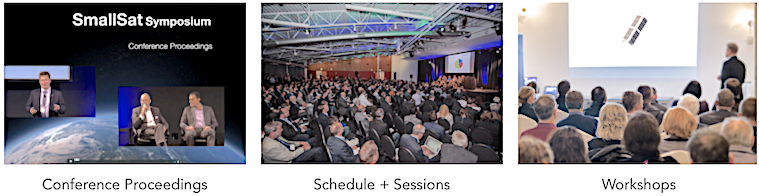
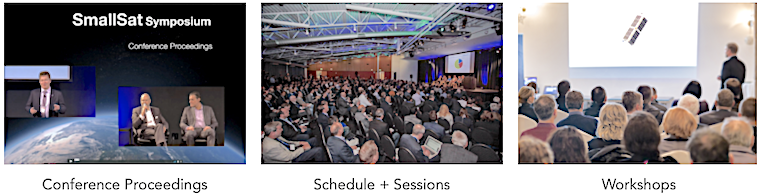
For all involved in the satellite and space industry and the various market segments that enhance these dynamic environments, the 2020 SmallSat Symposium is invaluable.

The 2020 SmallSat Symposium begins on February 3, 2020, with workshops on the first day. Then the Conference continues from February 4 to 6 at the Computer History Museum in Mountain View, California, in the heart of Silicon Valley.

The SmallSat Symposium is hosted by Satnews Publishers which, since 1983, has been a provider of satellite news, media and events. This information packed forum enables you and your company to secure a larger portion of market share as well as to take a step into the next stage of your company’s, or organization’s, growth.

The personal connections at the SmallSat Symposium enable attendees to network with established organizations, subject-matter experts as well as ‘New Space’ entrants.

The SmallSat Symposium will focus on the daily changes in new technologies and the business environment that is shaping the implementation of SmallSat constellations, SmallSat launchers, the challenges facing the SmallSat developer and actors as well as the enormous benefits of these advanced technologies that will benefit our world.

This event attracts more than 100 diverse speakers, all of whom possess deep industry experience. Additionally, numerous opportunities exist to mingle and network with peers while enjoying exceptional, complimentary meals and refreshment breakfast.

Learn more at this direct link…

Filed Under: News

Loft Orbital’s $13 Million Funds Operations

November 13, 2019 by editorial

Developing a “Satellite-as-a-Service” business is the driving force behind Loft Orbital, based in San Francisco.

The company has their Series A funding with a collection of $13 million to support operations in Boulder, Colorado, and Toulouse, France, as the company builds smallsats with initial launches scheduled for 2020.

Five customers have signed on for Loft’s first satellite and they include Eutelsat, the UAE Government flying an imager and SpaceChain. The company stated they have also signed on customers for the second and third satellites, as well. The firm’s business model has customers schedule milestone payments and then participate in a subscription service once the satellite is operational on-orbit.

Filed Under: News

ATLAS and Aevum Partner for USAF’s ASLON-45 LEO Mission

November 12, 2019 by editorial

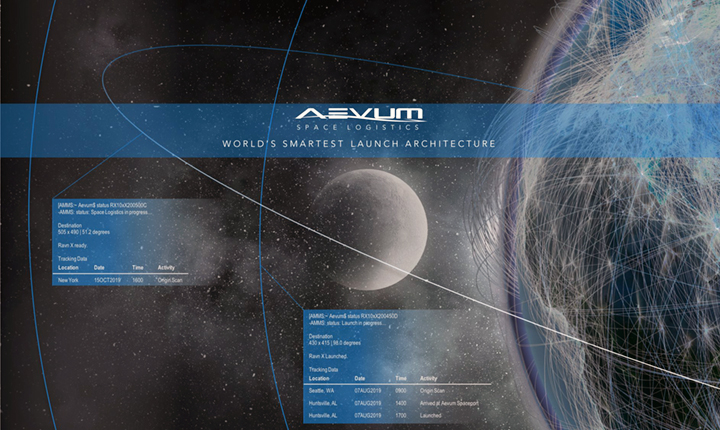
ATLAS Space Operations is partnering with Aevum, Inc. for the The Agile Small Launch Operational Normalizer (ASLON)-45 space lift mission.

The partnership expands on the existing collaboration between the companies with the $4.9 million ASLON-45 mission, which will provide LEO orbital launch services to the Department of Defense (DoD) Space Test Program and other government agencies to help the agency improve their real-time threat warnings.

ATLAS’ Freedom™ Ground Network currently has 31 operational and planned antennas placed around the world that forms the network that will complement Aevum’s scalable launch service, which enables autonomous lift vehicles to launch from virtually any runway in the world and not be limited to range.

This combination of services gives the partners and their customers global accessibility to space operations. As Aevum already uses ATLAS for telemetry, tracking, and command (TT&C), launch support to post-launch support will be a simple transition for customers and will also lower the cost of smallsat launches.

The Agile Small Launch Operational Normalizer-45 (ASLON-45) is a USAF mission that will consist of multiple 3U and larger U.S. government cubesats to LEO at a 45 degree inclination.

Sean McDaniel, CEO and Co-Founder of ATLAS, said this partnership will push the envelope of capabilities that are available to the space community. Beyond the ASLON-45 mission, ATLAS and Aevum are looking forward to conducting many successful launches and continuing to empower global access to space.

Jay Skylus, Founder and CEO of Aevum, added that vertical integration may reduce execution risk but often heightens cost and technology development risks. The company’s choice to integrate with ATLAS for ground communications provides the firm’s customers with more benefits and robust services.


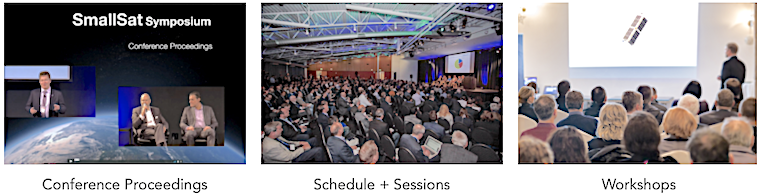
For all involved in the satellite and space industry and the various market segments that enhance these dynamic environments, the 2020 SmallSat Symposium is invaluable.

The 2020 SmallSat Symposium begins on February 3, 2020, with workshops on the first day. Then the Conference continues from February 4 to 6 at the Computer History Museum in Mountain View, California, in the heart of Silicon Valley.

The SmallSat Symposium is hosted by Satnews Publishers which, since 1983, has been a provider of satellite news, media and events. This information packed forum enables you and your company to secure a larger portion of market share as well as to take a step into the next stage of your company’s, or organization’s, growth.

The personal connections at the SmallSat Symposium enable attendees to network with established organizations, subject-matter experts as well as ‘New Space’ entrants.

The SmallSat Symposium will focus on the daily changes in new technologies and the business environment that is shaping the implementation of SmallSat constellations, SmallSat launchers, the challenges facing the SmallSat developer and actors as well as the enormous benefits of these advanced technologies that will benefit our world.

This event attracts more than 100 diverse speakers, all of whom possess deep industry experience. Additionally, numerous opportunities exist to mingle and network with peers while enjoying exceptional, complimentary meals and refreshment breakfast.

Learn more at this direct link…

Filed Under: News

GomSpace’s Didymoon Objective

November 12, 2019 by editorial

The continued development of the Juventas Cubesat is the focus of an addendum to the contract between GomSpace A/S and the European Space Agency (ESA) for the Asteroid Impact and Deflection Assessment (AIDA) mission, although final approval for this mission has not yet been approved by Europe’s space ministers as of this writing. That is expected to occur during ESA’s Space19+ meeting this month.

The total value of this contract to be shared among several partners is 1,165,000 euros, with the focus being the development of smallsat payloads in support of ESA’s Hera mission, which itself is part of the AIDA and NASA DART missions. The GomSpace share of the funding is 295,000 euros.

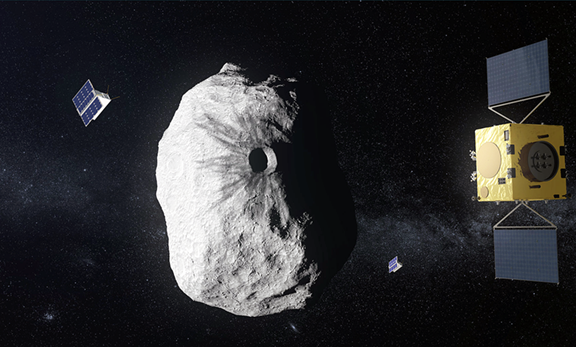
Travel to the Didymos binary asteroid system is the goal. Juventas is a 6U cubesat that contains a low frequency radar as the primary payload and the smallsat will operate in close proximity to the Didymos asteroid system to perform radar and radio-science experiments that target the moon of the binary asteroid, nicknamed Didymoon.


Artistic rendition of Hera at Didymos.

Image is courtesy of ESA.

The mission will be completed when the smallsat attempts to land on the surface of Didymoon to take measurements on the landing dynamics from likely bouncing events to capture details of the asteroids surface properties.

The mission will end with measurements taken by a gravimeter payload to give insight into the dynamical properties of the asteroid.

GomSpace is the project lead with the science team, including collaborators from the Royal Observatory of Belgium and the University of Grenoble Alpes. The project continues its collaboration with:

  • GMV Innovating Solutions from Romania leading the guidance, navigation and control subsystem
     
  • Brno University of Technology from the Czech Republic contributing to the radar digital design
     
  • Astronika from Poland delivering the radar antenna.


This addendum adds new partners to the Juventas team, including EmTroniX from Luxembourg who will deliver the radar electronics and GomSpace Luxembourg who will contribute to the mission operations and AIV activities.


Niels Buus

Niels Buus, CEO of GomSpace, said Juventas will be the first GomSpace designed nanosatellite in deep space demonstrating its capabilities in the most harsh  of environments to date.

Filed Under: News

Industry First … $50M in Funding for EO to BlackSky from Intelsat

November 12, 2019 by editorial

An industry first will create a strategic relationship that pairs Earth observation with a global communications infrastructure. The companies are BlackSky, provider of geospatial intelligence, satellite imaging and global monitoring services, and a $50 million senior secured loan from the global satellite communications company, Intelsat (NYSE: I). BlackSky currently has four 1-meter satellites in orbit with another four slated for launch in early 2020, and plans to have 16 satellites in its constellation by early 2021.

For this transaction, Evercore acted as a financial advisor to BlackSky and PJT Partners acted as financial advisor to Intelsat. The new capital enables BlackSky to further its existing assets and alliances to remain competitive in delivering Earth intelligence faster, with greater accuracy and more affordably. The objective is that over time, BlackSky could incorporate access to Intelsat’s global communications infrastructure, delivering first-to-know insights to customers anywhere in the world. With an established manufacturing capability, mission operations center and sales channels in place, BlackSky is in the process of expanding its constellation of smallsats that the company declares “will deliver the highest revisit rate in the industry.”

The company is also leading the industry in fusing AI/ML-powered computer vision, high revisit rate imagery from orbital assets and open-source intelligence to provide customers with comprehensive, deep insights about the locations in the world they care about.

Brian E. O’Toole, President and CEO of BlackSky stated that BlackSky is enabling a whole new level of global intelligence by leveraging the economics of small satellites so that their customers will always be the first to know. It takes a lot of expertise, engineering and capital to make smallsats viable; BlackSky is the first company to overcome these challenges with proven economies of scale. This latest partnership is a vote of confidence in their ability to deliver industry leading insights to their customers from one of the biggest players in the market.

Intelsat CEO Stephen Spengler offered that, BlackSky is well positioned to be a significant player in the expanding Earth observation sector, which they believe benefits from accelerating trends including cloud computing, change detection, predictive analytics and machine learning. They believe a significant number of commercial and government sector customers will increasingly rely on geospatial intelligence. Their investment will be used to fund enhancements to the current BlackSky infrastructure and will serve as a springboard for a commercial alliance with Intelsat and their Intelsat General government subsidiary.


For all involved in the satellite and space industry and the various market segments that enhance these dynamic environments, the 2020 SmallSat Symposium is invaluable.

The 2020 SmallSat Symposium begins on February 3, 2020, with workshops on the first day. Then the Conference continues from February 4 to 6 at the Computer History Museum in Mountain View, California, in the heart of Silicon Valley.

The SmallSat Symposium is hosted by Satnews Publishers which, since 1983, has been a provider of satellite news, media and events. This information packed forum enables you and your company to secure a larger portion of market share as well as to take a step into the next stage of your company’s, or organization’s, growth.

The personal connections at the SmallSat Symposium enable attendees to network with established organizations, subject-matter experts as well as ‘New Space’ entrants.

The SmallSat Symposium will focus on the daily changes in new technologies and the business environment that is shaping the implementation of SmallSat constellations, SmallSat launchers, the challenges facing the SmallSat developer and actors as well as the enormous benefits of these advanced technologies that will benefit our world.

This event attracts more than 100 diverse speakers, all of whom possess deep industry experience. Additionally, numerous opportunities exist to mingle and network with peers while enjoying exceptional, complimentary meals and refreshment breakfast.

Learn more at this direct link…

Filed Under: News

Building a Dozen … NanoAvionics Builds Nano-satellites for aLeMPSat Research Mission

November 12, 2019 by editorial

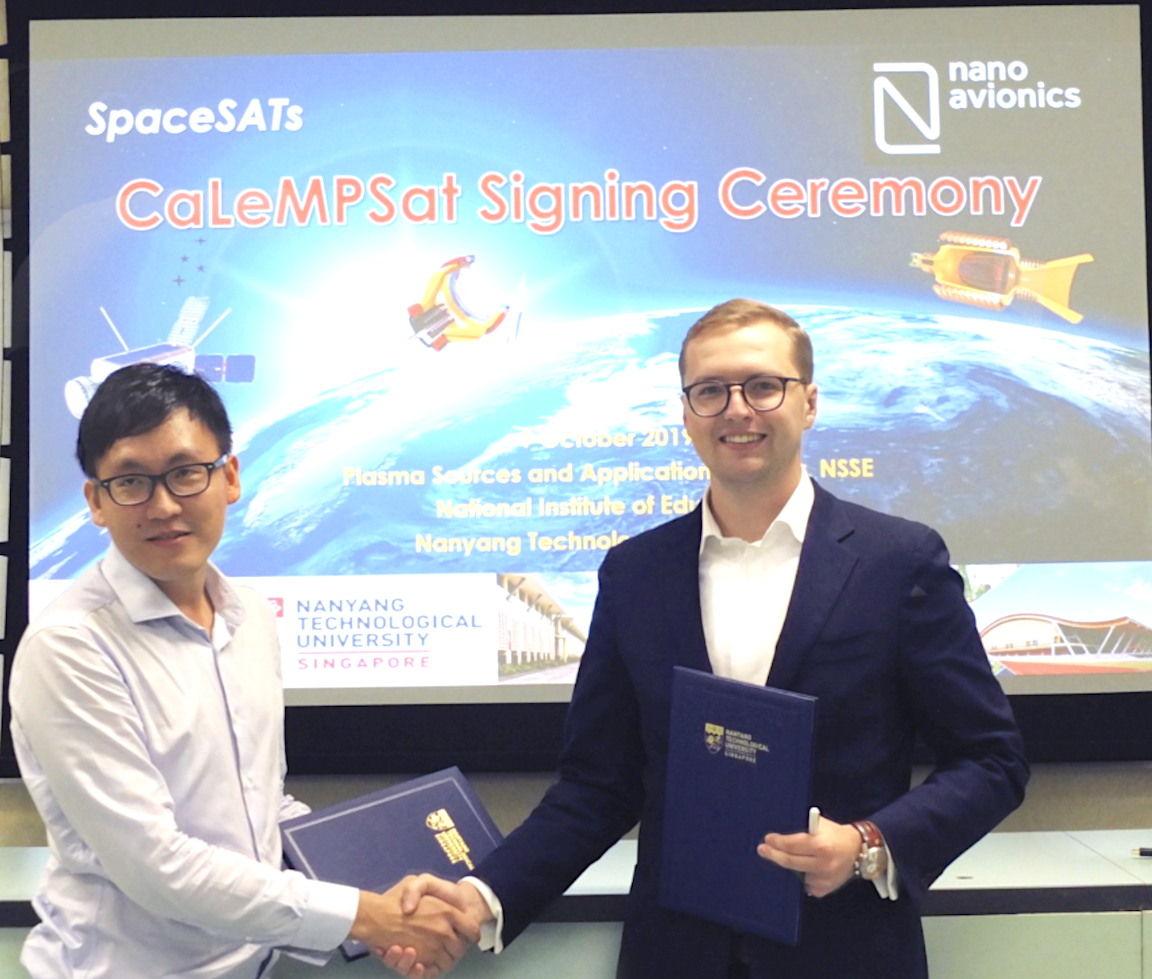
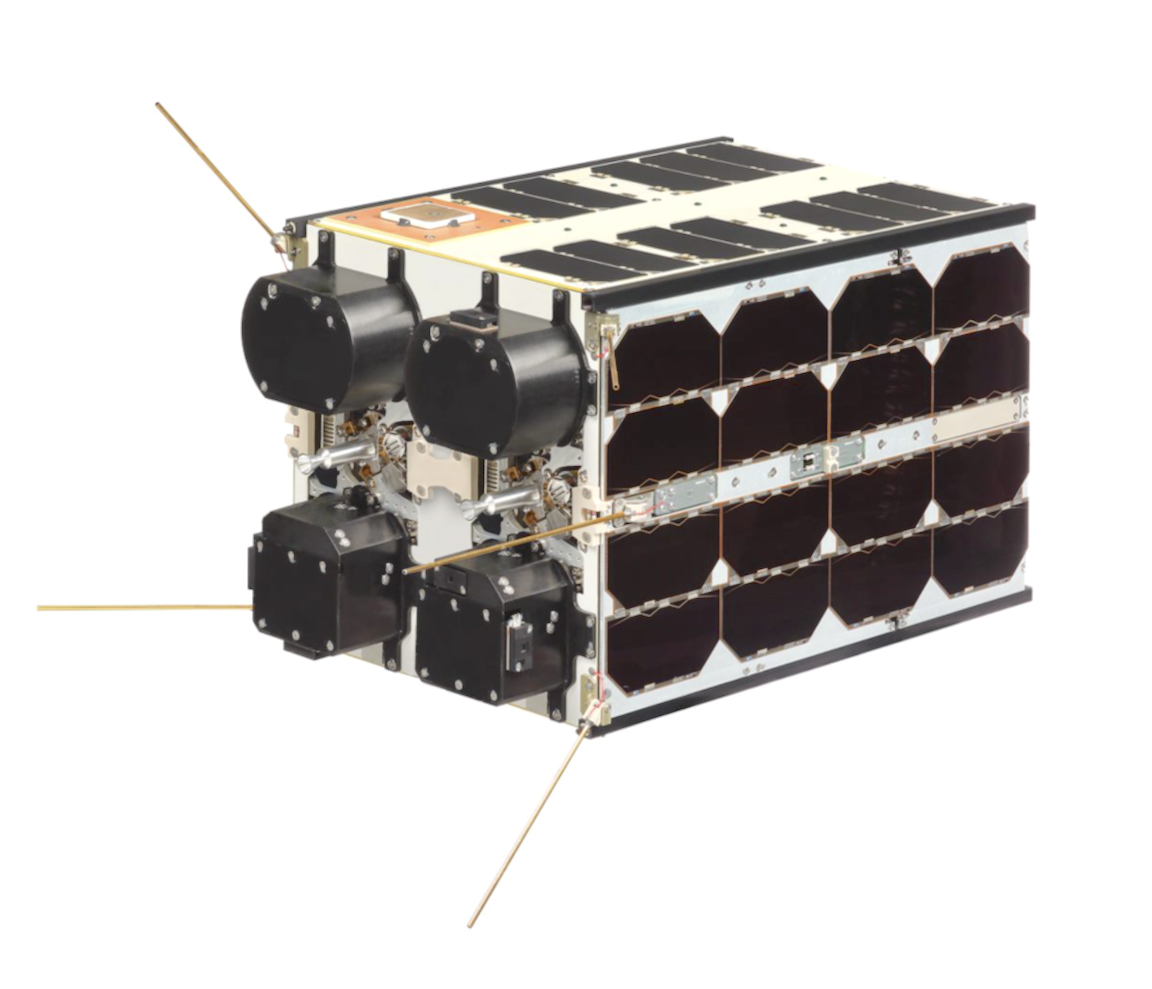
Another contract for small sats, and this one is for a Singaporean research mission —  nano-satellite mission integrator NanoAvionics received a contract to build a 12U nano-satellite bus for the Singaporean research mission “Cathode-Less Micro Propulsion Satellite” (CaLeMPSat). 

Developed by SpaceSATS, Plasma Innovation Labs (PILS) and the Plasma Source and Application Center (PSAC) at National Institute of Education (an autonomous institute of Nanyang Technological University), CaLeMPSat will test miniature Hall effect thrusters (HETs) that operate at power classes never before achieved.

The CaLeMPSat mission will test miniature HETs that operate at power classes far below the 100W-class thrusters of the current satellite industry. The research payload will consist of a 60W HET, an integrated 30W HET (in a 1.5U volume), and two 10W Hall Effect Micro Jets (HEM-Jets). A 3-axial, 5-nozzle cold gas thruster will round out the experimental thruster payload. The consortium will test additional miniaturized systems for plasma propulsion including:
 

  • 8-channel gas feeding unit,
  • plasma diagnostic unit,
  • power processing and control unit,
  • Earth magnetic field measurement unit.

NanoAvionics will provide its nano-satellite bus in a 12U configuration, of which CaLeMPSat will occupy more than 9U of payload volume. To support that payload, the nano-satellite bus will provide an average orbit power generation exceeding 20W as well as UHF and S-band communications. The spacecraft’s orientation will be managed by NanoAvionics’ Attitude Control and Determination System which includes reaction wheels, magnetorquers, an IMU, GPS, solar sensors, and a star tracker.

NanoAvionics has committed to deliver the satellite bus before the end of February 2020 and SpaceSATS and its partners are targeting launch of CaLeMPSat in late 2020.


NanoAvionics CEO Vytenis J. Buzas said that the propulsion technology that SpaceSATS and its collaborators will demonstrate on CaLeMPSat will open the door to new mission opportunities for nano-satellites. NanoAvionics is pleased to have been chosen to support such an innovative project with their multi-purpose nano-satellite bus, which has a proven track record of serving in-orbit demonstration missions in the past.

Miniaturized HETs will allow nano-satellites to perform high-impulse maneuvers such as orbital maintenance or formation flying as well as the decommissioning maneuvers needed to minimize space debris.

Dr. CHAN Chia Sern, Chief Executive Officer of SpaceSATS and Plasma Innovation Labs added that the robustness of NanoAvionics’ technology, its track record of successful nano-satellite missions and short lead times made NanoAvionics the ideal choice for the CaLeMPSat mission. The NanoAvionics team has given a great amount of support to provide the best possible technical solution, even before signing the contract, and they look forward to working together through integration, launch, and operation to achieve CaLeMPSat’s pioneering mission objectives.


Filed Under: News

SpaceX Success… the 60 Satellite Starlink Mission Launches from Cape Canaveral Aboard Repurposed Falcon 9 Rocket

November 11, 2019 by editorial

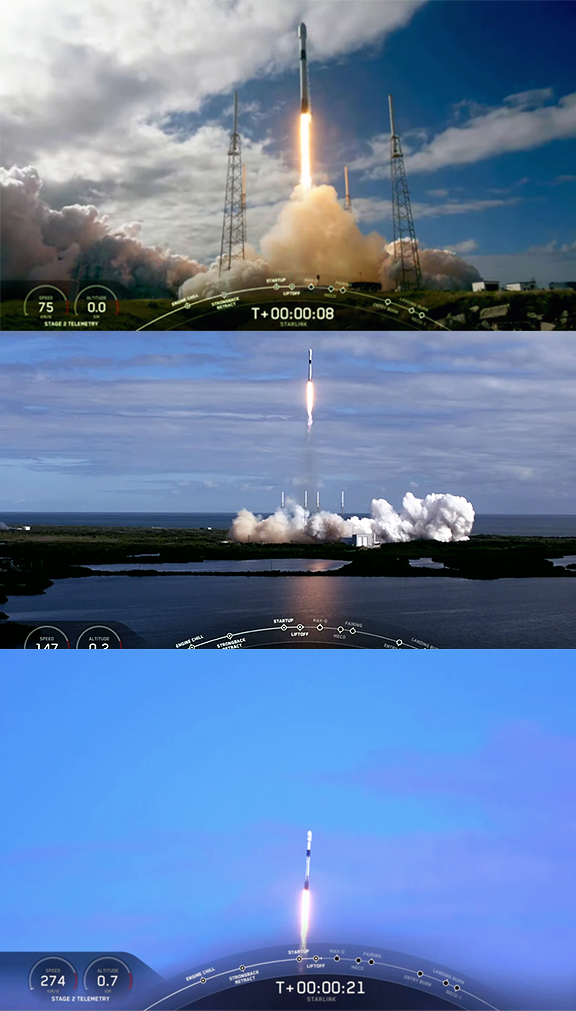
SpaceX is targeting On Monday, November 11, at 9:56 a.m.EST, 14:56UTC, SpaceX launched 60 Starlink satellites from Space Launch Complex 40 (SLC-40) at Cape Canaveral Air Force Station, Florida.

Falcon 9’s first stage previously supported the Iridium-7, SAOCOM-1A, and Nusantara Satu missions, and this Starlink mission’s fairing was previously flown on Falcon Heavy’s Arabsat-6A mission earlier this year.

Following stage separation, SpaceX landed Falcon 9’s first stage on the “Of Course I Still Love You” droneship, which is stationed in the Atlantic Ocean. There was no attempt to capture the fairing as previously planned by the recovery vessels, Ms. Tree and Ms. Chief, due to concerns regarding heavier than expected seas in the Atlantic Ocean. 

The Starlink satellites deployed at an altitude of 280 km. Prior to orbit raising, SpaceX engineers conducted data reviews to ensure all Starlink satellites are operating as intended — the satellites then used their onboard ion thrusters to move into their intended orbits.

SpaceX is developing a low latency, broadband internet system to meet the needs of consumers across the globe. Enabled by a constellation of LEO satellites, Starlink will provide fast, reliable internet to populations with little or no connectivity, including those in rural communities and places where existing services are too expensive or unreliable. As the most recent launch of Starlink satellites in May, SpaceX has increased spectrum capacity for the end-user through upgrades in design that maximize the use of both Ka- and Ku-bands.


The first stage of the Falcon 9 rocket that uplifted the SpaceX Starlink mission to orbit re-lands on the “Of Course I Still Love You” droneship.

Additionally, components of each satellite are 100% demisable and will quickly burn up in Earth’s atmosphere at the end of their life cycle — a measure that exceeds all current safety standards. Starlink is targeted to offer service in parts of the U.S. and Canada after six launches, rapidly expanding to global coverage of the populated world after 24 launches.

Additional information on the system can be found at the SpaceX Starlink infosite.

Filed Under: News

Drifting on an Arctic Ice Sheet for a Year Scientists Use Kepler’s World’s First High-Bandwidth Satellite

November 11, 2019 by editorial

Don’t know if any penguins were involved in the successful experiment that Kepler Communications demonstrated delivering over 100Mbps connectivity service in the Arctic region to the German icebreaker Polarstern.

The vessel is located around 85 degrees N and is the home to the MOSAiC scientific expedition. The demonstration marks the first time in history that the central Arctic is successfully connected through a high-bandwidth satellite network. 

Kepler’s two polar-orbiting satellites are being used to transfer data for scientists taking part in MOSAiC, the most extensive research expedition ever to the North Pole. MOSAiC is an international expedition consisting of hundreds of scientists and operations crew, which will remain locked into the Arctic ice sheet to study the environment. The team will spend the next 12 months drifting along with the ice sheet, with the purpose of the mission being to take the closest look ever at the effects of climate change on the Arctic. 

Kepler has provided the Polarstern is equipped witthe world’s only high-bandwidth satellite data link delivered from low-Earth orbit (LEO) that is available in the Arctic. With the vessel operating well outside the range of traditional high-throughput satellites, Kepler is providing 100x higher data speeds, when the satellite passes the vessel than would be otherwise available to the ship. This improved data transfer capability means scientists can share large data files between ship and shore, improving the ability to share, analyze, and disseminate information.


MOSAiC scientists setting up camp in the North Pole.
Photo by Stephan Hendricks.

Mina Mitry, CEO at Kepler said that their Global Data Service provides a cost-effective means to transfer large data volumes that will be gathered over the course of MOSAiC. Rather than only storing data locally and analyzing once physical storage can be sent back with supply vessels, they are giving scientists the ability to continuously transfer test and housekeeping data sets over their unique LEO satellite network. 

Kepler’s Global Data Service™ will save time, money and, most importantly, improve the ability for MOSAiC scientists to carry out their critical mission of studying climate change.

In charge of MOSAiC’s logistics is the Alfred Wegener Institute Helmholtz Centre for Polar and Marine Research (AWI), from Germany. They are responsible for leading this international expedition that involves the joint efforts of 19 countries around the world. With over USD 158 million in funding, the most advanced technology on a research icebreaker, and an astonishing quantity of planning and logistics, MOSAiC is the largest expedition to the North Pole ever in history.

Professor Markus Rex, MOSAiC project leader and atmospheric scientist at the Alfred Wegener Institute in Potsdam added that the high polar regions are the last frontiers of the globe where high bandwidth data connections could not be established so far. Kepler’s new Global Data Service now enables them to send back bulk data, including key data files for monitoring the status of instruments together with experts at home. This will contribute to the success of MOSAiC.

The MOSAiC expedition began when the Polarstern set sail from Norway this past September and will continue for more than a year. Findings from the mission will help better assess the future of Earth’s climate, and provide valuable information to help fight climate change. 

Kepler is the world’s only provider of high-bandwidth satellite services in the poles. Aboard the Polarstern, Kepler has demonstrated data rates of 38 Mbps downlink and 120 Mbps uplink to a 2.4m Ku-band VSAT (Very Small Aperture Terminal). 


Filed Under: News

SSTL Ships Target Satellite to Tokyo for Astroscale’s ELSA-d Mission

November 8, 2019 by editorial

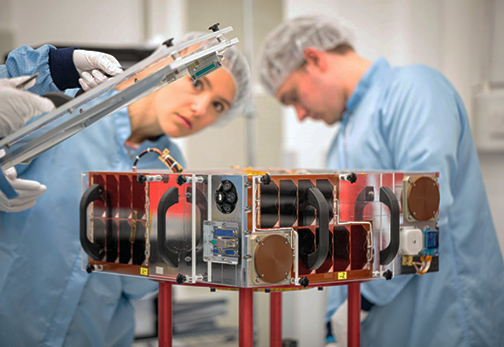
Surrey Satellite Technology Ltd. (SSTL) has shipped a 16 kg. Target satellite for Astroscale’s End-of-Life Services by Astroscale demonstration (ELSA-d) mission to Tokyo, where it will be bolted to the Chaser satellite for environmental testing ahead of the launch in 2020.

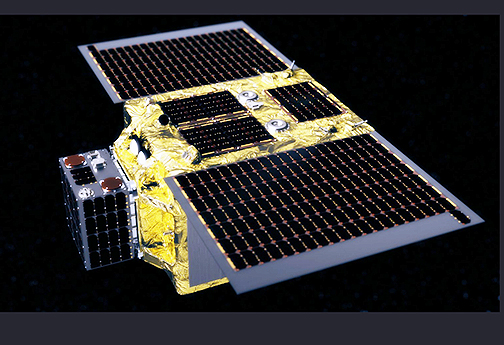
The ELSA-d mission is designed to simulate capture of orbital debris and validate key technologies for end-of-life spacecraft retrieval and disposal services. The Target and Chaser satellites will be attached for launch and de-orbit, but while on-orbit at 500 to 600 km., they will be deployed in a series of increasingly complex separation and capture maneuvers using search, identification, rendezvous, docking, and de-orbit technologies.


The ELSA-d mission comprises of a Chaser satellite and the Target satellite, and will demonstrate key technologies for orbital debris removal.

Photo is courtesy of SSTL.

The ELSA-d Target satellite was designed and manufactured by SSTL in Guildford, UK, and incorporates S-band communications, GPS positioning, and a 3-axis control system. It will also fly an HD camera and lighting to record the capture sequences during eclipse. A ferromagnetic docking plate with optical markers is attached to the Target, allowing the ~180 kg. Chaser satellite to identify and estimate attitude before deploying a capture extension mechanism with a magnetic plate to latch on to the Target satellite.

While rendezvous has been performed on-orbit in the past, ELSA-d will demonstrate the first semi-autonomous capture of a non-responsive, tumbling Target, as well as the first identification of a Target that is outside of the field of view of the relative navigation sensors on the Chaser. Once the demonstration concludes, the linked satellites will be moved to a lower orbit in readiness to re-enter the atmosphere where they will burn up.


Artistic rendition of the ELSA-d satellite. This mission is Astroscale’s on-orbit demonstration that aims to test several capabilities and technologies needed for future services.

Image is courtesy of Astroscale.

ELSA-d is scheduled to launch in 2020 on a Soyuz from the Baikonur Cosmodrome in Kazakhstan.

Sarah Parker, Managing Director of SSTL, said it is vital that the international space community tackles the issue of space junk and the company is pleased to be involved in Astroscale’s ELSA-d inaugural end-of-life spacecraft retrieval demonstration mission. SSTL is looking forward to following the on-orbit operations of this milestone mission.

Nobu Okada, Founder & CEO of Astroscale, added the company is delighted to receive SSTL’s Target satellite at the firm’s Tokyo headquarters as the next step is taken in this groundbreaking mission. Astroscale thanks SSTL for the commitment to ELSA-d and for working together to address the ongoing buildup of hazardous space debris in LEO.


Filed Under: News

  • « Go to Previous Page
  • Go to page 1
  • Interim pages omitted …
  • Go to page 331
  • Go to page 332
  • Go to page 333
  • Go to page 334
  • Go to page 335
  • Interim pages omitted …
  • Go to page 338
  • Go to Next Page »

Primary Sidebar

WEEKLY NEWSLETTER

Archives

  • February 2026
  • January 2026
  • December 2025
  • November 2025
  • October 2025
  • September 2025
  • August 2025
  • July 2025
  • June 2025
  • May 2025
  • April 2025
  • March 2025
  • February 2025
  • January 2025
  • December 2024
  • November 2024
  • October 2024
  • September 2024
  • August 2024
  • July 2024
  • June 2024
  • May 2024
  • April 2024
  • March 2024
  • February 2024
  • January 2024
  • December 2023
  • November 2023
  • October 2023
  • September 2023
  • August 2023
  • July 2023
  • June 2023
  • May 2023
  • April 2023
  • March 2023
  • February 2023
  • January 2023
  • December 2022
  • November 2022
  • October 2022
  • September 2022
  • August 2022
  • July 2022
  • June 2022
  • May 2022
  • April 2022
  • March 2022
  • February 2022
  • January 2022
  • December 2021
  • November 2021
  • October 2021
  • September 2021
  • August 2021
  • July 2021
  • June 2021
  • May 2021
  • April 2021
  • March 2021
  • February 2021
  • January 2021
  • December 2020
  • November 2020
  • October 2020
  • September 2020
  • August 2020
  • July 2020
  • June 2020
  • May 2020
  • April 2020
  • March 2020
  • February 2020
  • January 2020
  • December 2019
  • November 2019
  • October 2019

© 2019–2026 SatNews

Insert/edit link

Enter the destination URL

Or link to existing content

    No search term specified. Showing recent items. Search or use up and down arrow keys to select an item.
      x
      Sign Up Now!

      Enjoy a free weekly newsletter with recent headlines from the global SmallSat industry.

      Invalid email address
      We promise not to spam you. You can unsubscribe at any time.
      Thanks for subscribing! You will now receive weekly SmallSat News updates.
      We love our advertisers.
      And you will too!

      Please disable Ad Blocker to continue... We promise to keep it unobtrusive.
      We promise not to spam you. You can unsubscribe at any time.
      Invalid email address
      Thanks for subscribing! Please check your email for further instructions.