• Skip to main content
  • Skip to primary sidebar
  • Home
  • News
  • Featured
  • More News ⌄
    • SatNews
    • SatMagazine
    • MilSatMagazine
  • Events ⌄
    • MilSat Symposium
    • SmallSat Symposium
    • Satellite Innovation
  • Contacts
  • SUBSCRIPTION

SmallSat News

You are here: Home / Archives for 2024

Archives for 2024

Synspective’s 5th SAR Satellite reaches its target orbit + spreads its wings

August 5, 2024 by editorial

Synspective Inc., a SAR satellite data and solutions provider, has revealed that the firm’s fifth SAR satellite successfully reached its target orbit and spread its wings.

The new StriX satellite was successfully deployed into orbit by Rocket Lab’s Electron rocket from the Rocket Lab Launch Complex 1 on New Zealand’s Mahia Peninsula.

Photo of Rocket Lab’s launch of Synspective’s StriX SAR smallsat, courtesy of the company.

This fifth satellite operates in an inclined orbit. By operating from orbit, capturing images can be concentrated in densely populated areas in low- to mid-latitude regions, allowing for more frequent imaging in high-demand areas.

Until the launch of this new StriX satellite, the company’s satellite imaging direction was limited to a single direction, resulting in some areas being impossible to observe. However, combining satellites in inclined and sun-synchronous orbits will enable observation from four directions (east, west, north, and south), allowing us to reduce any blind spots.

Over the coming months, the company will verify observation and data acquisition. 

Filed Under: News

SpaceX still plans for Sunday launch of 23 Starlink smallsats; and now available in Tonga

August 3, 2024 by editorial

Starlink dish placed on a beach in Maldives (Photo: Starlink via Twitter)

SpaceX is targeting Sunday, August 4 for a Falcon 9 launch of 23 Starlink satellites to low-Earth orbit from Space Launch Complex 4 East (SLC-4E) at Vandenberg Space Force Base in California. Liftoff is targeted for 12:24 a.m. PT, with backup opportunities available until 3:52 a.m. PT. If needed, additional opportunities are also available on Monday, August 5 starting at 12:24 a.m. ET.

A live webcast of this mission will begin about five minutes prior to liftoff, which you can watch here and on X @SpaceX.

This is the sixth flight for the first stage booster supporting this mission, which previously launched USSF-6

2 and four Starlink missions. Following stage separation, the first stage will land on the Of Course I Still Love You droneship, which will be stationed in the Pacific Ocean.

Filed Under: News

SpaceX is back in the groove with Friday’s launch of 23 Starlink small satellites

August 2, 2024 by editorial

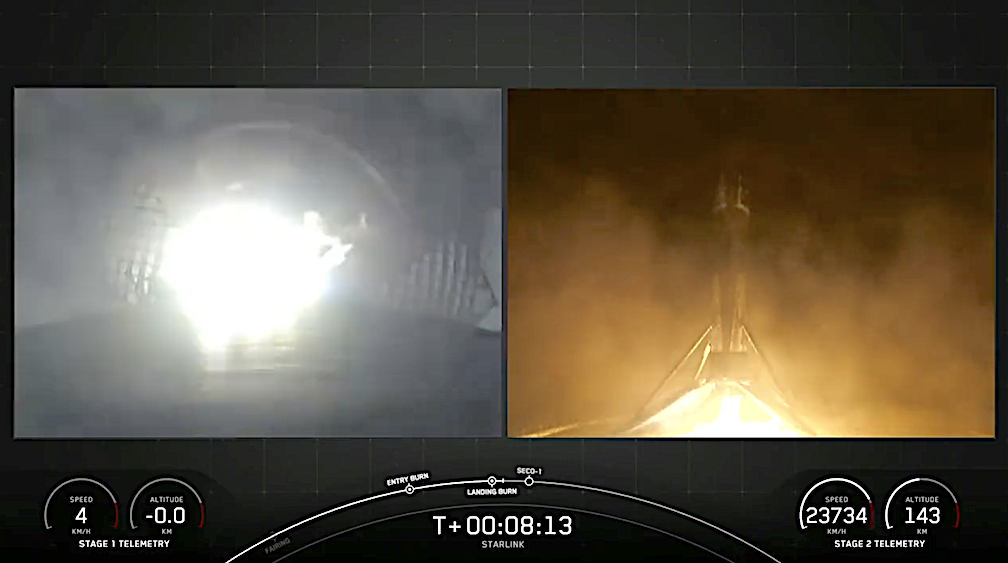
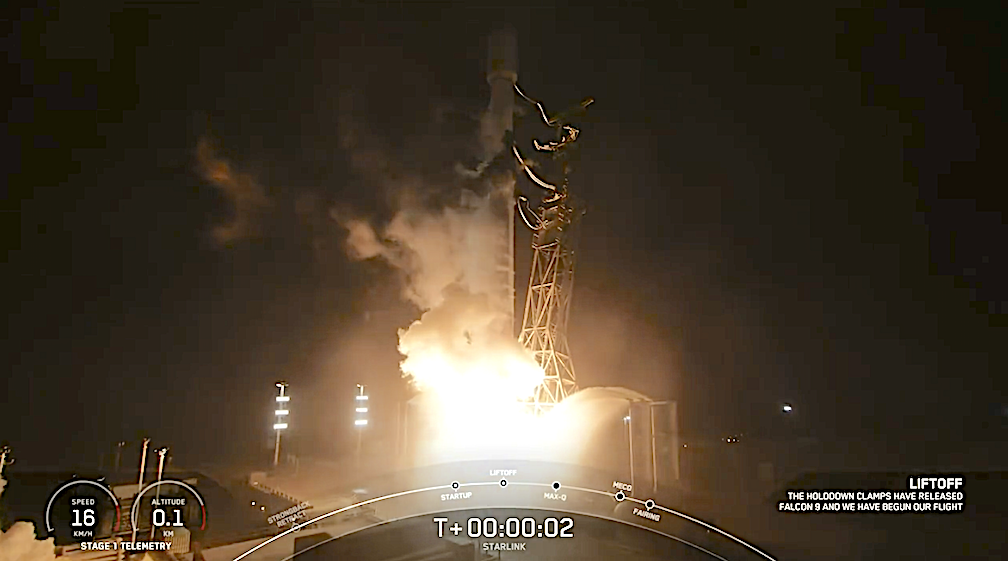
Photo from Friday, August 2, by Satnews from SpaceX’s video stream

On Friday, August 2 at 1:01 a.m. ET, Falcon 9 launched 23 Starlink satellites to low-Earth orbit from Launch Complex 39A (LC-39A) at Kennedy Space Center in Florida.

Photo from Friday, August 2, by Satnews from SpaceX’s video stream

This was the 12th flight for the first stage booster supporting this mission, which previously launched Crew-6, O3b mPOWER, USSF-124, and eight Starlink missions.

SpaceX ready for Friday Starlink satellite launch

This image has an empty alt attribute; its file name is Screen-Shot-2024-07-28-at-11.07.54-AM.png

Photo was captured from California on foggy Sunday, July 28, by Satnews from SpaceX’s video stream.

SpaceX is targeting Friday, August 2 for a Falcon 9 launch of 23 Starlink satellites to low-Earth orbit from Launch Complex 39A (LC-39A) at Kennedy Space Center in Florida. Liftoff is targeted for 1:01 a.m. ET, with backup opportunities available until 4:19 a.m. ET. If needed, additional opportunities are also available on Saturday, August 3 starting at 12:19 a.m. ET.

A live webcast of this mission will begin about five minutes prior to liftoff, which you can watch here and on X @SpaceX.

This is the 12th flight for the first stage booster supporting this mission, which previously launched Crew-6, O3b mPOWER, USSF-124, and eight Starlink missions. Following stage separation, the first stage will land on the A Shortfall of Gravitas droneship, which will be stationed in the Atlantic Ocean.

The 45th Weather Squadron at Patrick Space Force Base forecast 95 percent favorable conditions at liftoff. The only potential concern is a violation of the cumulus cloud rule. If SpaceX needs to pivot to its 24-hour launch delay, the weather outlook decreases to 80 percent favorable conditions.

Filed Under: News

ATLAS Space Operations completes rapid onboarding of TROPICS Spacecraft

August 2, 2024 by editorial

In May of 2024, the National Oceanic and Atmospheric Administration (NOAA) predicted an 85% likelihood of above-normal activity for the upcoming Atlantic hurricane season. This marked the fifth consecutive year with an above-normal prediction and, if proven accurate, would make 2024 the eighth year in the last decade to record above-normal activity. With the apparent increase in the destructive power of these storms, timely and detailed tropical cyclone data may be more important than ever.

Massachusetts Institute of Technology Lincoln Laboratory (MIT LL) is leading the NASA Time-Resolved Observations of Precipitation structure and storm Intensity with a Constellation of Smallsats’ (TROPICS) mission.

This mission will provide NASA, NOAA, and other government agencies and commercial partners with rapid refresh microwave sounding observations, delivering improved resolution, configurable coverage, flexibility, reliability, and extremely low-cost launch access compared to other space-based storm-sensing technology.

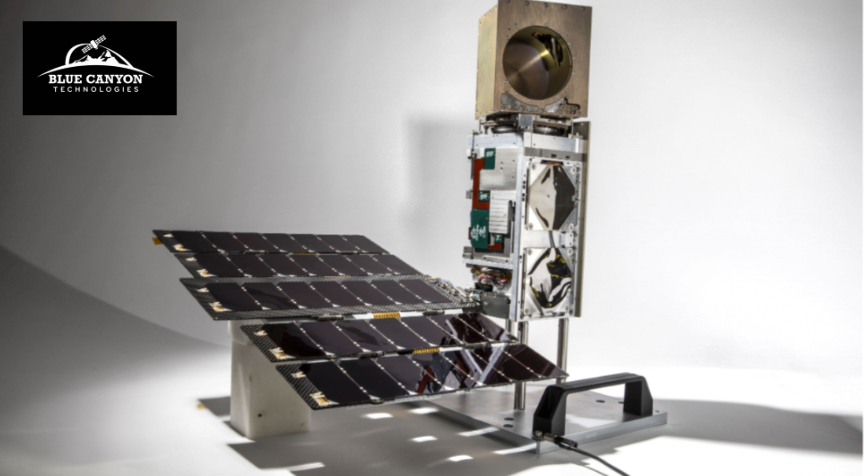
Photo of the TROPICS smallsat, courtesy of Blue Canyon Technologies.

The data TROPICS provides is vital to weather forecasters, so when Lincoln Laboratory contacted ATLAS Space Operations in June to establish support at its Dubai ground station, the ATLAS team responded with urgency.

Within four weeks of receiving MIT LL’s purchase order, ATLAS had completed spacecraft integration and TROPICS was declared operational on ATLAS’ Global Federated Network—a process that typically takes ground segment providers several months or more to perform.

A streamlined, best-in-class customer onboarding experience is among the stated benefits of ATLAS Ground Software as a Service™ model. Even so, the ATLAS team was quick to credit the TROPICS spacecraft operations team for their collaboration in making the expedited integration possible.

“There are few missions in space with such immediate and concrete benefits as severe weather monitoring,” said ATLAS CEO John Williams. “Simply put, data from Lincoln Laboratory’s TROPICS mission saves lives. ATLAS is honored to quickly, securely, and reliably deliver that data to their team.”

ATLAS Space Operations is a leading provider of Ground Software as a Service™ in the space communications industry. ATLAS’ revolutionary Freedom® software has been recognized by industry-leading publications and organizations such as Via Satellite and the World Teleport Association. Additionally, ATLAS was highlighted in the CIO Review: Telecom Edition as Company of the Year (2023) as well as one of the 10 Most Promising Technologies. Lastly, Aerospace & Defense Review acknowledged ATLAS as one of the Top Satellite Solutions Providers. ATLAS combines the Freedom™ Software Platform and its global antenna network to achieve its mission of securing space access anytime, anywhere. To learn more, visit atlasspace.com.

Filed Under: News

SpaceX ready for Friday Starlink satellite launch

August 2, 2024 by editorial

Photo captured from California on foggy Sunday, July 28, by Satnews from SpaceX’s video stream.

SpaceX is targeting Friday, August 2 for a Falcon 9 launch of 23 Starlink satellites to low-Earth orbit from Launch Complex 39A (LC-39A) at Kennedy Space Center in Florida. Liftoff is targeted for 1:01 a.m. ET, with backup opportunities available until 4:19 a.m. ET. If needed, additional opportunities are also available on Saturday, August 3 starting at 12:19 a.m. ET.

A live webcast of this mission will begin about five minutes prior to liftoff, which you can watch here and on X @SpaceX.

This is the 12th flight for the first stage booster supporting this mission, which previously launched Crew-6, O3b mPOWER, USSF-124, and eight Starlink missions. Following stage separation, the first stage will land on the A Shortfall of Gravitas droneship, which will be stationed in the Atlantic Ocean.

The 45th Weather Squadron at Patrick Space Force Base forecast 95 percent favorable conditions at liftoff. The only potential concern is a violation of the cumulus cloud rule. If SpaceX needs to pivot to its 24-hour launch delay, the weather outlook decreases to 80 percent favorable conditions.

Filed Under: News

Northrop Grumman completes PDR for SDA’s latest Proliferated Data Transport satellites

August 1, 2024 by editorial

Northrop Grumman Corporation (NYSE: NOC) has completed the Preliminary Design Review (PDR) for 74 high-speed data transport satellites for the Space Development Agency (SDA), including satellites that integrate advanced technology from an earlier generation of the Proliferated Warfighter Space Architecture (PWSA), providing increased capabilities to U.S. Forces.

The 74 satellites include the Tranche 2 Beta and Tranche 2 Alpha configurations. Tranche 2 Beta satellites incorporate new communications technologies into the PWSA, including S-band, Ultra High Frequency SATCOM and Integrated Broadcast Service, while the Tranche 2 Alpha satellites are a continuation of Northrop Grumman’s Tranche 1 Transport Layer satellites awarded in 2022.

PWSA includes two major lines of effort:
The Tracking Layer: Designed to detect, track and ultimately target hypersonic and ballistic missiles
The Transport Layer: Provides global data and voice connectivity to U.S forces defending the homeland and operating around the world.

To date, SDA has awarded Northrop Grumman more than 130 satellites. Northrop Grumman successfully completed a Critical Design Review (CDR) for its first generation Transport and Tracking Layer satellites last year and is now integrating space vehicles both in California, and at the Airbus factory in Florida.

Blake Bullock, vice president, military space systems, Northrop Grumman, said, “Space Development Agency’s vision is to field critical capabilities at an extremely rapid pace, and Northrop Grumman continues to demonstrate that we are up to the challenge. As we move into detailed design for our Tranche 2 satellites, we’re executing and on-track with our Tranche 1 offerings and evaluating future opportunities with SDA programs. We are delivering on our commitments and are focused on helping SDA make the Proliferated Warfighter Space Architecture a success.”

Filed Under: News

Rocket Lab completes integration + testing of twin spacecraft for NASA Mars Mission

July 31, 2024 by editorial

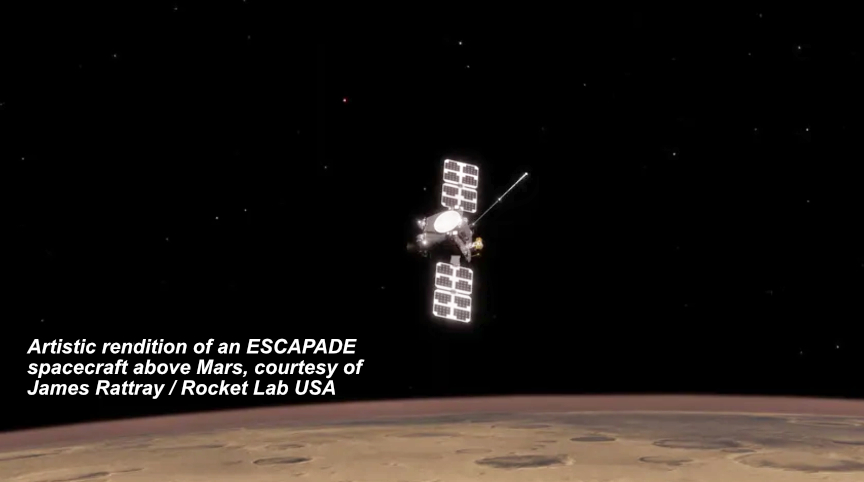
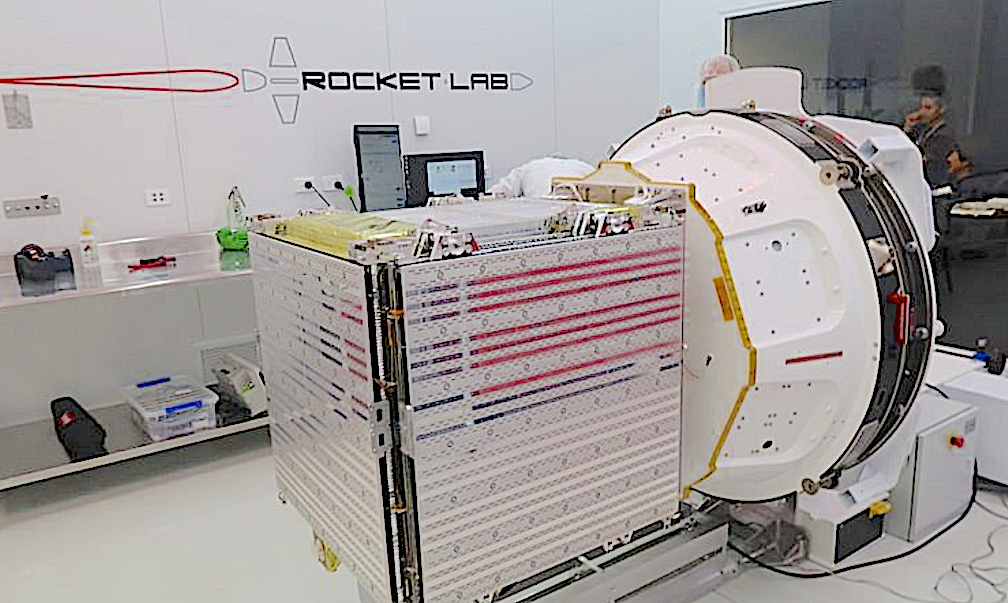
Rocket Lab USA, Inc. (Nasdaq: RKLB) has completed integration and testing of two spacecraft destined for Mars orbit.

Rocket Lab built the twin spacecraft for the University of California Berkeley’s Space Science Laboratory and NASA to enable the Escape and Plasma Acceleration and Dynamics Explorers (ESCAPADE) mission, scheduled to launch from Cape Canaveral this year. This heliophysics mission will measure plasma and magnetic fields around the Red Planet, helping scientists learn more about the processes that strip away atoms from Mars’ magnetosphere and upper atmosphere, driving Martian climate evolution.

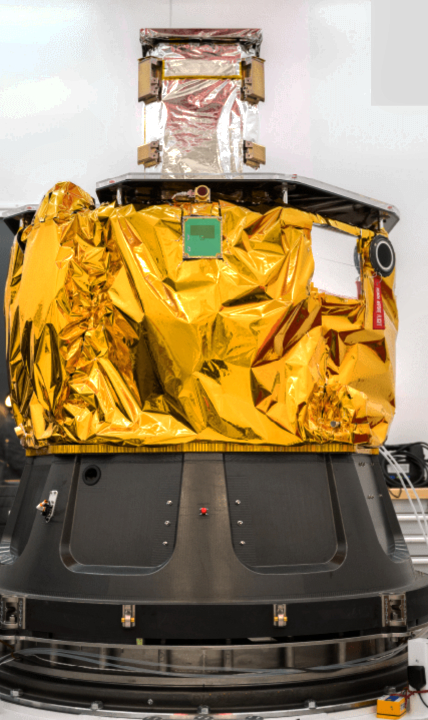
Photo of the Blue and Gold spacecraft, courtesy of Rocket Lab.
Rocket Lab’s Explorer bus.

Named Blue and Gold, the spacecraft were designed, built, integrated, and tested at Rocket Lab’s Spacecraft Production Complex and headquarters in Long Beach, California.

Based on Rocket Lab’s Explorer spacecraft, a configurable, high delta-V interplanetary platform, the duo features Rocket Lab-built components and subsystems, including solar panels, star trackers, propellant tanks, reaction wheels, reaction control systems, radios, and more.

Mars missions can take a decade or more from proposal to launch, but Rocket Lab was able to produce Blue and Gold in just three and half years due to mature, proven spacecraft development experience, as well as a vertically integrated supply chain that enables streamlined production.

Blue and Gold are scheduled to ship to Cape Canaveral in August where they will be integrated onto Blue Origin’s New Glenn rocket.

“Building one Mars spacecraft is an achievement, but building two and doing it on an accelerated timeline is testament to our team’s deep experience and our vertical integration strategy,” said Rocket Lab founder and CEO, Sir Peter Beck. “We are immensely proud to once again partner with NASA and support the UCB team to deliver new and important science from Mars.”

“Rocket Lab has been an invaluable partner to UC Berkeley over the last four years of ESCAPADE’s development,” said ESCAPADE Principal Investigator and Associate Director for Planetary Science at the UC Berkeley Space Sciences Laboratory, Rob Lillis. “Their energetic, talented engineers and managers have consistently gone above and beyond in responding rapidly and constructively to both our requests and the inevitable challenges inherent in developing new scientific spacecraft. We are proud to be flying with Rocket Lab to Mars.”

Filed Under: News

Astroscale’s ADRAS-J demos space debris observations

July 30, 2024 by editorial

Astroscale Japan Inc. (“Astroscale Japan”), a subsidiary of Astroscale Holdings Inc. (“Astroscale”), has revealed that the company’s commercial debris inspection demonstration satellite, Active Debris Removal by Astroscale-Japan (ADRAS-J), has achieved a technical milestone for a commercial company: the controlled fly-around operations of the space debris — a rocket upper stage — capturing images from various angles and lighting conditions while maintaining a controlled fixed-point relative position of approximately 50 meters from the upper stage.

Screenshot

ADRAS-J is the world’s first attempt to safely approach, characterize and survey the state of an existing piece of large debris through Rendezvous and Proximity Operations (RPO). This groundbreaking mission has rendezvoused with an unprepared Japanese upper stage rocket body that is approximately 11 meters long, 4 meters in diameter, and weighs approximately 3 tons.

After demonstrating safe approach and proximity operations with the object that is the size of a city bus, ADRAS-J has been gathering images and other data to assess its movement and structural condition. Unprepared objects in orbit are not designed with any technologies that enable docking or potential servicing or removal, heightening the complexity of operations.

The information gained from these images will provide essential data that will support a future mission to capture and remove the object.

During the first fly-around observation in June, ADRAS-J was approximately one-third through the maneuver (~120 degrees) when an unexpected attitude anomaly triggered an autonomous abort. ADRAS-J safely maneuvered away from the upper stage as designed, demonstrating the effectiveness of its on-board collision avoidance system in safely approaching a non-cooperative object. ADRAS-J then re-approached the upper stage and demonstrated two successful fly-around observations.

Watch the time lapses taken during fly-around operations:

Telephoto on July 15: https://www.youtube.com/shorts/bKKkkX-7fn8
Wide-angle on July 15: https://www.youtube.com/shorts/Wk2N9Ldh-SA
Telephoto on July 16: https://www.youtube.com/shorts/V_dW4PC139Q
Wide-angle on July 16: https://www.youtube.com/shorts/hXg_Jt4ni8I

Satellites and debris objects in low Earth orbit (below 2,000 km) travel at speeds of approximately 7 to 8 km per second, highlighting the challenge of locating, approaching, orbiting around, and gathering data from objects at this altitude. These capabilities are the baseline for on-orbit servicing and the achievements from the ADRAS-J mission will herald a new era in RPO missions, paving the way for future on-orbit services while laying the foundation for a sustainable space environment.

The ADRAS-J spacecraft was selected by the Japan Aerospace Exploration Agency for Phase I of its Commercial Debris Removal Demonstration program, aimed at demonstrating technologies for removing large debris. Astroscale Japan was also selected as the contracting party for Phase II, which will involve the capture and deorbit of the upper stage.

Development of the ADRAS-J2 spacecraft is underway, and the heritage of the ADRAS-J spacecraft and operations, along with the data collected, will be utilized for the removal phase of the program. The three fly-around operations have revealed no major damage to the payload attach fitting, which is the planned capture point for the ADRAS-J2 mission.

Since the launch in February, the major ADRAS-J mission highlights include:

  • Feb. 18: launch and start of in-orbit operations.
  • Feb. 22: start of rendezvous phase.
  • Apr. 9: start of Angles Only Navigation and proximity approach from several hundred kilometers.
  • Apr. 16: start of Model Matching Navigation relative navigation techniques.
  • Apr. 17: approach to the client within several hundred meters.
  • May 23: approach to the client within 50 meters.
  • May 23: first fixed-point observation completed.
  • Jun. 17: second fixed-point observation completed.
  • Jun. 19: start of fly-around operation and validation of collision avoidance system.
  • Jul. 14: approach to the client within 50 meters. Third fixed-point observation completed.
  • Jul. 15: successful second fly-around observation.
  • Jul. 16: successful third fly-around observation.

Filed Under: News

HawkEye 360’s Space-Based RF Data + Analytics now available on the global data marketplace

July 30, 2024 by editorial

HawkEye 360 Inc. continues the firm’s collaboration and investment in the Global Data Marketplace which expands HawkEye 360’s market reach, making the firm’s advanced data and analytics products accessible to a broader array of users with critical global missions — the Global Data Marketplace is a dynamic hub that connects government entities, academia, and international allies with commercial data vendors.

For HawkEye 360’s customers and U.S. government entities, the Global Data Marketplace streamlines the procurement process for our products and services, including GPS Interference, Maritime Domain Awareness, Electronic Order of Battle (EOB), and Communications mapping.  By eliminating traditional procurement barriers, the marketplace enhances operational efficiency and ensures critical data is readily accessible for mission-critical applications. Customers can easily access the necessary information, supporting timely decision-making and operations.

HawkEye 360’s robust data offerings are seamlessly integrated into the platform, allowing us to efficiently manage transactions and deliver precise geospatial insights to the right place at the right time.  This will allow HawkEye 360 to continue supporting the evolving needs of its customers worldwide, significantly impacting global safety missions.

“HawkEye 360’s integration with the Global Data Marketplace allows us to bring our novel RF data and analytics to a broader range of clients,” said Alex Fox, Chief Growth Officer at HawkEye 360. “The Marketplace enables HawkEye 360 to deliver precise and timely data, using a rapid acquisition process that empowers our customers to meet their strategic and operational requirements effectively.”

Filed Under: News

Rocket Lab ready to launch Synspective’s SAR satellite on Wednesday for “Owl for One, One for Owl” mission to build a constellation

July 30, 2024 by editorial

Rocket Lab USA, Inc. (Nasdaq: RKLB) provider of launch services and space systems revealed the launch window for its 51st Electron launch mission to deliver the latest satellite in a constellation being built by its long-standing customer Synspective.

The “Owl for One, One for Owl” mission is scheduled to launch from Rocket Lab Launch Complex 1 in Mahia, New Zealand during a 14-day launch window that opens on July 31st NZST / July 30th UTC. In addition to deploying a single StriX satellite to low Earth orbit for this mission, Rocket Lab will perform an advanced mid-mission maneuver with Electron’s Kick Stage to shield the satellite from the sun and reduce radiation exposure.

Synspective founder and CEO Dr. Motoyuki Arai on left, and Rocket Lab founder and CEO, Sir Peter Beck on right

The mission will be the fifth launch of a total of 16 launches on Electron for Synspective, a Japanese Earth observation company deploying a constellation of synthetic aperture radar (SAR) satellites designed to deliver imagery that can detect millimeter-level changes to the Earth’s surface from space. Rocket Lab has been the sole launch provider for Synspective’s constellation to date, and this latest mission continues a lasting and trusted partnership to deploy their StriX constellation to low Earth orbit. Most recently that partnership was further cemented by a new multi-launch contract of ten dedicated Electron launches for Synspective announced in June 2024, with the launches in that new deal set to take place across 2025-2027.

Rocket Lab founder and CEO, Sir Peter Beck, says, “Synspective’s long-standing trust in the team to build out their constellation is recognition of Electron’s continued dominance as the ultimate small launch vehicle for the industry. Schedule flexibility, a reliable rocket launching more and more frequently, and our unique in-space capabilities that support mission needs are all critical functions at play in the multi-launch contracts being signed by our domestic and international launch customers. It’s an honor to continue launching for Synspective through our ongoing partnership.”

“Owl for One, One for Owl” will be Rocket Lab’s 51st Electron mission and ninth launch this year. As well as an additional launch for Synspective scheduled to take place before the end of this year, other launches for multi-launch contract customers include space-based intelligence company BlackSky and French Internet-of-Things (IoT) company Kinéis.

Rocket Lab’s date set for Synspective satellites launch

This image has an empty alt attribute; its file name is Rocket-Lab-b-L.jpg

File photo of a Rocket Lab Electron launch.

Rocket Lab USA, Inc. (Nasdaq: RKLB) has announced the launch window for the company’s 51st Electron launch, a mission that will launch the latest satellite in a constellation that is being built by long-standing customer — Synspective.

This image has an empty alt attribute; its file name is Synspective-StriX-smallsat-on-oribt-b-L.jpg

Screenshot

This image has an empty alt attribute; its file name is Rocket-Lab-Synspective-Owl-For-one-patch.jpg

The “Owl for One, One for Owl” mission is scheduled to launch from Rocket Lab Launch Complex 1 in Mahia, New Zealand, during a 14-day launch window that opens on July 31st NZST / July 30th UTC. In addition to deploying a single StriX satellite to LEO for this mission, Rocket Lab will perform an advanced, mid-mission maneuver with Electron’s Kick Stage to shield the satellite from the sun and reduce radiation exposure.

The mission will be the fifth launch of a total of 16 launches on Electron for Synspective, a Japanese EO company deploying a constellation of synthetic aperture radar (SAR) satellites designed to deliver imagery that can detect millimeter-level changes to the Earth’s surface from space. Rocket Lab has been the sole launch provider for Synspective’s constellation to date, and this latest mission continues a lasting and trusted partnership to deploy their StriX constellation to low Earth orbit. Most recently that partnership was further cemented by a new multi-launch contract of ten dedicated Electron launches for Synspective announced in June 2024, with the launches in that new deal set to take place across 2025-2027.

“Owl for One, One for Owl” will be Rocket Lab’s 51st Electron mission and ninth launch this year. As well as an additional launch for Synspective scheduled to take place before the end of this year, other launches for multi-launch contract customers include space-based intelligence company BlackSky and French IoT company, Kinéis.

This image has an empty alt attribute; its file name is Synspective-b-L.jpg

Rocket Lab founder and CEO, Sir Peter Beck, said, “Synspective’s long-standing trust in the team to build out their constellation is recognition of Electron’s continued dominance as the ultimate small launch vehicle for the industry. Schedule flexibility, a reliable rocket launching more and more frequently, and our unique in-space capabilities that support mission needs are all critical functions at play in the multi-launch contracts being signed by our domestic and international launch customers. It’s an honor to continue launching for Synspective through our ongoing partnership.”

Filed Under: News

  • « Go to Previous Page
  • Page 1
  • Interim pages omitted …
  • Page 15
  • Page 16
  • Page 17
  • Page 18
  • Page 19
  • Interim pages omitted …
  • Page 42
  • Go to Next Page »

Primary Sidebar

WEEKLY NEWSLETTER

Archives

  • August 2026
  • July 2026
  • June 2026
  • May 2026
  • April 2026
  • March 2026
  • February 2026
  • January 2026
  • December 2025
  • November 2025
  • October 2025
  • September 2025
  • August 2025
  • July 2025
  • June 2025
  • May 2025
  • April 2025
  • March 2025
  • February 2025
  • January 2025
  • December 2024
  • November 2024
  • October 2024
  • September 2024
  • August 2024
  • July 2024
  • June 2024
  • May 2024
  • April 2024
  • March 2024
  • February 2024
  • January 2024
  • December 2023
  • November 2023
  • October 2023
  • September 2023
  • August 2023
  • July 2023
  • June 2023
  • May 2023
  • April 2023
  • March 2023
  • February 2023
  • January 2023
  • December 2022
  • November 2022
  • October 2022
  • September 2022
  • August 2022
  • July 2022
  • June 2022
  • May 2022
  • April 2022
  • March 2022
  • February 2022
  • January 2022
  • December 2021
  • November 2021
  • October 2021
  • September 2021
  • August 2021
  • July 2021
  • June 2021
  • May 2021
  • April 2021
  • March 2021
  • February 2021
  • January 2021
  • December 2020
  • November 2020
  • October 2020
  • September 2020
  • August 2020
  • July 2020
  • June 2020
  • May 2020
  • April 2020
  • March 2020
  • February 2020
  • January 2020
  • December 2019
  • November 2019
  • October 2019

© 2019–2026 SatNews

Insert/edit link

Enter the destination URL

Or link to existing content

    No search term specified. Showing recent items. Search or use up and down arrow keys to select an item.
      x
      Sign Up Now!

      Enjoy a free weekly newsletter with recent headlines from the global SmallSat industry.

      Invalid email address
      We promise not to spam you. You can unsubscribe at any time.
      Thanks for subscribing! You will now receive weekly SmallSat News updates.
      We love our advertisers.
      And you will too!

      Please disable Ad Blocker to continue... We promise to keep it unobtrusive.
      We promise not to spam you. You can unsubscribe at any time.
      Invalid email address
      Thanks for subscribing!