
• Skip to main content
  • Skip to primary sidebar
  • Home
  • News
  • Featured
  • More News ⌄
    • SatNews
    • SatMagazine
    • MilSatMagazine
  • Events ⌄
    • MilSat Symposium
    • SmallSat Symposium
    • Satellite Innovation
  • Contacts
  • SUBSCRIPTION

SmallSat News

You are here: Home / Archives for 2026

Archives for 2026

Space Energy Initiative Calls for UK Co-Funding of Orbital Solar Power Demonstrator

August 17, 2026 by donmcgee

On August 17, 2026, the UK-based Space Energy Initiative (SEI) published a whitepaper titled “The Case for Space Based Solar Power,” urging the United Kingdom government to co-fund a first orbital demonstrator satellite to secure sovereign, low-cost clean electricity.

The proposal outlines how space-based solar power (SBSP) can stabilize the national electricity grid, address high industrial energy costs, and support reindustrialization initiatives by delivering continuous baseload power from geostationary orbit.

The policy paper is backed by SEI member Space Solar, the company developing the CASSIOPeiA satellite platform, which recently completed the world’s first 360-degree wireless power transmission demonstration.

Architectural Metrics and System Economics

The whitepaper presents financial and technical modeling positioning space-based solar power as a cost-competitive baseload electricity source. Primary technical specifications and economic projections detailed in the report include:

  • Levelised Cost of Energy (LCOE): Modeled at approximately £30 per Megawatt-hour (£30/MWh) based on current heavy-lift launch costs, with projected declines toward £10/MWh as reusable launch capacity scales globally.
  • Grid Integration and Savings: Independent analysis from Imperial College London indicates that every 2 Gigawatts (2GW) of installed SBSP capacity could save the UK energy system between £1 billion and £2 billion annually by mitigating grid congestion, reducing backup storage requirements, and providing flexible beam switching to high-demand regions.
  • Continuous Operations: Positioned in geostationary orbit, SBSP platforms capture uninterrupted solar radiation to beam wireless high-frequency energy continuously to terrestrial rectifying antennas regardless of diurnal cycles or weather conditions.

The whitepaper emphasizes that the core subsystems required for space-based solar harvesting, high-efficiency photovoltaics, and microwave power beamsteering have achieved technical proof-of-concept, shifting the sector’s focus from scientific discovery to manufacturing scale and heavy-lift logistics.

“Our market leading CASSIOPeiA design offers continuous power with the reliability of nuclear but at a fraction of the cost, and with no need for water cooling or waste disposal,” stated Martin Soltau, Co-Chief Executive Officer of Space Solar. “We have the supply chain skills and expertise across the UK to be a global leader in space-based solar power. A first orbital demonstrator is the essential step to positioning Britain to capture this unique opportunity creating thousands of skilled jobs and a source of clean, abundant, affordable and sovereign power. It delivers directly on the government’s urgent priorities for energy security, re-industrialisation and growing prosperity for all regions of Britain.”

Commercial Demonstration Roadmap and Scaling Timeline

To de-risk private investment and capture market share against competing international initiatives in the United States and China, the Space Energy Initiative is requesting public co-funding to deploy a Megawatt-scale orbital pilot plant within five years. Space Solar plans to leverage domestic supply chain capabilities across robotics, semiconductors, and high-frequency power electronics to execute the pilot mission, serving as a stepping stone toward Gigawatt-scale commercial energy delivery.
Filed Under: Uncategorized

Resolve Optics Delivers Radiation-Resistant Star Tracker Lenses for Satellite Attitude Control

August 17, 2026 by donmcgee

On August 17, 2026, optical design and manufacturing specialist Resolve Optics announced the availability of custom-designed, space-qualified lens assemblies engineered for high-precision satellite star tracker systems.

The specialized optical systems focus starlight onto image sensors to enable satellite attitude determination, position tracking, and bearing control across geostationary orbit (GEO) and Low Earth Orbit (LEO) environments.

The product release addresses optical degradation risks caused by space environment factors, including cosmic radiation, vacuum conditions, and thermal swings.

Optical Engineering Specifications and Radiation Resistance

Star tracker optical systems combine custom lens element geometries, focal length calibration, and specialized mechanical housings to prevent image distortion, blurring, and chromatic aberration. Distorted star images reduce sensor measurement accuracy, impairing the spacecraft attitude and orbit control system (AOCS).

The optical architecture builds upon design principles previously established across Resolve Optics’ radiation-resistant space lenses, utilizing cerium-doped radiation-resistant glass formulations to prevent optical browning caused by long-term exposure to high-energy solar particle events and cosmic rays. The lens assemblies feature passive mechanical athermalization to maintain precise focus across temperature variations ranging from -54°C to +85°C, while utilizing low-outgassing structural materials certified for high-vacuum orbital operations.

“Not only should Star Tracker optics be robust to withstand the stress of space launch – they must also be lightweight and highly resilient to the radiation, wide temperature variation and vacuum conditions experienced in geostationary space orbit,” stated Rob Watkinson, Sales Manager at Resolve Optics. “Drawing upon our extensive expertise in design and supply of space ready optics we can develop optical solutions to exactly match even the most demanding application.“

Manufacturing Readiness and Custom Design Integration

Drawing upon 15 years of flight heritage supplying spaceborne lenses, Resolve Optics provides complete OEM design, modulation transfer function (MTF) testing, and shock and vibration qualification for commercial satellite developers, defense prime contractors, and international space agencies. Custom star tracker lens assemblies are manufactured to order at the company’s facility in Buckinghamshire, United Kingdom, with tailored mounting interfaces for standard CMOS and CCD image sensor formats.

Filed Under: Uncategorized

VinSpace Signs SpaceX Launch Agreement to Deploy Vietnam’s First Private Satellite Constellation

August 16, 2026 by donmcgee

On August 15, 2026, VinSpace, the space technology arm of Vietnamese conglomerate Vingroup, signed a launch services agreement with SpaceX to deploy its initial batch of commercial nanosatellites into Low Earth Orbit (LEO) aboard a SpaceX Transporter rideshare mission scheduled for 2027.

The deal marks a major commercial milestone in Vietnam’s emerging private space sector as domestic industrial groups expand into satellite manufacturing and orbital operations.

The agreement allows VinSpace to leverage commercial rideshare architecture, bypassing heavy dedicated launch costs to establish an indigenous satellite footprint.

Regional Commercial Context and Defense Demand

The partnership represents a shift from state-funded academic projects to commercial industrial development in Vietnam. Previously, domestic space initiatives were managed through government institutions, such as the Vietnam National Space Center’s deployment of the MicroDragon Earth observation satellite aboard a Japanese launcher.

The commercial expansion aligns with growing regional demand across Southeast Asia for persistent space-based monitoring. As highlighted in market research analyzing Earth observation and maritime domain awareness in Southeast Asia, governments and commercial entities across the region are turning to LEO satellite constellations to monitor trade corridors, track off-grid vessel activity, and manage natural disaster response.

Mission Specifications and Spacecraft Capabilities

Under the “Make in Vietnam” initiative, VinSpace is engineering a proprietary nanosatellite platform designed for multi-mission deployment. Primary mission parameters and technical capabilities for the initial flight include:

  • Nanosatellite Bus Architecture: Standardized modular CubeSat and nanosatellite buses optimized for low-cost, high-volume manufacturing.
  • Optical Remote Sensing Payloads: High-resolution optical sensors for agricultural monitoring, coastal zone management, and infrastructure planning.
  • Telecommunications and IoT Modems: Integrated narrow-band communication payloads providing machine-to-machine (M2M) and Internet of Things (IoT) connectivity across remote land and maritime sectors.
  • Orbital Target Parameters: Sun-synchronous orbit (SSO) deployment via SpaceX’s dedicated Transporter rideshare program to ensure consistent daily lighting conditions for imagery collection.

By manufacturing spacecraft buses locally, VinSpace aims to establish an end-to-end domestic industrial pipeline spanning hardware assembly, flight software development, and ground control station operations.

Launch Roadmap and Constellation Expansion

Following final hardware assembly, environmental qualification, and SpaceX payload integration testing throughout 2026, the initial VinSpace nanosatellite stack will be delivered to SpaceX’s launch site for orbital insertion in 2027. VinSpace plans to utilize subsequent rideshare launches to scale its orbital constellation, expanding data distribution services to commercial enterprises and government agencies across Southeast Asia.

Filed Under: Uncategorized

Astrolight and ATMOS Space Cargo Partner to Demonstrate In-Flight Spacecraft-to-Satellite Laser Link

August 10, 2026 by donmcgee

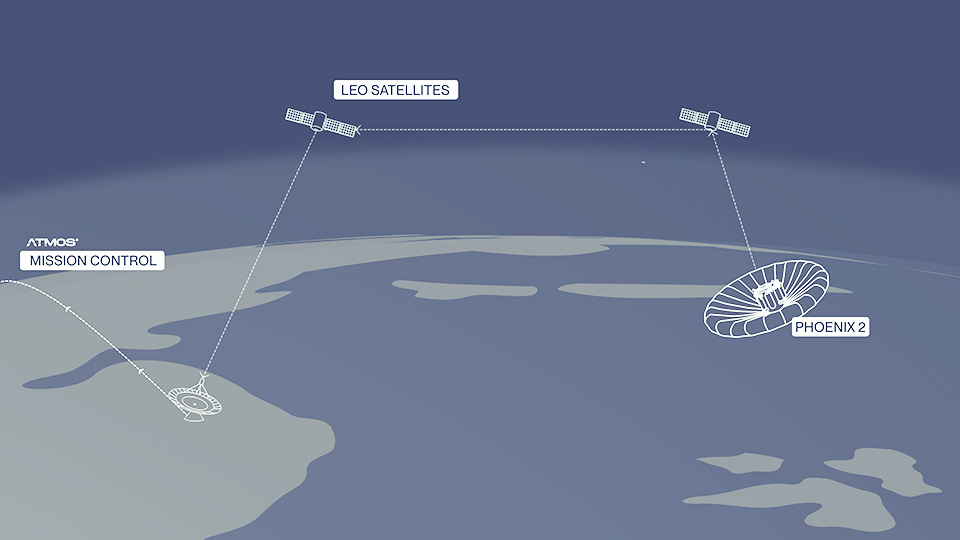
On August 10, 2026, Lithuanian optical communications company Astrolight and German space logistics firm ATMOS Space Cargo signed a Memorandum of Understanding (MoU) to demonstrate an in-flight optical communications link between a re-entry spacecraft and an orbiting low Earth orbit (LEO) satellite.

Scheduled for 2027, the flight test aims to establish real-time, high-speed data transmission during orbital operations and atmospheric re-entry.

The joint mission will address traditional radio-frequency (RF) telemetry degradation caused by ionization and spectrum congestion during spacecraft re-entry phases.

Terminal Hardware Integration and Data Transmission Metrics

During the 2027 demonstration, Astrolight’s low-SWaP (size, weight, and power) ATLAS-X laser communication terminal will fly aboard both the ATMOS PHOENIX 2 re-entry capsule and an orbiting partner satellite. The optical link is designed to transmit system, guidance, de-orbit performance, and payload data at rates up to 2.5 Gbps directly to orbiting relay assets before physical capsule recovery.

Building on ATMOS’s prior in-space payload integration campaign, the PHOENIX return architecture uses a non-ablative Inflatable Atmospheric Decelerator (IAD) that functions as both a heat shield and aerodynamic brake. Integrating compact laser terminals into the capsule allows operators to maintain continuous telemetry without adding significant mass or power demands to the return payload bay.

“Testing a laser link between PHOENIX and an orbiting satellite will mark an important first for re-entry communications,” stated Laurynas Mačiulis, CEO of Astrolight. “Our goal is to help re-entry vehicles connect directly with satellites and, in the future, satellite constellations, so operators can access as much data as possible in real time and make missions more controlled and scalable.”

“ATMOS is working to give Europe independent and routine commercial access to return from space,” added Sebastian Klaus, CEO of ATMOS Space Cargo. “Our partnership with Astrolight is a step toward integrating laser communication into PHOENIX as a strategic layer for payload monitoring, autonomous de-orbit, and re-entry operations.”

Demonstration Timeline and European Cargo Return Logistics

Following initial hardware integration and qualification reviews through late 2026, Astrolight and ATMOS plan to execute the orbital demonstration in 2027. The project aligns with broader European Space Agency (ESA) initiatives, including the LEO Cargo Return Services Initiative, aimed at establishing sovereign, reusable cargo return capabilities for European microgravity research, in-orbit manufacturing, and commercial payload recove

Filed Under: Uncategorized

SpaceX Reports Strong Q2 Results and Details Direct Mobile Telco Strategy

August 5, 2026 by donmcgee

On August 5, 2026, SpaceX President and Chief Operating Officer Gwynne Shotwell outlined the company’s Q2 performance and strategic direction, confirming plans to expand Starlink’s Direct-to-Cell capabilities to compete directly within the commercial mobile telecommunications market.

During a call with industry analysts, Shotwell stated that SpaceX is positioning its Starlink satellite constellation to operate as a full-fledged mobile telecommunications carrier. The strategy targets market share among the primary U.S. wireless carriers—Verizon, AT&T, and T-Mobile—a group that generates approximately $600 billion (€520 billion) in annual revenue.

Direct-to-Cell Architecture and Spectrum Strategy

The commercial expansion relies on SpaceX’s ongoing deployment of Direct-to-Cell (D2C) satellites equipped with onboard eNodeB modems, which act as orbital cell towers capable of connecting directly to unmodified LTE and 5G smartphones.

The technical capability builds on SpaceX’s $17 billion spectrum acquisition from EchoStar, securing AWS-4 and H-Block mid-band licenses. This dedicated 50MHz spectrum block enables high-throughput data connections independently of terrestrial towers, advancing SpaceX toward its target of delivering up to 150Mbps user speeds via VLEO (Very Low Earth Orbit) constellations.

Commercial Partnerships and Network Integration

While initially entering the market through wholesale partnerships—most notably the commercial rollout of the T-Mobile Starlink service—SpaceX’s expanded spectrum assets allow the company to offer direct connectivity to enterprise, commercial, and government users.

The system leverages multi-source network integration, allowing mobile devices to transition automatically from terrestrial cell signals to Starlink orbital beams when entering coverage dead zones.

“SpaceX’s first generation Starlink satellites with Direct to Cell capabilities have already connected millions of people when they needed it most,” said Gwynne Shotwell, President and COO of SpaceX. “In this next chapter, with exclusive spectrum, SpaceX will develop next generation Starlink Direct to Cell satellites, which will have a step change in performance and enable us to enhance coverage for customers wherever they are in the world.”

Telecommunications Market Outlook

SpaceX’s dual track of providing direct consumer satellite broadband and D2C mobile connectivity forms a core component of its long-term revenue model. By leveraging continuous Falcon 9 and Starship launch cadence to refresh its Low Earth Orbit fleet, the company aims to scale capacity, lower end-to-end latency, and secure a significant share of the global mobile-satellite services sector.

Filed Under: Uncategorized

IBSAT Becomes Authorized Amazon Leo Distributor Across Spain and Portugal

August 4, 2026 by donmcgee

MADRID – August 4, 2026 – Expanding enterprise access to low Earth orbit broadband across the Iberian Peninsula, satellite telecommunications provider IBSAT signed an agreement on August 4, 2026, to serve as an authorized distributor of Amazon Leo services throughout Spain and Portugal.

IBSAT, a subsidiary of BLUETEL WIRELESS registered with Spain’s National Markets and Competition Commission (CNMC), will market Amazon’s low Earth orbit network directly to large corporations, small and medium enterprises, and regional internet service providers.

Terminal Hardware and Performance Specifications

Under the partnership framework, IBSAT will integrate Amazon Leo’s user terminals into its connectivity platform. The commercial rollout features phased-array customer equipment options, headlined by the flagship Leo Ultra model.

The high-performance Leo Ultra terminal delivers download throughput of up to 1 Gbps and upload speeds reaching 400 Mbps. This capacity supports bandwidth-intensive operational workloads, high-frequency data transfers, and critical enterprise applications in regions unserved by terrestrial fiber infrastructure.

Regional Enterprise Market Integration

The distribution deal establishes a structured channel model for more than 80 regional ISPs and commercial sales agents operating within IBSAT’s Iberian ecosystem.

By adding Amazon’s network—formerly known as Project Kuiper—to its multi-orbit telecommunications portfolio, IBSAT targets enterprise deployments across diverse sectors. Key operational verticals include agriculture, maritime transport, energy production, remote construction, healthcare, and industrial Internet of Things networks. The reseller agreement follows similar regional commercial expansions by international channel partners, such as Globalsat Group’s distribution deal across the Americas.

Executive Directives on Iberian Expansion

“This agreement represents an extraordinary business opportunity for our clients and for the more than 80 ISPs and agents that are part of the IBSAT ecosystem,” said Javier Gómez, Chief Executive Officer of IBSAT. “This opportunity will allow IBSAT and our partners to participate in this new and growing market in Spain and Portugal, under a solid and consolidated collaboration model with IBSAT, taking advantage of the full capacity of the Amazon Leo satellite network. From large corporations to micro-enterprises, Amazon Leo offers reliable and secure connectivity, and IBSAT is proud to be part of this project to make it possible.”

Deployment and Commercial Rollout Schedule

IBSAT will immediately integrate Amazon Leo hardware and connectivity packages into its regional commercial catalog, enabling enterprise clients and reseller partners across Spain and Portugal to order managed LEO services ahead of network deployment expansion through late 2026.

Filed Under: Uncategorized

Kreios Space Selects Kongsberg NanoAvionics for Air-Breathing Electric Propulsion VLEO Mission

August 4, 2026 by donmcgee

NIGRÁN, Spain, and VILNIUS, Lithuania – August 4, 2026 – Targeting the environmental drag constraints of sustained operations in Very Low Earth Orbit (VLEO), satellite developer Kreios Space contracted small satellite manufacturer Kongsberg NanoAvionics on August 4, 2026, to provide the satellite platform for the first orbital demonstration of an air-breathing electric propulsion system.

The in-orbit demonstration will validate atmosphere-ingesting propulsion capabilities at orbital altitudes between 150 km and 300 km.

Spacecraft and Propulsion Specifications

The mission centers on NanoAvionics’ flight-proven MP42 microsatellite bus, configured to an approximate wet mass of 200 kilograms in its final operational setup. The spacecraft will integrate Kreios Space’s Air-Breathing Electric Propulsion (ABEP) thruster alongside a high-resolution visible and near-infrared (VNIR) optical payload.

Rather than relying on heavy onboard chemical or noble-gas propellants, the ABEP system uses an atmospheric intake to collect residual oxygen and nitrogen molecules present in the upper thermosphere. The collected gas is ionized and accelerated through an electric thruster, counteracting atmospheric drag to enable extended operational lifetimes in low altitudes without onboard propellant mass penalties.

VLEO Market Dynamics and Platform Heritage

Operating in VLEO offers distinct physical advantages for Earth observation and satellite communications, including enhanced sensor spatial resolution, reduced signal propagation latency, and lower launch energy requirements. However, atmospheric drag historically degraded unmaintained orbits within weeks.

The contract expands the operational footprint of NanoAvionics’ MP42 platform, which is currently deployed across multiple specialized payloads including the Eycore SAR demonstrator mission.

Executive Directives on Low-Orbiting Platform Mobility

“Kreios is building the satellites that make sustained operations in Very Low Earth Orbit possible,” said Adrián Senar, CEO of Kreios Space. “By enabling satellites to fly lower, longer, and more efficiently, we are enabling higher-resolution Earth observation, much better satellite communications, more responsive and accurate missions, and a more sustainable orbital infrastructure. Partnering with NanoAvionics in our first in-orbit flight provides us with a satellite bus and market-leading experience necessary to allow us to test our new technology in confidence.”

“Kreios is tackling one of the most demanding operating environments in space, and this mission joins a very short list of European VLEO initiatives,” said Atle Wøllo, CEO of Kongsberg NanoAvionics. “This contract reflects our customers’ continued confidence in the maturity of our platforms and our ability to tailor them for demanding new mission profiles. Our engineering team has worked closely with Kreios to configure the MP42 satellite bus to the mission’s specific requirements.”

Integration and Operational Flight Timeline

Under the agreement, NanoAvionics will customize the MP42 bus, integrate the optical payload and ABEP propulsion unit, conduct full environmental testing, and execute initial in-orbit commissioning before transferring operational control to Kreios Space.

Filed Under: Uncategorized

NASA and ISISPACE Deploy GRITSS CubeSat to Advance Orbital Reference Frame Precision

July 30, 2026 by donmcgee

On Tuesday, July 7, 2026, NASA’s Geodetic Reference Instrument Transponder for Small Satellites (GRITSS) technology demonstration spacecraft successfully launched into low Earth orbit.

The payload lifted off from Vandenberg Space Force Base in California aboard a SpaceX Falcon 9 rocket conducting the Transporter-17 dedicated small-satellite rideshare mission.

The scientific mission is designed to act as a space-based geodetic reference point to eliminate site tie errors between independent terrestrial observation networks. The mission is a collaborative effort between the NASA Goddard Space Flight Center, the University of Massachusetts Lowell, and Dutch small-satellite manufacturer ISISPACE.

Core Technical Subsystems and Signal Upconversion Specifications

The GRITSS instrument is housed within a 12U-XL CubeSat bus developed and integrated by ISISPACE. To minimize errors in the International Terrestrial Reference Frame (ITRF), the spacecraft coordinates tracking data from three distinct ground-based observing methods: Global Navigation Satellite Systems (GNSS), Very Long Baseline Interferometry (VLBI), and Satellite Laser Ranging (SLR). The physical payload architecture includes the following sub-components:

  • A geodetic-quality NavCube 3 Mini GPS receiver designed for high-precision orbit determination within a compact small-satellite form factor.
  • An onboard reference module featuring a 10 MHz ultra-stable oscillator precisely synchronized to GPS time to maintain timing accuracy.
  • Integrated S-band and X-band transmitters paired with highly stable miniature antennas to broadcast phase-stable reference signals back to Earth.
  • A concurrently mounted laser retroreflector array to allow direct ranging measurements from ground-based Satellite Laser Ranging laser stations.

The system architecture works by capturing incoming Global Positioning System signals at the satellite, upconverting them in real-time to S-band and X-band frequencies, and broadcasting them down to Earth. This processing loop establishes mutual spectral compatibility, allowing ground-based VLBI Global Observing System antennas to receive and track the coded information as if the satellite were a pseudo stand-alone GPS receiver.

Program History and International Topography Context

Historically, tying independent geodetic observation systems together relied on localized ground-based surveying techniques, which introduced millimeter-level site tie bias errors into global reference frames. By serving as a singular space-based observation node viewable by all three tracking techniques, the GRITSS payload aims to bridge these systems to achieve the Earth Science Decadal Survey’s target of 1-millimeter reference frame accuracy.

The physical assembly, mission design, and payload integration logistics for the flight segment were finalized under a commercial contract with ISISPACE. Final physical processing and launch vehicle fairing integration were executed in the weeks leading up to lift-off by launch integration provider SEOPS, which paired the satellite with an ISISPACE QuadPack deployment system to optimize the structural layout inside the Falcon 9 rocket.

Operational Validation and Tracking Timeline

The CubeSat is positioned in a low Earth sun-synchronous orbit, allowing it to systematically cross over primary ground tracking nodes. Following initial satellite deployment, ISISPACE engineers will manage the spacecraft’s early orbit tracking and commissioning phases from their secure operations center.

Nominal operations are scheduled to run for at least one full year. Initial data collection passes will focus on broadcasting signals to NASA tracking stations located in Maryland, Texas, and Hawaii. Data harvested during the second half of the tracking campaign will be exten

Filed Under: Uncategorized

Momentus Vigoride 7 Completes Orbital Altitude Adjustments as Hosted Payload Testing Progresses

July 30, 2026 by donmcgee


SAN JOSE, Calif., July 30, 2026 – Commercial space transportation provider Momentus Inc. announced on July 30, 2026, that its Vigoride 7 Orbital Service Vehicle (OSV) has achieved critical operational milestones during its ongoing multi-month mission in Low Earth Orbit (LEO).

The vehicle launched on March 30, 2026, aboard the SpaceX Transporter 16 rideshare flight, carrying ten dedicated and hosted payloads for commercial entities, NASA, and the U.S. Department of Defense. The mission follows earlier operational milestones, including a SpaceWERX and NASA Space Act Agreement focused on automated rendezvous and in-space inspection techniques.

Water-Powered Propulsion and Altitude Adjustments

During recent operations, the spacecraft successfully completed a series of orbit-lowering maneuvers that reduced its altitude by nearly 20 km. The orbital adjustments were executed through more than 50 controlled firings of the vehicle’s onboard dual Microwave Electrothermal Thrusters (METs), which utilize water as a non-toxic propellant.

The proprietary propulsion system creates thrust by heating water propellant using microwave energy to generate plasma. With the completion of these maneuvers, Momentus has logged more than 400 total operational firings of its MET propulsion hardware across its active flight history since 2023.

Additively Manufactured Hardware and Hosted Payloads

Alongside propulsion testing, Momentus continues to evaluate onboard hardware subsystems and customer payloads. Integrated momentum wheels operated on the Vigoride vehicle for the first time are functioning within nominal parameters. Additionally, flight testing of an in-house titanium additively manufactured fuel tank demonstrated successful pressure containment, validating 3D-printing manufacturing techniques designed to streamline small satellite component production timelines.

The vehicle also maintains active operations for partner payloads conducting communications trials, edge computing demonstrations, and structural in-space assembly tests.

Executive Directives and Forward Flight Schedule

“We’re proud of the performance that our satellite technologies, including our Vigoride 7 spacecraft, continue to show in orbit,” said John Rood, Chief Executive Officer of Momentus. “We leverage the many decades of space experience of our engineering and technology team and the experience gained on our past missions since 2022 to provide cost-effective results for our customers who, like Momentus, operate at the cutting-edge of space technology.”

Momentus is preparing its fully booked Vigoride 8 mission for launch in 2027 to carry two NASA payloads. Concurrently, production has commenced on the Vigoride 9 vehicle following initial commercial payload capacity bookings for Vigoride 9.

Filed Under: Uncategorized

Juniper Research Projects VLEO Satellite Investment to Reach $10 Billion by 2031

July 29, 2026 by donmcgee


To capture higher-resolution Earth observation data and deliver reduced communications latency at lower orbital altitudes, global tech market firm Juniper Research released a study on Tuesday, July 28, 2026, forecasting that global investment in Very Low Earth Orbit (VLEO) satellites will approach $10 billion (€8.8 billion) by 2031.

The projected expansion from $5.2 billion in 2026 represents a growth rate of nearly 100 percent over the five-year period. The market shift is driven by expanding commercial constellation deployments, lower launch expenditure, and advancements in onboard processing, materials science, and specialised electric propulsion systems.

Operational Parameters and Earth Observation Focus

The study identifies Earth observation (EO) as the primary commercial driver for VLEO satellite capital expenditures throughout the forecast horizon. By operating at orbital altitudes below 450 kilometers, satellites experience significantly less physical distance to the surface, enabling smaller optical and synthetic aperture radar (SAR) payloads to achieve resolution comparable to much larger, higher-altitude low Earth orbit (LEO) platforms.

This altitude advantage reduces hardware production and launch costs, enhancing mission economics for commercial imagery and remote sensing applications. The report follows earlier market tracking by Juniper Research that identified VLEO commercial growth indicators across telecommunications, navigation, and environmental monitoring sectors.

Technical Challenges and Sector Outlook

Despite favorable payload economics, the research highlights that long-term commercial viability depends on mitigating severe atmospheric drag and atomic oxygen erosion characteristic of orbits below 450 kilometers. Sustained operation requires satellite developers to implement aerodynamic structural designs, durable protective coatings, and high-efficiency continuous propulsion systems to prevent rapid orbital decay.

The report notes that market vendors successfully overcoming these drag constraints will secure early commercial advantages, mirroring ongoing defense initiatives such as the European Defence Agency’s GomSpace-led VLEO military satellite program and DARPA’s Orion Space Solutions-led Ouija mission.

Filed Under: Uncategorized

  • « Go to Previous Page
  • Page 1
  • Interim pages omitted …
  • Page 19
  • Page 20
  • Page 21
  • Page 22
  • Page 23
  • Interim pages omitted …
  • Page 32
  • Go to Next Page »

Primary Sidebar

WEEKLY NEWSLETTER

Archives

  • November 2026
  • October 2026
  • September 2026
  • August 2026
  • July 2026
  • June 2026
  • May 2026
  • April 2026
  • March 2026
  • February 2026
  • January 2026
  • December 2025
  • November 2025
  • October 2025
  • September 2025
  • August 2025
  • July 2025
  • June 2025
  • May 2025
  • April 2025
  • March 2025
  • February 2025
  • January 2025
  • December 2024
  • November 2024
  • October 2024
  • September 2024
  • August 2024
  • July 2024
  • June 2024
  • May 2024
  • April 2024
  • March 2024
  • February 2024
  • January 2024
  • December 2023
  • November 2023
  • October 2023
  • September 2023
  • August 2023
  • July 2023
  • June 2023
  • May 2023
  • April 2023
  • March 2023
  • February 2023
  • January 2023
  • December 2022
  • November 2022
  • October 2022
  • September 2022
  • August 2022
  • July 2022
  • June 2022
  • May 2022
  • April 2022
  • March 2022
  • February 2022
  • January 2022
  • December 2021
  • November 2021
  • October 2021
  • September 2021
  • August 2021
  • July 2021
  • June 2021
  • May 2021
  • April 2021
  • March 2021
  • February 2021
  • January 2021
  • December 2020
  • November 2020
  • October 2020
  • September 2020
  • August 2020
  • July 2020
  • June 2020
  • May 2020
  • April 2020
  • March 2020
  • February 2020
  • January 2020
  • December 2019
  • November 2019
  • October 2019

© 2019–2026 SatNews

Insert/edit link

Enter the destination URL

Or link to existing content

    No search term specified. Showing recent items. Search or use up and down arrow keys to select an item.
      x
      Sign Up Now!

      Enjoy a free weekly newsletter with recent headlines from the global SmallSat industry.

      Invalid email address
      We promise not to spam you. You can unsubscribe at any time.
      Thanks for subscribing! You will now receive weekly SmallSat News updates.
      We love our advertisers.
      And you will too!

      Please disable Ad Blocker to continue... We promise to keep it unobtrusive.
      We promise not to spam you. You can unsubscribe at any time.
      Invalid email address
      Thanks for subscribing!