• Skip to main content
  • Skip to primary sidebar
  • Home
  • News
  • Featured
  • More News ⌄
    • SatNews
    • SatMagazine
    • MilSatMagazine
  • Events ⌄
    • MilSat Symposium
    • SmallSat Symposium
    • Satellite Innovation
  • Contacts
  • SUBSCRIPTION

SmallSat News

You are here: Home / Archives for 2020

Archives for 2020

Open Cosmos Begins the Build and Operation of One of the One Hundred Smallsats for Sateliot’s Constellation

July 28, 2020 by editorial

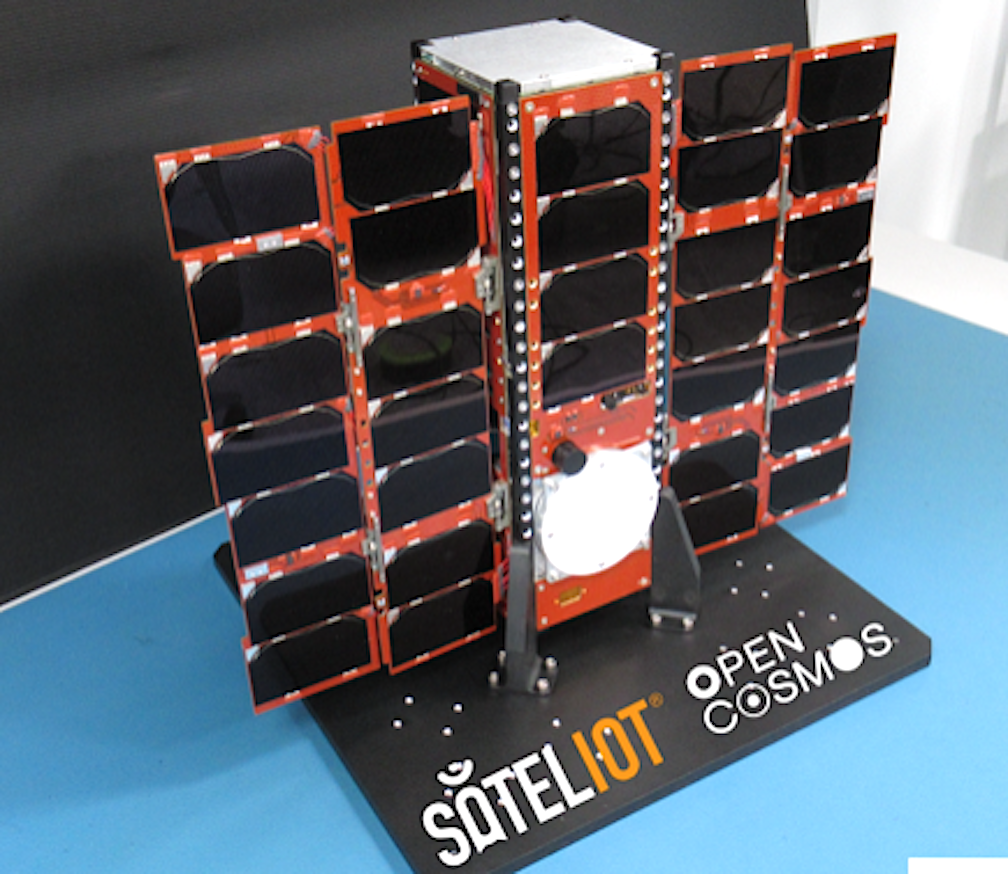
Open Cosmos announced that they have ‘sealed a deal’ with satellite communications operator Sateliot to build and operate their small satellite constellation. This enables continuous global connectivity for Internet of Things (IoT) under 5G architecture.

Open Cosmos is already manufacturing the first of the one hundred that will comprise the full constellation, that Sateliot has scheduled for construction before the end of 2022. Additionally they will control the mission management and launch of the first satellites.

These microwave oven-sized satellites operate in Low Earth Orbit (LEO), flying at an approximate altitude of 500km to guarantee IoT connectivity at a global scale and in almost real-time.

In the next two years it is forecast that there will be more than 50 billion IoT devices globally, and with this constellation Sateliot is perfectly positioned to partner with conventional telecommunication providers to ensure ubiquitous coverage.

Sateliot will also offer monitoring and tracking systems, data analysis, and processes in areas such as: maritime, railways, aeronautical, agriculture and farming, gas and petroleum exploration, electric or critical infrastructure.

Rafel Jordá, Founder and CEO of Open Cosmos said, “We are excited to have satellite production underway for these satellites and be progressing all other aspects of the mission, including system integration, launch, licensing and logistics, as well as orbit operations. We are delighted to partner with Sateliot to enable the reality of IoT anywhere.”

Jaume Sanpera, co-founder and CEO of Sateliot, added that, “A bond with a partner, such as Open Cosmos, allows us to move forward with our project, meeting head-on the requirements and challenges the New Space industry faces, while keeping control over the design of the antennae and the radio that will allow the operational and commercial management of our telecommunications service.”


Filed Under: Featured, News

HawkEye 360 Now Delivering Daily Regional Awareness Subscription Service

July 28, 2020 by editorial

HawkEye 360 Inc. is now offering a daily Regional Awareness Subscription (RAS) service.

Leveraging the company’s RFGeo product, RAS delivers mission-critical insights by allowing organizations to identify, monitor, and analyze signal behavior over time. Large-scale RF signal mapping provides deeper situational awareness in these regions, with the data sets enabling trend analysis using traditional and artificial intelligence algorithms.

HawkEye 360 will work with customers to define a Regional Awareness Subscription that can span millions of square kilometers. Current RAS collection areas include the Mediterranean, South China Sea, and the Korean Peninsula. HawkEye 360 curates a collection plan that routinely gathers a combination of high-demand signals. The company delivers the data in an open standard GeoJSON format that seamlessly integrates with most applications.

HawkEye 360’s RFGeo product identifies and geolocates RF signals collected by HawkEye 360’s proprietary satellite constellation. RFGeo is the first commercially available product offering global spectrum awareness across a broad range of radio signals. HawkEye 360 plans to expand the RAS offering to include new areas of interest important to customers.

Executive Comments

“We’re offering a massive collection of data across a broad area. We are also enabling organizations to access periodic data and analytics for areas they want to monitor,” said Tim Pavlick, VP of Product, HawkEye 360. “Subscribers will receive a daily collection of RF data, allowing them to gain comprehensive insight into their regions, establish historical analysis, and augment other geospatial intelligence solutions.”

“With our Regional Awareness Subscription service, we provide customers with a dependable source of timely, trusted RF signal insights that have been detected, characterized, and geolocated over the region,” said Alex Fox, EVP Business Development, Sales and Marketing, HawkEye 360. “These insights allow our customers to identify, understand, and respond to activities important to their operations more effectively.”

Filed Under: Featured, News

A Virtual Presence: Orbital Transports @ the Small Satellite Conference

July 28, 2020 by editorial

The annual Small Satellite Conference is a premier space conference that is devoted entirely to smallsats and among the best places to find out what’s happening in the smallsat industry. Orbital Transports will be participating in this event.

Usually held in Logan, Utah, this year’s virtual SmallSat conference will be held from August 1-6, 2020 — registration is free.

David Hurst

Orbital Transports is participating this year and invite all to visit the company’s virtual exhibition booth. There will be a live video chat channel where you can talk with company representatives — plus, don’t miss CEO David Hurst’s webinar on Tuesday about the firm’s new Get Spaceborne service. Details below:

Live Chat: Orbital Transports SmallSat Virtual Booth August 3-6, 2020 11:00 AM – 3:00 PM MDT

Webinar: Get Spaceborne – Flight Heritage for Your Product Tuesday, August 4, 2020 11:30 – 11:45 AM MDT

Check out the Space Catalog, Orbital Transport’s digital portal for the smallsat industry that showcases some of the industry’s most innovative and reliable companies. Featuring smallsat buses, COTS hardware components, ground station services and mission operations software, orbital transfer services, hosted payloads, and satellite servicing and refueling technologies, the Space Catalog provides a convenient go-to resource to check out the latest and greatest that the smallsat industry has to offer.

Filed Under: News

Benchmark’s Smallsat Propulsion Workshop A Success

July 28, 2020 by editorial

It’s no surprise anymore that work is different — at Benchmark Space Systems, the company wanted to offer an opportunity for the propulsion community to stay connected – even if that is harder working from home.

In early July, the Benchmark team produced a 2.5 hour workshop entitled “Propulsion Systems 101 Interactive Workshop – A guide to selecting the right propulsion technology for your Small Satellite mission.” In the firm’s opinion, this workshop was a great success. The company wanted to share some highlights and lessons learned for others wanting to build a learning experience for the community during COVID.

The propulsion workshop focused on providing brand-agnostic summaries of different propulsion technology as well as topics that relate to spacecraft in general – such as launch operations, mission design and financial decisions that impact the economics of a mission. While these are topics in which the firm could have easily deep dived into the technical weeds, all of the speakers focused on making their content accessible to the wider audience. This paid off greatly when it came time for the actual workshop – with more than 150 attendees, there was a huge swath of experience and backgrounds ranging from college students to industry veterans.

Working with amazing people makes the whole process infinitely more enjoyable. At Benchmark, several team members were present. Jake Teufert presented a summary of chemical propulsion systems, Isa Peterson discussed the mission level impacts that drive propulsion decisions and Chris Carella acted as the MC for the event. Other colleagues rounded out the conversation:

  • Grant Bonin (Spaceflight Industries) discussed launch site considerations and advice for propulsion manufactures
  • Ian Christensen (Secure World Foundation) spoke on regulatory impacts coming soon and how that might impact the propulsion and spacecraft industries
  • Jason Wallace (Phase Four, Inc) discussed brand-agnostic electric propulsion systems
  • Jared Bottoms (Kepler) enlightened us on the economic considerations for having a propulsion system for your spacecraft fleet

All these contributors brought sizable impact to this workshop.

The main goal of this workshop was to put together an event that every attendee in the audience would walk away from having learned something in an enjoyable way. Keeping the topics dynamic, brand agnostic and light in nature offered a safe space for the audience to learn together and ask questions without feeling like they were getting a sales pitch for three hours.

In addition to the conversation and presentations, a mega mission design tool was created. This high-level, criteria driven tool allows mission designers of all capability and program maturity to consider different propulsion systems side by side for the mission they are building. Toggles include total delta-V,mission life, de-orbiting preferences, and more. Benchmark hopes this tool enables designers the ability to quick trade options in the future.

Benchmark Space Systems Propulsion Systems.

Filed Under: News

SFL Presents Their New Line Of Smallsat Buses

July 27, 2020 by editorial

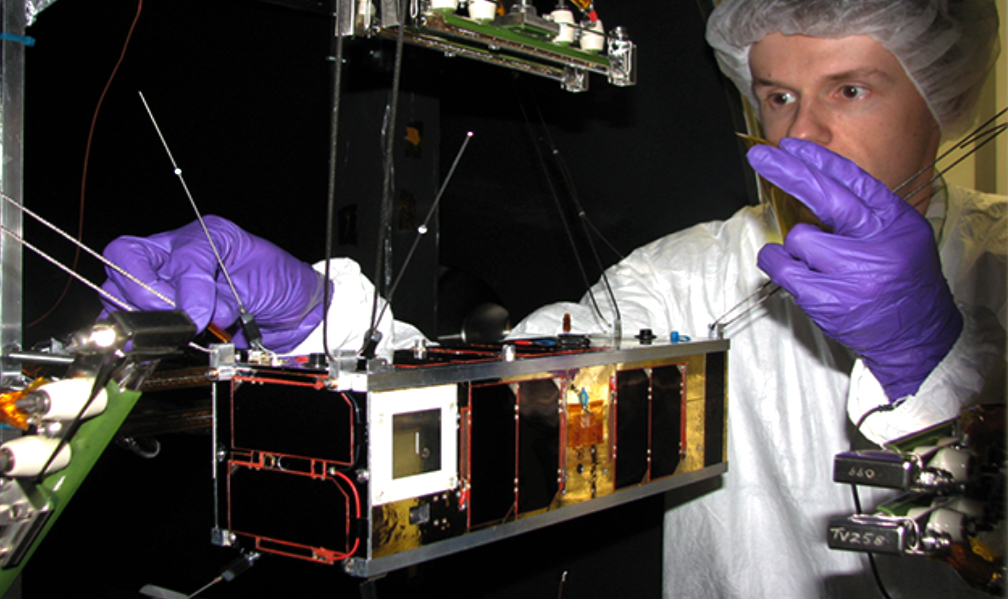
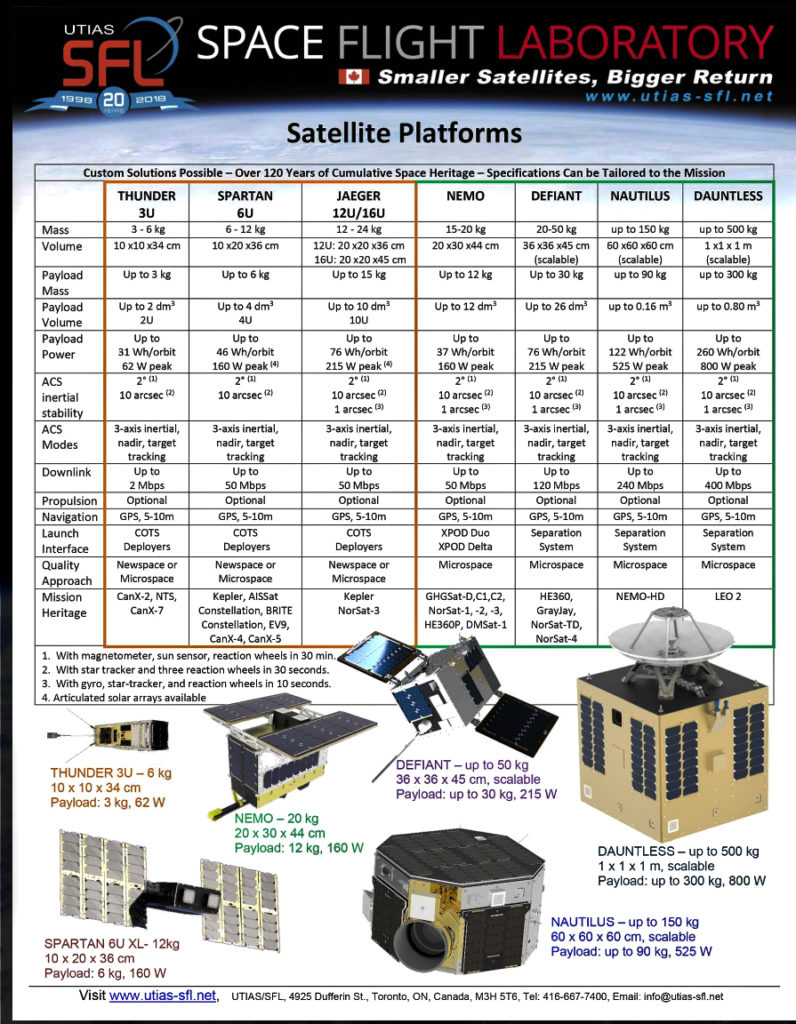
Space Flight Laboratory (SFL) has revealed a new line of high-performance, low-cost cubesat buses — these are the 3U (“THUNDER”), 6U (“SPARTAN”) and 12U/16U (“JAEGER”) cubesats, which complement SFL’s legacy suite of space-heritage smallsats, fulfilling mission size requirements from 3 to 500 kg.

SFL will discuss its new cubesats and legacy buses at the virtual Small Satellite Conference (SmallSat 2020) that is being held online Aug. 1-6, 2020.

SFL was among the first in the world to launch cubesats that included the CanX-1 CubeSat in 2003 and CanX-2 in 2008, with capabilities that exceeded the state-of-the-art at that time. Since then, SFL has focused on somewhat larger, more capable satellites for more challenging missions, garnering a reputation for “quality at low cost.” As SFL delivered high-performance, high-quality smallsats for more than two decades, the cubesat market matured and the number of commercial opportunities increased.

The new product line of high performance CubeSats leverages SFL’s quality platform technologies while addressing the need for aggressive, disruptive missions and satellites that are as small as possible to meet highly constrained business demands. This represents a return to cubesats for SFL but with the ability to leverage more than 22 years of experience and technological advancements.

Bringing to bear the accumulated power of SFL know-how and technologies will satisfy the now mature demand for platforms that perform well and are compatible with commercial-off-the-shelf cubesat deployers and aggregated launches.

With demonstration and operational programs in mind, SFL has also announced Newspace (accelerated) and Microspace (standard) development options for the new cubesat line. The accelerated procedures are designed to move demonstration satellites quickly through the development process and into orbit for short-term proof-of-concept performance.

They can also be used operationally in scenarios where rapid replenishment is planned. Microspace, or SFL’s standard development approach, which has been perfected at SFL for more than two decades, ensures the reliability of operational spacecraft built for long-duration missions in orbit.

SFL satellites have achieved more than 121 cumulative years of operation in orbit. These microspace missions have included SFL’s trusted attitude control and, in some cases, formation-flying capabilities. Other core SFL-developed components include modular (scalable) power systems, onboard radios, flight computers, and control software.

The new SFL cubesats will be ideal for NewSpace programs that are intended to either disrupt commercial markets or operate from a long-term rapid replenishment strategy. The industry-accepted form factors of cubesats make them attractive for proof-of-concept programs or programs that involve repetitive quick replenishment where cost constraints are critical. They fit the cost models of some businesses because they are built for orbital deployment from, and aggregation of relatively inexpensive, standardized dispensers being mass produced on the market today.

SFL’s heritage of on-orbit successes includes missions related to Earth Observation (EO), atmospheric monitoring, ship tracking and communication, radio frequency signal geolocation, technology demonstration, space astronomy, solar physics, space plasma, and other scientific research.

At SmallSat 2020, SFL will present a paper on “Guidance, Navigation, and Control for Agile Small Spacecraft with Articulating Solar Arrays” during (cubesat) Workshop, Session I: Advanced Concepts I (Session Q&A Webinar, Noon to 1pm MDT, Tuesday August 4). SFL will also host live Zoom sessions to answer questions from 12:00 to 4:00 p.m., MDT, on August 3, 8:00 a.m. to 4:00 p.m., MDT, on August 4-5, and 8:00 a.m. to 12:00 p.m., MDT, on August 6.

The SFL SmallSat 2020 Zoom link is
https://utoronto.zoom.us/j/96150927505

Executive Comment

Dr. Robert E. Zee

“SFL can accommodate the budget and performance objectives of any microspace mission,” said SFL Director Dr. Robert E. Zee. “And we are positioned to meet the evolving spacecraft development and business model requirements of different organizations – from disruptive demonstration missions to fully operational constellations. The new line of high-performance cubesats will allow us to offer something for everyone, from market disruption to long-term operational stability. The spectrum of SFL platform offerings will enable staged roadmaps to larger missions for some customers. Having platforms that cover the full range of capability will make transitioning and forward compatibility easier for our most demanding clients.”

Zee continued, “Every satellite we build – whether CubeSat, nanosat, or microsat – incorporates the same flight heritage, avionics, and attitude control that we have developed and refined after developing 52 distinct satellites – either launched or launching soon – the Microspace Way,” said Zee. “Regardless of the demands of the mission, we use the same generic core and scale the platform as necessary to meet specific mission objectives. Once a demonstration CubeSat is launched and successfully commissioned, SFL is able to trigger mass production for rapid deployment and replenishment or leverage the success to take our client’s business model to the next step. This may involve transitioning to longer lifetime CubeSats and/or our legacy microspace platforms which can be done with relative ease.”

Filed Under: News

Hughes To Participate In The OneWeb Consortium

July 27, 2020 by editorial

Artistic rendition of the Hughes EchoStar XIX satellite that connects a greater number of households and small businesses with fast satellite Internet speeds.

Hughes Network Systems, LLC (HUGHES) will participate in the consortium, led by the U.K. Government and Bharti Enterprises (“Bharti”) that will acquire OneWeb out of bankruptcy.

Hughes has agreed in principle to invest $50 million in the consortium. Additionally, Hughes will continue as a trusted technology and distribution partner to OneWeb, the Low Earth Orbit (LEO) satellite operator which had launched 74 satellites before filing for Chapter 11 protection in March.

Artistic rendition of a OneWeb satellite on-orbit.

Consummation of the consortium is contingent upon execution and effectiveness of definitive agreements. Confirmation of OneWeb’s reorganization is contingent on certain conditions established by the Bankruptcy Court.

Through its Hughes Europe division, which is headquartered outside of London, and sister company EchoStar Mobile Limited, Hughes has worked closely with the U.K. Government. Furthermore, Hughes Communications India Ltd, (HCIL), a majority-owned subsidiary of Hughes, and Bharti Airtel Limited (“Airtel”), a leading Indian telecom provider affiliated with Bharti, are in the process of combining their satellite broadband operations in India.

The merger, which was announced in 2019, is pending regulatory approvals and is expected to bring greater scale, operational efficiencies and market reach to deliver solutions for enterprise and government networks.

Executive Comments

Pradman Kaul

“We are pleased to be part of this winning team, along with the British Government and Bharti,” said Pradman Kaul, President, Hughes. “Our continuing and strengthened involvement with OneWeb extends naturally from our position as a leading geostationary satellite operator and ground network innovator, along with a meaningful partnership with Bharti and longstanding relationship with the U.K. through our business operations in both countries. This global consortium brings the right players together to fulfill the promise of the OneWeb constellation in deploying low-latency services for communities, enterprises, governments, airplanes and ships – complementing geostationary connectivity and ushering in the new era of multi-transport services that will serve growing bandwidth demand around the world. We look forward to doing our part in developing this groundbreaking technology and bringing those services to market.”

Sunil Bharti Mittal

Sunil Bharti Mittal, Founder and Chairman, Bharti Enterprises, added, “We are delighted to welcome Hughes to the consortium. The investment by Hughes underlines OneWeb’s exciting commercial prospects, reflected in the ongoing discussions with some of the world’s leading strategic and financial investors.”

Filed Under: News

Combining Their Smallsat Expertise… RHEA Group and GomSpace

July 24, 2020 by editorial

RHEA Group and GomSpace have recently signed a Memorandum of Understanding (MOU) to further combine their expertise on Security for Space and the development and operations of large constellations of smallsats.

The MOU consolidates a closer collaboration between the two companies as a result of past and ongoing activities in related fields. Under this MOU, the companies are partnering on security developments and monitoring operations associated with GomSpace’s present and future on-orbit satellite constellation activities, including taking advantage of RHEA’s Cyber-Range and Cyber Security Operations Centre (C-SOC).

The two companies are joining forces to address the need from customers for secure and cyber-resilient satellite constellations. The partnership will focus on security throughout the design, development and operations of the GomSpace satellite constellations.

Executive Comments

“We are delighted to be working closely with GomSpace, which is a thriving example of the new era of space companies. Its innovative approach to the development and use of SmallSat systems and subsystems is very exciting and is a perfect match to the RHEA way of working. This partnership will provide a unique offering for customers needing an end-to-end secure satellite constellation solution,” said Arne Matthyssen, RHEA Group Chief Solutions and Innovation Officer.

Niels Buus

Niels Buus, CEO at GomSpace, added, “GomSpace and RHEA have worked together on some very interesting projects and we are delighted to consolidate the relationship through this MOU. RHEA has proven to be a front runner in Security and Cybersecurity for Space, and this alliance will enable both parties to benefit from each respective domain expertise and provide GomSpace with a unique selling proposition in the SmallSat market. There is no question that security aspects of future missions are becoming more important for our customers.”

Filed Under: News

Ground Segment Services For Agnikul’s Agnibaan Rocket To Be Managed by Leaf Space

July 24, 2020 by editorial

Leaf Space has announced their official partnership with Agnikul, a company building an affordable launch vehicle that is capable of launching smallsats on-demand.

Under the MoU just signed, the company will be supporting Agnikul in the provisioning of ground segment services for their highly portable launch vehicle – Agnibaan – through Leaf Space’s ground station network infrastructure.

Leaf Space’s support will be delivered via the development of a mobile and versatile ground station that is capable of supporting the Agnibaan launcher in the initial phases of lift-off from any of their launch locations. Short setup and turnaround time will be key elements of the Leaf Space service support. Furthermore, the launcher will be supported by the rest of Leaf Space’s ground station network infrastructure.

The company is also exploring the ability to offer to Agnikul’s customers the firm’s ground segment support as a package with the Agnibaan launch service itself. This will further simplify mission management for the firm’s customers.

Filed Under: Featured, News

An Analysis of Prospects for the Small Satellite Market

July 24, 2020 by editorial

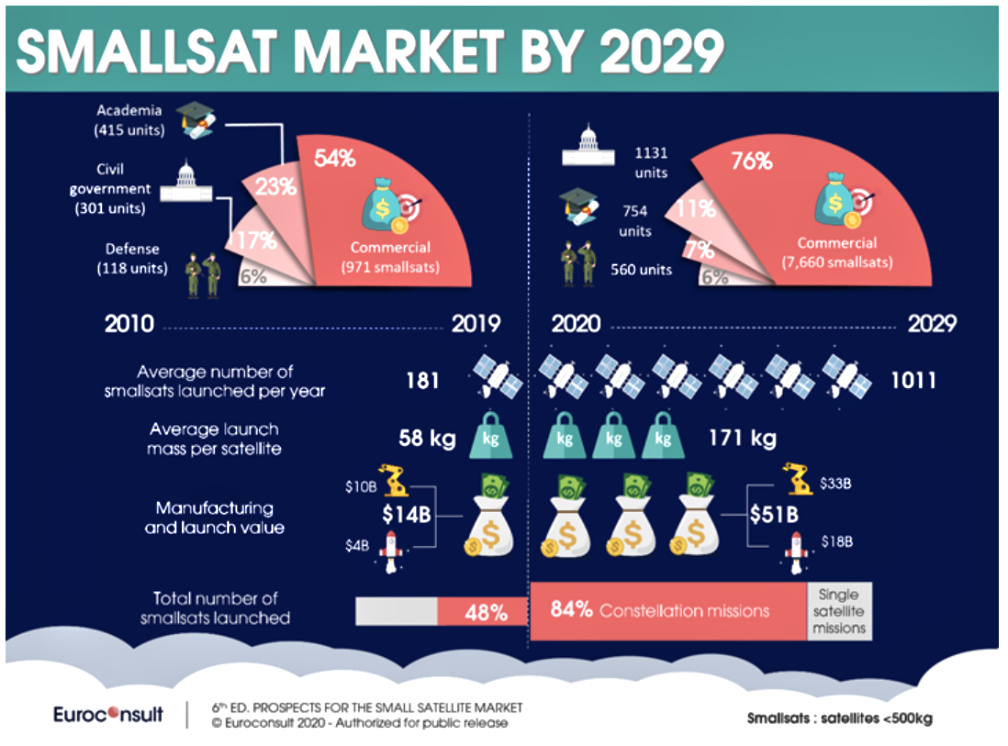
In the 6th edition of its latest research titled “Prospects for the Small Satellite Market,” Euroconsult forecasts that two mega-constellations will account for half of the smallsats to be launched between 2020 and 2029, yet only account for one fifth of the total smallsat market value due to economies of scale, mass manufacturing and batch launches.

The report also addresses the impact of COVID-19 on the small satellite industry and provides updated analysis of the ongoing uncertainties related to the pandemic, smallsat constellations and the OneWeb bankruptcy, despite its recent acquisition.

The 2020s are predicted to be the decade of small satellites with an annual average of 1,000 smallsats to be launched. By comparison, 2019 had the highest number of smallsats to date, with 385 smallsats launched. These spacecraft generated $2.8 billion of market value in 2019, of which 70 percent for manufacturing and 30 percent for launch.

From 2020 to 2029, the smallsat market value is projected to reach $51 billion, of which $33 billion for manufacturing and $18 billion for launch. This is more than four times the market size of the previous decade.

In the coming decade, smallsat market growth will be dominated by communication satellites with nearly 5,700 units forecasted for launch. In contrast, Earth Observation satellites will decrease in market share but will nonetheless triple in terms of units, with 1,520 anticipated. Nonetheless, high levels of uncertainty remain as the smallsat market is, by definition, very volatile. The failure (or market entry) of a single constellation may represent hundreds of satellites of variation.

Executive Comment

Alexandre Najjar

“The COVID-19 pandemic is expected to have a significant impact on the industry. This impact will however vary depending on the size and nature of stakeholders. While many early-stage commercial new entrants will fail to raise funding and deploy their constellations, the two market leaders, SpaceX and Amazon, have been strengthened by the pandemic,” said Alexandre Najjar, Senior Consultant at Euroconsult. “While the commercial sector (Starlink and Kuiper excepted) will decrease compared to previous years due to a COVID-19-induced market rationalization, growth in government smallsat projects is accelerating as nations now recognize the potential and cost savings enabled by the smallsat form, both for civilian and military use cases. Vertical integration is increasing in the smallsat industry. Significant future market shares are now captive of a region, of a country or of an integrator and/or launch provider, challenging both commercial satellite integrators and launch providers which see more of their target customers now competing with their own services. The Asian market, 72% of which is government-driven, will account for 1,600 smallsats over the next decade, competing with US companies to provide connectivity services to foreign countries. The regional market is largely driven by, but not limited to China.”

Filed Under: Featured, News

Sateliot + Gatehouse Join Forces To Bring sat5G Connectivity To The World

July 23, 2020 by editorial

Sateliot has sealed an agreement with the Gatehouse Group to develop the world’s first NB-IoT network, which will enable the company to offer global 5G connectivity once their LEO smallsat constellation is deployed.

This agreement with Gatehouse is part of the $4.6 million investment plan in R&D of Sateliot and is one of the three projects that the Spanish company will carry out in the next two years.

Specifically, this work will consist of adapting the NB-IoT Slack Protocol and the NB-IoT waveform so that IoT terminals can be connected to Sateliot’s LEO satellite network whenever they do not have land coverage or are deployed in areas where there is no classic mobile communication infrastructure, such as remote regions of the Arctic or the Australian outback, for example.

Within this framework, both companies will develop a ‘laboratory environment’ where they will simulate the connection using configurable hardware and test the commercial Sateliot services that are expected to start operating in the third quarter of 2022.

Sateliot’s research and work with Gatehouse will contribute to the implementation of the 5G NB-IoT international standard for small and low altitude satellite networks promoted by the 3GPP association, responsible for the 3G/4G and 5G standard, of which Sateliot is an active member. This innovative standard will also be patentable for Sateliot’s exclusive use.

Nevertheless, and according to these implementations and developments, the company will deploy from the last part of the year a constellation composed of up to 100 of these devices. With the size of a microwave, they will orbit some 500 km from the Earth, rising as telecommunications towers from space that will provide an extension of coverage to traditional operators so that they can connect objects anywhere terrestrial networks do not reach.

Executive Comments

Michael Bondo Anderson

For Michael Bondo Andersen, CEO of Gatehouse, “Considering the potential of the New Space or data as 2.7 million IOT devices are connected today through satellites, it is necessary to develop a solution that moves the NB-IOT protocols into space.”

Marco Guadalupi

According to Marco Guadalupi, technical director of Sateliot, “Our agreement with Gatehouse is strategic and fundamental for the implementation of our services. And a differentiating step since it will allow us to put our expertise in the main organizations of the sector of which we are members such as 3GPP, GSMA, ETSI or 5G IA“.

Sateliot will provide global and continuous connectivity to all the elements that will make up the universe of the Internet of Things (IoT) – such as the car or the house connected – under the 5G protocol. Thanks to a constellation of the latest generation of smallsats, located at low altitude that act as mobile towers, Sateliot is the perfect complement to the large telecommunications companies by providing them with the necessary infrastructure where terrestrial technologies do not reach.

Filed Under: News

  • « Go to Previous Page
  • Page 1
  • Interim pages omitted …
  • Page 24
  • Page 25
  • Page 26
  • Page 27
  • Page 28
  • Interim pages omitted …
  • Page 57
  • Go to Next Page »

Primary Sidebar

WEEKLY NEWSLETTER

Archives

  • June 2026
  • May 2026
  • April 2026
  • March 2026
  • February 2026
  • January 2026
  • December 2025
  • November 2025
  • October 2025
  • September 2025
  • August 2025
  • July 2025
  • June 2025
  • May 2025
  • April 2025
  • March 2025
  • February 2025
  • January 2025
  • December 2024
  • November 2024
  • October 2024
  • September 2024
  • August 2024
  • July 2024
  • June 2024
  • May 2024
  • April 2024
  • March 2024
  • February 2024
  • January 2024
  • December 2023
  • November 2023
  • October 2023
  • September 2023
  • August 2023
  • July 2023
  • June 2023
  • May 2023
  • April 2023
  • March 2023
  • February 2023
  • January 2023
  • December 2022
  • November 2022
  • October 2022
  • September 2022
  • August 2022
  • July 2022
  • June 2022
  • May 2022
  • April 2022
  • March 2022
  • February 2022
  • January 2022
  • December 2021
  • November 2021
  • October 2021
  • September 2021
  • August 2021
  • July 2021
  • June 2021
  • May 2021
  • April 2021
  • March 2021
  • February 2021
  • January 2021
  • December 2020
  • November 2020
  • October 2020
  • September 2020
  • August 2020
  • July 2020
  • June 2020
  • May 2020
  • April 2020
  • March 2020
  • February 2020
  • January 2020
  • December 2019
  • November 2019
  • October 2019

© 2019–2026 SatNews

Insert/edit link

Enter the destination URL

Or link to existing content

    No search term specified. Showing recent items. Search or use up and down arrow keys to select an item.
      x
      Sign Up Now!

      Enjoy a free weekly newsletter with recent headlines from the global SmallSat industry.

      Invalid email address
      We promise not to spam you. You can unsubscribe at any time.
      Thanks for subscribing! You will now receive weekly SmallSat News updates.
      We love our advertisers.
      And you will too!

      Please disable Ad Blocker to continue... We promise to keep it unobtrusive.
      We promise not to spam you. You can unsubscribe at any time.
      Invalid email address
      Thanks for subscribing!