• Skip to main content
  • Skip to primary sidebar
  • Home
  • News
  • Featured
  • More News ⌄
    • SatNews
    • SatMagazine
    • MilSatMagazine
  • Events ⌄
    • MilSat Symposium
    • SmallSat Symposium
    • Satellite Innovation
  • Contacts
  • SUBSCRIPTION

SmallSat News

You are here: Home / Archives for 2020

Archives for 2020

HawkEye 360’s Pathfinder Smallsat to Become a Resident at the National Air and Space Museum

March 3, 2020 by editorial

HawkEye 360 Inc. has revealed that a model of their Pathfinder satellite has been transferred to the Smithsonian’s permanent collection and will be displayed in a future gallery at the National Air and Space Museum — this comes one year after HawkEye 360’s Pathfinder satellites were formally commissioned into service to geolocate RF signals.

HawkEye 360’s three satellite cluster has successfully geolocated more than 11 million RF signals in the past year. This data enables a safer world by supporting many applications, such as finding dark ships that may be engaged in smuggling or illegal fishing.
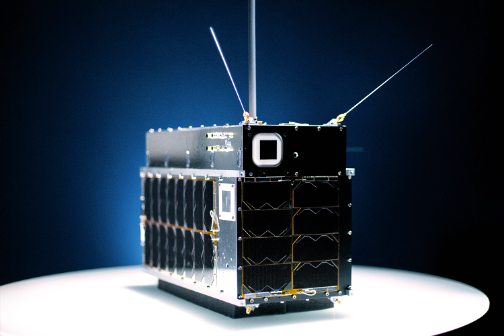

Photo of a model of HawkEye 360’s Pathfinder smallsat.

The Pathfinder satellite is scheduled to go on display when the National Air and Space Museum’s renovation is completed, slated for 2025. The Smithsonian is the world’s largest museum, education and research complex. The National Air and Space Museum is one of 19 museums that make up the Smithsonian.

HawkEye 360 is fully funded to deploy an additional five clusters, to reach a total of 18 satellites in orbit by the end of 2021. HawkEye 360 is currently building a second cluster of satellites, set for launch in fall 2020.

John Serafini, CEO, HawkEye 360, stated that this is an incredible honor for the Smithsonian to select the company’s Pathfinder satellites for its collection. Small satellites are changing what we can achieve in space and HawkEye 360 is excited to be on the cutting edge of that revolution and that these smallsats will inspire the next generation of talented minds.

James David, curator in the Space History Division at the National Air and Space Museum, added that the Pathfinder is an excellent representation of how small satellites are transforming the space industry. The National Air and Space Museum looks forward to displaying this commercial RF signals satellite, a first-of-its-kind, to help tell the story of the space age.

Filed Under: News

PLD Space and HISPASAT Collaborate for Miura 5 Launch Services

March 3, 2020 by editorial

HISPASAT and PLD Space have signed an agreement to work together on defining the technical features and analyzing the compatibility to launch services on board Miura 5.


Photo: Raúl Torres (left), CEO and Co-Founder of PLD Space; Antonio Abad (right) Technical and Operations Director of HISPASAT.

The companies will validate PLD Space as a launch services provider and they will draft a formal framework that specifies the services and deliverables to validate MIURA 5 launches.

HISPASAT has extensive work experience with large launchers on defining the technical conditions that satellites must meet to be put in orbit by a rocket.


Artistic rendition of Miura 5. Image is courtesy of PLD Space.

That means the company can provide valuable collaboration to PLD Space in order to establish the specifications (mass, volume, mechanical features, electromagnetic environment, etc.) that satellites must meet to be integrated and launched on board MIURA 5.

Antonio Abad, Technical and Operations director of HISPASAT, said that for the company, this is immensely satisfying, to be able to collaborate with a young and entrepreneurial Spanish company like PLD Space. This new launcher will open new opportunities to access space and who the company may be able to establish a business relationship with in the future.

The CEO and Co-Founder of PLD Space, Raúl Torres, noted that HISPASAT’s interest in working with PLD Space means a lot to the company. HISPASAT is a highly important operator, with extensive experience and well-established trajectory in the telecommunications satellite industry. The small launchers market is new for them and small satellites are a new business opportunity. Without a doubt, this agreement with HISPASAT is a step forward in PLD Space’s positioning and an opportunity for HISPASAT to explore a new market in this highly competitive field.

Filed Under: News

Rice University’s OwlSat Smallsat to Collect Ultraviolet Radiation Data

March 3, 2020 by editorial


Andrea Leinfelder

The space reporter, Andrea Leinfelder, at the Houston Chronicle posted a feature revealing that Rice University students are developing a research satellite to help alleviate the space junk orbiting the planet.

The OwlSat cubesat will collect data over the course of one year to see how extreme ultraviolet radiation, which is always emitted from the sun but becomes more intense during events such as solar flares, can alter a satellite’s path in Low Earth Orbit (LEO), the area where the International Space Station resides. Better understanding a satellite’s orbit can help prevent collisions that can create space junk, said Ryan Udell, president of Rice University’s chapter of Students for the Exploration and Development of Space.

“We don’t have a fool-proof way of mapping orbits,” Udell said. “There are very good predictors out there, but we can’t fully predict it.”


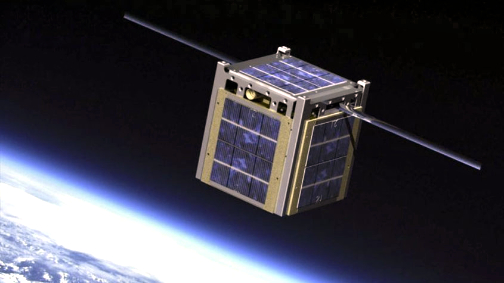
Artistic rendition of the OwlSat cubesat on-orbit.<>I>Image is courtesy of Rice University.

The OwlSat, measuring smaller than a tissue box, was one of 18 small research satellites recently selected by NASA to hitch a ride into space in 2021, 2022 and 2023. The OwlSat proposal was created by Students for the Exploration and Development of Space and is slated for liftoff in January of 2022. Students will start building the satellite this semester.

The research is important because small satellites are becoming increasingly popular. According to analytics and engineering firm Bryce Space and Technology, more than 1,700 smallsats (which can weigh up to 1,323 pounds) were launched between 2012 and 2019. This number is expected to grow as companies including SpaceX, Amazon and OneWeb plan to launch hundreds or thousands of desk-sized satellites to provide broadband internet to people who currently have little or no connectivity on Earth.

Udell, a 21-year-old mechanical engineering major, said the data collected by OwlSat could help predict how extreme ultraviolet radiation affects a satellite’s orbit. Then satellites equipped with propulsion systems could be moved before colliding with another satellite. The OwlSat will also collect data to help predict harmful radiation levels to humans in LEO.

To read the entire Houston Chronicle article, please access this direct link…

Filed Under: News

NewSpace Systems Acquired by Schauenburg Ventures

March 2, 2020 by editorial

Schauenburg Ventures SA (Pty) Ltd., the South African arm of German based Schauenburg Ventures, has acquired NewSpace Systems (Pty) Ltd. as of January29, 2020.

Schauenburg Ventures SA (Pty) Ltd. was established to enrich the product portfolio of the Schauenburg International – Africa Group, as well as Schauenburg Ventures, the focus primarily being on corporate ventures involved in highly innovative technologies that are available internationally as well as in South Africa.

This share acquisition of NewSpace Systems (NSS) fits strategically with Stratosat Datacom (Pty) Ltd. within the SCHAUENBURG International Group, which provides turnkey satellite and wireless converged communication network solutions into Africa. Stratosat was one of the main contractors for the Meerkat project in the Karoo with the Department of Trade and Industry.

NSS is a leader in the area of Microsatellite Attitude Control Solutions. With a focus on innovation and optimization, NSS delivers on high performance, reliability and cost efficiency, which has made it extremely successful in the international, operational, satellite constellation market. To date, NSS has supported more than 50 international customers, including 11 of the National Space Agencies.

James Barrington-Brown, CEO of NewSpace Systems, said this investment from SCHAUENBURG will enable the accelerated growth of NewSpace Systems by supporting additional product development and the establishment of new facilities, which is needed to accommodate the firm’s rapidly growing customer base.

Frederik de Ridder, Principle at Vaalbara and Interim Chair of the NSS Board of Directors, stated that the company views this as a pivotal moment in the growth, technological leadership and success of NewSpace globally. With this new investment and support from SCHAUENBURG, NSS can tackle bigger challenges as well as find new ways to add more value to the satellite sector.”

Florian Schauenburg, CEO of SCHAUENBURG International Group, offered that the acquisition of NewSpace delivers an interesting opportunity and strategic complement for the group. The investment gives the company further access to this interesting technology segment with high potential for future business in the new generation of satellite technology.”

Filed Under: News

Forrester Reports: Telesat to Initiate Some LEO Services Next Year

March 2, 2020 by editorial


Chris Forrester

According to a new report from journalist Chris Forrester at Advanced Television, Ottawa-based Telesat stated the firm could start some services from its constellation of LEO satellites by the end of 2022.

The first craft will launch later in 2021 or early 2022 although final decisions as to the extent of the service are yet to be made. Indeed, orders for the construction of the fleet have yet to be placed and will be determined around mid-year.

Telesat said the planned constellation of 300 satellites will be in orbit during 2023, and the design calls for craft which are larger and more complex than those being orbited by SpaceX’s Starlink.

Dan Goldberg, Telesat’s President/CEO addressing analysts during the company’s Q4 and full year results statement, said, “In addition to achieving stable financial results relative to the prior year, we took significant steps in laying the foundations for our future growth. In particular we made meaningful progress in refining the design of our planned revolutionary Low Earth Orbit (LEO) satellite constellation and, importantly, announced a Memorandum of Understanding with the Canadian Government to leverage the constellation to bridge the Digital Divide in Canada, an arrangement we expect will generate $1.2 billion in revenue over a 10 year period.”

For the year ended December 31, 2019, Telesat reported consolidated revenue of C$911 million, an increase of 1 percent (C$8 million) compared to the same period in 2018. When adjusted for changes in foreign exchange rates, revenue was unchanged compared to 2018. Revenue increases related to the Telstar 19 VANTAGE and Telstar 18 VANTAGE satellites, which were launched in 2018, and revenues earned from short-term services to other satellite operators.

Operating expenses were C$165 million, a decrease of 11 per cent from 2018. When adjusting for the impact of foreign exchange rate changes, expenses decreased by 12 per cent (C$22 million). Fleet utilization was 81 percent,and backlog was C$3.3 billion.

It also emerged that Canada’s government is also looking to repurpose C-band satellite capacity for 5G usage, which could lead to further compensation payments for satellite operators servicing the nation.

Filed Under: News

New Generation of European Rocket Engines to Result from SSC and Isar Aerospace Partnership

March 2, 2020 by editorial

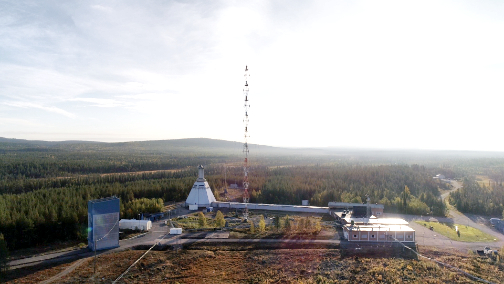
Swedish Space Corporation, SSC, and Isar Aerospace, have signed a long-term contract for testing of a new generation of European rocket engines for mini-launchers at Esrange Space Center in Sweden — the agreement includes a rocket stand for vertical tests and this agreement can be extended to include rocket stage tests with multiple rocket engines.


Photo of the Esrange Space Center.

SSC’s new engine and stage test capability plays a crucial part in supporting research and the development of rocket engines for mini-launchers in Europe. The first engine tests are planned for mid-2020 and the aim is to launch satellites with Isar Aerospace rockets based on this engine technology from 2021 onward.

Stefan Gardefjord, CEO at SSC said this is the first rocket engine test customer and providing this service is fully in line with SSC’s overall strategy to develop the ability to launch satellites from Esrange. The partnership shows that the company has already come a long way and that SSC is on its way to meet both current and future customer needs.

Josef Fleischmann, COO and Co-Founder of Isar Aerospace, added that the company is progressing fast in its development of these engines and are happy that the firm is so quickly able to find a suitable test site for the upcoming engine and stage tests — this is the start of a long and fruitful relationship with SSC and Sweden.

Filed Under: News

‘Quelle Surprise’ … Not … DARPA’s Launch Scrubbed Due to Bad Winter Weather in Kodiak, Alaska

March 1, 2020 by editorial

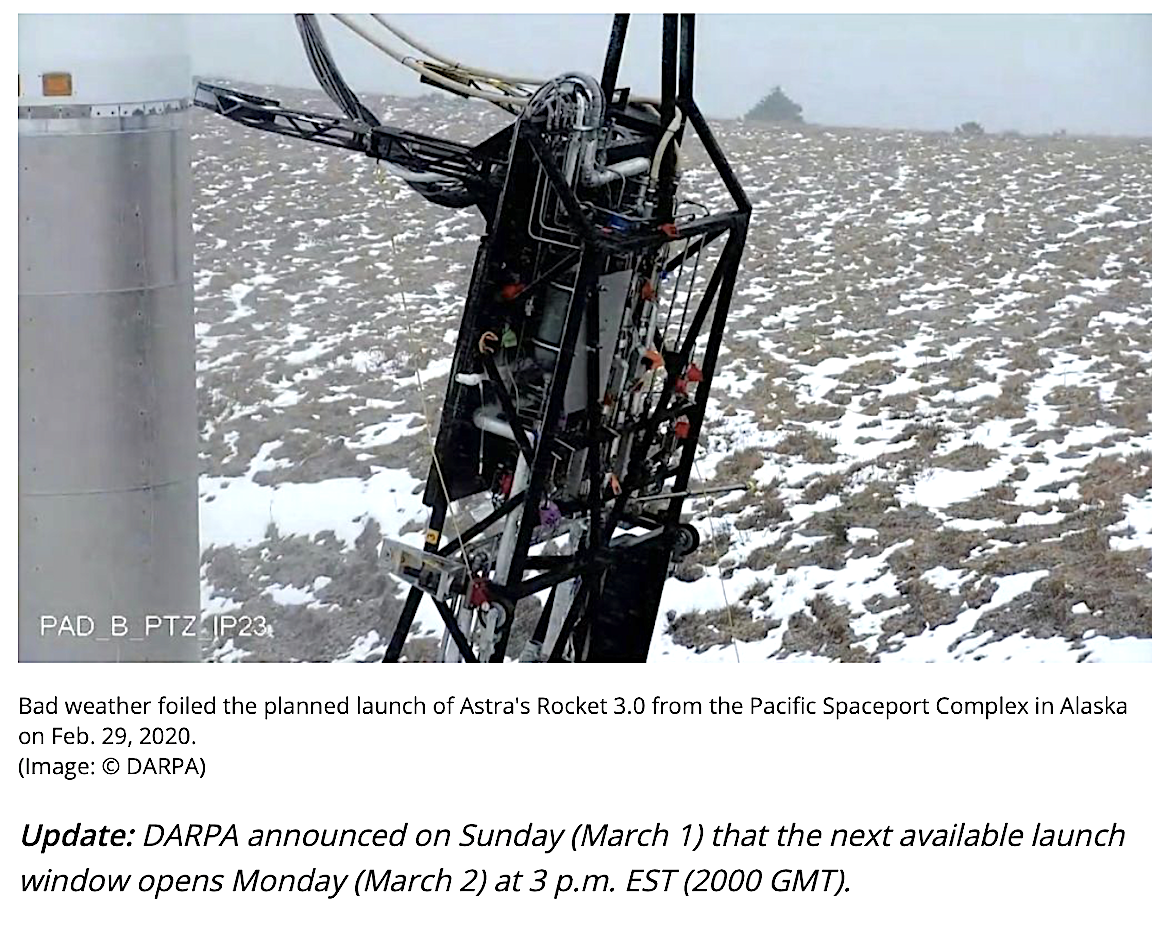
The launch, originally scheduled for February 29 of DARPA’s satellite by Spaceflight’s startup, Astra, has been scrubbed due to bad weather.

The weather conditions should come as no surprise considering that the launch site is the Pacific Spaceport Complex on Alaska’s Kodiak Island. The bad winter weather — specifically, strong winds and thick clouds — has pushed the attempt back at least another day.

Update: DARPA announced on Sunday (March 1) that the next available launch window opens Monday (March 2) at 3 p.m. EST (2000 GMT).

According to DARPA’s (Defense Advanced Research Projects Agency) website;

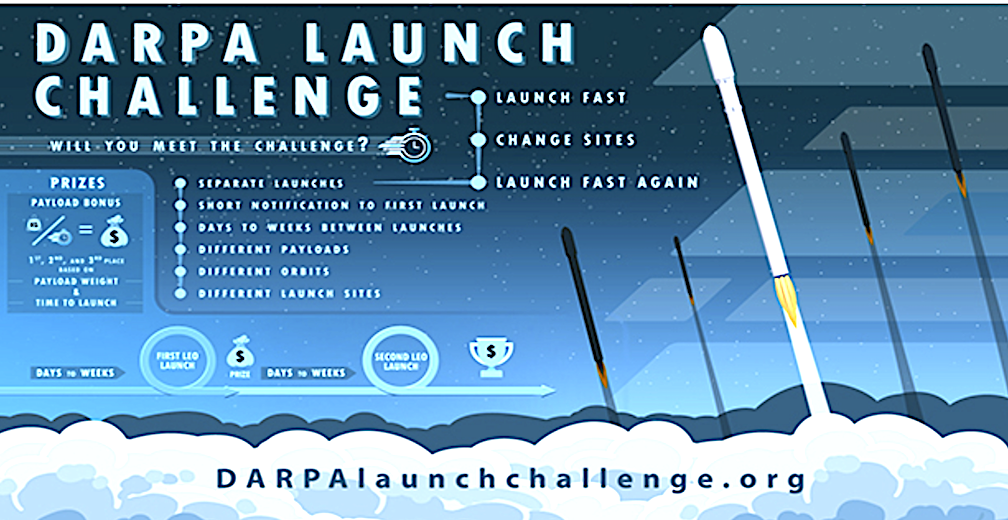
“The goal of the DARPA Launch Challenge is to demonstrate responsive and flexible space launch capabilities from the burgeoning industry of small launch providers. 

For nearly 60 years, the nation’s space architecture has been built around exquisite systems that are launched by large, expensive boosters. The development cycle with the systems is tedious, with a process driven by a desire to reduce risk, rather than deliver timely capabilities.”

The $12 million DARPA Launch Challenge is to demonstrate new and groundbreaking capabilities to address emerging Department of Defense needs. The challenge will culminate in two separate launch competitions to low Earth orbit (LEO) within days of each other at different locations in the United States.

This will be Astra’s first flight, which is carrying four small payloads. If successful the company will get $2 million, then conducting a another launch shortly after, from a different pad at the Kodiak complex, will bring in an additional $10 million.

Filed Under: News

Atos Testing Assisted OneWeb’s Latest Satellite Launch

February 28, 2020 by editorial

Atos supported OneWeb and that firm’s mega-constellation program in the successful launch of 34 satellites that was conducted on February 6 from Baikonur, Kazakhstan.

Atos contributed to this success by providing to OneWeb Satellites the testing equipment with revolutionary technologies that have reduced the environmental footprint of the process – and received an award from OneWeb Satellites for the Payload Test Systems (PTS) and Tele Command Ranging (TCR) solutions.

This key ‘OneWeb mega-constellation’ project, led by OneWeb Satellites and supported by Atos, involves sending into orbit, over a period of time, more than 650 satellites — these satellites will provide affordable high-speed Internet access across the globe. The first six satellites were launched in February 2019.

Thanks to its advanced solutions, Atos was named “Best Ground Support Equipment (GSE) supplier” by OneWeb Satellites in recognition of its technical and commercial capabilities and the quality of its solutions and customer support. The award was presented at the OneWeb Satellites Global Partnership Summit 2020.

Atos’ ProUST univerSAS suite is composed of Power and RF special check-out equipment (SCOE) for electrical ground support equipment (EGSE) which enables satellites to be tested prior to launch – to prevent or fix any issues and make sure requirements are met, thus reducing the strategic and financial impact of faulty components.

Based on a breakthrough full-digital design, ProUST univerSAS improves work quality and optimizes the power and energy density of satellite power testing. This illustrates Atos’ commitment towards an energy-conscious future and paves the way for future environmental-friendly developments. The solution was developed by Atos in Austria with Austrian national co-funding via the European Space Agency (ESA).

Bruno Milard, VP, Head of Business Unit Aerospace & Defense Electronics at Atos, said the company isproud to support such an ambitious program with the firm’s testing solutions; Atos ensures all OneWeb Satellites are rigorously tested in the most efficient and effective way. Together with OneWeb Satellites, the firm makes the mass-production of satellites real. Atos is delighted to help define the leading edge of satellite manufacturing technology.

Filed Under: News

First Place Win for Collaboration of Dutch Companies With New Power System for SmallSats

February 27, 2020 by editorial


From left to right: Mattijs Otten & Jeffrey Miog, Founding team of Tective, Bert Monna, CEO of Hyperion Technologies and Jochem Frudiger, Managing Director of GTM – Copyright: Hyperion Technologies

Three Dutch companies are celebrating their first place solution regarding a highly modular and scalable power system for small satellites.

The consortium, consisting of Hyperion Technologies, GTM Advanced Structures and Tective BV, scored first place among 31 winning subsidy applications. Starting in February 2020, the consortium will take on an 18-month journey to develop a highly modular and scalable power system for small satellites. By winning the province’s MIT Research & Development subsidy worth over €130K, the CubeSat Advanced Power System (CAPS) will soon be reality. 

Small satellites, like CubeSats and Nanosats, have come a long way to earn their respect within the scientific and commercial community. Today, many miniaturized high-performance systems and payloads exist to deliver reliable data products, for example through making use of constellations and distributed risks. Integrated power systems for these kinds of small satellites are already available. 

However, the NewSpace market is getting mature: With launch cost steadily dropping, “small” satellites can afford to grow in size, allowing for more complex payloads — not least of all because the global market is showing a growing user base for more, new or innovative space-based data products. Standardized and commercial off-the-shelf components for these sizes of satellites are, however, still a rarity. 

CAPS aims to target this growing niche of “larger” small satellites to facilitate their increased power demands. The result will consist of a high-power, end-to-end power solution for demanding payloads. A unified system architecture will allow for modular implementations of solar panels, power storage and power distribution in a variety of larger CubeSat sizes. The solution will be made tailorable for individual client needs at an affordable price.

Hyperion Technologies has been steadily expanding its product portfolio. With the development of CAPS, the company expects to be able to offer an even broader range of products for small satellites within the next two years. This will allow the company to act as a one-stop-shop, being able to supply everything needed to facilitate satellite systems for demanding CubeSat payloads.

CEO Bert Monna is clear in his vision of CAPS as he said they aim to offer clients a plug-and-play experience. The different components of CAPS will allow them to tune the system specifically to match the client’s mission profile.

GTM, with its experience in supplying advanced structures and solar panels to the space industry, will pioneer efficient solar panels for CubeSats within this project. By implementing novel ways to deploy and steer solar panels, energy output will be maximized in ways that are new to the CubeSat industry. 

Meanwhile, Tective sees opportunities to transfer new battery and charging technology into robotics. CEO and Founder Mattijs Otten added that they aim to capitalize on innovations within the CAPS project to facilitate fully autonomous robotics. In order for robots to truly start playing a significant role in remote areas, on-board power supply is critical. CAPS has all the components to start integrating solar panels and autonomous charging systems into robots aimed for exploration, surveillance and emergency response.

The CAPS team would like to extend special thanks to the province of Zuid-Holland for their enthusiasm and subsequent first place. The team is exited to start development, and will update about its progress frequently … stay tuned.

Filed Under: News

HawkEye 360’s Advisory Board Adds Deliver Broad Range of Expertise

February 27, 2020 by editorial

HawkEye 360 Inc. has publicized that Martin Faga, the former Director of the National Reconnaissance Office (NRO); Joan Dempsey, the former Deputy Director of Intelligence at the Defense Intelligence Agency; and former Senator Joe Donnelly have joined the company’s Advisory Board — these new additions bring extensive experience working in defense and intelligence in both the government and private sectors.


Martin C. Faga

During his time as President and CEO of The MITRE Corporation, Faga spent several years working on the integration of intelligence systems. He retired from MITRE in 2006. Prior, Faga worked extensively in the government sector. He served as Assistant Secretary of the U.S. Air Force for Space and as the Director of the NRO. From 2006 to 2009, he served on the President’s Intelligence and Advisory Board. Over the course of his career, Faga has received several honors and awards for his work from intelligence and government agencies. He said that Hawkeye 360 is pursuing a new dimension in commercial space and he is happy to have the opportunity to contribute to this fascinating and important new business.


Joan Dempsey

Dempsey joins HawkEye 360 with extensive experience in intelligence, security and business. Most recently, Dempsey held the role of Senior Partner and Executive Vice President for Booz Allen Hamilton’s defense and intelligence group. Before joining the private sector, Dempsey served more than 25 years with the federal government, which included two political appointments: Deputy Director of Central Intelligence for Community Management and Executive Director of the President’s Foreign Intelligence Advisory Board. Dempsey has also served as Deputy Director of Intelligence at the Defense Intelligence Agency. He commented that he looks forward to working with HawkEye 360 as it develops its unique data analysis and collection capabilities using RF signals. As the world grows more complex, defense and intelligence agencies must employ more sophisticated tools, such as those HawkEye 360 is building.”


Senator Joe Donnelly

Senator Donnelly served a dozen years in Congress, first representing Indiana for three terms in the U.S. House of Representatives (2007-2013) and then one term in the U.S. Senate (2013-2019). Among his committee assignments, Senator Donnelly served on the Committee on Veterans’ Affairs while in the House of Representatives and the Committee for Armed Services while in the Senate. He brings valuable public policy expertise related to defense. Senator Donnelly has a law degree from the Notre Dame Law School and currently works for Akin Gump Strauss Hauer & Feld LLP with a focus upon the financial services, defense and health care industries.


John Serafini

John Serafini, CEO, HawkEye 360, added that the addition of Marty, Joan, and Joe further deepens the breadth of experience and valuable knowledge on the HawkEye Advisory Board. The company could not ask for a more exceptional group of Advisors to lead HawkEye 360 in the firm’s mission to create a safer world through advanced RF analytics.

Filed Under: News

  • « Go to Previous Page
  • Page 1
  • Interim pages omitted …
  • Page 47
  • Page 48
  • Page 49
  • Page 50
  • Page 51
  • Interim pages omitted …
  • Page 57
  • Go to Next Page »

Primary Sidebar

WEEKLY NEWSLETTER

Archives

  • May 2026
  • April 2026
  • March 2026
  • February 2026
  • January 2026
  • December 2025
  • November 2025
  • October 2025
  • September 2025
  • August 2025
  • July 2025
  • June 2025
  • May 2025
  • April 2025
  • March 2025
  • February 2025
  • January 2025
  • December 2024
  • November 2024
  • October 2024
  • September 2024
  • August 2024
  • July 2024
  • June 2024
  • May 2024
  • April 2024
  • March 2024
  • February 2024
  • January 2024
  • December 2023
  • November 2023
  • October 2023
  • September 2023
  • August 2023
  • July 2023
  • June 2023
  • May 2023
  • April 2023
  • March 2023
  • February 2023
  • January 2023
  • December 2022
  • November 2022
  • October 2022
  • September 2022
  • August 2022
  • July 2022
  • June 2022
  • May 2022
  • April 2022
  • March 2022
  • February 2022
  • January 2022
  • December 2021
  • November 2021
  • October 2021
  • September 2021
  • August 2021
  • July 2021
  • June 2021
  • May 2021
  • April 2021
  • March 2021
  • February 2021
  • January 2021
  • December 2020
  • November 2020
  • October 2020
  • September 2020
  • August 2020
  • July 2020
  • June 2020
  • May 2020
  • April 2020
  • March 2020
  • February 2020
  • January 2020
  • December 2019
  • November 2019
  • October 2019

© 2019–2026 SatNews

Insert/edit link

Enter the destination URL

Or link to existing content

    No search term specified. Showing recent items. Search or use up and down arrow keys to select an item.
      x
      Sign Up Now!

      Enjoy a free weekly newsletter with recent headlines from the global SmallSat industry.

      Invalid email address
      We promise not to spam you. You can unsubscribe at any time.
      Thanks for subscribing! You will now receive weekly SmallSat News updates.
      We love our advertisers.
      And you will too!

      Please disable Ad Blocker to continue... We promise to keep it unobtrusive.
      We promise not to spam you. You can unsubscribe at any time.
      Invalid email address
      Thanks for subscribing!