
• Skip to main content
  • Skip to primary sidebar
  • Home
  • News
  • Featured
  • More News ⌄
    • SatNews
    • SatMagazine
    • MilSatMagazine
  • Events ⌄
    • MilSat Symposium
    • SmallSat Symposium
    • Satellite Innovation
  • Contacts
  • SUBSCRIPTION

SmallSat News

You are here: Home / Archives for 2020

Archives for 2020

Propulsion Systems from Exotrail to Empower AAC Clyde Space’s Smallsats

February 19, 2020 by editorial

Exotrail has signed a contract with AAC Clyde Space to equip that firm with propulsion solutions for their customers, including Eutelsat for their ELO 3 and ELO 4 spacecraft.

Exotrail will provide propulsion systems for the two 6U cubesats that will be manufactured and delivered to orbit by AAC Clyde Space. The Eutelsat mission is a precursor to a potential constellation called ELO (Eutelsat LEO for Objects). The contract is to be delivered before the end of the year, both satellites will be launched in 2021.

Artistic rendition of a smallsat powered by Exotrail’s propulsion system.

Image is courtesy of the company.

Exotrail started its propulsion system development with a flight demonstrator project that was designed, built, qualified and delivered in only 10 months. The launch of the flight system demonstrator, initially scheduled to fly in November of 2019 on board a PSLV, is now planned for March of 2020 (due to a launcher delay).

The resulting heritage acquired with this project, along with the expertise and innovation put forward in Exotrail’s product development, has allowed the company to secure their first customers.


Artistic rendition of Eutelsat’s ELO constellation on-orbit.

Image is courtesy of the company.

According to the company, these customer contracts demonstrate that Exotrail’s strategy is paying off and that the company has moved quickly from vision to reality, a vision to provide a propulsion system as well as a set of software, hardware and services and to change the way satellites are launched and operated on orbit. This vision is now translating into revenue and success.

AAC Clyde Space CEO Luis Gomes said the company is looking forward to working with Exotrail. Their product is a perfect fit for both the firm’s needs and the customer’s requirements. Their modular ExoMG™ product has a highly compact and flexible form factor with industry leading performance levels, in particular with respect to thrust levels.

David Henri, Co-founder and CEO of Exotrail, added that the firm is an established specialist in advanced smallsat missions and provides market-leading New Space solutions. Exotrail is delighted to be able to assist AAC Clyde Space for this mission with the ExoMG™ – smallsat. This underlines the relevance of the company’s solutions for optimizing global constellations and the firm’s expertise in this growing sector.
Filed Under: News

Another First for Gilat — ESA Terminal Achieves In-Flight Connectivity over NGSO

February 18, 2020 by editorial

Gilat Satellite Networks Ltd. (NASDAQ, TASE: GILT) has announced that Gilat’s first-to-flight Electronically Steered Antenna (ESA) terminal achieved another industry-first with in-flight connectivity over NGSO (Non-Geostationary Orbit) — this success well-positions Gilat to win opportunities within the ESA market.


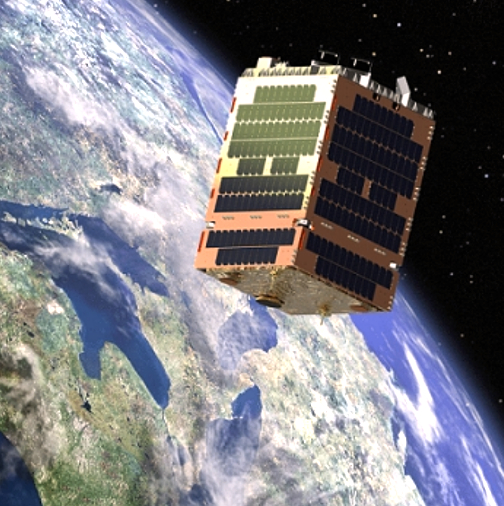
Artistic rendition of Telesat’s Phasae 1 LEO satellite.

Image is courtesy of the company.

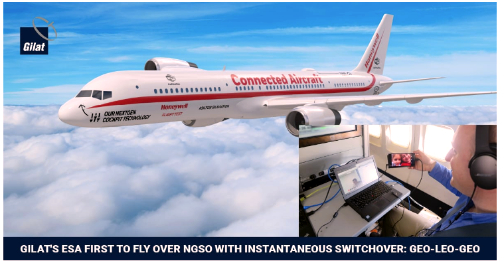
The demonstration showed high performance and instantaneous Ka-band switchovers between and operating on Telesat’s Phase 1 LEO satellite and its Anik-F3 GEO satellite, onboard Honeywell’s Boeing 757 commercial test aircraft, across several flight tests.

Gilat’s high throughput and small form factor ESA operated continuously over GEO and then instantaneously switched connectivity to operate on LEO when it came into view and then back to GEO after operating on LEO. The ESA terminal demonstrated high performance, with broadband throughput of up to 58 Mbit/sec on both FWD and RTN, round trip delay as low as 18 msec. and robust operation at low elevation angles of down to 20 degrees.

Gilat’s ESA has a no moving parts and is a full electronic beam steering flat panel antenna with an extremely low profile. The company’s innovative design combines the benefits of ESA with the advantages of Ka-band, as highlighted by the performance achieved in this testing. The ESA terminal serves both GEO and NGSO constellations and, as such, opens the market to low latency, real-time applications.

Michel Forest, Director of Systems Engineering for the LEO Program at Telesat, said that Gilat’s multi-orbit ESA switchover capabilities will enable airlines to future-proof their connectivity decisions. Airlines will be able to access high-performing Ka-band connectivity today and easily incorporate LEO low-latency connectivity without replacing terminals. The company’s ongoing development efforts with valued partner Gilat will ensure airlines have flexibility and ability to meet their inflight data requirements of the future.

Roni Stoleru, the VP of Antenna Products & Strategy at Gilat, added that the company’s innovative ESA terminal opens up great opportunities in the commercial and business aviation markets with a winning proposition that addresses the two major ESA industry growth dynamics: mobility, with emphasis on in-flight connectivity and the upcoming NGSO constellations. Gilat is appreciative of the collaboration with the firm’s long-standing partners, Honeywell and Telesat, and looks forward to continued cooperation.

Note: Gilat’s ESA terminal will be displayed at Satellite 2020 in Washington DC, booth #1017.

Filed Under: News

New Satellite Manufacturing Facility is Opened by Mitsubishi Electric Corporation

February 18, 2020 by editorial

Mitsubishi Electric Corporation (TOKYO: 6503)  has completed construction of a new facility for the production of satellites at the company’s Kamakura Works in Kamakura, Japan.

Together with existing facilities, Mitsubishi Electric’s combined annual capacity will increase to 18 satellites, up from 10 at present, which will enable the company to satisfy the growing demand for governmental satellites in Japan and commercial communication satellites worldwide. New facility at Kamakura Works.


Photo of the new Mitsubishi satellite factory is courtesy of the company.

The new facility will increase production efficiency, shorten production time, reduce costs and elevate product quality for enhanced competitiveness. It will incorporate information technologies based on Mitsubishi Electric’s e-F@ctory solutions, which extract hidden benefits from existing resources through integrated automation to realize improved efficiencies, reduced costs and increased productivity.

In addition, the new facility will incorporate Mitsubishi Electric products, such as a heat pump air-conditioning system, LED lights and high-efficiency transformers to further reduce energy consumption.

The Japanese market for governmental satellites is expected to grow under the country’s Basic Plan for Space Policy, which calls for the development of observation, communication and positioning satellites that support daily life and facilitate the commercial use of space for the enhancement of Japan’s industrial and scientific foundations.

Last year, the Japan Aerospace Exploration Agency (JAXA) announced its participation in the U.S. government’s Gateway project targeting a manned station near the moon, which is expected to stimulate increased demand for governmental satellites. Separately, the global market for small communication and observation satellites also is envisioned growing.

Mitsubishi Electric’s long involvement with satellites includes the Himawari-7, -8 and -9 weather satellites, the Superbird-C2-Japan’s first commercial communications satellite, QZS high-accuracy positioning satellite systems, and the Es’hail-2 for Qatar Satellite Company in Qatar. Going forward, Mitsubishi Electric aims to more widely apply technologies it cultivates for governmental satellites to enhance its position in expanding fields, such as next-generation-engineering test satellites.

Filed Under: News

Financial Inflow of 3.1 Million Euros for Kleos Space S.A.

February 18, 2020 by editorial

Kleos Space S.A. (ASX: KSS, Frankfurt: KS1) has secured a €3.1 million loan agreement with Dubai-based family office Winance to progress its commercialization plans and repay the extant convertible note— Winance will further provide optional €6.0 million through a convertible note agreement, subject to final documentation.

Dubai-based Winance reached out to Kleos Space during the trade mission organized in Dubai by the Chamber of Commerce of the Grand Duchy of Luxembourg, in cooperation with the Ministry of the Economy, the Luxembourg Embassy and the Luxembourg Trade and Investment Office in Abu Dhabi at the end of January.


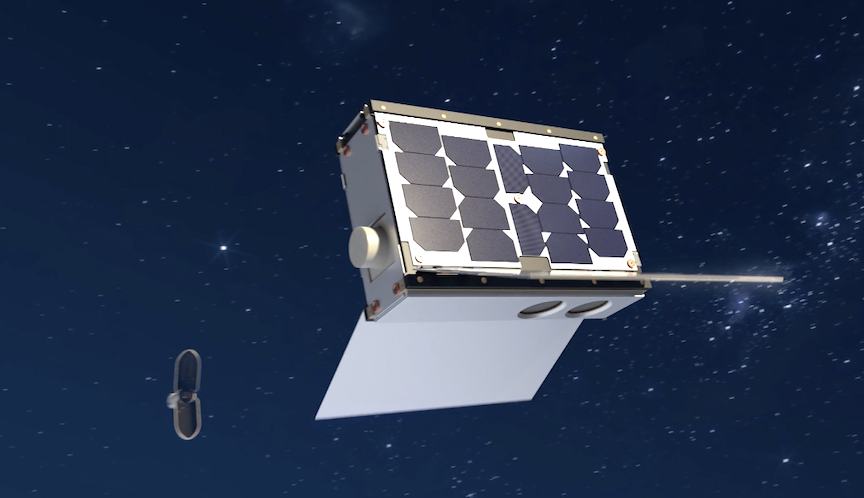
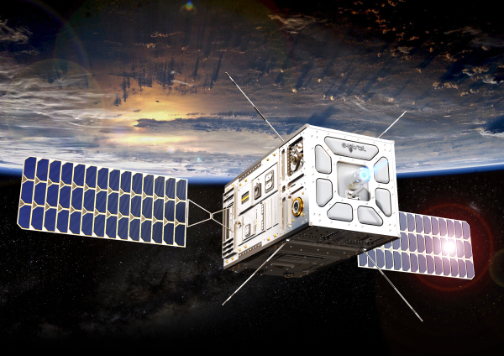
Artistic rendition of Kleos Space’ Scouting Mission smallsat.

Image is courtesy of the company.

These funds will allow Kleos to repay extant Evolution Equities convertible notes for the development and launch of the firm’s second cluster of satellites and increase its presence within the US defence sector. The Loan Agreement ensures Kleos is well-funded to execute its commercialization plans while awaiting revenues from early adopter contracts.

Kleos will commence generating first revenues after the launch of its Scouting Mission satellites from Chennai, India, in the coming weeks. This initial satellite cluster is the foundation of a larger constellation which will geolocate radio frequency transmissions to provide global activity-based intelligence irrespective of the presence of positioning systems, unclear imagery and targets out of patrol range.

CEO of Kleos Space, Andy Bowyer, said that the Loan Agreement provides Kleos with working capital to progress the development of the company’s second cluster of satellites while awaiting revenues from the Scouting Mission satellites. Luxembourg has a successful economic partnership with the UAE, developed over the past decades. This collaboration provides Luxembourg-based organisations operating in the space sector, such as Kleos Space, with access to investment and financing opportunities.

Waqas Ibrahim, Director & CFO of Winance, added that this new partnership is in line with Winance’s vision of investing in proficient and progressive thinking management teams. The firm is convinced that this collaboration can serve as a springboard for both our companies in the GCC, Australian and Luxembourg markets. Kleos technology has never been more relevant than today in addressing a real world need and has attracted interest from governments and private organizations.

Marc Serres, CEO of the Luxemboug Space Agency, noted that Luxembourg and the UAE share the same commitment to support the economic development of the commercial space industry. The agreement between a Luxembourg-based company and a Dubai family office shows that our bilateral cooperation with the UAE is successful when it comes to developing high technology space products and services through financing instruments tailored to meet the needs of private companies.

Filed Under: News

Rocket Lab’s Announcement …  Selected by NASA to Launch Pathfinder Mission to the Moon

February 14, 2020 by editorial

The following is Rocket Lab’s announcement regarding the selection by NASA to become launch provider for a small satellite mission to the same lunar orbit targeted for Gateway.

Rocket Lab, a space technology company and global leader in dedicated small satellite launch, has been selected by NASA as the launch provider for a small satellite mission to the same lunar orbit targeted for Gateway – an orbiting outpost astronauts will visit before descending to the surface of the Moon in a landing system as part of NASA’s Artemis program.


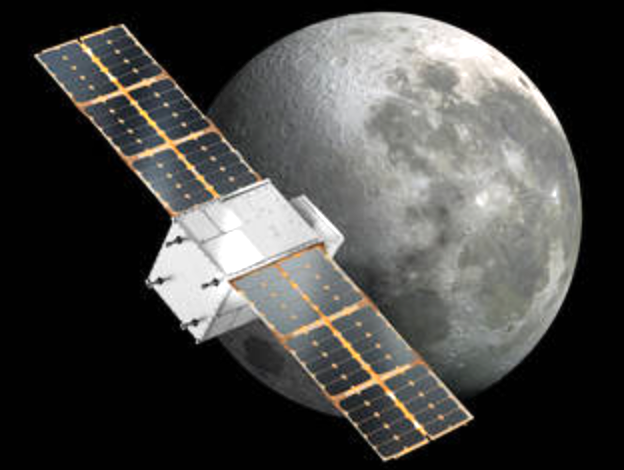
Updated illustration of NASA’s CAPSTONE CubeSat. The spacecraft design has changed since the mission contract award in September 2019. Credits: NASA

The Cislunar Autonomous Positioning System Technology Operations and Navigation Experiment (CAPSTONE) is expected to be the first spacecraft to operate in a near rectilinear halo orbit around the Moon. In this unique orbit, CAPSTONE will rotate together with the Moon as it orbits Earth and will pass as close as 1,000 miles and as far as 43,500 miles from the lunar surface. CAPSTONE will demonstrate how to enter into and operate in this orbit as well as test a new navigation capability. This data will help to reduce navigation uncertainties ahead of future missions for Gateway, as NASA and international partners work to ensure astronauts have safe access to the Moon’s surface.

The satellite will be launched on Rocket Lab’s Electron launch vehicle from Launch Complex 2, located within the NASA Wallops Flight Facility in Virginia, USA. After launch, Rocket Lab’s high performance configurable satellite bus platform, Photon, will deliver CAPSTONE on a ballistic lunar transfer. Photon’s Curie propulsion system will allow the satellite to break free of Earth’s gravity and head to the Moon. After launch, CAPSTONE take approximately three months to enter its target orbit and begin a six-month primary demonstration phase to understand operations in this unique orbit. The mission is targeted for launch in early 2021.

Rocket Lab founder and chief executive Peter Beck said that small satellites like CAPSTONE will play a crucial role in supporting the return of human missions to the Moon and they’re proud to be supporting NASA in this unique and pivotal mission. As a dedicated mission on Electron, they’re able to provide NASA with complete control over every aspect of launch and mission design for CAPSTONE, something typically only available to much larger spacecraft on larger launch vehicles. In the same way we opened access to low Earth orbit for small satellites, we’re proud to be bringing the Moon within reach to enable research and exploration.

Supporting the mission on Electron is Space Exploration Engineering, who will contribute to mission planning, trajectory analysis, orbit determination, as well as KSAT who will provide global ground station coverage for the mission.  

Note: see Satnews’ article regarding NASA’s announcement regarding CAPSTONE project.

Filed Under: News

NASA Announces … Awards CAPSTONE CubeSat Contract to Rocket Lab

February 14, 2020 by editorial

The following is NASA’s announcement regarding the selection of Rocket Lab to deliver CAPSTONE CubeSat to the Moon.


Part of the Mid-Atlantic Regional Spaceport at NASA’s Wallops Flight Facility in Virginia, Launch Complex 2 is Rocket Lab’s second launch site for the Electron rocket. Rocket Lab will launch NASA’s Cislunar Autonomous Positioning System Technology Operations and Navigation Experiment (CAPSTONE) CubeSat mission to the Moon from the Virginia launch site in early 2021. Credits: Rocket Lab

NASA has selected Rocket Lab of Huntington Beach, California, to provide launch services for the Cislunar Autonomous Positioning System Technology Operations and Navigation Experiment (CAPSTONE) CubeSat.

Rocket Lab, a commercial launch provider licensed by the Federal Aviation Administration, will launch the 55-pound CubeSat aboard an Electron rocket from NASA’s Wallops Flight Facility in Virginia. After launch, the company’s Photon platform will deliver CAPSTONE to a trans-lunar injection. The engine firing will allow the CubeSat to break free of Earth’s gravity and head to the Moon. Then, CAPSTONE will use its own propulsion system to enter a cislunar orbit, which is the orbital area near and around the Moon. The mission is targeted for launch in early 2021 and will be the second lunar mission to launch from Virginia.

“NASA’s Launch Services Program (LSP) is pleased to provide a low-cost launch service for CAPSTONE and to work with Rocket Lab on this inaugural NASA launch from their new launch site at the Mid-Atlantic Regional Spaceport in Virginia,” said Ana Rivera, LSP program integration manager for CAPSTONE at NASA’s Kennedy Space Center in Florida. LSP will manage the launch service. 

“This mission is all about quickly and more affordably demonstrating new capabilities, and we are partnering with small businesses to do it,” said Christopher Baker, Small Spacecraft Technology program executive at the agency’s headquarters in Washington. “This is true from the perspective of CAPSTONE’s development timeline, operational objectives, navigation demonstration and its quickly procured commercial launch aboard a small rocket.”


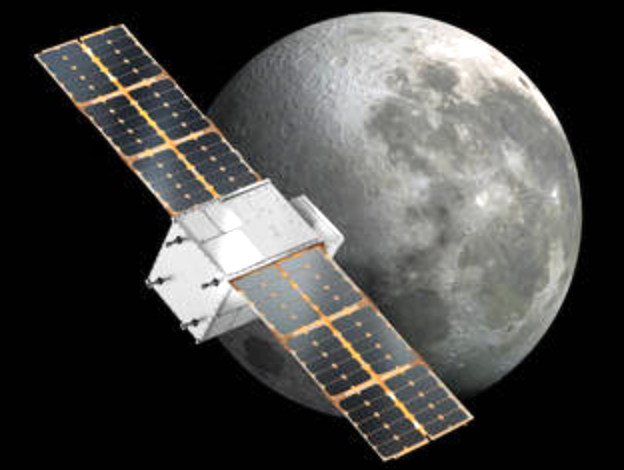
Updated illustration of NASA’s CAPSTONE CubeSat. The spacecraft design has changed since the mission contract award in September 2019. Credits: NASA

Following a three-month trip to the Moon, CAPSTONE will enter a near rectilinear halo orbit, which is a highly elliptical orbit over the Moon’s poles, to verify its characteristics for future missions and conduct a navigation demonstration with NASA’s Lunar Reconnaissance Orbiter. CAPSTONE will serve as a pathfinder for the lunar spaceship Gateway, a key component of NASA’s Artemis program.

“CAPSTONE is a rapid, risk-tolerant demonstration that sets out to learn about the unique, seven-day cislunar orbit we are also targeting for Gateway,” said Marshall Smith, director of human lunar exploration programs at NASA Headquarters. “We are not relying only on this precursor data, but we can reduce navigation uncertainties ahead of our future missions using the same lunar orbit.”

The firm-fixed-price launch contract is valued at $9.95 million. In September, NASA awarded a $13.7 million contract to Advanced Space of Boulder, Colorado, to develop and operate the CubeSat.

After a final design review this month, Advanced Space and Tyvak Nano-Satellite Systems Inc. of Irvine, California, will start building and testing the spacecraft.

CAPSTONE is managed by NASA’s Small Spacecraft Technology program within the agency’s Space Technology Mission Directorate. Advanced Exploration Systems within NASA’s Human Exploration and Operations Mission Directorate supports the launch and mission operations.

Read Satnews’ article about Rocket Lab’s contract with NASA.

Learn more about NASA’s Launch Services Program.


Filed Under: News

ICEYE US Acquires a CEO

February 14, 2020 by editorial

ICEYE has named Dr. Mark Matossian as the CEO of ICEYE US, Inc.—he most recently served for more than a decade in program management at Google, including carrying the responsibility of manufacturing and launch of the Terra Bella Earth imaging constellation. This hire marks a significant expansion in the US activities of ICEYE, including plans to extend satellite manufacturing to the US.


Dr. Mark Matossian

Initially, Dr. Matossian will be working with ICEYE’s current partners in the US, including R2 Space, Ursa Space, RS Metrics, and others, to fully use ICEYE’s growing satellite constellation with three satellites operating in orbit and additional satellites launching later this year. In addition, Dr. Matossian will be focused on evaluating ICEYE satellite manufacturing in the US. The ICEYE US, Inc subsidiary is evaluating locations for manufacturing based on access to facilities, people, suppliers, partners, and interest from the local governments.

A veteran of Silicon Valley telecom and IT startups, Dr. Matossian most recently spent 13 years managing global projects at Google – from data centers to Android to satellites. There, he specialized in scaling up new products and services, leading projects across Asia, Europe, and South America. He is a co-founder of Solstar Space Co., which partnered with Blue Origin and NASA to develop innovative satellite constellation telecom services for spacecraft.

As part of his aerospace work at Google, Dr. Matossian worked on the precursor to OneWeb; led program management of the Titan Aerospace UAV effort; and guided substantial growth at Terra Bella. At Terra Bella, he managed Earth imaging spacecraft production and launch operations, shifting the organization from a prototype-focused startup to a process-driven, scalable venture. Prior to moving to Silicon Valley, Dr. Matossian worked on the first wave of commercial constellation efforts, including Iridium and Teledesic, as well as the Strategic Defense Initiative.

Rafal Modrzewski, CEO and co-founder, ICEYE, said Mark’s leadership is instrumental as the company fully expands into the American market. His experience will be invaluable in this exciting new chapter for ICEYE. While the firm already works with customers around the globe, Mark’s expertise will help ICEYE focus on the value the firm creates for customers in the US, building higher quality and faster technology capabilities to meet their needs.

Dr. Matossian added that ICEYE’s leadership in New Space technology is already undeniable in Europe and he’s looking forward to further expanding ICEYE’s best-in-class imaging capabilities to US government and industry leaders. ICEYE’s innovative SAR technology, growing constellation, and compelling value are a winning combination for the sophisticated US SAR market.

Filed Under: News

$90 Million for Astranis to Support the Launch of the Company’s First Satellite

February 13, 2020 by editorial

Astranis has received $90 million in a financing round to launch the company’s first commercial satellite and build the foundation for the internet infrastructure of the future — the round was led by Venrock, with significant participation from existing investor Andreessen Horowitz.

Astranis aims to solve a problem in the modern space race that hasn’t been cracked: bringing the next four billion people online with low-cost, reliable internet. The $120 billion market is growing quickly – demand for internet is rising 40% per year, every year – but until now, there has been no practical, cost-effective solution for bringing internet access to remote parts of the world. Astranis is singularly focused on solving this problem.

Astranis is building a first-of-its-kind micro-geostationary orbit (GEO) satellite that is 20 times smaller in size than that of its predecessors – just 350 kg. – compared to traditional satellites that are upwards of 6,500 kg. The satellite’s secret sauce is a flexible, ultra-wideband software-defined radio technology that allows Astranis to replace heavy and bulky analog radio hardware with lightweight, compact, digital alternatives. The satellites are small enough to be manufactured and launched in months instead of years, all with more bandwidth than was previously possible with the same form size.

The Series B round includes $40 million of equity financing led by Venrock with continued investment from Andreessen Horowitz and participation from existing investors Fifty Years, Refactor Capital and Y Combinator, among other funds and angel investors. The recent fundraising also includes a debt facility of up to $50 million from TriplePoint Capital, which Astranis will use to support current and future projects.

The company is in talks to kick off new projects around the world in 2020 and 2021 by partnering with internet service providers (ISPs), established satellite operators, governments and many others. Astranis has raised more than $108 million in financing to date. As part of the most recent financing round, Ethan Batraski and Dan Berkenstock, founding CEO of Skybox, joined the Astranis Board of Directors.

Astranis was founded in 2015 by John Gedmark and Ryan McLinko. Astranis’s  team includes leaders and engineers from premier satellite and space programs, including SpaceX, Boeing, Lockheed Martin, Skybox, Planet Labs, and NASA, in addition to top talent from Qualcomm, Apple and Google. After tripling its headcount in 2019, Astranis is now a team of more than 100 people.

Ethan Batraski, partner at Venrock, said that global connectivity is an industry prime for disruption. Astranis’s team and microsatellite technology put them in a strong position to fulfill the needs of the new market, which is vastly different than the market of 20 or 30 years ago.

John Gedmark, CEO and co-founder of Astranis, added the the company knows that increasing internet access can change lives for the better, especially for people living in developing countries and the world’s most remote locations. By connecting those who need connectivity the most, Astranis is encouraging health, learning, and entrepreneurship across the world.

Filed Under: News

GomSpace’s Team of U of Arizona, FreeFall Aerospace, and Rincon Research Support a Cat

February 12, 2020 by editorial

A European company’s subsidiary in North America, GomSpace, has teamed up with the University of Arizona to deliver satellite elements and related services to support their CatSat high-gain antenna mission. The contract that they agreed upon is valued at 4.5 MSEK (Swedish Krona). The satellite, ‘CatSat’, has been named for the University of Arizona Wildcats.

The team will demonstrate a new ultra-lightweight, high-gain antenna developed by FreeFall Aerospace based on technology invented at and licensed from the University of Arizona (UA). Under the leadership of Professor of Astronomy, Dr. Christopher Walker, UA students and staff will provide a camera system and radio propagation experiment, integrate the science and communications payloads, deliver the flight system for launch, and lead mission operations. The mission was selected by the NASA Cubesat Launch Initiative for launch in early 2021. 


Steve Zylstra – CEO Arizona Technology Council, Doug Stetson – CEO FreeFall Aerospace, and Sandra Watson – CEO Arizona Commerce Authority. Photo by Tech Launch Arizona

The FreeFall Aerospace inflatable antenna system takes minimum space as it packages into less than 1.5U of the total 6U Cubesat volume and deploys in orbit to provide a lightweight one meter or larger aperture that can increase total data return by 10-100 times that of conventional technology, with less mass and power. 

Doug Stetson, CEO of FreeFall Aerospace said that this is an exciting step forward for FreeFall and the entire small spacecraft industry. Working with UA and GomSpace they’ll be able to help realize the full potential of small low-cost spacecraft by dramatically increasing their data return capability.   

GomSpace’s CEO, Niels Buus added that the satellite will be a 6U platform provided by GomSpace and delivered to the University of Arizona, the mission will utilize GomSpace’s space-proven 6U platform which provides the reliable foundation for many exciting in-orbit demonstrations proving the technology for tomorrow’s new applications.

Rincon Research will provide and program their advanced, compact, flight-qualified Software Defined Radio (AstroSDR) to complete the payload package. The AstroSDR will perform high-rate signal and image processing to support mission experiments and establish a high-bandwidth telecom link between the spacecraft and Earth.

Filed Under: News

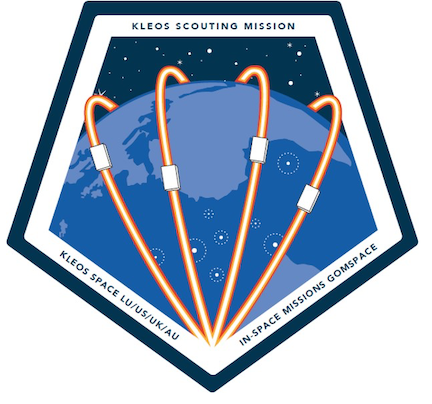
Kleos Scouting Mission Satellites En Route to India for Upcoming Launch

February 12, 2020 by editorial

Luxemberg based Kleos Space S.A, has dispatched its four Scouting Mission nanosatellites to Chennai, India, in preparation for launch aboard their PSLV C49 from the Satish Dhawan Space Centre. As of December 2019, PSLV has launched 319 foreign satellites from 33 countries, the most notable among these was the launch of PSLV C37 on February 15, 2017 successfully deploying 104 satellites in sun-synchronous orbit.

Kleos is a space-powered Radio Frequency Reconnaissance data-as-a-service (DaaS) company.  Kleos’ Scouting Mission satellites will detect and geolocate maritime radio frequency transmissions to provide global activity-based intelligence, enhancing the intelligence, surveillance and reconnaissance (ISR) capabilities of governments and commercial entities, which is important when Automatic Identification System (AIS) is defeated, imagery unclear or targets out of patrol range. Used with other data sources, Kleos’ independent geolocation data will assist the detection of hidden maritime activity, such as piracy, drug and people smuggling and illegal fishing.

The dispatch starts the Kleos specific launch activity for the Scouting Mission satellites on PSLV C49, a rideshare mission conducted by the Indian Space Research Organisation (ISRO) that includes satellites from other organizations such as Spire Global. The satellites are being transported to the integration facility where they will undergo a system checkout and mechanical inspection prior to battery charging, and fuelling. The satellites will be armed for flight, inserted into their dispensers and finally integrated onto the PSLV launch vehicle. After launch, Kleos’ satellites will commence their Launch and Early Orbit Phase (LEOP), one of the most critical phases of a mission. Spacecraft operations engineers take control of the satellites after launch vehicle separation, up to the time when the satellites are safely established in their final orbit.

The Polar Satellite Launch Vehicle (PSLV) is an expendable medium-lift launch vehicle designed and operated by the Indian Space Research Organisation (ISRO). PSLV has gained a reputation as a provider of rideshare services for smallsats, due to its numerous multi-satellite deployment campaigns with auxiliary payloads usually ride sharing along with an Indian primary payload.

The Scouting Mission satellites will be launched into a 37-degree inclination orbit, delivering information over crucial shipping regions including the Strait of Hormuz, South China Sea and East and West African coasts.

Kleos Space CEO Andy Bowyer said that their Scouting Mission satellites are the foundation of their future constellation, which will deliver unprecedented situational awareness at sea with near real-time coverage over key regions of maritime interest including the Strait of Hormuz, South China Sea and African coast.


Filed Under: News

  • « Go to Previous Page
  • Page 1
  • Interim pages omitted …
  • Page 49
  • Page 50
  • Page 51
  • Page 52
  • Page 53
  • Interim pages omitted …
  • Page 57
  • Go to Next Page »

Primary Sidebar

WEEKLY NEWSLETTER

Archives

  • May 2026
  • April 2026
  • March 2026
  • February 2026
  • January 2026
  • December 2025
  • November 2025
  • October 2025
  • September 2025
  • August 2025
  • July 2025
  • June 2025
  • May 2025
  • April 2025
  • March 2025
  • February 2025
  • January 2025
  • December 2024
  • November 2024
  • October 2024
  • September 2024
  • August 2024
  • July 2024
  • June 2024
  • May 2024
  • April 2024
  • March 2024
  • February 2024
  • January 2024
  • December 2023
  • November 2023
  • October 2023
  • September 2023
  • August 2023
  • July 2023
  • June 2023
  • May 2023
  • April 2023
  • March 2023
  • February 2023
  • January 2023
  • December 2022
  • November 2022
  • October 2022
  • September 2022
  • August 2022
  • July 2022
  • June 2022
  • May 2022
  • April 2022
  • March 2022
  • February 2022
  • January 2022
  • December 2021
  • November 2021
  • October 2021
  • September 2021
  • August 2021
  • July 2021
  • June 2021
  • May 2021
  • April 2021
  • March 2021
  • February 2021
  • January 2021
  • December 2020
  • November 2020
  • October 2020
  • September 2020
  • August 2020
  • July 2020
  • June 2020
  • May 2020
  • April 2020
  • March 2020
  • February 2020
  • January 2020
  • December 2019
  • November 2019
  • October 2019

© 2019–2026 SatNews

Insert/edit link

Enter the destination URL

Or link to existing content

    No search term specified. Showing recent items. Search or use up and down arrow keys to select an item.
      x
      Sign Up Now!

      Enjoy a free weekly newsletter with recent headlines from the global SmallSat industry.

      Invalid email address
      We promise not to spam you. You can unsubscribe at any time.
      Thanks for subscribing! You will now receive weekly SmallSat News updates.
      We love our advertisers.
      And you will too!

      Please disable Ad Blocker to continue... We promise to keep it unobtrusive.
      We promise not to spam you. You can unsubscribe at any time.
      Invalid email address
      Thanks for subscribing!