• Skip to main content
  • Skip to primary sidebar
  • Home
  • News
  • Featured
  • More News ⌄
    • SatNews
    • SatMagazine
    • MilSatMagazine
  • Events ⌄
    • MilSat Symposium
    • SmallSat Symposium
    • Satellite Innovation
  • Contacts
  • SUBSCRIPTION

SmallSat News

You are here: Home / Archives for 2024

Archives for 2024

Kongsberg NanoAvionics appoints new CEO

June 12, 2024 by editorial

Atle Wøllo

Kongsberg NanoAvionics has appointed Atle Wøllo as its new CEO, replacing Žilvinas Kvedaravičius who became interim CEO last year following the departure of co-founder and former CEO Vytenis J. Buzas in 2023.

Wøllo, with educational background in business administration and electronic engineering, comes from Kongsberg Defence & Aerospace where most recently, and prior to this latest appointment, he held the position as senior vice president special programs, and was president of Kongsberg Aviation Maintenance Services division.

During his time as president of Kongsberg Aviation Maintenance Services, he led a turnaround and business transformation into a healthy margin company with significant revenue growth.

With 30 years of experience and as a long-time employee of Kongsberg, he is very familiar with both the defence and wider aerospace industry.

“This is a fantastic time to join NanoAvionics, one of the prime smallsat manufacturers and mission operators in Europe,” Atle Wøllo said. “Their track record of successful and sophisticated missions as well as their outstanding customer list speaks for themselves. As we are entering the next evolution of the space industry with Space 3.0 and a strategic focus on mission longevity, performance, reliability, and interoperability, we intend to capture more of the global market share. Already having a fantastic and mission experienced team and the industry’s largest standard satellite platform portfolio puts us in a great position. It will allow us to cater for both commercial constellations on standardised buses as well as governments with sophisticated and customized missions.”

NanoAvionics standardized buses

Harald Aarø, a Chairman of the NanoAvionics board and Executive Vice President Business Development and Strategy at Kongsberg Defence & Aerospace, said, ” Wøllo’s strong leadership skills and experiences together with his capability to foster excellent teams, and further strengthen operations is a new steppingstone for the company. He also has a fantastic track record working on business development and partnership side with both governments and primes. This vast experience will be very beneficial, in particular to strengthening NanoAvionics’s position in large space programs.”


Filed Under: News

Viasat Energy Services intros enhanced hybrid network service for the Energy industry

June 12, 2024 by editorial

Viasat, Inc. (NASDAQ: VSAT) has launched a purpose-built managed communications service for remote oil and gas customers via the firm’s Energy Services division that significantly expands the capacity and capabilities of its industry leading enterprise-grade connectivity service.

The new solution, part of Viasat Energy Services’ range of offerings for the Energy sector, has been expanded to seamlessly incorporate LEO satellite capacity alongside Viasat Energy Services’ existing multi-orbit and terrestrial capacity designed to deliver highly flexible capabilities that can address energy customer needs through a single, integrated and fully managed service. The enhanced service is expected to be available early in the third quarter of calendar year 2024.

The integrated service offering, as part of the Viasat network, enhances performance through capacity augmentation to support additional capabilities for Energy Services customers – oil and gas operators, drilling contractors, and service companies – by powering a range of applications, including enterprise-grade solutions for customers’ cloud-based computing services, applications to drive operational efficiency and safety, and enhanced crew welfare offerings. The service is also designed to incorporate Viasat’s cybersecurity expertise and its operational artificial intelligence software and machine learning platform, IntelieTM. These capabilities are all delivered alongside Viasat’s existing robust service commitments.

Screenshot

Lee Ahlstrom, President, Viasat Energy Services, said, “Serving customers exceptionally well is our North Star – no matter the underlying technology to get there. Our energy customers are looking to solve complex challenges and operate more safely, efficiently, and sustainably. Our services are designed to make that happen. This enhanced hybrid network service offering will allow customers to improve operational efficiency and support their most advanced digital transformation efforts in the future.”

Filed Under: News

TESAT selected by MDA Space for optical inter-satellite links

June 11, 2024 by editorial

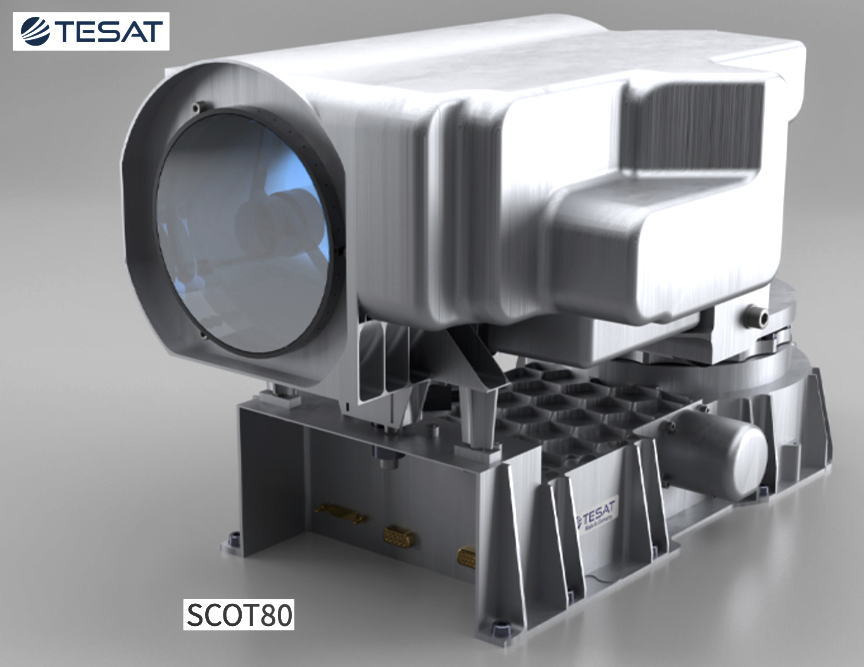
TESAT was recently selected by MDA Space Ltd. (TSX:MDA) to deliver 792 Optical Communication Terminals (OCT) as part of the supply chain for MDA AURORATM.

The 792 SCOT80 OCTs will be manufactured on a specific line in TESAT’s new high-volume production facility in Backnang, Germany. The facility has been built to meet the requirements of next space satellite constellations. The MDA AURORATM supply chain will help support product deliveries for anchor customer Telesat LEO satellite constellation Telesat Lightspeed, an innovative, advanced global network that will bring enterprise-class connectivity to customers worldwide.

TESAT began its collaboration with MDA Space more than 20 years ago and the company’s have been working closely together on several successful space programs since that time.

“We feel honored that we have been selected once again working in close cooperation with MDA Space for Telesat Lightspeed. This program will result in the next level of advanced broadband networks. We have been preparing for this kind of constellation orders by investing continuously in R&D to keep our pole position in optical communications technology, already proven by in-orbit applications with more than 86,000 successful links, and by investing in our new production facility in Backnang for serial production of OCTs. The trust that MDA Space puts again in us now proves that we are well on track,” said Thomas Reinartz, CEO of TESAT.

Filed Under: Featured, News

INNOSPACE signs agreements to launch Brazilian satellites + inertial system

June 11, 2024 by editorial

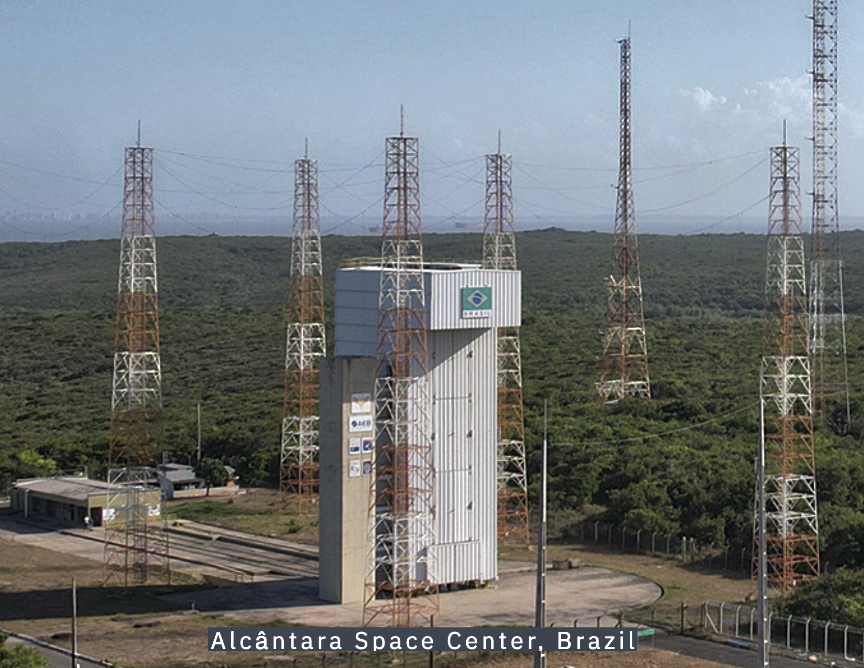
INNOSPACE recently signed a launch service agreement with the Federal University of Maranhão (UFMA) and Castro Leite Consultoria LTDA (CLC) for a rideshare launch mission on the company’s ‘HANBIT-Nano’ launch vehicle from the Alcântara Space Center in Brazil, now scheduled for the first half of 2025.

The mission will deploy smallsats developed by DARTilab and BAITES, both Brazilian research institutes participating in the project through a contract signed with UFMA, which is leading the Alcântara Scientists Project in the state of Maranhão, Brazil.

Under this agreement, INNOSPACE’s HANBIT-Nano will carry onboard the payload, an inertial system being developed by CLC, an engineering consulting service provider specialized in aerospace, defense, and inertial systems with a decade of experience in Brazil.

“The partnership with INNOSPACE for the launch of the picosatellite is a historic milestone, which will provide the residents of Alcântara with the unique opportunity to actively participate in the advancement of science and space exploration. We are excited because with this undertaking we highlight the importance of inclusion and respect for local communities in large-scale projects that drive technological progress, as well as encourage community unity and pride. We hope that this initiative will motivate the young people of Alcântara and contribute to the emergence of new opportunities for knowledge in the region,” said UFMA.

“It’s an excellent opportunity to qualify our products for a space flight. This will add value to both our equipment and the means of testing,” said CLC.

“It’s very meaningful to be selected by Brazilian customers, as this mission will be INNOSPACE’s first commercial launch and the maiden flight of its HANBIT-Nano rocket after successfully launching our first test launch vehicle, HANBIT-TLV, from the Alcântara Space Center in Brazil on March 19, 2023 (BRT),” said Soojong Kim, founder and CEO of INNOSPACE. “INNOSPACE’s priority for HANBIT is to support customers who share an innovative vision for space, and we are proud to offer them with the launch services required to achieve their objectives.”

Filed Under: News

Scout Space signs LSA for SDA satellite with ABL Space Systems

June 10, 2024 by editorial

Scout Space Inc. has signed a Launch Services Agreement (LSA) with ABL Space Systems, an aerospace and launch service provider based in El Segundo, California.

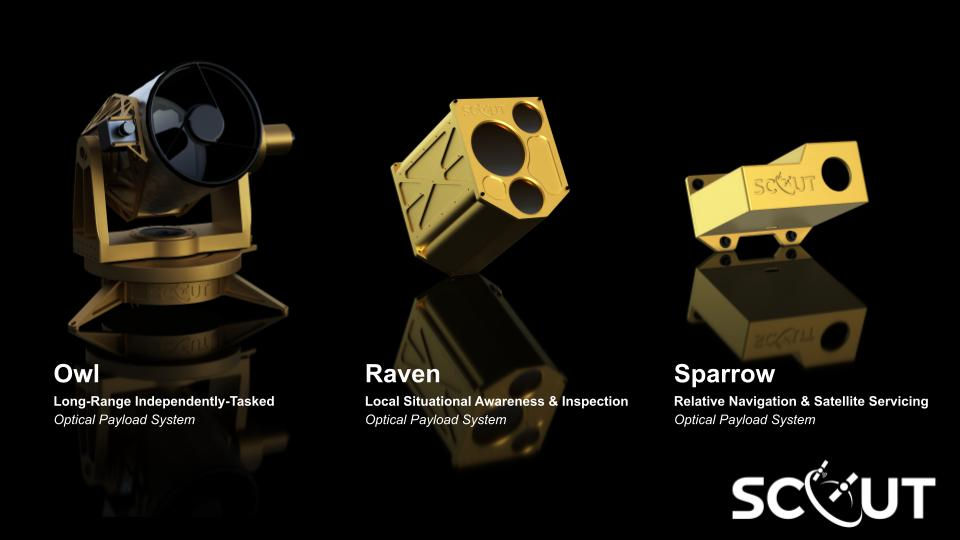
This agreement secures the launch of Scout’s “Owlet-01,” a dedicated 16U Space Domain Awareness (SDA) satellite, as the primary customer payload on ABL’s third flight of its RS1 launch vehicle scheduled for later this year.

The Owlet-01 launch represents a significant milestone for Scout Space, as this is the first standalone operational SDA satellite to be launched by the company, featuring the firm’s Owl, long-range, optical telescope and payload system. The mission aims to substantially de-risk critical elements of the Owl family of payloads, including its core optical design, while also demonstrating fundamental segments of Scout’s software stack, including on orbit demonstration of key algorithms and autonomy functionality. 

The partnership between Scout Space and ABL Space Systems signifies a notable advancement in space security and domain awareness. With this launch, both companies are set to make substantial contributions to the evolving landscape of space operations and safety.

The Owl is a long-range space domain awareness optical sensor designed to enhance missions with advanced space domain awareness capabilities. It provides on-board object detection and orbit determination.

“We are thrilled to partner with ABL Space Systems for this pivotal launch,” said Philip Hover-Smoot, CEO of Scout Space. “This mission will not only validate our Owl product line of optical payload systems but also demonstrate the advanced capabilities of our data exploitation and autonomy solutions. Moreover, the team’s ability to execute this mission on such a tight schedule is remarkable—we are taking this mission from concept to launch in less than six months. This includes not just the primary payload build within the next 90 days, but also the full integration and test of the bus within a few short weeks that follow.”

Dan Piemont, President and CFO of ABL Space Systems, said, “We’re excited that Scout Space has chosen RS1 to deliver their critical technology demonstrator to orbit and look forward to strengthening our partnership through this mission and into the future.”

Scout Space was founded in 2019 with the mission to enable a new era of space safety and transparency. Scout’s in-space products and services, first launched in 2021, allow spacecraft to see and understand things around them. The orbital distributed sensor network developed by Scout will significantly improve Space Domain Awareness (SDA) and ensure responsible use of the space environment. The company is a Techstars, MassChallenge, and venture-backed startup with ongoing government and commercial contracts. Scout holds the Established® 2021 Startup of the Year® title.

ABL Space Systems builds rockets to launch small satellites. ABL’s RS1 launch vehicle deploys over 1 ton of payload into orbit. The GS0 launch system enables RS1 to be operated from any flat pad globally. ABL is based in El Segundo, California.

Filed Under: News

RTX provides Blue Canyon satellites for NASA Polar climate mission

June 10, 2024 by editorial

Successful contact has been accomplished by Blue Canyon Technologies with NASA’s PREFIRE smallsats.

RTX‘s (NYSE: RTX) Blue Canyon Technologies has established communication with both CubeSats for the NASA PREFIRE (Polar Radiant Energy in the Far InfraRed Experiment) mission — the PREFIRE mission will measure the amount of heat Earth emits into space from the Arctic and Antarctica.

Close-up photo of one of Blue Canyon Technologies’ smallsats.

Blue Canyon provided two heritage 6U CubeSats for the mission, which is managed by NASA’s Jet Propulsion Laboratory for the agency’s Science Mission Directorate. Analysis of PREFIRE’s measurements will inform climate and ice models, helping to improve projections of how a warming world will affect sea ice loss, ice sheet melt and sea level rise.

The PREFIRE project was jointly developed by NASA and the University of Wisconsin-Madison. JPL provided the thermal infrared spectrometer payload, and the University of Wisconsin-Madison will process the data collected by the instruments.

“Improving climate models can provide more accurate projections on the impacts of storm severity and frequency, as well as coastal erosion and flooding,” said Chris Winslett, general manager for Blue Canyon Technologies.

Filed Under: News

The first 5 Kinéis smallsats to be launched to orbit via Rocket Lab’s Electron launcher

June 9, 2024 by editorial

Screenshot

Kinéis is scheduled to deploy the 1st European constellation comprised of 25 nanosatellites and dedicated to IoT for June 18, 2024, engaging the first of five launches via Rocket Lab‘s Electron launcher — this launch phase comes four years after the company raised a historic 100 million euros in funding.

This first launch for Kinéis corresponds to the 50th launch of the Electron launch vehicle. Electron has strong flight heritage after seven years of launches and meets the constraints of the Kinéis constellation, which is positioned on 5 precisely defined orbital planes. With 5 satellites placed in orbit per launch, Kinéis is the sole passenger on each of the five launches, enabling it to control its launch schedule and improve the operability of satellite positioning.

The 5 launches required to deploy the Kinéis constellation are scheduled to occur between June 2024 and early 2025, a first for the new French space sector. The launches will take place from Rocket Lab Launch Complex 1 on the Māhia Peninsula on the east coast of New Zealand’s North Island. The Rocket Lab mission Control Center is located in Auckland, the country’s economic capital, around 500 km from the launch base.

Thanks to the constellation of 25 nanosatellites, Kinéis’ mission is to connect an object anywhere in the world (including black points) and transmit useful data to users, in near real time, from any point on the globe.

Kinéis operates for a global market (with subsidiaries in the United States, Brazil and Singapore) in fields that represent major challenges for mankind, its activities and its environment today: prevention of natural risks (detection of forest fires, floods, drought, pollution, etc.), agriculture, traceability of wild and farmed animals, monitoring of infrastructures and energy networks, monitoring of transport and logistics, monitoring of commercial and scientific maritime activities. The applications are infinite and the benefits considerable: risk reduction, anticipation of breakdowns, optimization of activities, etc.

With a reference to the Pink City where Kinéis is based and where the 25 nanosatellites in the constellation are produced, the mission for this 1st launch is called ‘No Time Toulouse’. Rocket Lab designed the patch for this mission.

Alexandre Tisserant, Chairman of Kinéis, said,
”Kinéis is proud and confident to entrust the deployment of its IoT constellation to Rocket Lab. The Electron launcher meets our technical requirements for positioning the 5 nanosatellites for each of our 5 launches. Kinéis is leading the IoT revolution thanks to its space connectivity, which will enable any object to be connected anywhere in the world.”

Peter Beck, Rocket Lab founder and CEO, said, “We’re excited to launch Kinéis on the first of five dedicated Electron launches. Electron is perfectly suited to deploying constellations as we can deliver spacecraft to multiple orbital planes across multiple missions, and we’re proud to make this possible for the team at Kinéis.”

Follow the Kinéis live show from Toulouse with the live broadcast of the launch
from New-Zealand at this direct link…

Filed Under: News

SpaceX Starlink Friday launch takes 22 smallsats skyward

June 8, 2024 by editorial

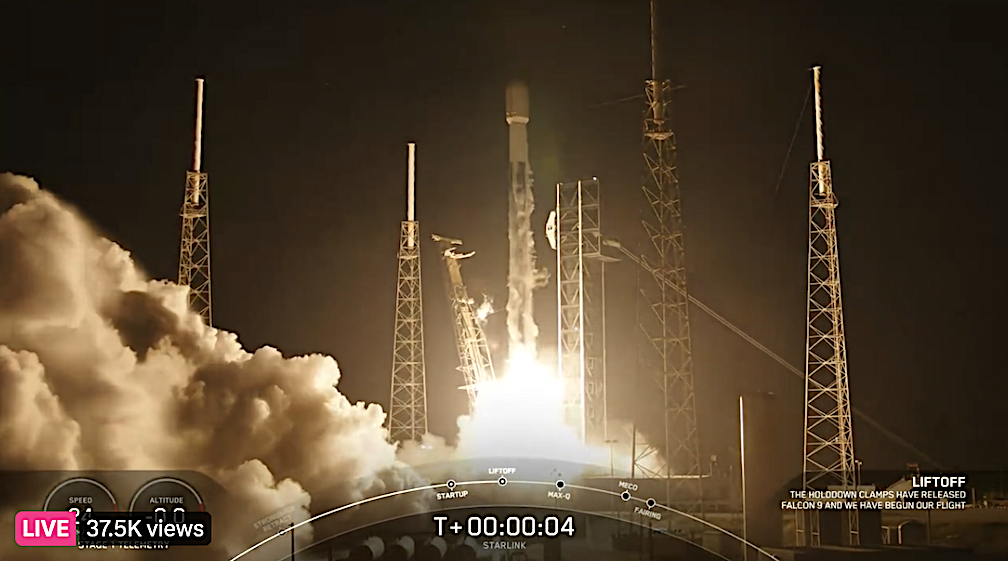
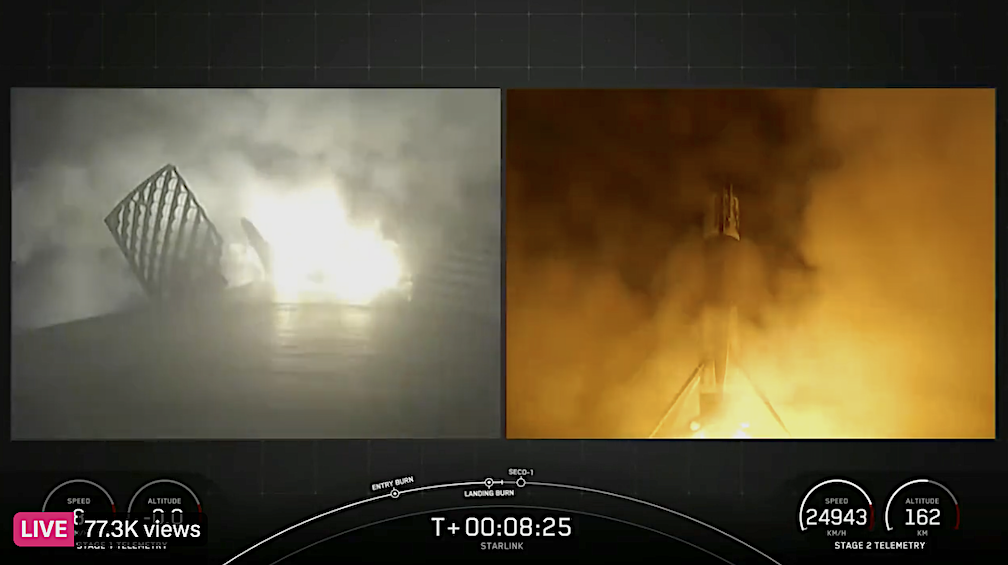
Photo captured on Friday, June 7, by Satnews from SpaceX’s video stream.

SpaceX Falcon 9 launched 22 Starlink satellites to low-Earth orbit from Space Launch Complex 40 (SLC-40) at Cape Canaveral Space Force Station in Florida on Friday, June 7. Liftoff was at 9:50 PDT despite rumors yesterday of possible inclimate weather shown below.

The Friday night flight marks the 344th Falcon 9 to launch, a little more than 14 years after its launch debut on June 4, 2010.

The weather might be a bit uncertain for Friday night’s launch of SpaceX’s Starlink satellites.

A weak cold front is pushing into the panhandle today, increasing moisture and bringing greater
instability across the peninsula. Steering level flow and upper-level winds will become more westerly, allowing showers and storms that develop with heating and seabreeze interaction to migrate back toward the coast by the late afternoon hours. The latest forecast models have increased coverage of showers and storms over the central to southern portions of the state for Friday, so showers and storms could linger well into the launch window. On Saturday, the front is expected to wash out as high pressure begins to build back in. This will result in slightly drier conditions, so any afternoon shower activity should diminish quickly after sunset. A stray shower over the coastal areas can’t be ruled out,
so the primary concern for the backup day is the Cumulus Cloud Rule. Launch Day Probability of

Photo captured on Friday, June 7, by Satnews from SpaceX’s video stream.

This is the 16th flight for the first stage booster supporting this mission, which previously launched CRS-24, Eutelsat HOTBIRD 13F, OneWeb 1, SES-18 and SES-19, and 11 Starlink missions. Following stage separation, the first stage landed on the A Shortfall of Gravitas droneship, stationed in the Atlantic Ocean.

SpaceX Starlink launch Friday

This image has an empty alt attribute; its file name is Screen-Shot-2024-06-05-at-11.36.52-PM.png
Photo captured on Tuesday, June 4, by Satnews from SpaceX’s video stream.

SpaceX is targeting Friday, June 7 for a Falcon 9 launch of 22 Starlink satellites to low-Earth orbit from Space Launch Complex 40 (SLC-40) at Cape Canaveral Space Force Station in Florida. Liftoff is targeted for 8:00 p.m. ET, with backup opportunities available until 10:10 p.m. ET. If needed, additional opportunities are also available on Saturday, June 8 starting at 7:47 p.m. ET.

A live webcast of this mission will begin on X @SpaceX about five minutes prior to liftoff. Watch live.

This is the 16th flight for the first stage booster supporting this mission, which previously launched CRS-24, Eutelsat HOTBIRD 13F, OneWeb 1, SES-18 and SES-19, and 11 Starlink missions. Following stage separation, the first stage will land on the A Shortfall of Gravitas droneship, which will be stationed in the Atlantic Ocean.

Filed Under: News

Pale Blue raises million$$ in Series B funding

June 7, 2024 by editorial

Pale Blue Inc. has completed its Series B funding round of 2.5 billion yen (approx. $16 million)— this funding will accelerate research, development, and manufacturing of propulsion systems for small satellites.

The Series B funding round was completed through a third-party allocation of new shares to venture capital and CVC funds. Including the amount raised during the first close announced in October of 2023, the total amount raised in this Series B funding round is approximately 2.5 billion yen (approx. $16 million). With this funding, the company will focus on the development and on-orbit demonstration of the firm’s water ion thruster and water Hall-effect thruster, the establishment of a development base for production technologies, and the enhancement of the Pale Blue team.

Photo, from left to right: Asakawa, Yaginuma, and Nakagawa, the co-founders of Pale Blue.

Jun Asakawa, CEO and Co-Founder of Pale Blue, said, “With this Series B funding round, Pale Blue will strengthen its team while accelerating the development and on-orbit demonstration of our water ion thruster and water Hall-effect thruster, as well as the establishment of a development base for production technologies. We are deeply grateful for the support of our investors and remain committed to developing innovative technologies and implementing them in society. We will create a mobility that is core to the space industry and pioneer the expansion of human possibility.”

CEO and General Partner Kazumasa Watanabe of aSTART Co., Ltd., said, “Our company has cultivated extensive knowledge and relationships, particularly with enterprises providing low Earth orbit services for small satellites. One of the significant challenges we have identified is the absence of propulsion systems that can deliver safety, high-performance, low-cost, sustainability, and short-lead-times. Pale Blue is developing technologies that address all these issues simultaneously, revolutionizing the satellite propulsion market. We are fully committed to supporting this transformative journey that will change the world.”

Yasuhiro Saito Department Manager, Innovation Department, YAMATO TRANSPORT CO., LTD., Senior Manager, Innovation Department, YAMATO HOLDINGS CO., LTD., said, “We have decided to make an additional investment in Pale Blue in the hope that its advanced technological capabilities will make a significant contribution to the market expansion of the space industry. We are also attracted to Pale Blue because it is a company that addresses environmental issues and has a high affinity with our goal of contributing to the realization of a sustainable future. We will continue to work with the company to create new value.“

Hidetaka Aoki, Partner/Fellow, Global Brain Corporation, said, “Following the previous Series A round, we have made additional investment in Pale Blue. We think Pale Blue deserves credit for speedily promoting its business based on its advanced technological capabilities, and for having a solid track record in space. Space Sustainability is becoming an increasingly important theme, and we expect Pale Blue to become a world leader in this field as well.”

General Partner Shinzo Nakano / Principal, Kaoru Nakagamie of ITC Ventures, Inc., said, “In recent years, the space business has been experiencing significant global growth, and it remains one of the few promising sectors where Japanese startups can compete on an international level. Pale Blue, a highly capable startup originating from the University of Tokyo, has already built a strong track record of orders from both domestic and international clients. We have decided to invest in this promising company and are committed to fully supporting their business expansion as ITV.””

Pale Blue is a space technology company that was spun out from the University of Tokyo in 2020. The company is dedicated to providing a propulsion solution for spacecraft and it produces a range of systems that use water as a propellant. Through its innovative propulsion technology, Pale Blue aims to create mobility that is core to the space industry.

Filed Under: Featured, News

Firefly Aerospace announces multi-launch agreement with Lockheed Martin

June 7, 2024 by editorial

Firefly Aerospace, Inc. has signed a multi-launch agreement with Lockheed Martin for 25 launches on Firefly’s Alpha rocket through 2029. This agreement commits Lockheed Martin to 15 launch reservations and 10 optional launches.

Screenshot

Under the agreement, Alpha will launch Lockheed Martin spacecraft into LEO from Firefly’s facilities on the west and east coast. The first mission will launch on Alpha flight 6 (FLTA006) from Firefly’s SLC-2 launch site at the Vandenberg Space Force Base later this year. The mission will be conducted as another responsive space operation that includes transporting the payload fairing to the launch pad, mating it to Firefly’s Alpha rocket, and completing final launch operations within hours of the scheduled liftoff.

Photo of the Alpha rocket in launch mode, courtesy of Firefly Aerospace.

Built with lightweight carbon composites and patented propulsion technologies, Firefly’s Alpha rocket provides low-cost launch services for satellites up to 1,030 kg and supports the growing demand for responsive space missions when and where customers need to fly.

“Firefly is honored to continue this partnership with Lockheed Martin and appreciates their confidence in our rapid launch services to support their critical missions for years to come,” said Bill Weber, CEO of Firefly Aerospace. “The Firefly team has scaled up Alpha production and testing and significantly streamlined our launch operations to fly Alpha more frequently and responsively. This allows us to continue delivering the one metric ton rocket the industry is demanding.”

“Our customers have told us they need rapid advancement of new mission capabilities,” said Bob Behnken, Director, Ignite Technology Acceleration at Lockheed Martin Space. “This agreement with Firefly further diversifies our access to space, allowing us to continue quickly flight demonstrating the cutting-edge technology we are developing for them, as well as enabling our continued exploration of tactical and responsive space solutions.”

Filed Under: News

  • « Go to Previous Page
  • Page 1
  • Interim pages omitted …
  • Page 20
  • Page 21
  • Page 22
  • Page 23
  • Page 24
  • Interim pages omitted …
  • Page 42
  • Go to Next Page »

Primary Sidebar

WEEKLY NEWSLETTER

Archives

  • August 2026
  • July 2026
  • June 2026
  • May 2026
  • April 2026
  • March 2026
  • February 2026
  • January 2026
  • December 2025
  • November 2025
  • October 2025
  • September 2025
  • August 2025
  • July 2025
  • June 2025
  • May 2025
  • April 2025
  • March 2025
  • February 2025
  • January 2025
  • December 2024
  • November 2024
  • October 2024
  • September 2024
  • August 2024
  • July 2024
  • June 2024
  • May 2024
  • April 2024
  • March 2024
  • February 2024
  • January 2024
  • December 2023
  • November 2023
  • October 2023
  • September 2023
  • August 2023
  • July 2023
  • June 2023
  • May 2023
  • April 2023
  • March 2023
  • February 2023
  • January 2023
  • December 2022
  • November 2022
  • October 2022
  • September 2022
  • August 2022
  • July 2022
  • June 2022
  • May 2022
  • April 2022
  • March 2022
  • February 2022
  • January 2022
  • December 2021
  • November 2021
  • October 2021
  • September 2021
  • August 2021
  • July 2021
  • June 2021
  • May 2021
  • April 2021
  • March 2021
  • February 2021
  • January 2021
  • December 2020
  • November 2020
  • October 2020
  • September 2020
  • August 2020
  • July 2020
  • June 2020
  • May 2020
  • April 2020
  • March 2020
  • February 2020
  • January 2020
  • December 2019
  • November 2019
  • October 2019

© 2019–2026 SatNews

Insert/edit link

Enter the destination URL

Or link to existing content

    No search term specified. Showing recent items. Search or use up and down arrow keys to select an item.
      x
      Sign Up Now!

      Enjoy a free weekly newsletter with recent headlines from the global SmallSat industry.

      Invalid email address
      We promise not to spam you. You can unsubscribe at any time.
      Thanks for subscribing! You will now receive weekly SmallSat News updates.
      We love our advertisers.
      And you will too!

      Please disable Ad Blocker to continue... We promise to keep it unobtrusive.
      We promise not to spam you. You can unsubscribe at any time.
      Invalid email address
      Thanks for subscribing!