• Skip to main content
  • Skip to primary sidebar
  • Home
  • News
  • Featured
  • More News ⌄
    • SatNews
    • SatMagazine
    • MilSatMagazine
  • Events ⌄
    • MilSat Symposium
    • SmallSat Symposium
    • Satellite Innovation
  • Contacts
  • SUBSCRIPTION

SmallSat News

You are here: Home / Archives for editorial

editorial

Umbra a Next Generation Space Company Prepares for Launch of SAR Microsatellite

January 6, 2020 by editorial

Described as “nearly four years of secretive research and development,” Umbra, located in downtown Santa Barbara, is preparing to launch its first Synthetic Aperture Radar (SAR) microsatellite.

Umbra states that they have developed the world’s only microsatellites capable of generating high resolution imagery from space. Umbra can build a scalable constellation which supports high revisit rates. Average hourly revisits are achievable with 12 satellites while maintaining 1 meter resolution (NESZ ≤ -18 dB). 

Founders of Umbra, David Langan (CEO) and Gabe Dominocielo (CSO), long-time friends born and raised in Santa Barbara, wanted to start a space company there. Dominocielo said that Santa Barbara is well known as a tourist destination, few realize that is has a century long legacy of aerospace industry. They are proud to be a part of it and participate in the development of its next stage. 

Umbra’s microsatellite weighs about 50 kg (110 lbs) and is launched into space in a rideshare volume of a rocket such as SpaceX’s Falcon 9, reducing the costs of the mission. Once in space, Umbra’s antenna expands into a parabolic dish larger than the side of a small school bus, allowing Umbra to achieve unparalleled performance.

The company’s 10,000 square foot facility recently welcomed local public officials including Santa Barbara Mayor Cathy Murillo, City Council members Jason Dominguez and Kristen Sneddon. Wendy Motta, representing Congressman Salud Carbajal, a member of the U.S. House Committee on Armed Services were in attendance. 

Santa Barbara Mayor Cathy Murillo said that Umbra’s microsatellite offers an incredible capability [.25 meter single look imagery] which is unlike anything else she has seen before. 

During the tour of Umbra’s Mission Operations Control (MOC), Councilmember Kristen Sneddon, a geophysicist with an expertise in radar technology, noted, they are building a SAR satellite, it is very exciting to have this technology [high-resolution SAR] developed and directed locally within the city. SAR data can be very useful in the Santa Barbara area, specifically to monitor shifting topography, fires, water aquifers, oil leaks/spills and overall environmental monitoring and more.

The location of the company in Santa Barbara joins part of an aerospace legacy such as Loughead Aircraft Manufacturing Company was founded in 1912, by Allan Lockheed who later formed Lockheed Aircraft Company, one of the companies that formed today’s Lockheed Martin. Jack Northrop began as a draftsman for Loughead Aircraft Manufacturing Company and later founded what became Northrop Grumman. Other innovative aerospace companies have established offices in Santa Barbara County, including, Astro Aerospace, AEC-Able, DSS and Raytheon.

Umbra currently employs about 20 people and has raised capital from CrossCut Ventures, Hemisphere Ventures, Starbridge Ventures, PonValley and Champion Hill Ventures. 

Filed Under: News

Blue Origin Opens Their Operations Hub

January 6, 2020 by editorial

Blue Origin has opened their new headquarters and R&D facility in Kent, Washington.

The facility is Blue Origin’s hub of operations as the firm continues to grow their team. Below are excerpts from remarks given by Blue Origin CEO Bob Smith at the ribbon cutting event.

“2019 was a great year of progress and preparation for us, and 2020 is going to be even more remarkable – so we’re growing quickly. We grew by a third last year and we’re going to continue to grow at a rapid pace.

“We named this building the O’Neill Building after Gerard O’Neill, a physicist who envisioned millions of people living and working in space for the benefit of Earth. Gerard O’Neill was one of the visionaries who thought about how we go out into space in a quick and sustainable way so that we can preserve our planet.

“For those of you that are Washington State residents, what is exciting is we’re going to be doing all this work from a headquarters based here in Kent. It’s a remarkable statement to say that we’re going to fly humans to space, we’re going to build and design large engines and a large orbital rocket, and we’re going to go back to the Moon – all through work centered here.

“We’re excited to continue to see this growth in this new facility. We broke ground on this facility in January of 2019 and it came up in just 11 months. It houses approximately 1,500 people. The building sits on a 30-acre plot of land, and we’re using 13 of those acres for a wildlife habitat and flood storage, as well as protecting against invasive species. This is a very sustainable building with better insulation and better energy consumption than a traditional building. And it all came together very quickly.

“This couldn’t have been done without our great partners. Thanks to Sprung Instant Structures, our architect Nelson, our general contractor Sierra Construction, civil engineering group Barghausen Consulting Engineers and our environmental consultants Soundview Consultants.

“We want to recognize Congressman Smith, Congressman Kilmer and Congressman Heck for joining us here today, thank you for your support. We also want to give a huge thank you to the City of Kent and Mayor Dana Ralph for their tremendous support and leadership.”

Filed Under: News

Forrester Reports: A Busy Month for SpaceX with a Launch Today

January 6, 2020 by editorial


Chris Forrester

Chris Forrester has filed a story that, on January 6th, SpaceX is scheduled to launch one of their Falcon 9 rockets into LEO carrying 60 ‘Starlink’ satellites — the rocket was successfully test fired on January 4th.

SpaceX will also have a floating barge down range in the Atlantic Ocean ready to provide a landing stage for the rocket. The company will also ready a couple of ships with giant nets that will be deployed to capture the valuable rocket fairings, each worth a reported $6 million.

However, this first launch of the new year is just the start of a heavy schedule for Elon Musk’s SpaceX. The company is planning another three launches this January, two of which will carry similar cargoes of Starlink satellites.

By the close of this month, Musk could have 300 working satellites in space and be adding another 1,200 during the course of 2020. The process could see Starlink’s ‘broadband by satellite’ system brought into use, perhaps as early as this autumn’s notorious Hurricane Season for use by safety and rescue personnel.

There’s more — also due in January is a test launch of Musk’s Dragon (unmanned) crew capsule craft, due later this week on January 11th. Musk has contracts in place with NASA to deliver human astronauts to the International Space Station later this year.

Back in 2018 Musk, launched his rockets 21 times. Last year (2019) was a little slower with just 13 launches. This slowdown is being blamed on a lack of clients with satellites ready to launch and was not helped by a definite downturn in commercial launch activity.

Also on SpaceX’s busy manifest is a longer test launch of Musk’s giant Big Falcon Rocket Starship SN1, with Musk saying this will occur within the next two to three months. A test engine firing is scheduled for January 6 at 3:00 p.m. (Texas) time.

Filed Under: News

New Year New Launches … Success for SpaceX’s Starlink 2

January 6, 2020 by editorial

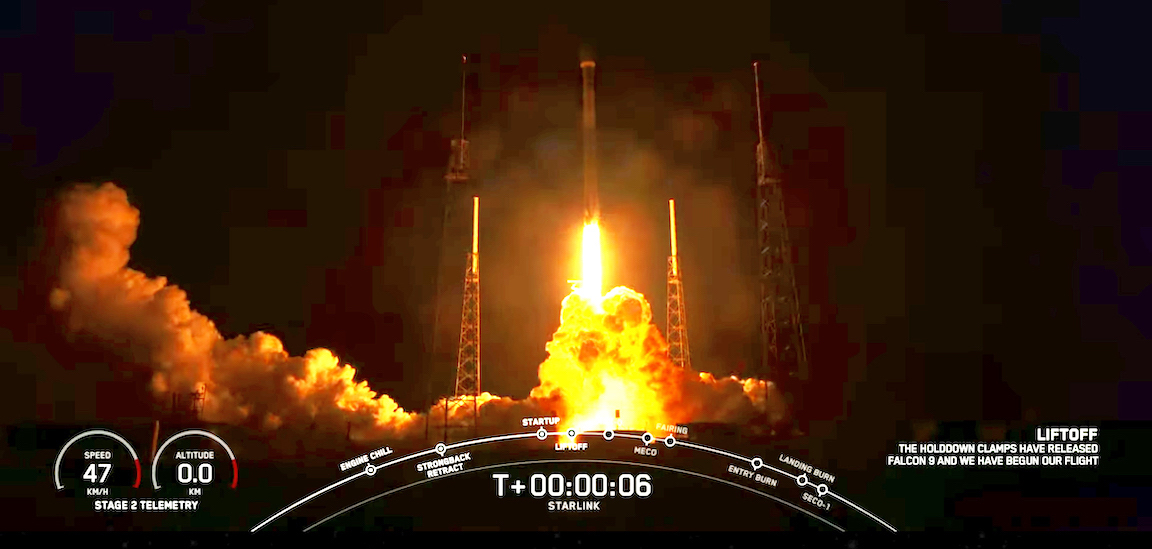
A new year and a new successful launch occurred for SpaceX ‘s  Falcon 9 Block 5 rocket with the Starlink 2 mega-constellation communications mission on its way. 

The launch took place a 7:19 PM MST (Mountain Standard Time) from Space Launch Complex 40, Cape Canaveral, Florida. Recovery of a payload fairing was unsuccessful.

Falcon 9’s first stage supported a Starlink mission in May 2019, the Iridium-8 mission in January 2019, and the Telstar 18 VANTAGE mission in September 2018.

The Starlink satellites each weigh approximately 500 pounds, and deploy at an altitude of 290 km. Prior to orbit raise, SpaceX engineers will conduct data reviews to ensure all Starlink satellites are operating as intended. Once the checkouts are complete, the satellites will then use their onboard ion thrusters to move into their intended orbits. 

Starlink satellite flight operations take place in three phases: orbit raise, on-station service, and deorbit. After deployment, over the course of one to four months, the satellites use their onboard thrusters to raise from an altitude of 290 km to 550 km. During this phase of flight the satellites are closely clustered and their solar arrays are in a special low-drag configuration, making them appear more visible from the ground.

Once the satellites reach their operational altitude of 550km and begin on-station service, their orientation changes and the satellites become significantly less visible from the ground. On this flight, SpaceX is also testing an experimental darkening treatment on one satellite to further reduce the albedo of the body of the satellites.

Throughout flight operations, SpaceX shares high-fidelity tracking data with other satellite operators through the U.S. Air Force’s 18th Space Control Squadron. Additionally, SpaceX is providing leading astronomy groups with predictive two-line elements (TLEs) in advance of launch so astronomers can better coordinate their observations with the satellites.

Falcon 9 is a two-stage rocket designed and manufactured by SpaceX specifically for reliable and safe transport of satellites and the Dragon spacecraft into orbit. The Block 5 variant is the fifth major interval aimed at improving upon the ability for rapid reusability.


This photo reveals how 60 Starlink satellites look when packed into the nosecone of the Falcon 9 rocket. Photo by SpaceX.

Space Exploration Technologies Corp.,  (SpaceX), founded in 2002 by entrepreneur Elon Musk, is headquartered in Hawthorne, California. SpaceX has many pads located on the East Coast of the United States. The company owns SLC-40 at Cape Canaveral and LC-39A at the Kennedy Space Center specifically for their lower inclination launches. They also own SLC-4E at Vandenberg, California for their high inclination launches, and another site is also being developed at Boca Chica, Texas.


Filed Under: News

Japan’s Tsubame Smallsat Gains Guinness World Records Recognition

December 31, 2019 by editorial

Japan’s Tsubame satellite, known for its ultra-low orbiting capabilities, has been recognized in the Guinness World Records as achieving the “lowest altitude by an Earth observation satellite in orbit,” according to the Japan Aerospace Exploration Agency (JAXA).


Artistic rendition of the Tsubame satellite.

Image is courtesy of JAXA.

As part of the satellite’s test mission, Tsubame, flew at an orbital altitude of 167.4 km. from December 23, 2017, to October 1, 2019. This compares to the 600 to 800 km. range in which regular Earth Observation (EO) satellites usually operate.

Using a combination of gas-jet thrusters and a special ion engine system designed by JAXA, Tsubame kept its record low altitude for seven days and captured high resolution images as well as collected atmospheric-related data. The satellite’s ultra-low orbit enabled it to capture more detailed information on the Earth’s surface, but required it to deal with more atmospheric resistance, JAXA explained.

At such a low altitude, the satellite will be exposed to “1,000 times more atmospheric resistance than those at usual altitudes and concentrated atomic oxygen that would accelerate the deterioration of satellite parts,” the space agency here said.  JAXA also said that the materials it developed to ensure Tsubame would be able to withstand being exposed to atomic oxygen for lengthy periods, could help the future of satellite technology.

Masanori Sasaki, the Super Low Altitude Test Satellite project manager at JAXA, stated that the organization would like to make use of this achievement toward future science, technology and satellite utilization and contribute to helping solve as many social issues as possible.

Article source: Xinhua

Filed Under: News

Russian Rokot Pushes Thee Smallsats Plus a Military Satellite to Orbit

December 27, 2019 by editorial


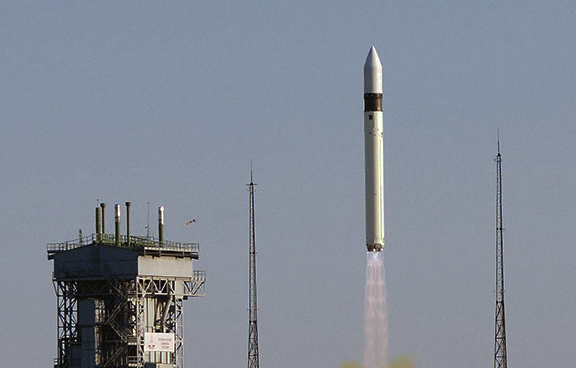
The Rokot rocket launch from the Plesetsk cosmodrome.

The launch photo is courtesy of TASS/Andrei Morgunov.

On December 27 at 2:11 a.m., Moscow time, the Russian Briz-KM upper stage delivered to orbit a military satellite plus three Gonets-M communication smallsats, according to the Russian Defense Ministry.

In a statement from the ministry, they said that the Rokot light carrier rocket was launched from the Plesetsk cosmodrome (Arkhangelsk region) and delivered three Gonets-M communications spacecraft and the spacecraft of the Russian Defense Ministry to the orbit at the assigned time.

The launch of the Rokot rocket and delivery of the spacecraft to the orbit were carried out in the routine mode, the ministry added.


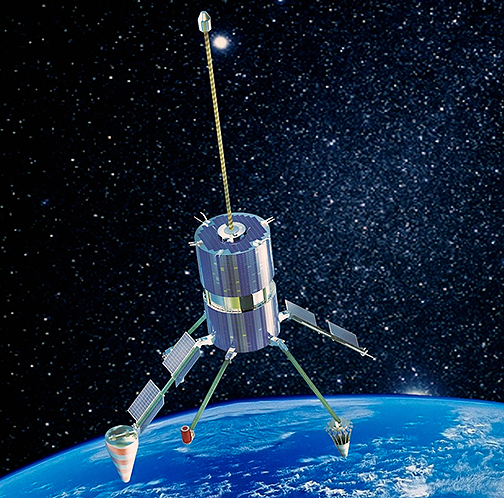
Artistic rendition of a Russian Gonets-M satellite.

The defense ministry said that JSC Gonets SatCom has assumed control over the Gonets-M satellites, adding that after delivery to the orbit, the control over the Gonets-M spacecraft was transferred to the operator, who will continue controlling them throughout the orbital flight.

These smallsats were built by Reshetnev Information Satellite Systems and weight approximately about 300 kilograms — their life expectancy on-orbit is five years. No information, as of this writing, has been offered regarding the Russian military satellite payload.

This is the second launch of the Rokot rocket from Plesetsk in 2019. The previous Rokot launch was successfully carried out on August 30. Moreover, combat crews of the Space Forces of the Russian Aerospace Forces have launched six more Soyuz-2 carrier rockets from the Plesetsk cosmodrome during 2019.

Filed Under: News

FCC Gives OK To SpaceX for More Satellites

December 20, 2019 by editorial

On December 19, 2019, the U.S. Federal Communications Commission (FCC) approved the application1 of Space Exploration Holdings, LLC (SpaceX) to further modify their previously authorized 4,425 non-geostationary orbit (NGSO) fixed-satellite service (FSS) satellite constellation using Ku- and Ka-band spectrum.

Specifically, the agency has now authorized SpaceX to increase the number of orbital planes authorized for operations of SpaceX’s satellites at the 550 kilometer (km.) orbital shell, to reduce the number of satellites in each orbital plane and to reconfigure existing satellites in its constellation accordingly.  In doing so, the FCC denies petitions to deny or defer SpaceX’s application3.

Grant of this application will allow SpaceX to accelerate the deployment of their satellite constellation to deliver broadband service throughout the United States, especially to those who live in areas underserved or unserved by terrestrial systems.

On April 26, 2019, the FCC’s International Bureau (Bureau) granted SpaceX’s request to modify its initial authorization and allowed SpaceX to: (1) reduce the number of satellites in the constellation from 4,425 to 4,409; (2) operate 1,584 satellites previously authorized to operate at an altitude of 1,150 km. at the lower altitude of 550 km.; and (3) make related changes to the operations of the satellites in this new lower shell of the constellation.

To read the entire FCC’s Order and Authorization, please access this infolink for the PDF document…

1Space Exploration Holdings, LLC, Request for Modification of the Authorization for the SpaceX NGSO Satellite System, IBFS File No. SAT−MOD−20190830−00087, filed August 30, 2019 (SpaceX Second Modification Application).

2See Space Exploration Holdings, LLC, Application for Approval for Orbital Deployment and Operating Authority for the SpaceX NGSO Satellite System, Memorandum Opinion, Order and Authorization, 33 FCC Rcd 3391 (2018) (SpaceX Authorization).

3Petition to Defer of SES Americom and O3b Limited (filed Oct. 15, 2019) (SES/O3b Petition); Letter from Nickolas G. Spina, Counsel to Kepler Communications, Inc., to Marlene H. Dortch, Secretary, FCC (filed Oct. 15, 2019) (Kepler Letter).  Kepler’s Letter comprises (1) a petition for reconsideration of the SpaceX First Modification Order (as defined in n.4 below) (Kepler Letter, Recon Petition) (2) a petition to defer or deny this SpaceX Second Modification Application (Kepler Letter, Second Mod Petition), and (3) a petition to defer or deny SpaceX’s request for special temporary authority to launch its second tranche of satellites (Kepler Letter, STA Petition).


Filed Under: Featured, News

Brazil and China’s EO Satellite and Smallsats Driven into Orbit

December 20, 2019 by editorial


Artistic rendition of the CBERS-4A satellite on-orbit.

An Earth Observation (EO) satellite that was jointly developed by China and Brazil was launched into space on Friday, December 20, under a bilateral program that is seen as a template for broader cooperation among BRICS (Brazil, Russia, India, China and South Africa) nations.

The China-Brazil Earth Resource Satellite 4A was launched via a Long March 4B rocket from the northern Chinese province of Shanxi, the official Xinhua news agency reported.

This satellite was the sixth developed under the China-Brazil Earth Resources Satellite (CBERS) program that began in 1988. The satellites are designed for EO from orbit for non-military use. The CBERS 4A will support the Brazilian government’s monitoring of the Amazon rainforest and changes in the country’s environment, according to Xinhua.

An additional eight satellites were also placed into orbit by the same rocket, including a wide-range, multi-spectral, remote-sensing smallsat donated to Ethiopia.

The BRICS nations have been in talks on a framework agreement to create a constellation of satellites for Earth remote-sensing and to enable the sharing of data obtained by each others’ satellites. Each country will provide one to two satellites to the constellation, according to the China National Space Administration. The CBERS satellites would be included in the constellation program.

Currently, only South Africa in the BRICS bloc does not have satellites of its own on-orbit.

Article source: NDTV

Filed Under: News

Satellogic Acquires $50 Million in New Funding

December 20, 2019 by editorial

Satellogic has received $50 million in funding from new and existing investors — this announcement comes on the heels of Satellogic’s $38 million Dedicated Satellite Constellation (DSC) agreement with ABDAS to deliver access to a dedicated fleet of satellites providing them with high-resolution geospatial insights that will contribute to the monitoring of agriculture over the Henan Province in China and strengthen governmental decisions.

Existing investors, including Tencent and Pitanga,


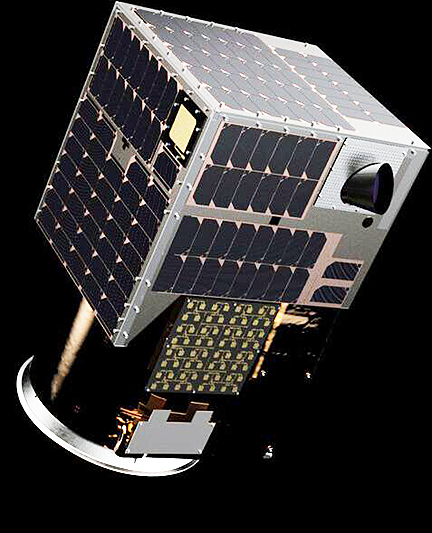
Artistic rendition of a Satellogic satellite.

Image is courtesy of the company.

contributed approximately 40% of the $50 million in newly announced funding, with some existing investors requesting more than their pro rata share. The remaining capital comes from a number of new financial and strategic investors, including the Inter-American Development Bank (IDB), through IDB Lab, the innovation laboratory of the IDB Group.

Pitanga, also based in the Latin American region, invests in innovative companies with high growth potential and is among the existing investors contributing to Satellogic’s newly announced funding.

Satellogic recently closed a $38 million agreement with ABDAS, a data science company established under the technical support of the Institute of Remote Sensing and Digital Earth. The agreement gives ABDAS access to a Dedicated Satellite Constellation and geospatial analytics that will provide them with multi-spectral imagery for monthly remapping of sites they define within their departmental territory and derive insights through their in-house data science capabilities. Through the partnership, ABDAS is able to leverage their constellation to strengthen and support key policy decisions in the province, with no capital outlay and no technical or operational risks.

Today, less than one-third of the countries in the world have their own satellites orbiting the Earth, limiting their ability to capture data about their policy implementation and infrastructure. However, that landscape is changing. One recent report valued the geospatial analytics market at $19.59B in 2018 and predicted that it will reach a value of $29.28 billion by 2024. In this report, government interest was noted as a key driver of growth. New investor, IDB Lab, sees an opportunity for Satellogic to have a meaningful impact in Latin America and the Caribbean in particular. IDB Lab’s financing will be specifically directed toward Satellogic’s development of user-end satellite imagery solutions in these sectors.

Tomás Lopes Teixeira, Senior Investment Officer at IDB Lab, said the company’s mission is to leverage innovation toward inclusion in Latin American and the Caribbean. The firm is excited to support Satellogic’s mission of democratizing access to geospatial analytics solutions, such as monitoring crop growth and preventing the spread of plagues in agriculture to help increase yields and livelihoods of a vast universe of small and medium-sized farmers caught in a low-productivity cycle in the region; improving the reaction time and accuracy in natural disaster response, which typically disproportionately impacts vulnerable populations; and preventing deforestation.

Fernando Reinach, Partner, Pitanga Fund, added that as an investor that has continued to support Satellogic through multiple phases of growth and development, the company is excited to see the market dynamics shift toward what our team has been building since 2010. Governments and industry alike now recognize the power of geospatial analytics and Satellogic is a proven partner. When choosing where to invest and reinvest, Pitanga seeks to fund companies that have the potential to be disruptive and capture a significant portion of large markets in a short time. In this regard, Satellogic is the perfect archetype of the Pitanga portfolio.

Satellogic Founder and CEO, Emiliano Kargieman noted that the company is experiencing significant commercial momentum and the firm is grateful to have investors that want to fuel that growth and help Satellogic service the demand for the company’s Dedicated Satellite Constellation (DSC) and Dedicated Satellite Services (DSS) solutions. Given the commercial success with Satellogic’s DSC bookings and pipeline, in particular, the firm is fortunate to be in a position to use that cash flow to better leverage investor capital in executing the company’s business plan.

Filed Under: Featured, News

Apple Considering iSats…

December 20, 2019 by editorial


Apple Headquarters, Cupertino, California.

SATCOM continues to draw increased interest by major technology actors… in the case of Apple, this interest is… according to several reports by major news outlets… to drive comms directly to the firm’s devices from on-orbit satellites and the project has apparently been in the firm’s development pipeline since 2017.

This is definitely becoming a somewhat crowded market, with the Amazons and SpaceXs of the world driving new LEO constellations to service the entire globe and bathe the previously unconnected with beams of cyberspace connectivity.

With the numerous reports now filtering to the internet, Apple’s secret is “out”… Bloomberg News reporters, apparently infiltrating the hallowed halls of the computer, device and services company, indicated around 12 engineers have joined the form to work on this technology. Whether or not these folk are developing satellite to device beam technology, or Apple satellite builds, is unknown as of this writing. However, given the firm’s astounding monetary wherewithal, none of these arenas are outside the realm of possibility.

Bloomberg News filed a story also indicated that the former head of satellite engineer at Google and the founder of Ettus Research have been taken aboard the Apple ship in Cupertino, California. According to Fox Business, former technologists that worked at Skybox Images, prior to its acquisition by Google, are heading up this Apple mission, those being John Fenwick (the former head of Google’s spacecraft operations) and Michael Trela. Additionally, the company has allegedly been involved in a number of conversations regarding LEO satellite launches with Boeing.

Key motivation for these moves by the company could certainly be with the aim to reduce the influence of service providers to reduce consumer as well as Apple dependency on those firms as well as to increase Apple’s ability to provide better maps and location tracking. Mix in the burgeoning 5G environs for wireless connectivity and realize Apple, even if somewhat late to the game, has the capability to surmount numerous challenges to provide products that will be eagerly consumed.

SATCOM and 5G services provisioning are certainly within the firm’s technology purview and, if successful, could easily please consumers with advanced products, all the while generating higher atmospheric streams of revenue for Apple.

Filed Under: News

  • « Go to Previous Page
  • Page 1
  • Interim pages omitted …
  • Page 325
  • Page 326
  • Page 327
  • Page 328
  • Page 329
  • Interim pages omitted …
  • Page 338
  • Go to Next Page »

Primary Sidebar

WEEKLY NEWSLETTER

Archives

  • March 2026
  • February 2026
  • January 2026
  • December 2025
  • November 2025
  • October 2025
  • September 2025
  • August 2025
  • July 2025
  • June 2025
  • May 2025
  • April 2025
  • March 2025
  • February 2025
  • January 2025
  • December 2024
  • November 2024
  • October 2024
  • September 2024
  • August 2024
  • July 2024
  • June 2024
  • May 2024
  • April 2024
  • March 2024
  • February 2024
  • January 2024
  • December 2023
  • November 2023
  • October 2023
  • September 2023
  • August 2023
  • July 2023
  • June 2023
  • May 2023
  • April 2023
  • March 2023
  • February 2023
  • January 2023
  • December 2022
  • November 2022
  • October 2022
  • September 2022
  • August 2022
  • July 2022
  • June 2022
  • May 2022
  • April 2022
  • March 2022
  • February 2022
  • January 2022
  • December 2021
  • November 2021
  • October 2021
  • September 2021
  • August 2021
  • July 2021
  • June 2021
  • May 2021
  • April 2021
  • March 2021
  • February 2021
  • January 2021
  • December 2020
  • November 2020
  • October 2020
  • September 2020
  • August 2020
  • July 2020
  • June 2020
  • May 2020
  • April 2020
  • March 2020
  • February 2020
  • January 2020
  • December 2019
  • November 2019
  • October 2019

© 2019–2026 SatNews

Insert/edit link

Enter the destination URL

Or link to existing content

    No search term specified. Showing recent items. Search or use up and down arrow keys to select an item.
      x
      Sign Up Now!

      Enjoy a free weekly newsletter with recent headlines from the global SmallSat industry.

      Invalid email address
      We promise not to spam you. You can unsubscribe at any time.
      Thanks for subscribing! You will now receive weekly SmallSat News updates.
      We love our advertisers.
      And you will too!

      Please disable Ad Blocker to continue... We promise to keep it unobtrusive.
      We promise not to spam you. You can unsubscribe at any time.
      Invalid email address
      Thanks for subscribing!