• Skip to main content
  • Skip to primary sidebar
  • Home
  • News
  • Featured
  • More News ⌄
    • SatNews
    • SatMagazine
    • MilSatMagazine
  • Events ⌄
    • MilSat Symposium
    • SmallSat Symposium
    • Satellite Innovation
  • Contacts
  • SUBSCRIPTION

SmallSat News

You are here: Home / Archives for editorial

editorial

Scout Space to deliver Owl product pine of Advanced long-range vision payload systems

April 4, 2024 by editorial

Scout Space Inc. has unveiled their Owl product line of advanced, modular, long-range SDA sensors, designed as a scalable solution, bringing purpose-built capabilities to a broad array of operators. 

The Scout Owl product line development is supported by an AFWERX Phase 2 SBIR awarded on Dec. 13, 2023 in the amount of $1.8 million as a dual-use sensor payload to enable tactically responsive space (TacRS) payload modularity, integration, and capability for the Department of the Air Force (DAF).

Building upon the operational success of the TRL-7 Sparrow (formerly known as Scout-Vision) hardware and software, the Owl system offers visible spectrum sensing and insights to host vehicles. 

Philip Hover-Smoot, CEO of Scout, said, “Owl’s independent tasking capability significantly expands the range and quality of products we can offer to both commercial and government customers. It sets new benchmarks for achievable SDA outcomes across all orbital domains, marking a major milestone for Scout as a leading SDA provider.”

Scout holds the
Established® 2021 Startup of the Year® title.

Key Features of the Owl Vision Payload System:

  • On-board long-range object detection and orbit estimation
  • Autonomous or tasked operation modes
  • Hemispherical field of view scanning capability enables by its dual-axis gimbal

Josiah Gruber, Scout’s Vice President of Engineering, highlighted the significance of the Owl system and said, “A modular and interoperable Owl system is a foundational element for the future space architecture, fostering resilience, self-reliance and multi-functionality. Integrating Owl into tactically-responsive frameworks underscores the U.S.’s commitment to enhancing safety in space operations for multiple orbital regimes.” 

Owl Capabilities & Services Offered
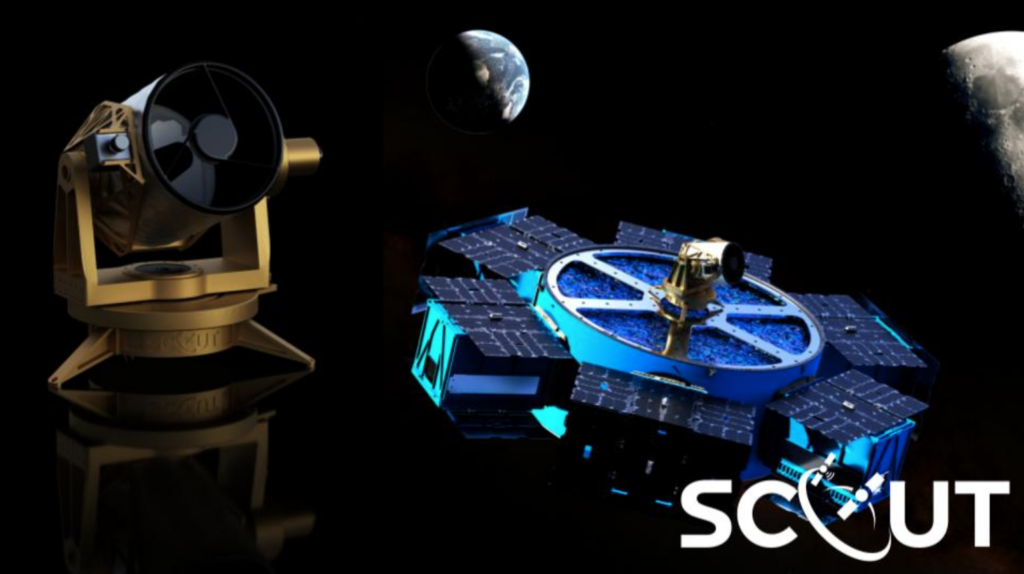
Owl is a gimbaled, long-range, space domain awareness vision payload system designed to augment missions for added in-space capabilities and services which include:

  1. Tracking & Catalog Maintenance: Survey the space domain around its host and collect photometric or orbital data on nearby objects.
  2. Neighborhood Watch: Perform hemispherical surveys and identify untracked objects outside the domain of traditional sensors.
  3. Self Protect: Gimbal flexibility helps identify, and track Resident Space Objects (RSOs) through flyby or rendezvous scenarios and tip its host to take evasive action.

Sparrow Flight Proven Capabilities
The baseline Sparrow (the production version of Scout’s Scout-Vision system), including the stereoscopic sensor suite and software, demonstrated its core capabilities onboard the Orbit Fab TANKER-001 mission in 2021 producing commercial, non-Earth imagery and space data products. The initial Sparrow payload was decommissioned in November of 2023, but Scout recently launched an updated version on the SpaceX Transporter-10 mission.

About Scout Space
Scout Space was founded in 2019 with the mission to enable a new era of space safety and transparency. Scout’s in-space products and services, first launched in 2021, allow spacecraft to see and understand things around them. The orbital distributed sensor network developed by Scout will significantly improve Space Domain Awareness (SDA) and ensure responsible use of the space environment. The company is a Techstars, MassChallenge, and venture-backed startup with ongoing government and commercial contracts


Filed Under: News

Terran Orbital’s Tyvak International Secures European Defense Agency Contract for Pioneering VLEO Satellite Project

April 4, 2024 by editorial

Tyvak International SRL, a Torino, Italy-based subsidiary of Terran Orbital Corporation (NYSE: LLAP) and a leading European provider of nano and microsatellites, has announced a secured service subcontract for the European Defense Agency’s (EDA) Hub for EU Defense Innovation (HEDI) proof-of-concept prototype 2023. This groundbreaking project focuses on VLEO satellite exploration, marking a significant leap forward in military space technology.

The contract encompasses Phase A of the LEO to VLEO spacecraft, culminating in a Preliminary Design Review. Tyvak International will play a leading role within a consortium including prime contractor CNIT, collaborating with FlySight and Politecnico di Milano.

Tyvak International, leveraging its extensive experience in satellite design, development, and spaceflight heritage, will spearhead critical aspects of the project. This includes leading market analysis, identifying key components, defining requirements based on the business case, and ultimately assessing the feasibility of satellite development.

This contract underscores the commitment of Tyvak International to push the boundaries of satellite technology. The collaboration with the European Defence Agency extends to strategic applications encompassing Earth observation, in-space situational awareness, signal detection, and navigation warfare, ultimately advancing European defense capabilities.

“We are delighted to announce our participation in this significant EDA VLEO contract,” said Fabio Nichele, Chief Executive Officer of Tyvak International. “This collaboration presents a remarkable opportunity to leverage our expertise and innovative solutions to support the critical mission objectives of the European Defence Agency. By doing so, we will drive advancements in satellite technology and propel future defense capabilities.”

Filed Under: Featured, News

HawkEye 360 secures million$$ in debt commitment

April 3, 2024 by editorial

HawkEye 360 has secured $40 million in debt financing from Silicon Valley Bank (SVB), a division of First Citizens Bank, to further its mission of delivering advanced geospatial capabilities. Over the past 12 months, HawkEye 360 has raised $108 million across its Series D-1 round and this debt financing, which has underscored the support and confidence from investors and lenders regarding its business and financial momentum.

The debt financing will play a crucial role in furthering HawkEye 360’s efforts to enhance its technological infrastructure and continue the buildout of its satellite constellation. These strategic developments are pivotal in maintaining HawkEye 360’s commitment to providing actionable, multi-dimensional geospatial insights and facilitating informed decision-making for the company’s valued clients worldwide.

“Raising over $400 million in capital in under five years is a landmark achievement for HawkEye 360,” said John Serafini, CEO of HawkEye 360. “This remarkable level of funding not only underscores the strength and validity of our strategic vision but also significantly enhances our ability to pioneer and lead in the provision of vital geospatial solutions. It’s a powerful testament to our team’s ability and the trust in our path forward.”

“HawkEye 360’s innovative space-based technology and RF data and analytics is paving the way for better spectrum mapping and monitoring,” said Sean Stone, SVB Senior Market Manager. “SVB is thrilled to continue our relationship with HawkEye 360 and provide them with the financing to help them execute their growth strategy.”

Filed Under: News

Rocket Lab prepares to launch mission for KAIST and NASA satellites to 2 separate orbits

April 3, 2024 by editorial

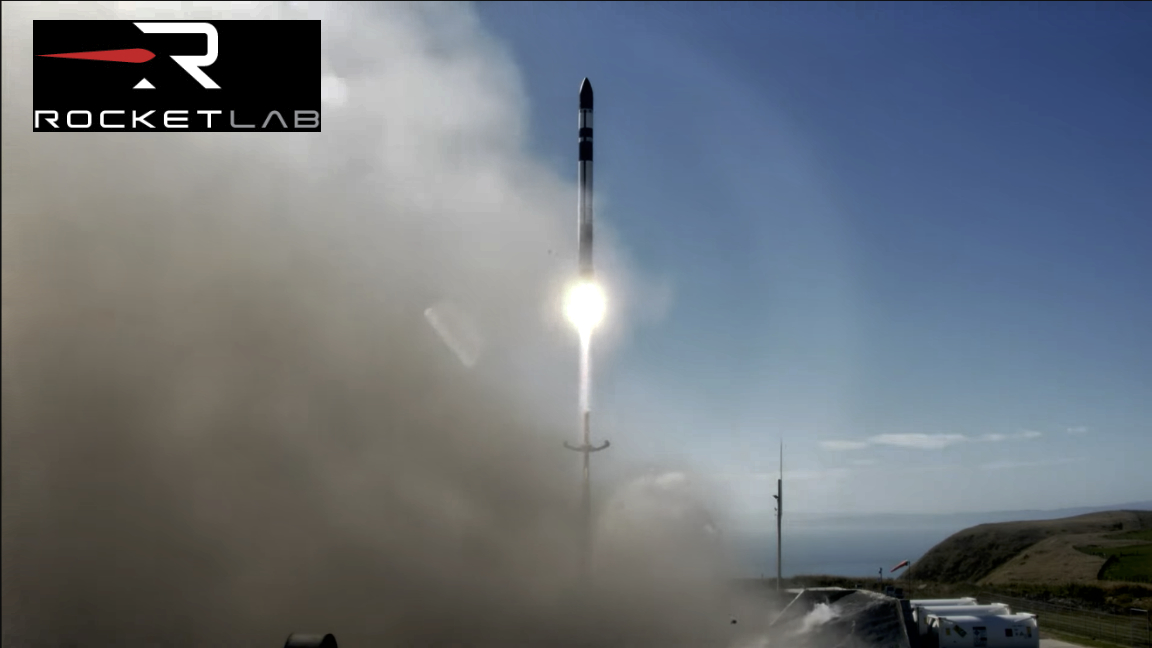
A previous Rocket Lab Electron launch, photo courtesy of the company.

Rocket Lab USA, Inc. (Nasdaq: RKLB) has set the launch window for the company’s next Electron launch.

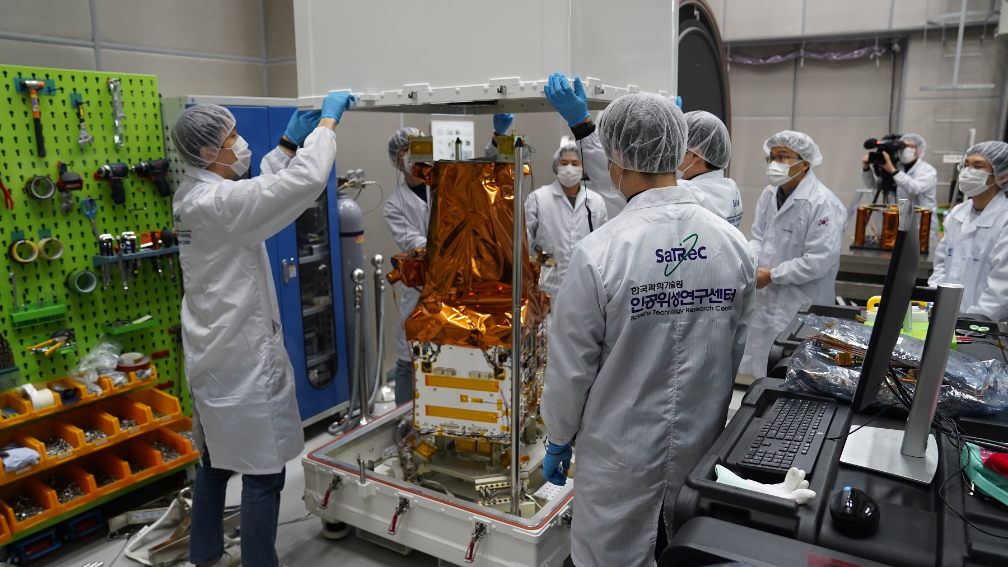
The ‘Beginning Of The Swarm’ mission is scheduled to launch from Rocket Lab Launch Complex 1 in Mahia, New Zealand, during a 14-day launch window that opens on April 24th. Electron will carry two satellites for two separate customers: NEONSAT-1, an Earth Observation (EO) satellite for the Satellite Technology Research Center (SaTReC) at the Korea Advanced Institute of Science and Technology (KAIST), and NASA’s Advanced Composite Solar Sail System (ACS3).

The primary payload for this mission, NEONSAT-1, is an EO satellite with a high-resolution optical camera designed to monitor for natural disasters along the Korean Peninsula by pairing its images with artificial intelligence. NEONSAT-1 is the first satellite developed under the NEONSAT program by SaTReC and KAIST, Korea’s leading university in science and technology, which developed and operated Korea’s very first satellite KITSAT-1 more than 30 years ago. Other NEONSAT satellites are planned to be launched in 2026 and 2027 to build out the NEONSAT constellation.

The program is a collaboration across multiple Korean academic, industry, and research institutions including SaTReC in KAIST, which is leading the program’s system design and engineering; the SaTReC Initiative, a Korean satellite manufacturer that has successfully developed seven previous remote sensing satellites for LEO; and the Korea Aerospace Research Institute (KARI), which is managing the mission’s ground segments and technology supervision for the NEONSAT program. NEONSAT is funded by the Koren government’s Ministry of Science and ICT (MSIT).

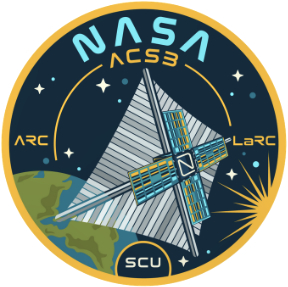
NASA’s ACS3 is a technology demonstration of new materials and deployable structures for solar sail propulsion systems that use sunlight to propel the spacecraft. Much like a sailboat is powered by wind pushing against a sail, solar sails employ the pressure of sunlight for propulsion, eliminating the need for conventional rocket propellant.

The mission plans to test the deployment of new composite booms that will unfurl the solar sail to measure approximately 30 feet per side, or about the size of a small apartment in total. Flight data obtained during the demonstration will be used for designing future larger-scale composite solar sail systems for space weather early warning satellites, asteroid and other small body reconnaissance missions, and missions to observe the polar regions of the sun. T

The ACS3 was designed and built at NASA’s Langley Research Center in Hampton, Virginia, and the technology demonstration is managed and funded by the Small Spacecraft Technology program at and with NASA’s Ames Research Center in Silicon Valley. NASA’s Science Mission Directorate, interested in larger solar sail missions in the future, is funding an extended operations component to execute a series of maneuvers to raise and lower the spacecraft’s orbit, demonstrating the practicality of solar sailing.

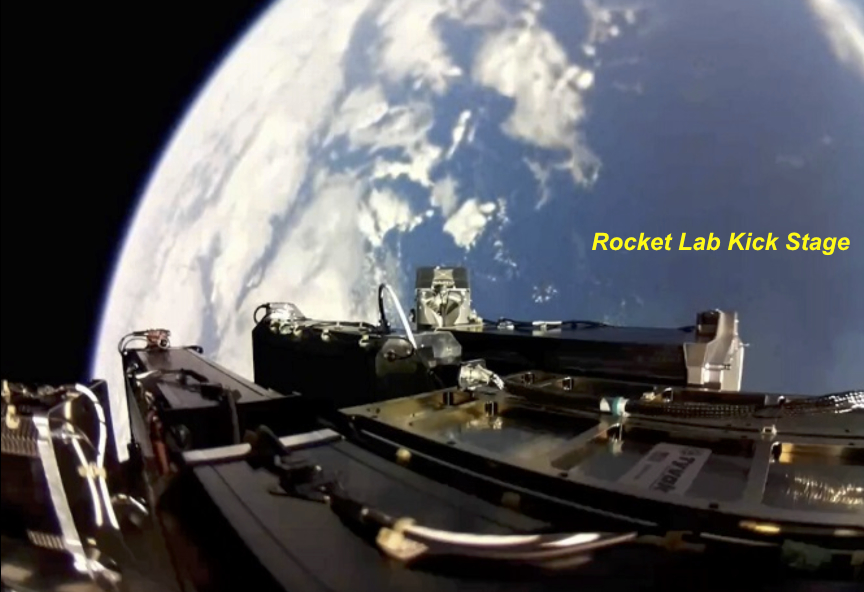
The capability of Electron’s Kick Stage to perform multiple engine burns in space and deploy individual satellites to unique orbits is critical to this mission. The Kick Stage will first ignite its Curie engine to deploy NEONSAT-1 to its target 520km circular Earth orbit. After the payload’s separation, it will ignite its Curie engine again to perform an apogee raise to 1,000km. Once in this phasing orbit, the Curie will ignite a third time to circularize before deploying the solar sail demonstration spacecraft. The Kick Stage will then ignite Curie a fourth and final time to perform a deorbit burn that returns the Kick Stage closer to Earth, speeding up its eventual deorbit and removal from space to support a more sustainable space environment.

Rocket Lab has demonstrated similar orbit raises, inclination changes, and deorbit maneuvers across previous Electron missions and most recently with its successful spacecraft re-entry for Varda on February 21, 2024.

‘Beginning Of The Swarm’ will be Rocket Lab’s fifth mission of 2024 and the 47th Electron launch overall.

‘Beginning Of The Swarm’ details…

  • Launch window: opens no-earlier-than April 24, 2024.
  • Customers: The Korea Advanced Institute of Science and Technology (KAIST) and NASA.
  • Satellites: NEONSAT-1 for SaTReC/KAIST and the Advanced Composite Solar Sail System (ACS3) for NASA.
  • Target orbits: NEONSAT-1 to 520km circular Earth orbit, ACS3 to 1,000km circular Earth orbit.
  • Launch broadcast: The launch will broadcast live at www.rocketlabusa.com/live-stream

Filed Under: News

Orbex secures reusable rocket tech patent and gains ESA Flight Ticket Initiative position

April 2, 2024 by editorial

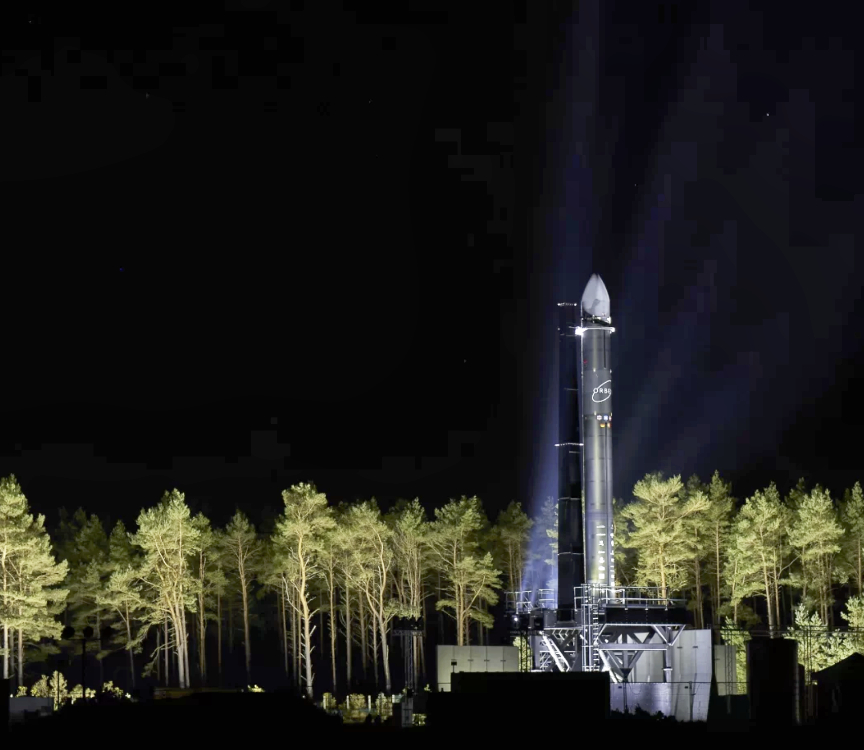
Orbex, the only UK owned orbital launch services and rocket manufacturing company, has successfully patented its REFLIGHT reusable rocket technology following patent approval in several European markets as well as the United States. This protection was based on the patent grant by the European Patent Office.

The technology is uniquely suited to micro-launcher rockets such as Orbex’s Prime rocket as it enables recovery of the launch vehicle by repurposing existing structural features, while adding very little additional weight to the vehicle. It enables reusability with very limited overall performance penalty and no additional rocket propulsion emissions in the upper atmosphere during re-entry. This should be compared to other reusable launch systems using powered descent (rocket engine firings) to slow down the vehicle during re-entry and landing.

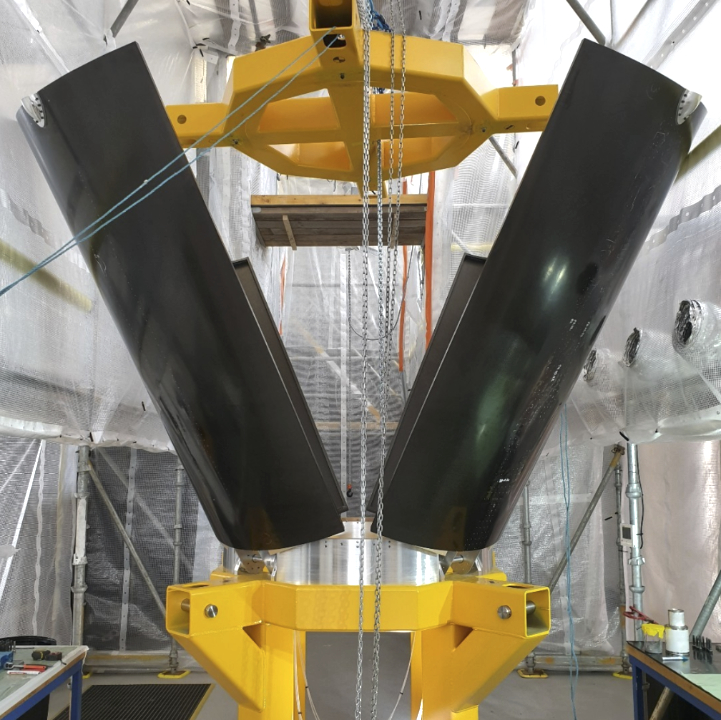
Orbex’s Prime rocket will consist of two stages, and the REFLIGHT system repurposes the interstage structure located between the stages. After Stage 1 detaches from Stage 2, the interstage on top of Stage 1 reconfigures into four ‘petals’ which fold out and create drag forces that passively reorients and slows the spent rocket stage’s descent to Earth.

In combination with a lightweight parachute the drag created by the petals will enable Stage 1’s to perform a low velocity landing at sea.

Orbex will then recover the floating Stage 1 and return it to its factory in Forres for refurbishment and/or recycling. During descent and recovery, there will be no debris left in orbit, on land or in sea, creating a ‘circular rocket economy’.

Artistic rendition of a launch at Sutherland Spaceport. Image is courtesy of ORBEX.

Additionally, the construction of Sutherland Spaceport continues to move forward, with two new watercourse crossing bridges transported on-site in February, the bridges will form part of the floating road connecting the launch site to the Launch Service Integration Facility (LSIF) and the Launch Pad.

The special bridges will help respect and preserve the natural conditions and ecology of the watercourse, such as the bed and banks, water levels, and wildlife habitats. The bridges also support ecosystem health through ecological design features that will prevent erosion, improve water quality, and facilitate wildlife movement.

Aerial image of Sutherland Spaceport as construction continues. Photo is courtesy of Orbex.

Orbex is the only UK supplier, and only launch services provider with its own spaceport, to be selected for the European Commission and European Space Agency (ESA) Flight Ticket Initiative. The Flight Ticket Initiative will supply payload for Orbex’s Prime rocket when undergoing test phases, demonstrating the UK start-up as a trusted supplier in the orbital services sector. The support will help Orbex achieve its goal of making the UK a central hub for European space flight.

Jonas Bjarnø, CTO at Orbex, said, “At each step in the construction of Prime, we are looking at how to improve the launch system efficiency and sustainability. Our REFLIGHT technology is a critical innovation in overall efficiency of the system, and the slower return to Earth reduces risk of significant aerothermal damage, enabling refurbishment and re-use of parts. This is really critical to our vision for a more sustainable, circular rocket economy.”

Phil Chambers, CEO at Orbex, said, “Securing a spot on the ESA Flight Ticket Initiative is a significant milestone for Orbex as we continue our journey to achieving sustainable space launch solutions. We are proud to be the only UK-based company to be selected, enabling us to lead the way in carbon-neutral spaceflight operations and propel the UK to the forefront of the global space industry.“

Filed Under: News

Telesat + Government of Canada agree to billionC$ loan terms in support of Lightspeed

April 2, 2024 by editorial

Telesat (NASDAQ and TSX: TSAT) has received a letter from Canada’s Minister of Innovation, Science and Industry regarding an investment in Telesat Lightspeed.

The letter states that, following several months of negotiations between Telesat and federal officials, the Government of Canada (GoC) is prepared to invest C$2.14 billion in Telesat Lightspeed by way of a loan to Telesat LEO Inc., a wholly owned subsidiary of Telesat, that is developing and will own and operate the Telesat Lightspeed LEO global broadband satellite constellation.

The loan will carry a floating interest rate that is 4.75% above the Canadian Overnight Repo Rate Average (CORRA) with a 15-year maturity. Interest is payable in-kind during the Telesat Lightspeed construction period, followed by a 10-year sculpted amortization. Furthermore, Telesat LEO Inc. will provide the GoC with warrants for 10% of the common shares of Telesat LEO based upon an equity valuation for Telesat LEO of US$3 billion.

“Telesat Lightspeed is a highly innovative and disruptive global broadband network and the largest space program in Canada’s long and distinguished history as a space faring nation,” said Dan Goldberg, Telesat’s President and CEO. “I am delighted with the engagement we have had with the Government of Canada on this flagship program, which will help bridge the global digital divide, create and sustain thousands of high-quality jobs in Canada, spur domestic innovation, investment and exports, and ensure that Canada is at the forefront of the rapidly growing New Space Economy. The Government of Canada has been a strong supporter of the Telesat Lightspeed program and we applaud their leadership and foresight. We estimate that, in addition to the roughly $2 billion of capital cost savings, we will realize roughly $750 million of savings in reduced borrowing costs relative to the original Telesat Lightspeed program. Telesat Lightspeed will revolutionize broadband connectivity for enterprise and government users and represents a highly compelling growth and value creation opportunity for Telesat and its stakeholders.”

The GoC investment is subject to certain conditions, including the entry of definitive documentation with the GoC and Telesat’s other financing sources to the GoC’s satisfaction.

Filed Under: Featured, News

FOSSA Systems opens a subsidiary in Portugal

April 2, 2024 by editorial

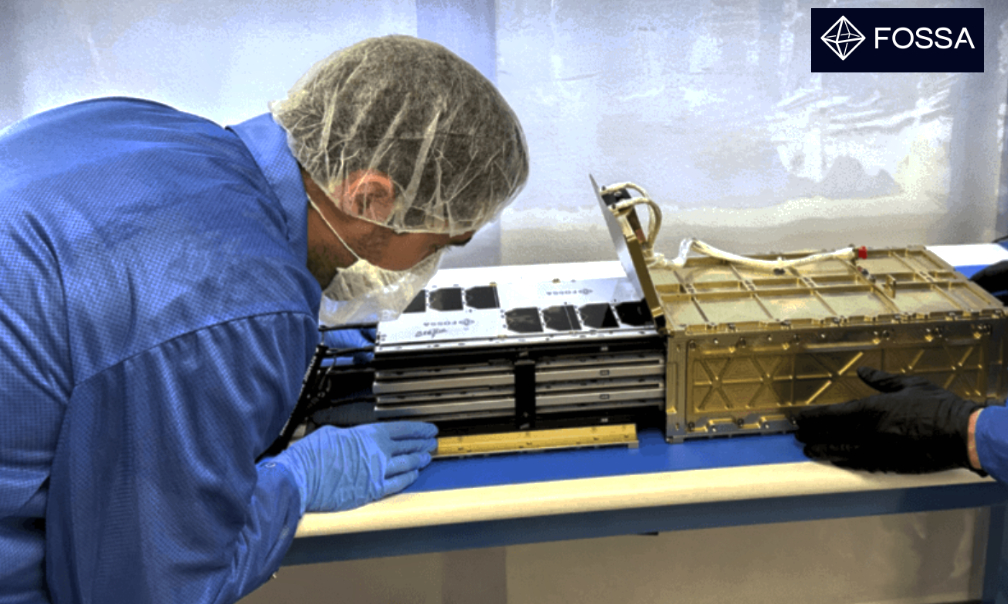
FOSSA Systems has made the international leap with the firm’s first opening outside Spain — a subsidiary dedicated to R&D that will serve customers from its new Portugal location.

A team of highly qualified professionals will work on the development of new technologies and applications that are related to the space industry, aeronautics, telecommunications and satellite connectivity as they are applied to IoT.

With this operation, which has marked the start of of the company’s international expansion, FOSSA aims to promote new business opportunities and establish academic collaborations with Portugal where the space sector is growing. The first international office of the aerospace will be coordinated from the company’s headquarters of Madrid.

Founded in July 2020 by Vicente González, with the aim of democratizing access to space, FOSSA continues to position itself as a pioneer with disruptive technology that addresses global connectivity services IoT.

In just three years, the company ranks well in an expanding market, which currently has 10 billion connected devices that will grow to more than $25 billion by 2025 and that, according to IoT Analytics forecasts, will reach $525 billion by 2027.

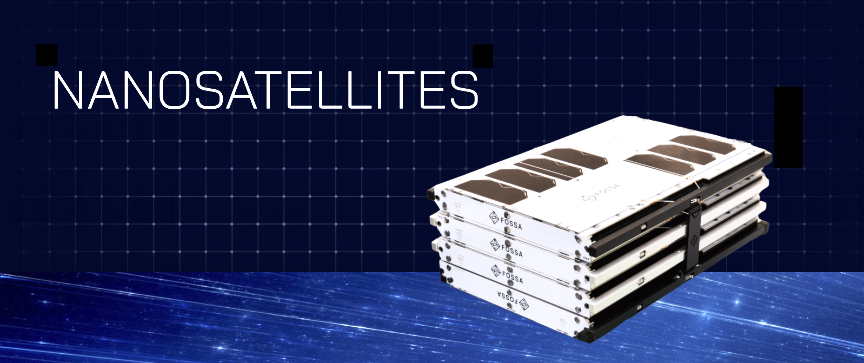
The aerospace startup group is currently comprised of a team of 25 professionals, which is expected to double by 2025. FOSSA was the European company that launched the most smallsats in 2022 and has, so far, launched 17 of the firm’s own, development satellites.

With a constellation of 80 satellites, the company hopes to connect millions of devices directly to its network, offering global and real-time LPWAN coverage direct to the device. FOSSA has verticalized the process of satellite manufacturing, space operations and ground-based services and launched 17 satellites into space since 2022.

“With this first delegation outside Spain we seek to increase our international presence and attend to new markets. We have worked with several Portuguese entities, and we see this new R&D&i center as a great opportunity to take advantage of the potential offered by Portugal,” said Julián Fernández, CEO and co-founder of FOSSA Systems.

“Portugal is emerging as a key player in the new space economy. The presence of FOSSA here means a new way for innovative local solutions in the field of advances in satellites and IoT,” said Roberto Carlos Medina, R&D Engineer at FOSSA Systems Portugal.

Filed Under: News

BAE Systems completes integration of NASA’s Carruthers Observatory

April 2, 2024 by editorial

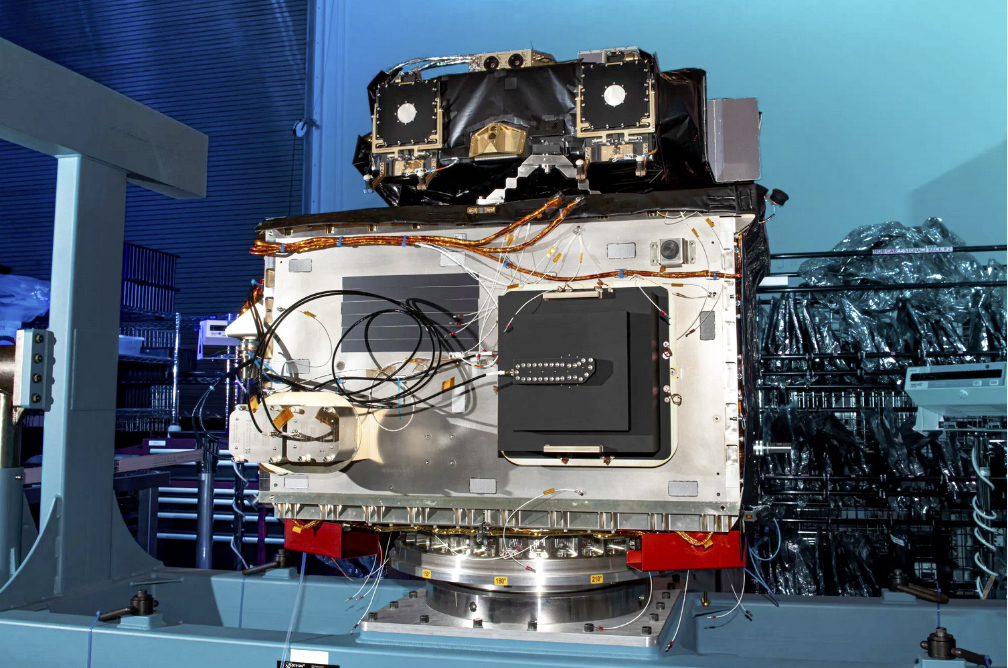
BAE Systems has successfully completed the integration of the Carruthers Geocorona Observatory’s ultraviolet (UV) spectrometer onto the satellite bus, the next major step in completing the NASA Earth-monitoring satellite.

BAE Systems successfully completes the integration of the Carruthers Geocorona Observatory’s ultraviolet (UV) spectrometer onto the satellite bus, the next major step in completing the NASA Earth-monitoring satellite. NASA/BAE Systems

Carruthers is a smallsat designed around BAE Systems’ configurable spacecraft platform. Once on-orbit at Lagrange Point 1 (L1), the observatory will use an advanced UV imager to observe the exosphere — the outermost part of the atmosphere — to determine how it changes in response to space weather caused by the Sun. Carruthers is expected to be the first smallsat to operate at L1, a gravitationally stable orbit point between the Earth and Sun about 1 million miles away, and it will be the first satellite to provide continuous observations of the Earth’s exosphere.

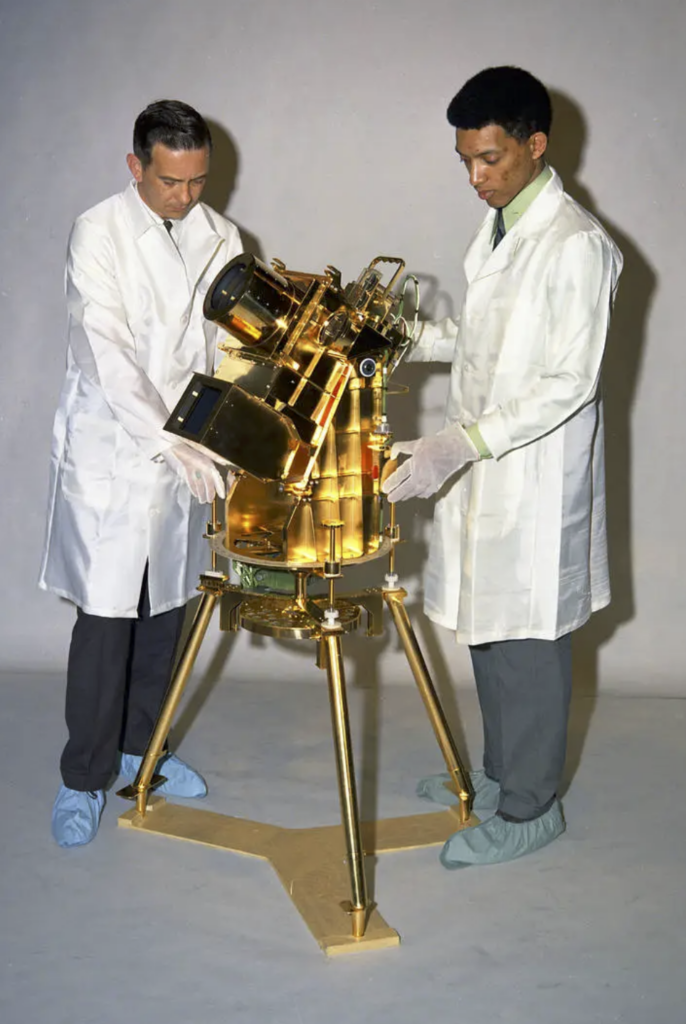
Dr. George Carruthers, right, and William Conway, a project manager at the Naval Research Institute, examine the gold-plated ultraviolet camera/spectrograph, the first Moon-based observatory that Carruthers developed for the Apollo 16 mission. Apollo 16 astronauts placed the observatory on the moon in April 1972.

The mission was previously called the Global Lyman-alpha Imager of the Dynamic Exosphere (GLIDE), but it was renamed in 2020 in honor of Dr. George R. Carruthers, the renowned scientist responsible for designing and building the moon-based telescope that took the first images of the Earth’s geocorona from space as part of the Apollo 16 mission.

The mission comes as part of a collaboration between NASA and the Space Sciences Laboratory at the University of California, Berkeley, which developed the primary scientific instrument with support from Utah State University’s Space Dynamics Laboratory and the Liège Space Center. Dr. Lara Waldrop of the University of Illinois, Urbana-Champaign, serves as the principal investigator for the mission.

BAE Systems was responsible for designing and building the satellite bus for the mission, in addition to leading integration and environmental testing, which will continue through June of this year to ensure the satellite will withstand launch conditions and perform properly in space.

The satellite is currently scheduled to launch in 2025 as a rideshare component of NASA’s Interstellar Mapping and Acceleration Probe (IMAP) mission.

“This mission will allow us to better understand how our atmosphere interacts with the ever-changing conditions in space, carrying on the remarkable legacy that began with Dr. Carruthers’ work more than 50 years ago,” said Dr. Alberto Conti, VP and GM of Civil Space for BAE Systems Space & Mission Systems. “Space weather has a significant impact on Earth, from amazing phenomenon like the aurora borealis to major disruptions with satellite communications and electrical grids. This satellite will deliver a wealth of new data and better equip us to respond to whatever the Sun throws at us.”

Filed Under: News

ALOFT AeroArchitects to equip private Boeing business jet aircraft with Eutelsat OneWeb’s LEO satellite connectivity service

April 1, 2024 by editorial

ALOFT AeroArchitects has selected Eutelsat OneWeb to deliver high-speed, low-latency broadband connectivity aboard their client’s aircraft.

Under the agreement, ALOFT will equip a private BBJ aircraft with Eutelsat OneWeb’s LEO satellite connectivity service. The service will be facilitated by a new Electronically Steered Array (ESA) terminal being developed by Stellar Blu Technologies and delivered through Eutelsat OneWeb’s distribution partner and connectivity expert, Satcom Direct.  ALOFT is developing a Supplemental Type Certification (STC) for the B737-platform using its internal engineering, certification, and ODA resources, which is now available for purchase by VVIP B737 operators and MROs worldwide.

Eutelsat OneWeb’s LEO constellation of advanced satellites will deliver a reliable, high-speed, low-latency connectivity experience which will enable the VIP passengers to remain as productive, entertained and connected with family, friends, colleagues, and social media as if they were on the ground.

“As an innovator in cabin technology integration, ALOFT is ensuring its discerning BBJ customers will experience high-speed internet in the air, no matter where they are flying – just as they do on the ground,” said Jason Sperry, Head of Business Aviation at Eutelsat OneWeb. “The low latency that is inherent in our low Earth orbit network, means that principals and passengers will have access to applications for both passenger productivity and entertainment that to date have been out of reach while inflight.”

Colby Hall, Director of Integrated Technology at ALOFT, said, “Our BBJ customers expect their aircraft to be as comfortable and capable as their homes and offices. This expectation now includes high speed connectivity and being able to remain connected through their personal devices – all the time. Thanks to the connected ecosystem that Eutelsat OneWeb and their partners are deploying in the business aviation market, our VIP customers will be connected, entertained and productive like never before – able to work, stream, trade, as they choose.” 

About Eutelsat Group
Eutelsat Group is a global leader in satellite communications, delivering connectivity and broadcast services worldwide. The Group was formed through the combination of Eutelsat and OneWeb in 2023, becoming the first fully integrated GEO-LEO satellite operator with a fleet of 35 geostationary (GEO) satellites and a Low Earth Orbit (LEO) constellation of more than 600 satellites. The Group addresses customers’ needs in four key verticals of Video, where it distributes more than 6,500 television channels, and the high-growth connectivity markets of Mobile Connectivity, Fixed Connectivity, and Government Services. Eutelsat Group’s unique suite of in-orbit assets and on-ground infrastructure enables it to deliver integrated solutions to meet the needs of global customers. The Company is headquartered in Paris and Eutelsat Group employs more than 1,700 people from more than 50 countries. The Group is committed to delivering safe, resilient, and environmentally sustainable connectivity to help bridge the digital divide. The Company is listed on the Euronext Paris Stock Exchange (ticker: ETL) and the London Stock Exchange (ticker: ETL).

About ALOFT AeroArchitects
ALOFT AeroArchitects specializes in completions, inspections, overhaul, maintenance, and auxiliary fuel systems installation for large-cabin, head-of-state, VVIP, and government aircraft. The company’s campus includes its FAA Part 145 Repair Station for STC, PMA, and ODA engineering services and aircraft systems manufacturing. ALOFT is also a Boeing-authorized service center. The ALOFT manufacturing team and its ODA and engineering division are also available to support design and certification requirements for project work on behalf of our global customers. The company holds maintenance authorizations and ratings from the FAA, EASA, UAE, GCAA, Bermuda DCA, and a variety of other global entities.

Filed Under: News

National Cybersecurity Center to host SSC’s Spring 2024 AEE Symposium

April 1, 2024 by editorial

U.S. Space Command’s bi-annual Academic Engagement Enterprise (AEE) Symposium will convene on April 12, 2024, at the National Cybersecurity Center (NCC) in Colorado Springs, Colorado. This symposium brings together the AEE’s 50+ university members to present research and engage in collaborative dialogue with USSPACECOM around topics prioritized by directorates and senior leadership.

The event will kick off with opening remarks from Brigadier General Samuel Keener, followed by insights from Chief Master Sergeant Jacob Simmons, with a special appearance from the Lieutenant Governor of Colorado. The sessions will feature updates from the NCC, USSPACECOM, and presentations from universities such as UCCS, MIT, Purdue, Kansas State University, and others to discuss Space Situational Awareness (SSA) and cybersecurity vulnerabilities.

The content-rich agenda prioritizes the importance of space mission assurance by delving into both technological and policy implications of in-space assembly, CubeSat deployment for rapid response, and the pursuit of a sustainable extraterrestrial presence amidst geopolitical complexities. The event will also highlight the critical role of multi-objective route planning and signal detection in enhancing space communication systems, alongside the use of simulations and models for robust strategic planning. The discussions aim to foster an environment that prioritizes long-term sustainability and security in space through advanced supply chain management and the development of satellite inspection technologies.

The summit brings partners together to advance a secure, resilient, and sustainable framework for space and cyberspace that contributes to national and global security.

“As one of the original members of the AEE, we are honored to welcome the US Space Command’s Academic Engagement Enterprise community to the National Cybersecurity Center,” said NCC CEO, Greg Oslan. “It is essential to our national security that military, government, and industry partners work together to develop our next generation workforce, pursue research and innovation, and enrich the strategic space dialog.”

About the NCC
The National Cybersecurity Center (NCC) is a 501(c)(3) non-profit for cybersecurity education, collaboration and leadership development grounded in a shared mission to advance pragmatic, forward-thinking security policies and programs. Serving public and private organizations, the NCC, in collaboration with The University of Colorado Springs (UCCS) and the Colorado cybersecurity and SpaceCyber eco -systems, delivers an integrated and fully interdisciplinary cyber center that is actively transforming the nation’s ability to deter cyber threats.

Filed Under: News

  • « Go to Previous Page
  • Page 1
  • Interim pages omitted …
  • Page 75
  • Page 76
  • Page 77
  • Page 78
  • Page 79
  • Interim pages omitted …
  • Page 338
  • Go to Next Page »

Primary Sidebar

WEEKLY NEWSLETTER

Archives

  • July 2026
  • June 2026
  • May 2026
  • April 2026
  • March 2026
  • February 2026
  • January 2026
  • December 2025
  • November 2025
  • October 2025
  • September 2025
  • August 2025
  • July 2025
  • June 2025
  • May 2025
  • April 2025
  • March 2025
  • February 2025
  • January 2025
  • December 2024
  • November 2024
  • October 2024
  • September 2024
  • August 2024
  • July 2024
  • June 2024
  • May 2024
  • April 2024
  • March 2024
  • February 2024
  • January 2024
  • December 2023
  • November 2023
  • October 2023
  • September 2023
  • August 2023
  • July 2023
  • June 2023
  • May 2023
  • April 2023
  • March 2023
  • February 2023
  • January 2023
  • December 2022
  • November 2022
  • October 2022
  • September 2022
  • August 2022
  • July 2022
  • June 2022
  • May 2022
  • April 2022
  • March 2022
  • February 2022
  • January 2022
  • December 2021
  • November 2021
  • October 2021
  • September 2021
  • August 2021
  • July 2021
  • June 2021
  • May 2021
  • April 2021
  • March 2021
  • February 2021
  • January 2021
  • December 2020
  • November 2020
  • October 2020
  • September 2020
  • August 2020
  • July 2020
  • June 2020
  • May 2020
  • April 2020
  • March 2020
  • February 2020
  • January 2020
  • December 2019
  • November 2019
  • October 2019

© 2019–2026 SatNews

Insert/edit link

Enter the destination URL

Or link to existing content

    No search term specified. Showing recent items. Search or use up and down arrow keys to select an item.
      x
      Sign Up Now!

      Enjoy a free weekly newsletter with recent headlines from the global SmallSat industry.

      Invalid email address
      We promise not to spam you. You can unsubscribe at any time.
      Thanks for subscribing! You will now receive weekly SmallSat News updates.
      We love our advertisers.
      And you will too!

      Please disable Ad Blocker to continue... We promise to keep it unobtrusive.
      We promise not to spam you. You can unsubscribe at any time.
      Invalid email address
      Thanks for subscribing!