• Skip to main content
  • Skip to primary sidebar
  • Home
  • News
  • Featured
  • More News ⌄
    • SatNews
    • SatMagazine
    • MilSatMagazine
  • Events ⌄
    • MilSat Symposium
    • SmallSat Symposium
    • Satellite Innovation
  • Contacts
  • SUBSCRIPTION

SmallSat News

You are here: Home / Archives for Featured

Featured

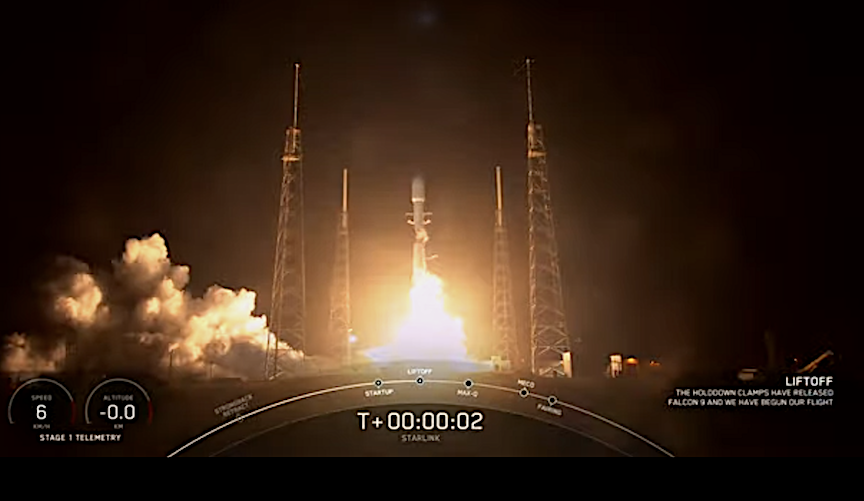
SpaceX’s Sunday Starlink launch sends 22 small satellites soaring

August 7, 2023 by editorial

SpaceX was successful with the Falcon 9 launch of 22 Starlink satellites today, Sunday, August 6 at 10:41 p.m. ET (02:41 UTC on August 7) to low-Earth orbit from Space Launch Complex 40 (SLC-40) at Cape Canaveral Space Force Base in Florida.
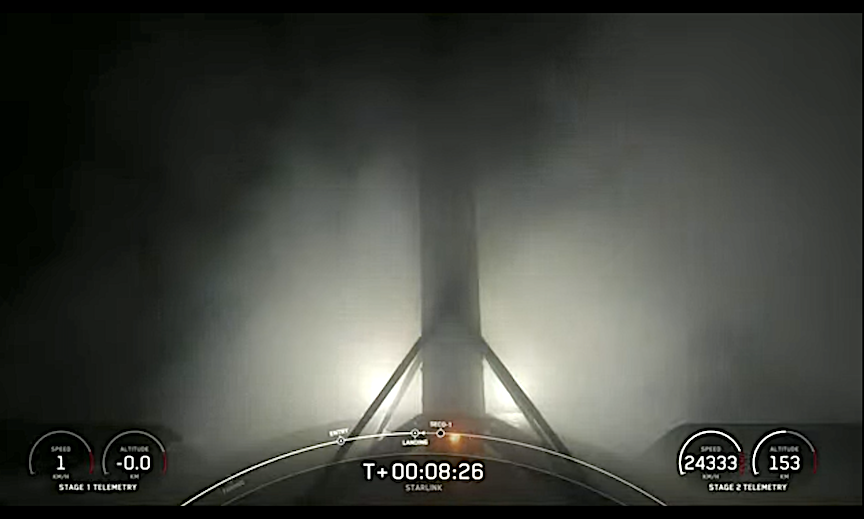
This is the fourth flight for the first stage booster supporting this mission, which previously launched Crew-6, SES O3b mPOWER, and one Starlink mission. To date SpaceX has launched 4,881 Starlink spacecraft.

A successful stage separation, resulted in the first stage landing on the A Shortfall of Gravitas droneship, stationed in the Atlantic Ocean.


Filed Under: Featured, News

Satcom Direct + Gilat sign a strategic agreement

August 2, 2023 by editorial

Satcom Direct and Gilat Satellite Networks Ltd. (Nasdaq: GILT, TASE: GILT) have signed a strategic agreement to develop and supply new, ultra-low profile, electronically steered antennas (ESA) to support in-flight connectivity (IFC) for business, government, and defense.

Available from 2025, and designed for optimized compatibility with the OneWeb LEO constellation, the hardware strengthens the Plane Simple® Antenna Series portfolio with the addition of the Gilat advanced ESA that will unlock the full broadband potential of OneWeb.

The collaboration will see Gilat develop the antenna system while Satcom Direct Avionics will work with OneWeb to develop the SD Modem Unit to harness the full potential of the LEO constellation. To meet soaring data demands, customers will also benefit from the antenna’s full-duplex performance, a key capability in a small-form, power efficient device that allows data to be sent and received simultaneously.

This ESA terminal, including the radome, will aim to provide an industry-leading compact form factor (around 2.5 inches or 64 millimeters) that will unlock the highest possible bandwidth from the OneWeb network. The addition to the Plane Simple antenna series reflects the SD agnostic philosophy, which enables customized connectivity solutions tailored for every mission requirement with a common terminal architecture, simplified upgrades, and flexible pricing plans.

“We already have a strong relationship with OneWeb and have engaged with Gilat, due to their long SATCOM, aviation, and radio frequency pedigree, to create the next generation ESA in support of creating a solution that provides more options to our customers seeking reliable high-speed connectivity or additional redundancy. The ESA terminal will provide genuine global coverage and superior bandwidth performance, complemented by ease of installation. This most advanced terminal will also address customer requests to lower aircraft drag, weight and fuel burn. We’re excited to add this new state-of-the-art antenna from Gilat to our portfolio. We know customers will welcome the reality of the truly global coverage from such a small format terminal.” — Chris Moore, President, Satcom Direct

“We are honored to have been selected by Satcom Direct to provide them with our expertise to develop this new ESA product. Together, we will create a next-generation ESA to support the dynamic connectivity demands of the global business aviation sector with a best-in-class antenna. The agreement gives us the opportunity to expand our proven technology know-how in commercial aviation and to showcase our expertise alongside Satcom Direct, the only company dedicated to delivering satcom connectivity to business and government aviation worldwide. It is a major milestone for Gilat as we extend our global IFC leadership in commercial aviation to business aviation, as well as into our strategic focus area in government and defense.” — Adi Sfadia, CEO, Gilat

“The combined expertise of Satcom Direct Avionics, Gilat and OneWeb will deliver customers faster, more consistent broadband services across the globe. In the dynamic connectivity landscape, it is essential we team with premium partners, which is why we’re delighted to be part of this powerful offering as we reinforce our presence and service in the business aviation sector.” — Neil Masterson, CEO, OneWeb

Filed Under: Featured, News

Forrester’s Digest: China wanted to buy OneWeb + is Viasat is going to alter Inmarsat’s LEO plans??

August 1, 2023 by editorial

There was reportedly once an attempted takeover of OneWeb by Chinese interests. An article in the Sunday Telegraph stated that the UK’s MI5 security service investigated the China involvement, and this prompted the UK government to step in and buy a major stake in OneWeb.

There was also a further complication in that OneWeb is being merged with Paris-based Eutelsat, which already has a major Chinese shareholder. OneWeb operates 600 LEO satellites providing broadband connectivity around the planet.

The UK government purchased a £400 million stake in OneWeb as the company emerged from bankruptcy. The purchase in OneWeb also gives the UK a ‘golden share’ and thus a strong influence in what happens to the business.

The newspaper claims that a report from the UK’s GCHQ (the UK government’s intelligence, security and cyber agency) as well as the UK’s parliamentary Intelligence & Security Committee, investigated the Chinese interests.

Chinese bidders, including the state-owned China Aerospace Science and Technology Corporation, were considering investment in OneWeb.

However, OneWeb is now on the verge of being acquired and merged into Eutelsat. The acquisition is expected to formally close by the end of September.

China is already a shareholder in Eutelsat with China Investment Corporation (CIC), described as a sovereign wealth fund that manages part of the People’s Republic of China’s foreign exchange reserves. CIC is frequently said to be a “passive” investor in Eutelsat and does not influence board decisions.

The Chinese stake in Eutelsat was engineered when Michel Rosen was CEO at Eutelsat in 2012. CIC obtained a 7 percent stake from Spanish infrastructure company Abertis.

Is Viasat changing Inmarsat’s plan for LEOs?

Inmarsat, prior to its acquisition by US-based Viasat, had planned to launch a fleet of LEO satellites (Orchestra) and now it seems that Viasat is re-thinking the scheme that would save millions in terms of investment.

Viasat has written to the Federal Communications Commission (FCC) withdrawing its applications for V-band satellite spectrum. The letter from Viasat to the FCC said, “Viasat’s wholly owned subsidiary, Inmarsat Inc., is today withdrawing its application for authority to access the US market with a planned NGSO system using portions of the V band.”

Inmarsat itself has not helped clear any confusion, given that it Tweeted a statement on July 26th stating, “Communication lies at the heart of everything we do and being in touch no matter where you are is an expectation. Orchestra will combine multiple orbits & 5G into a single seamless solution so you don’t have to worry about getting connected – you just are.”

Inmarsat already has a test satellite on-orbit that is testing new concepts and system configurations for Orchestra’s proposed LEO constellation, “which will seamlessly integrate with geosynchronous orbit (GEO) and highly elliptical orbit (HEO) satellites, and a terrestrial 5G network, to deliver a uniquely powerful global communications solution for mobility and government customers,” said Inmarsat as long ago as December of 2021.

Inmarsat claimed, “Orchestra the first global network of its kind; creating a global, multi-dimensional, dynamic mesh network that will redefine connectivity at scale with the highest capacity for mobility worldwide and at hot spots across the world. It will deliver the fastest average speeds and the lowest average latency of any network, planned or in existence.”

Rajeev Suri, CEO of Inmarsat and now a Viasat board member, speaking in 2021, said, “Our vision for Orchestra is a network that uses the right technology for the right purpose. We are not beholden to a single approach and believe that the best way to meet customer needs is a multidimensional approach that includes GEO, LEO and terrestrial 5G in a dynamic mesh that brings capacity to where it is needed in the most efficient way possible. [The] announcement is yet another testament to the fact that Inmarsat is a company with commercial momentum and technology leadership.”

Filed Under: Featured, News

OneWeb Technologies demos seamless LEO and GEO multi-orbit services for the U.S.M.C.

July 28, 2023 by editorial

OneWeb Technologies, Inc. has successfully concluded a series of demonstrations during the U.S. Marine Corps’ 1st Air Naval Gunfire Liaison Company (ANGLICO) “Exercise Red Flag.”

The demonstrations showcased the seamless integration of a combined multi-orbit, LEO and GEO solution to deliver high-bandwidth, reliable communications in denied and degraded environments.

Exercise Red Flag showcased 1st ANGLICO’s ability to support Large Force Employment training across the full spectrum of conflict, including air superiority, precision engagement, close air support, command and control, intelligence coordination, and personnel recovery.

The demonstration consisted of OneWeb Technologies’ global, low-latency LEO communications network, Kymeta Corporation’s LEO terminal for low-latency and high-bandwidth connectivity, along with Viasat’s high-capacity, and multi-band, multi-mission terminal (MMT) connecting to the Viasat GEO Global Network (VGNet). The solution used Viasat’s NetAgility™ SD-WAN router to connect the LEO and GEO networks together.


A key part of this training was demonstrating the ability to interoperate with other systems, and multiple orbital planes. The combined OneWeb Technologies, Viasat and Kymeta solution showcased multi-orbit capability and connectivity is possible between solution providers, which is an important component of the 1st ANGLICO’s automated primary, alternate, contingency, and emergency (PACE) plan.

The PACE plan supports the maneuvering warfighting function’s (WFF) mission command requirement to maintain communications, seamlessly by transitioning connectivity across multiple networks.

The trial followed OneWeb Technologies’ participation in a similar successful demonstration, known as “Exercise Northern Edge,” held at the Joint Pacific-Alaska Range Complex (JPARC) in Alaska.

“Connectivity in a denied and degraded communications environment is an essential safety requirement, and I am proud of OneWeb Technologies’ ability to support the 1st ANGLICO at Exercise Red Flag. We are looking forward to future opportunities to enable Marine Corps operations with advanced satellite communications (SATCOM) solutions. Our collaboration with Kymeta and Viasat highlights our commitment to leveraging cutting-edge technologies and strategic partnerships to offer our government customers the mission-critical connectivity solutions they require.” — Kevin Steen, CEO, OneWeb Technologies

“Viasat is pleased to collaborate with partners like OneWeb Technologies and Kymeta to demonstrate multi-network mission capabilities with the optionality and increased resilience required to operate in contested environments. Our advanced network orchestration technology is a critical component, enabling assured connectivity and a seamless user experience across a multi-orbit, multi-network SATCOM solution that offers the operational flexibility warfighters need.” — Craig Miller, President, Viasat Government Systems

“Kymeta has been steadily working on ruggedized and hardened communications on the pause and move tactical systems. The combination of our terminals and OneWeb’s low latency, high data rate, and satellite communications available through OneWeb Technologies will provide warfighters with the tactical edge they need today.” — Walter Berger, President and Co-CEO, Kymeta

Filed Under: Featured, News

Smallsat market continues growth

July 26, 2023 by editorial

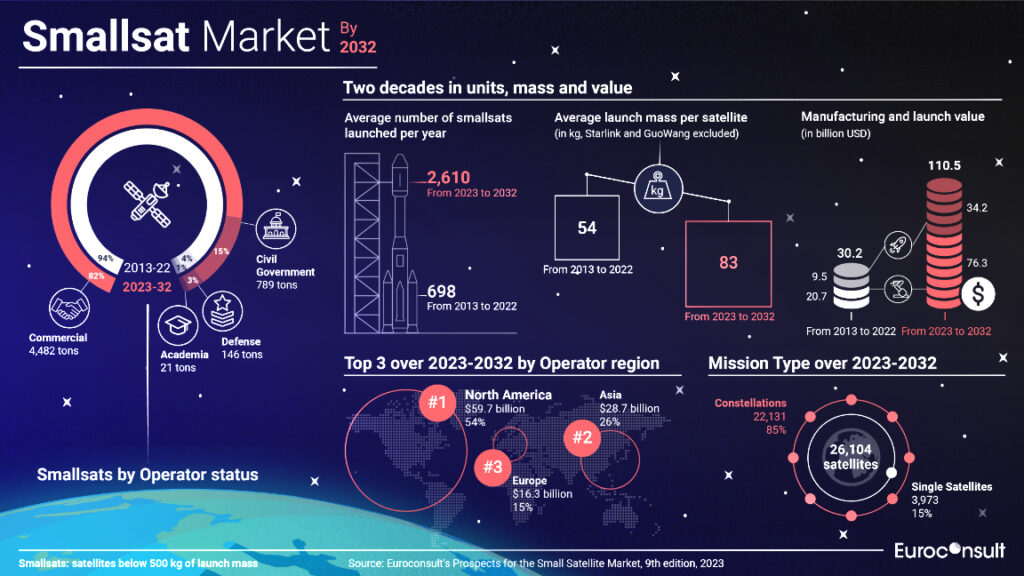
Approximately 26,104 smallsats (satellites <500 kg) will be launched between 2023-2032, representing a daily launch mass of 1.5 tons over the 10 year period, according to Euroconsult.

Two constellations – Starlink (SpaceX) and GuoWang (China SatNet) – will collectively account for nearly two-thirds of the smallsats to be launched throughout the next decade and more than four-fifths of smallsat launch mass. This significant prominence is largely a consequence of the Federal Communications Commission’s (FCC) partial approval of Starlink Gen 2 filings, alongside SpaceX’s launch of 1G satellites on 2G orbital planes and the substantial expansion of GuoWang activities in China. However, the two mega-constellations will only represent less than a quarter of market value, due to the considerable cost efficiencies of mega-constellations, leaving significant opportunities for other market participants.

Euroconsult’s latest ‘Prospects for the Small Satellite Market’ market intelligence report, now in its 9th edition, anticipates that the smallsat industry will accumulate around $110.5 billion in market value over the next decade, driven by the replenishment cycles of constellations around the world but also by more complex and costly single satellite missions for government users. Yet, the high-volume market keeps presenting several challenges, including limited market addressability for suppliers, difficult profitability, oversupply, and dominance of commercial activities by a handful of established players.

Regional demand retention rates and vertical integration are expected to only increase in the future, according to Euroconsult, as more emerging countries and operators seek to procure their own smallsat systems and develop their manufacturing or launch capabilities.

However, this will impose constraints on the addressable markets for many commercial smallsat players, with emerging launch operators also actively exploring opportunities to diversify into subsystems and satellite manufacturing, enticed by the higher profit margins offered compared to the launch industry. Some launch providers are even venturing into satellite operations and downstream services to further expand their business horizons. Several players are thus considering >500 kg constellations, including Starlink 2G, Project Kuiper, Telesat Lightspeed, Rivada, Intelsat MEO, and O3b mPower.

Though, as some constellation operators transition to larger satellites in a quest for more performance and lower capacity costs, this may create the impression of a shrinking smallsat market towards the end of the decade. SpaceX’s shift alone, powered by Starship’s entrance to the launch market, can lead to a perceived deficit in the industry. However, Euroconsult indicates that the industry’s growth is forecasted to continue at a steady rate when removing Starlink and GuoWang from the equation.

Long-term government agency contracts will continue to serve as a pivotal driver for this growth by offering reassurance and resilience to investors, including ESA’s commercial additions to its Copernicus program, Starlink’s government support, and the National Reconnaissance Office’s 10 year contract with Maxar, BlackSky, and Planet Labs.

Euroconsult will provide an even more in-depth overview of the next decade’s outlook for the smallsat market at the Small Satellite Conference in Utah on August 8th in a one-time-only presentation. Their ‘Prospects for the Small Satellite Market’ report, now available with a free extract, includes a comprehensive analysis of market drivers and inhibitors across five mass categories, six regions, seven satellite applications, five manufacturer typologies, and four types of operators.

The intelligence report also carries a unique and exhaustive database of over 325 projects featuring tens of thousands of satellites, as well as Euroconsult’s brand new “Data Behind the Graphs” feature, which enables access to data from all the graphs in the report and a complete understanding of smallsat market trends.

‘Prospects for the Small Satellite Market’ is the ninth edition in the series and presents the various factors that will drive/inhibit growth in demand for small satellites (<500 kg) over the next 10 years. It considers satellites by five mass categories, six regions, seven satellite applications, five manufacturer typologies, four types of operators, and much more. Consolidated figures for three metrics (units, mass, value) over two decades, including Euroconsult’s forecast for the next decade, are broken down by application, orbit, operator type, mass category, region of the operator as well as integrator and launch provider, type of integrator and type of launcher.

“New constellations are expected to face scope reductions and consolidation, as inflation will keep impacting their materialization probability, alongside supply chain issues and growing costs or limited availability of semiconductors and raw materials. Nonetheless, smallsats still represent a significant capability-building opportunity for new entrants in the space sector, with the conflict in Ukraine spotlighting the merits and value of commercial satcom and Earth observation smallsat constellations.” — Alexandre Najjar, Lead Report Author

Space and Satellite Market Intelligence and Data

Filed Under: Featured, News

Forrester’s Digest: Project Kuiper gets closer

July 25, 2023 by editorial

The Amazon-backed Project Kuiper LEO broadband satellite system moved a major step closer with the establishment of a satellite processing and test facility in Florida.

Kuiper is investing $120 million in a 100,000 sq. ft. factory which is being built near the Kennedy Space Center in Florida. Kuiper received its FCC license in July of 2020.

Project Kuiper calls for at least 3,236 LEO satellites to be launched that will provide broadband coverage to the entire planet. These LEO smallsats will be a direct competitor to Elon Musk’s fast-growing, Starlink service. Kuiper’s satellites will operate at heights between 590 and 630 kms.

The Kuiper satellites will be built at Amazon’s primary factories in Redmond and Kirkland, Washington. Kirkland is said to be producing five satellites per day. Upon completion, they will be shipped to Florida for final testing and integration into their rockets.

Business news channel CNBC quotes Steve Metayer, Amazon’s VP/Kuiper Production Operations, as confirming that the facility has commenced building and which will be ready to receive satellites in H2/2025. Project Kuiper’s own website states it expects it to start providing broadband services by the end of 2024.

“I am thrilled that Amazon is the first major tenant to locate [at the Florida Launch & Landing Facility],” Frank DiBello, CEO of Space Florida, told CNBC. “It’s a testament to the fact, though, that we view the whole state as an ecosystem supporting space.”

Kuiper is expected to launch the first couple of prototype test satellites later in 2023.

Filed Under: Featured, News

Blue Canyon Technologies provides defense-critical smallsats on Transporter-8 Launch

July 20, 2023 by editorial

Blue Canyon Technologies, a subsidiary of RTX (NYSE: RTX), announced the firm’s contributions to the recent SpaceX Transporter-8 launch on June 12th, kickstarting several defense-critical missions.

Blue Canyon’s products on the Transporter-8 launch included four, Saturn-class smallsats for DARPA’s Blackjack mission, two 6U CubeSats for the Department of Defense (DoD) Modular ISR program (MISR) and one 12U CubeSat for a government customer.

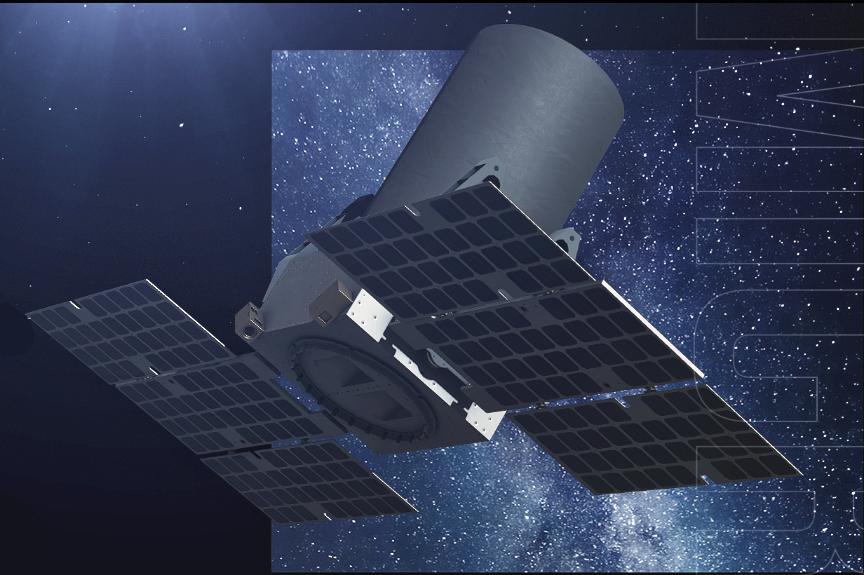
DARPA’s Blackjack mission aims to lay the groundwork for a high-speed, global network in LEO (artistic rendition below). This network will provide the DoD with connected, resilient, and persistent coverage. Each Blackjack satellite has a Pit Boss data processing node and a Storm King radio-frequency (RF) payload made by SEAKR Engineering, also an RTX subsidiary.

The MISR program is intended to demo a robust, responsive, multi-mission, CubeSat capability to satisfy various requirements. The pair of MISR CubeSats are the start in a series of missions to demonstrate various capabilities and mission effectiveness.

All seven spacecraft are in good working order and performing as expected following the launch. Commissioning activities are ongoing.

Blue Canyon’s work was performed in Lafayette, Colorado.

“Blue Canyon’s product line of smallsat buses provide the proven performance and heritage needed to support these critical defense missions. Our ability to also manufacture most of the components and subsystems for the spacecraft are what sets us apart within the industry.” — Jeff Watts, General Manager, Blue Canyon Technologies

Filed Under: Featured, News

Millennium Space Systems Missile Track Custody PDR completed in four months

July 18, 2023 by editorial

Millennium Space Systems completed the U.S. Space Force Space Systems Command’s Missile Track Custody Program Design Review in just four months, ensuring the program is on schedule for Critical Design Review (CDR) in the fourth quarter.

SSC’s MTC Program underscores Assistant Secretary of the Air Force for Space Acquisition and Integration Frank Calvelli‘s move toward smaller, proliferated, and resilient systems across multiple mission areas.

“For example, we are pivoting from the legacy missile warning architecture to a resilient missile warning architecture that adds capability to actually track missile threats,” Calvelli said, and referred to MTC as an “outstanding effort building small sats in medium Earth orbit” during his Apr. 26 testimony with the House Armed Services Committee strategic forces subcommittee.”

“We’re clearly demonstrating we can design, build and test systems in shorter time frames on schedule,” said Jason Kim, CEO, Millennium Space Systems. “In the PDR, our team demonstrated sound technological understanding of mission needs and requirements, including the space and ground segments and how launch plays into those.”

The company’s ability to reduce risk and move fast is enabled by its flight-proven ALTAIR spacecraft – developed and invested in since 2015 – and by design for manufacturability and test processes, vertical integration of mature in-house components and software re-use. Following the PDR, Millennium Space Systems is focusing on the detailed design phase in preparation for CDR, with the digital model serving as the design’s authoritative single source of truth.

Millennium Space Systems is on contract for MTC space vehicle, or SV, one, with options for SVs two and three. The company expects those options to be exercised, in addition to a contract for SVs four through six in Q4 2023.

Filed Under: Featured, News

Rocket Lab signs a multi-launch deployment deal

July 14, 2023 by editorial

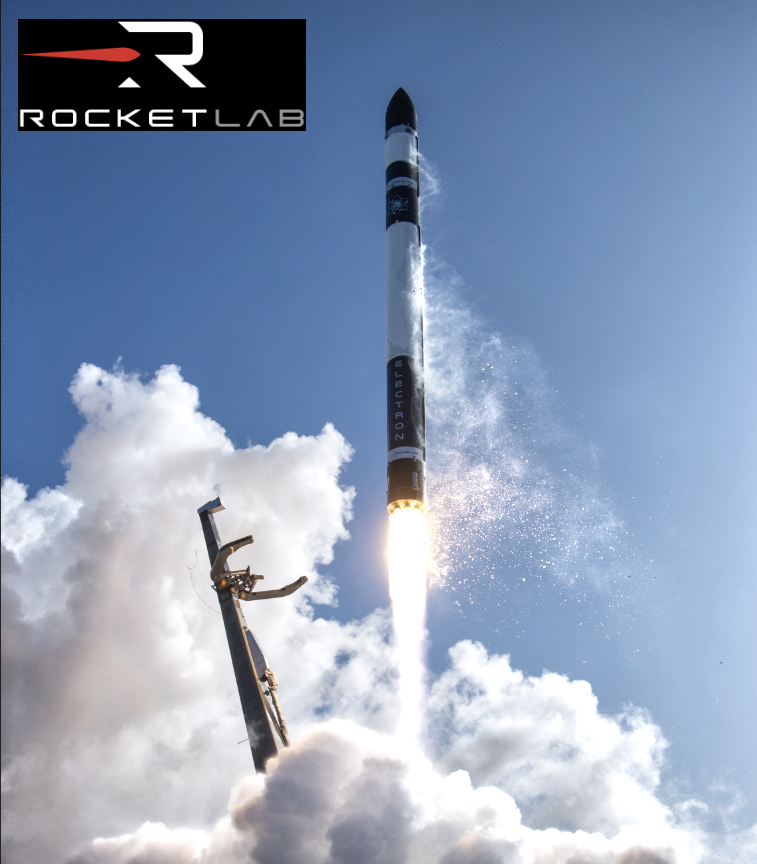
Photo of Rocket Lab’s third launch for Synspective, The Owl Spreads Its Wings, that was launched in September of 2022. Image is courtesy of the company.

Rocket Lab USA, Inc. (Nasdaq: RKLB) has signed a deal with Synspective to launch two, dedicated, Electron missions — these new missions bring the total number of Electron launches contracted by Synspective to six in number.

Rocket Lab has been launching for Synspective since 2020 when the Company deployed the first satellite in their synthetic aperture radar (SAR) constellation that is designed to deliver imagery that can detect millimeter-level changes to the Earth’s surface from space. Since that first mission, Rocket Lab has been the sole launch provider for Synspective’s StriX constellation to date, successfully deploying three StriX satellites across three dedicated Electron launches.

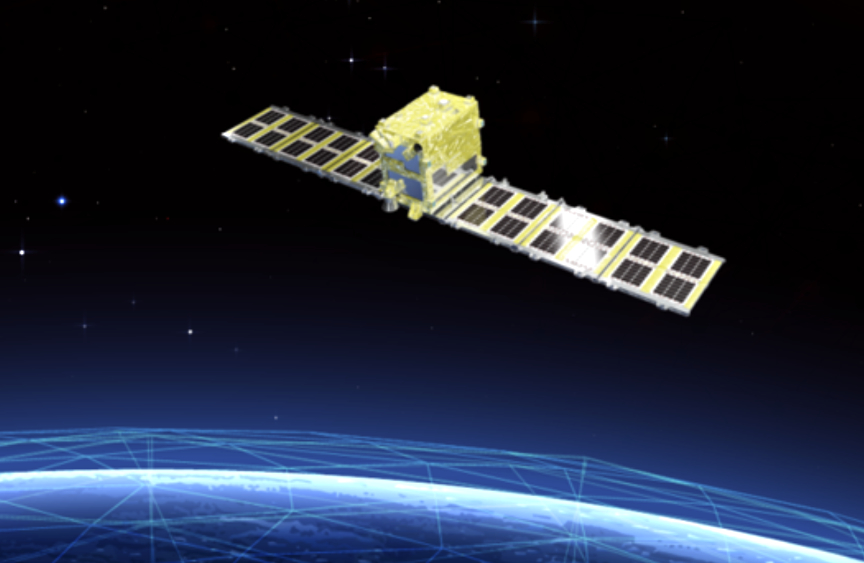
Artistic rendition of Synspective’s StrX 100 kg. SAR smallsat on-orbit.

Including the two new missions, Rocket Lab is now scheduled to launch three missions for Synspective beginning in late 2023 from Launch Complex 1 in New Zealand.

Aerial photo of Rocket Lab’s Launch Complex 1 in New Zealand.

In addition to providing Synspective with a high degree over schedule and orbit by flying as a dedicated mission, Rocket Lab also delivers the unique ability to perform an advanced mid-mission maneuver with the Electron rocket’s Kick Stage to shield the StriX satellite from the sun to reduce radiation exposure ahead of payload deployment.

Synspective joins several commercial constellation operators that have signed multi-launch agreements on Electron this year, including HawkEye 360 and Capella Space.

“It’s an honor to be entrusted with the continued deployment of Synspective’s constellation. We’re proud to enable them to build out their constellation with precision and efficiency, giving Synspective ultimate schedule and orbit flexibility with frequent dedicated launch opportunities. We’re delighted to continue delivering this unique ability to Synspective through our continued partnership.” — Peter Beck, Founder and CEO, Rocket Lab

“As we celebrate our three-year partnership with Rocket Lab, which began with our first StriX-α satellite in 2020, we are thrilled to entrust them with two more contracts for our StriX satellite launches. Their unwavering reliability and precision have been pivotal to our successful deployments. We’re looking forward to the upcoming launches and the new insights to enhance our satellite data and solution service in line with our customer needs.” — Dr. Motoyuki Arai, Founder and CEO, Synspective

Filed Under: Featured, News

ITU Radio Regulations Board approves waiver for Rivada LEO constellation and the company signs an MoU with IEC Telecom

July 12, 2023 by editorial

Rivada Space Networks recently announced that the ITU’s Radio Regulations Board has waived the requirement that Rivada place 10% of its constellation into orbit this year.

The ITU waiver process seeks clear evidence of funding, manufacturing and launch contracts as well as coordination with other systems. Having reviewed the submission made by Liechtenstein’s telecommunications regulator and filing administration (the “Amt für Kommunikation”), the ITU Radio Regulations Board determined that Rivada can proceed to its second deployment milestones of placing 144 satellites (plus six on-orbit spares) by June of 2026 and an additional 144 satellites (plus six on-orbit spares) by September of 2026.

“The Office for Communications has put its trust in the ITU process and is delighted about the positive decision of the RRB. These filings were secured at a very early stage in the development of NGSO constellations for global connectivity and are an important asset – not only for Liechtenstein. A shortage of launch capacity and delays in technology development have been significant challenges to overcome in order to deploy these constellations in the stipulated timeframe. The perseverance of Rivada and ITU’s positive decision mean that the deployment of the constellations can move forward for the benefit of all the stakeholders.” — Dr. Rainer Schnepfleitner, Director of the AK of Liechtenstein

“Rivada has the manufacturing and launch contracts in place to complete the constellations and launch 600 satellites by 2028, within the timeframe allowed by the ITU. We are working very closely with the regulator to make sure that all the conditions attached to these filings are satisfied and to ensure the success of these ground-breaking satellite constellations. We are building something unique, which we call the OuterNET: the first truly private global network, on which data travels through space alone and not over terrestrial networks to provide ultra secure communications anywhere on the globe.” — Declan Ganley, CEO, Rivada

Additionally, Rivada Space Networks and IEC Telecom have signed a Memorandum of Understanding (MoU) to enable innovative connectivity solutions for land and maritime communications.

IEC Telecom is an international satellite service operator offering satellite communication solutions to governments, public institutions, and enterprises across the world. IEC Telecom specializes in digitalization for the maritime industry as well as providing remote communications on land where GSM coverage is not available as well as delivering dependable communication for humanitarian operations and special missions. For urban networks, the company provides a powerful, satellite back-up to ensure business continuity.

The communications landscape is developing rapidly with providers now able to offer first-generation, LEO satellite connectivity. However, not all LEO networks are created equal — what Rivada is now providing is the first, true “OuterNET”, a global, low latency, point-to-point, connectivity network of LEO satellites. What sets Rivada apart is the nexgen unique architecture combining inter-satellite laser links with advanced onboard data routers to create an optical mesh network in space.

This approach to “orbital networking,” where data stays in space, enables access to an ultra-secure satellite network with pole-to-pole reach, offering end-to-end latencies similar to or better than terrestrial fiber. By routing traffic on a physically separated network, Rivada provides a layer of defence for any organization that needs to securely share data over long distances.

For the humanitarian sector, IEC Telecom will leverage Rivada’s OuterNET to provide leading NGO agencies with enhanced connectivity for the coordination of humanitarian efforts, the safety of remote workers, the security of NGO assets, and the sustainability of long-term operations. From housing and food distribution to education and medicine, all field requirements will be supported to allow humanitarian missions to expand their reach and multiply their scope of services.

In addition to land connectivity services, IEC Telecom will use Rivada’s OuterNET to provide enhanced ICT infrastructure for the maritime environment, further expanding digitalization at sea. IEC Telecom offers cyber-secure network solutions optimized for the maritime sector.

Powered by Rivada’s OuterNET, these technologies will support digital decarbonization globally by helping vessels improve onboard operations, leading to reduced fuel consumption.

“This partnership supports IEC Telecom’s commitment to pursue innovation for the best customer experience. Rivada’s service will allow us to expand our network’s SLA and offer high-throughput data connectivity ‘Fiber-like’ in the sky versus DSL-like today. We are excited to explore cost-effective packages for the humanitarian sector and test the resilience of maritime connectivity in the open sea. We are confident that Rivada is on its way to becoming a key market player in the SATCOM world.” — Erwan Emilian, CEO & Partner, IEC Telecom Group

“We are delighted to be working with IEC Telecom to support their high throughput voice and data services. We are moving full speed ahead to deploy the first true OuterNET, with its unique data-connectivity capabilities. Both of our companies see the importance of providing ultra-secure, highly reliable low latency communications anywhere on the globe.” — Declan Ganley, CEO, Rivada Space Networks

Rivada Space Networks is set to deploy and operate the first true “OuterNET”: a global, low latency, point-to-point, connectivity network of LEO satellites. By connecting its satellites with lasers, Rivada Space Networks will provide resellers and B2B customers with the ability to securely connect any two points on the globe with low latency and high bandwidth. The constellations, comprising 600 low-earth-orbit communications satellites, will represent a fundamental change in the availability of secure, global, end-to-end enterprise-grade connectivity for Telecom, Enterprise, Maritime, Energy and Government Services markets. Rivada Space Networks is a wholly owned subsidiary of Rivada Networks, Inc.

Filed Under: Featured, News

  • « Go to Previous Page
  • Go to page 1
  • Interim pages omitted …
  • Go to page 18
  • Go to page 19
  • Go to page 20
  • Go to page 21
  • Go to page 22
  • Interim pages omitted …
  • Go to page 58
  • Go to Next Page »

Primary Sidebar

WEEKLY NEWSLETTER

Archives

  • February 2026
  • January 2026
  • December 2025
  • November 2025
  • October 2025
  • September 2025
  • August 2025
  • July 2025
  • June 2025
  • May 2025
  • April 2025
  • March 2025
  • February 2025
  • January 2025
  • December 2024
  • November 2024
  • October 2024
  • September 2024
  • August 2024
  • July 2024
  • June 2024
  • May 2024
  • April 2024
  • March 2024
  • February 2024
  • January 2024
  • December 2023
  • November 2023
  • October 2023
  • September 2023
  • August 2023
  • July 2023
  • June 2023
  • May 2023
  • April 2023
  • March 2023
  • February 2023
  • January 2023
  • December 2022
  • November 2022
  • October 2022
  • September 2022
  • August 2022
  • July 2022
  • June 2022
  • May 2022
  • April 2022
  • March 2022
  • February 2022
  • January 2022
  • December 2021
  • November 2021
  • October 2021
  • September 2021
  • August 2021
  • July 2021
  • June 2021
  • May 2021
  • April 2021
  • March 2021
  • February 2021
  • January 2021
  • December 2020
  • November 2020
  • October 2020
  • September 2020
  • August 2020
  • July 2020
  • June 2020
  • May 2020
  • April 2020
  • March 2020
  • February 2020
  • January 2020
  • December 2019
  • November 2019
  • October 2019

© 2019–2026 SatNews

Insert/edit link

Enter the destination URL

Or link to existing content

    No search term specified. Showing recent items. Search or use up and down arrow keys to select an item.
      x
      Sign Up Now!

      Enjoy a free weekly newsletter with recent headlines from the global SmallSat industry.

      Invalid email address
      We promise not to spam you. You can unsubscribe at any time.
      Thanks for subscribing! You will now receive weekly SmallSat News updates.
      We love our advertisers.
      And you will too!

      Please disable Ad Blocker to continue... We promise to keep it unobtrusive.
      We promise not to spam you. You can unsubscribe at any time.
      Invalid email address
      Thanks for subscribing! Please check your email for further instructions.