• Skip to main content
  • Skip to primary sidebar
  • Home
  • News
  • Featured
  • More News ⌄
    • SatNews
    • SatMagazine
    • MilSatMagazine
  • Events ⌄
    • MilSat Symposium
    • SmallSat Symposium
    • Satellite Innovation
  • Contacts
  • SUBSCRIPTION

SmallSat News

You are here: Home / Archives for Featured

Featured

Spire Global has unveiled their next-gen smallsat bus

November 21, 2022 by editorial

Earlier this month, Spire Global, Inc. revealed the firm’s next-gen 16U satellite bus design — the bus is tailored for customers with missions that require larger payloads and more power, volume, and data capabilities than a conventional 16U smallsat, such as EO and space domain awareness missions.

Spire, which operates the world’s largest, multipurpose, satellite constellation, designs and builds satellites entirely in house at the firm’s manufacturing facility in Glasgow, Scotland. The company has built and launched more than 150 satellites, carrying nearly 500 years of spaceflight heritage across its fleet.

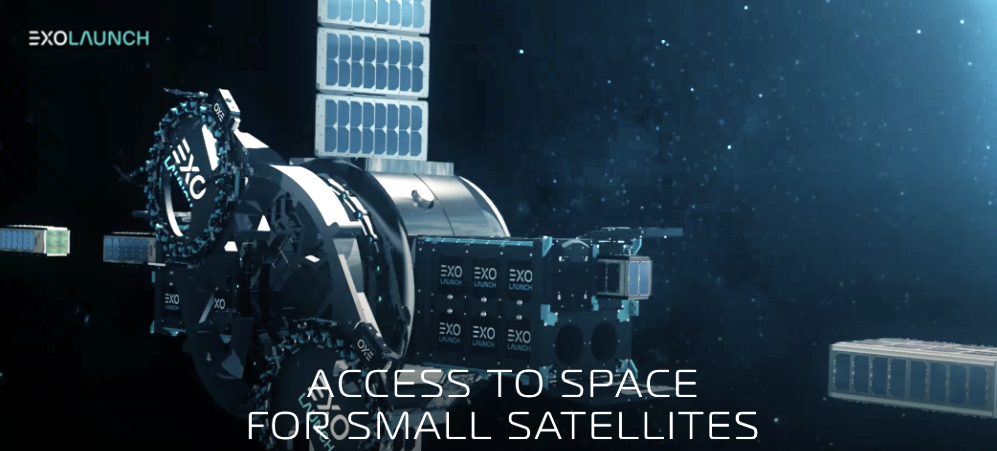
Exolaunch’s EXOpod Nova deployer, a custom launch deployer developed in partnership with Spire, has enabled the company to optimize the capacity and volume of the satellite while still fitting into standard deployment settings. The 16U satellite can accommodate payloads of up to 30 kilograms.

Spire Space Services customers can leverage the company’s proven space, ground and web infrastructure to quickly scale their own constellation. In 2023, Spire will launch its next-gen 16U satellites to orbit, carrying payloads for Space Services customers NorthStar Earth & Space and GHGSat.

“Increasingly we’re seeing that our customers’ missions require buses that offer the performance of a larger satellite with the agility of a nanosatellite,” said Joel Spark, Co-Founder and General Manager, Space Services, Spire. “It’s a tall order, but we’ve leveraged our extensive space heritage and experience in satellite design and manufacturing to build a one-of-a-kind satellite bus that checks all those boxes. Our next-gen satellite has been a natural next step for us, driven by the needs of the market.“

“Spire Global is leading the market to address a growing demand for affordable access to space,” said Stewart Bain, NorthStar Earth & Space CEO and Co-Founder. “The timing of this new product fits well with NorthStar’s plans to launch the first commercial space-based services to improve space situational awareness precision and coverage over all near-Earth orbits. NorthStar is pleased to be engaged with Spire in this endeavor as part of a vibrant and innovative space economic ecosystem.”

“This is an exciting time for the space sector in Scotland. Businesses such as Spire Global are delivering innovative new satellites, helping to position Scotland as a global leader for commercial space developments gaining a £1 billion share of the global space market,” said Scottish Government Minister for Business, Trade, Tourism and Enterprise, Ivan McKee MSP. “We continue to lead the way in small satellite manufacturing, with our manufacturing hub in Glasgow and innovative new designs like the next-generation 16U satellite bus design from Spire highlighting the ambition set out in our 10 year transformation strategy to build an internationally competitive economy founded on entrepreneurship and innovation.”

Spire (NYSE: SPIR) is a leading global provider of space-based data, analytics and space services, offering access to unique datasets and powerful insights about Earth from the ultimate vantage point so that organizations can make decisions with confidence, accuracy, and speed. Spire uses one of the world’s largest multipurpose satellite constellations to source hard to acquire, valuable data and enriches it with predictive solutions. Spire then provides this data as a subscription to organizations around the world so they can improve business operations, decrease their environmental footprint, deploy resources for growth and competitive advantage, and mitigate risk. Spire gives commercial and government organizations the competitive advantage they seek to innovate and solve some of the world’s toughest problems with insights from space. Spire has offices in San Francisco, Boulder, Washington DC, Ontario, Glasgow, Oxfordshire, Luxembourg, and Singapore.

Filed Under: Featured, News

Arianespace’s first Vega C mission to complete Pléiades Neo constellation for Airbus Defence and Space

November 21, 2022 by editorial

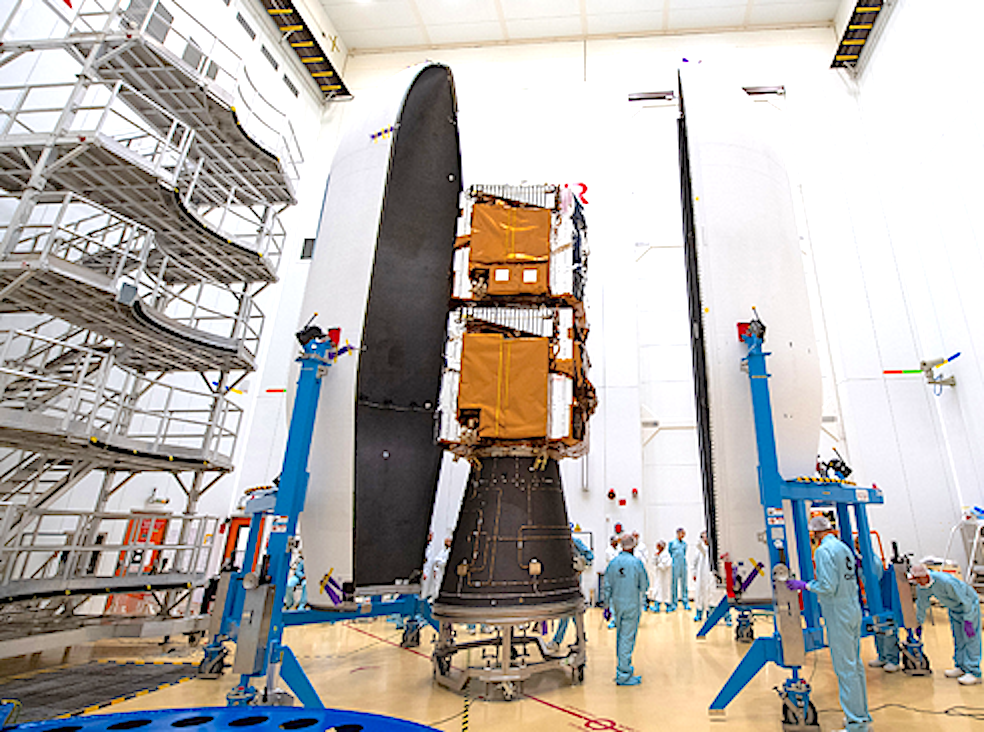
On Thursday, November 24, 2022 at 10:47 pm local time (01:47 am (UTC) on Friday, November 25), Arianespace’s first Vega C mission will lift off from Europe’s Spaceport in French Guiana, with the 30cm resolution satellites Pléiades Neo 5 and 6. This first commercial flight follows the success, July 13, of Vega C inaugural launch operated by the European Space Agency (ESA).

After liftoff from Europe’s Spaceport, the Vega C launcher will fly powered by the first three stages for a little over seven minutes. The third stage ZEFIRO 9 will then separate from the upper composite, which comprises the AVUM+ upper stage and the two Pléiades Neo satellites. The AVUM+ stage will ignite its engine for the first time about nine and an half minutes, followed by a ballistic phase lasting approximately 35 minutes, in order to reach the injection altitude of the first satellite.

The AVUM+ stage will then restart its engine for a second burn lasting 2 minutes and 30 seconds to circularize the orbit at an altitude of 629 km before releasing the first satellite. The next step, 6 minutes and 39 seconds later, will be a 15 seconds RACS boost leading to a new ballistic phase lasting about 36 minutes. It will be interrupted by a third AVUM+ ignition phase lasting exactly 5 seconds, and will be followed by the release of the second satellite at an altitude of 614 km. Approximately nine minutes later will occur the fourth and last AVUM+ ignition for a period of 61 seconds, that will deorbit the launcher — marking the end of mission VV22, one hour, 53 minutes and 55 seconds after liftoff.

Pléiades Neo 5 and 6 fully funded and manufactured by its operator Airbus, are the two final satellites of the Pléiades Neo constellation that will respectively be the 139th and 138th Airbus Defence and Space satellites to be launched by Arianespace as well as the 120th and 119th satellites launched by a launcher of the Vega family.

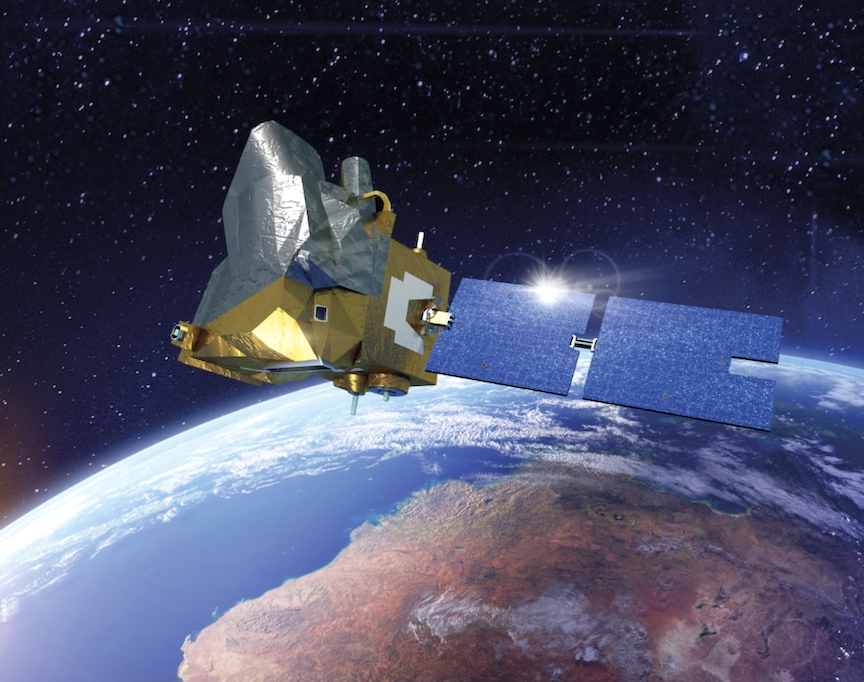
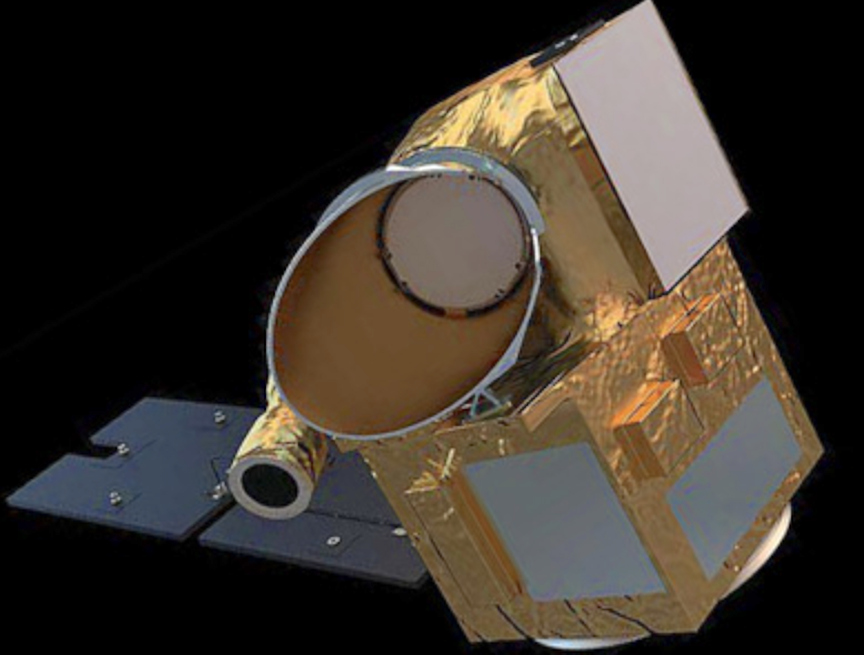
The first one, Pléiades Neo 3, has been successfully orbited by Vega Flight 18 on April 28, 2021, and the second one, Pléiades Neo 4, by Vega Flight 19 on August 16, 2021. Built using the latest Airbus’ innovations and technological developments, the constellation allows imaging any point of the globe, several times per day, at 30cm resolution. Highly agile and reactive, they can be tasked up to 15 minutes before acquisition, and send the images back to Earth within the following hour. Smaller, lighter, more agile, accurate and reactive than the competition, they are the first of their class whose capacity will be fully commercially available. Thanks to these state-of-the-art satellites, each step of the acquisition and delivery cycle offers top-level Earth observation services now and going forward for the next ten years.

Vega C, which stands for Consolidation, has been developed to better respond to customers’ needs based on the lessons learned from the first decade (2012-2022) of Vega operations. The launcher has been upgraded with more powerful first and second stage Solid Rocket Motors, bigger AVUM tanks and with a larger fairing that significantly increase payload mass (up to 2,350t in SSO – Sun-Synchronous Orbit) and double allowable volume.

The launcher also better meets the specific needs of small spacecraft, as a result of its improved SSMS (Small Spacecraft Mission Service) dispenser and to its AVUM+ that will allow seven re-ignitions. Vega C can thus achieve three different orbits for its multiple payloads on the same mission, instead of the two previously possible with Vega.

Vega C development program has been managed by ESA. It associates 12 of Member States of the Agency. Avio Spa (Colleferro, Italy) is the industrial prime contractor for both launch vehicle and interfacing ground infrastructure. Avio is also responsible for campaign operations and preparation of the launch vehicle up to lift-off. Avio hands over a “ready to fly” rocket to Arianespace, which sells the Vega C, defines the missions’ requirements, validates its flight worthiness, and operates it from Europe’s Spaceport in French Guiana.

During launch campaigns, Arianespace works closely with CNES, the French space agency and the launch range authority at the European Spaceport in Kourou, who is notably looking after the satellite preparation facilities besides being responsible for the protection of populations.

Filed Under: Featured, News

Benchmark Space Systems grows nearly tripling their team and expanding production to meet propulsion system demand

November 16, 2022 by editorial

With its Halcyon propulsion systems playing pivotal roles in key military and commercial space missions this year, Benchmark Space Systems announced it has tripled its team from 30 to 83 and boosted its 5-year production capacity to one-thousand engines — all in the last twelve months to meet rapidly rising demand for its mission-proven thrusters.

Benchmark has booked more than 250 engine orders, with the majority of those systems being built and tested at the company’s headquarters facility in Burlington, Vermont, where the firm’s wave of recent hires includes new key executives, Wesley Grove, Senior Operations Manager and Matt Bradley, Vice President of Finance. Benchmark also appointed Kent Frankovich as Vice President of Electric Propulsion, who will be based at Benchmark’s pre-delivery system test center in Pleasanton, California.

Benchmark has expanded its Guidance, Navigation and Control (GNC) software engineering team to further develop its SmartAIM™ GNC for unprecedented operational versatility aboard cubesats, microsats and ESPAs powered by its Halcyon chemical and new Xantus electric metal plasma thruster (MPT) propulsion systems ‚ as well as complementary thrusters and positioning subsystems.

Benchmark also announced it is ready to initiate propulsion system production at its new UK manufacturing and test facility at the Westcott Innovation Centre Northwest of London in Aylesbury, England. A collaboration with UK-based Satellite Applications Catapult enabled Benchmark to accelerate the build out of its European assembly and clean room operations in less than six months.

The first propulsion engines to roll off Benchmark’s new UK production line will be Halcyon Avant bipropellant systems destined for Space Forge satellites, which are designed to return products made in space back to Earth. While the down mass re-entry market attracts much skepticism and scrutiny, it is a key aspect of the in-space market, proven and practiced for years by SpaceX. 

“The space market has seen our performance on orbit, and our breakthrough chemical, electric, and hybrid propulsion systems, and has responded with major engine orders we will deliver over the coming months. We have quickly emerged as the company that empowers leading satellite manufacturers and operators by unleashing the full potential of their missions with the best in-space mobility solutions,” said Ryan McDevitt, Benchmark Space Systems CEO. “Benchmark continues to grow exponentially, nearly tripling the size of our team this year alone and expanding our five-year production capacity to one-thousand engines in the U.S. and the UK. Benchmark is inking major contracts to enable mission-critical government and commercial space programs, and we have the people and infrastructure in place to deliver on the exciting demand.”

“Benchmark’s UK expansion is an important piece of our global strategy, as we are now very well positioned to meet the specific needs of the European space market with tailored chemical, electric and hybrid propulsion solutions,” according to Mark Arthur, Benchmark’s Director of European Operations.  “Our alignment with S.A.  Catapult has allowed Benchmark to stand up our UK manufacturing and testing capabilities in record time at the Westcott Innovation Centre, with access to specialized capital equipment available on campus. We expect to conduct our first hot fire testing early next year, and we will be exchanging ideas, capabilities and technologies across our teams in the UK, Vermont and California to solve key challenges for customers and partners around the world — from in-space manufacturing to space debris and collision avoidance.”

“We are thrilled to see our facilities at the Westcott Innovation Center play a role in Benchmark’s ability to accelerate the production and testing of propulsion systems customized to the requirements of UK and European space demands,” said Sam Adlen, Chief Strategy Officer for Satellite Applications Catapult. “Benchmark brings incredibly innovative propulsion systems and technologies to the region and is on the verge of rolling its first tailored offerings off its Westcott assembly line.”

Filed Under: Featured, News

Space Flight Laboratory awarded HawkEye 360 contract for RF Geolocation smallsat builds

November 14, 2022 by editorial

Space Flight Laboratory (SFL) has been contracted to support development of Clusters 7 through 11 in the HawkEye 360 radio frequency (RF) geolocation smallsat constellation.

Created with New Space companies in mind, the SFL Flex Production program gives customers the option of contracting SFL to completely develop the first satellite, or satellite cluster, in a smallsat constellation at its Toronto facility. SFL then assists the customer in setting up subsequent mass production at their own site or another site. However, development can shift back to SFL when a new spacecraft design or technology update is needed.

“Flex Production offers NewSpace companies the best of two worlds – they can leverage SFL’s Microspace expertise while satisfying the financial requirements of the NewSpace business model,” said SFL Director, Dr. Robert E. Zee. “New Space companies can mass produce satellites in-house at a price point that works for them.”

Designing new satellites and upgrading technologies require workflows and personnel that are often different from the processes related to production of duplicate follow-on spacecraft, Zee explained. Progressive development of smaller satellite technology is the strength of microspace businesses such as SFL.

Under the Flex Production program, SFL offers customers a variety of options as to the level of production they want to bring in-house. For customers without their own production capabilities, SFL continues to maintain the capacity to develop complete smallsat, microsatellite, nanosatellite, and cubesat missions in Toronto. SFL also has third-party partnerships to mass produce satellites at another facility when high volume and/or rapid cadence is required.

The HawkEye 360 Constellation detects and geolocates RF signals for maritime situational awareness, emergency response, national security, and spectrum analysis applications. Each new cluster expands HawkEye 360’s global revisit and collection capacity.

Artistic rendition of a HawkEye 360 smallsat on orbit, courtesy of the company.

SFL developed the three-satellite Pathfinder Cluster on its 15 kg. NEMO bus and then built Clusters 2, 3, 4, 5, and 6 on its space-proven 30-kg DEFIANT microsatellite bus. The first five clusters are now operating successfully in orbit with Cluster 6 expected to launch on Rocket Lab’s inaugural Electron mission from Wallops Island, Virginia, as early as December 2022.

Photo of SFL’s NEMO bus, courtesy of SFL.

SFL has been selected for the HawkEye 360 missions due to the importance of formation flying by multiple satellites for successful RF geolocation. SFL is the acknowledged leader in developing and implementing high-performance attitude control systems that make it possible for relatively low-cost nanosatellites and microsatellites to fly in stable formations while in orbit.

SFL is a unique microspace provider that offers a complete suite of nano-, micro- and small satellites – including high-performance, low-cost cubesats – that satisfy the needs of a broad range of mission types from 3 to 500 kilograms. Dating from 1998, SFL’s heritage includes 61 operational successes and 30 currently under construction or awaiting launch. These missions relate to Earth Observation (EO), atmospheric monitoring, ship tracking, communication, radio frequency (RF) geolocation, technology demonstration, space astronomy, solar physics, space plasma, and other scientific research.

In its 24-year history, SFL has developed all forms of smallsats, such as cubesats, nanosatellites and microsatellites that have achieved more than 215 cumulative years of operation in orbit. These microspace missions have included SFL’s trusted attitude control and, in some cases, formation-flying capabilities. Other core SFL-developed components include modular (scalable) power systems, onboard radios, flight computers, and control software.

SFL generates bigger returns from smaller, lower cost satellites. Small satellites built by SFL consistently push the performance envelope and disrupt the traditional cost paradigm. Satellites are built with advanced power systems, stringent attitude control and high-volume data capacity that are striking relative to the budget. SFL arranges launches globally and maintains a mission control center accessing ground stations worldwide. The pioneering and barrier-breaking work of SFL is a key enabler to tomorrow’s cost-aggressive satellites and constellations.

Filed Under: Featured, News

AAC Clyde Space’s Seahawk smallsat to continue ops

November 11, 2022 by editorial

AAC Clyde Space has won a contract to continue to operate the Seahawk satellite for one more year, a contract that may be extended up to two years further provided that the spacecraft continues to deliver data. Launched in 2018 with an expected lifetime of four years, the Seahawk is exceeding life expectancy for cube satellites, continuing to deliver data.

The 3U cube satellite, launched in 2018, is part of a partnership between the University of North Carolina Wilmington and NASA funded by the Gordon and Betty Moore Foundation. It features a compact, multispectral imager (HawkEye) that captures approximately 100 images weekly which are used to analyze the color of the ocean. The data enables a greater understanding of the marine food chain, oceanic climate, fisheries and pollution phenomena, factors used to support the health and sustainability of the oceans.

The satellite is operated from AAC Clyde Space’s Glasgow Operations Centre, with instrument data downloaded to the NASA’s Alaska station, through the satellite’s X-band downlink. The data is integrated into NASA’s SeaWiFS Data Analysis System (SeaDAS) and is distributed free of charge to scientists worldwide.

“AAC Clyde Space are delighted to continue to support the SeaHawk mission to improve environmental surveillance and generate reliable data to support the health and sustainability of our oceans. The SeaHawk is a cube satellite with a great mission for our planet,” said AAC Clyde Space CEO, Luis Gomes.

Filed Under: Featured, News

Amazon’s new Project Kuiper facility will increase satellite manufacturing with goal of four satellites daily

November 9, 2022 by editorial

Amazon plans to develop a dedicated, 172,000-square-foot satellite production facility in Kirkland, Washington. The new facility will create more than 200 highly skilled aerospace and manufacturing jobs in the Puget Sound region and provide the scale required to build as many as four satellites per day.

Amazon’s new facility in Kirkland, Washington, will provide jobs and infrastructure to scale satellite production ahead of a full commercial deployment. Amazon is continuing to invest in people and facilities to support Project Kuiper, a low Earth orbit (LEO) satellite network that will provide fast, affordable broadband to unserved and underserved communities around the world. The program, based in Redmond, Washington, continues to expand the footprint in the region following the announcement of an initial 219,000-square-foot research and development facility in 2020.

These facilities have the capacity to support prototype development and begin commercial satellite production, but to deliver on our vision for the project, we need to operate on a much larger scale. That requires dedicated manufacturing space, and we’re excited to announce plans to develop a dedicated, 172,000-square-foot satellite production facility in Kirkland, Washington. The new facility will create more than 200 highly skilled aerospace and manufacturing jobs in the Puget Sound region and provide the scale required to build as many as four satellites per day.

“Getting Project Kuiper’s satellites into space requires significant precision, expertise, and a world-class team committed to our vision,” said Rajeev Badyal, vice president of technology for Project Kuiper. “This new satellite production facility will significantly expand our manufacturing capacity as we approach launch and deployment, and it brings us another step closer to delivering on our mission to connect unserved and underserved communities around the world.”

Project Kuiper satellites have been designed and developed in-house to maximize performance while reducing costs, and the manufacturing facility will provide additional control over the production and testing process. By centralizing operations in the Puget Sound, it can also ensure close coordination between design and development teams in Redmond and manufacturing teams in Kirkland.

“We’re excited with Amazon’s selection of Kirkland for Project Kuiper’s satellite production facility,” said Kirkland Mayor Penny Sweet. “Whether you’re looking to get your foot in the door or are pursuing an advanced, high-level career, this will bring even more economic opportunity for professionals who live here and for those who have yet to call Kirkland home. Partners like Amazon are critical in demonstrating why our city is such a great place to live, work, and play. Our state’s pioneering spirit has revolutionized aerospace. As Project Kuiper’s partner, Kirkland is proud to continue this tradition.”

Amazon’s Project Kuiper satellites will fly on the new Vulcan Centaur rocket in early 2023

Project Kuiper, Amazon’s satellite broadband program, will launch two prototype satellites on an upcoming United Launch Alliance mission to test system performance in space.

For over a century, Washington state has been home to a thriving aerospace sector. Project Kuiper recently joined a White House-led coalition to bolster the country’s commercial space workforce, and these investments will allow them to extend that commitment to the local communities in the Puget Sound region. The new production facility will open new doors in advanced manufacturing for a diverse range of space-focused job seekers, and it will provide additional opportunities for local partners with expertise in manufacturing materials and services.

“In the 21st century, a reliable high-speed internet connection is essential for living, learning, and working from home. Amazon’s Project Kuiper will be critical to help close the digital divide and provide more affordable internet options. Our region’s tech industry is strong, and its continued growth has significant benefits across the country,” said U.S. Representative Suzan DelBene (D-WA), whose district includes Kirkland. “Project Kuiper’s new production facility will bring good-paying, high-skilled jobs to the Puget Sound region as work continues to expand broadband access everywhere.“

Project Kuiper, Amazon’s satellite broadband program, will launch two prototype satellites on an upcoming United Launch Alliance mission to test system performance in space.

“Amazon could have located their Project Kuiper satellite production facility anywhere in the world, and yet they chose Kirkland and the Greater Seattle region to expand,” said Brian Surratt, president and CEO of Greater Seattle Partners. “The decision to continue to grow here will create new jobs and opportunities for our rich ecosystem of aerospace companies and talent that has evolved over more than a century of research, development, and manufacturing. We are honored to be Amazon’s partner in pushing the boundaries of space and delivering fast, affordable broadband to unserved and underserved communities around the world.”

Project Kuiper’s first two prototype satellites will launch in early 2023 on United Launch Alliance’s (ULA) Vulcan Centaur rocket, and Amazon has secured up to 92 heavy-lift launches from Arianespace, Blue Origin, and ULA, marking the largest commercial procurement of launch vehicles in history. These contracts will provide enough capacity to deploy the majority of our satellite constellation and support thousands of suppliers and highly skilled jobs across the United States and Europe. Also on Thursday, ULA announced the groundbreaking of new facilities in Decatur, Alabama, nearly doubling its capacity to support the partnership and supply the launch vehicles needed to get Kuiper satellites into orbit.

More than 1,000 people are working on Project Kuiper across the U.S., including cities such as San Diego, Austin, New York City, and Washington, D.C., and are continuing to hire across a wide range of roles and disciplines.

Filed Under: Featured, News

Spire Global solution enlightens dark shipping detection 

November 8, 2022 by editorial

Dark ship detection solution is essential to identify and locate vessels suspected of unlawful activities, such as evading sanctions, illegal fishing and human trafficking 

Spire Global, Inc. , a global provider of space-based data, analytics and space services, reveal a dark shipping detection solution to track vessels that manipulate their reported position in order to conceal nefarious activities.

The Automatic Identification System (AIS) on a vessel helps avoid collisions at sea, track global shipping trends and monitor individual vessel activity — however, crew members on board can manipulate the system by turning off the transponder to go dark or ‘spoofing’ the AIS to report false positions. Typically this is done in order to hide activity that is illegal or could have negative consequences to the ship owner, such as illegal trading, loading or unloading sanctioned goods, or illegal, unreported and unregulated (IUU) fishing.

Alert Tools: For subscribers, delete all currently displayed alerts, clear any on map alert icons, and refresh the alerts list
Alert Rules/Filters: Add rules to filter alerts list including by layer, type, and date/range
Alerts List: For subscribers, displays any available alerts based on the alert rules/filters

Spire’s near real-time, global geolocation position validation service can uncover suspicious activity and pinpoint a vessel without the need for an approximate location. The applications are critical to governments, intelligence and security agencies, and nonprofit organizations’ efforts to identify and locate vessels that are breaking international law. 

“For a long time, having the tools to accurately identify and track ships that are attempting to hide their activities or location has been the missing key to preventing sanctions evasion, illegal fishing, human trafficking and many more pressing societal issues,” said Peter Mabson, CEO, Spire Maritime. “Dark shipping detection builds on our breadth of maritime tracking solutions and underscores Spire’s mission to use data that can only be collected from space to improve life on Earth.”

Spire operates thelargest multipurpose constellation with more than 100 satellites. The company plans to launch additional products in 2023 for geolocation and identification of dark targets, at sea, on land, and in the air.

Filed Under: Featured, News

Rocket Lab and Inmarsat Government to develop L-Band radio for NASA’s Communications Services Project

November 7, 2022 by editorial

Inmarsat spacecraft depicted in Earth orbit. Credit: Inmarsat

Rocket Lab USA, Inc., a launch and space systems company, has been selected by Inmarsat Government as partner to develop and manufacture an L-band radio in support of NASA’s Communications Services Project (CSP). CSP seeks to accelerate the development of commercial near-Earth communications services by partnering with satellite communications (SATCOM) providers. Rocket Lab will help enable Inmarsat’s InCommand, a real-time, near-Earth telemetry, command, and control (TT&C) service for satellites in low Earth orbit (LEO) for the CSP with the Company’s new Frontier-L radio connecting to Inmarsat’s ELERA global L-band network in geosynchronous orbit (GEO).

As NASA prepares to decommission the agency’s owned and operated Tracking and Data Relay Satellite System (TDRSS) system, which has provided communication for the Hubble Space Telescope, the International Space Station, and numerous NASA’s Earth-observation satellites, the CSP aims to tap into commercial satellite communications services to ensure future NASA missions have similar reliable, secure, and high-performance space relay capabilities.

Rocket Lab’s Frontier-L radio is a transmitter that will support Inmarsat Government’s demonstrations of a variety of TT&C applications, enabled by Inmarsat’s ELERA worldwide L-band network, including Launch and Early Operations Phase (LEOP), ubiquitous command and control, real-time tasking, and contingency operations for satellites in LEO orbits.

“Rocket Lab and Inmarsat Government both share a culture of innovation, pioneering technology and delivering reliable mission success, so we’re honored to be working together to support NASA in this vital project to enable major missions of the future,” said Rocket Lab founder and CEO, Peter Beck. “We look forward to building on the strong heritage of our Frontier radios by supporting Inmarsat’s world-renowned satellite network and leading capabilities providing satcom as a service.”

Frontier-L join’s Rocket Lab’s existing line of radios including the software-defined telemetry, tracking, and command (TT&C) S-band Frontier-S and X-band Frontier-X radios which can support near Earth and deep space missions. Based on the Johns Hopkins University (JHU) Applied Physics Lab (APL) Frontier Radio, Frontier-L packs Deep Space Network (DSN) and other typical waveforms (SN, KSAT, SSC) into a compact package with up-screened commercial components for high reliability applications. The family of Frontier by Rocket Lab radios includes extended functionality not typically available in a low-cost radio including a coherent transponder to enable radiometric navigation methods, precision timekeeping functions, forward error correction (FEC) encoding and decoding, and a hardware based critical command decoder (CCD).

Steve Gizinski, President, Inmarsat Government, said, “Inmarsat Government has joined with major space-based industry suppliers to demonstrate the capabilities of Inmarsat’s ELERA global, reliable satellite network, including for NASA’s Communications Services Project and Rocket Lab is a key partner for us. Rocket Lab’s Frontier-L radio will leverage InCommand on the ELERA network as an important new capability for ubiquitous command and control to enhance the operation of low Earth orbit spacecraft. This will enable new communications services for industry and government alike.”

Filed Under: Featured, News

Rocket Lab to attempt their next mid-air Electron rocket catch by helicopter with their next launch mission

November 3, 2022 by editorial

Rocket Lab USA, Inc. will attempt to catch an Electron rocket with a helicopter as it returns to Earth from space during the firm’s next launch.

Lift-off of a Rocket Lab Electron rocket.

Rocket Lab’s 32nd Electron launch, the “Catch Me If You Can” mission, is scheduled to launch from Pad B at Rocket Lab Launch Complex 1 during a launch window opening on November 04, UTC. Electron will carry a science research satellite by space systems provider OHB Sweden for the Swedish National Space Agency (SNSA). The Mesospheric Airglow/Aerosol Tomography and Spectroscopy (MATS) satellite is the basis for the SNSA’s science mission to investigate atmospheric waves and better understand how the upper layer of Earth’s atmosphere interacts with wind and weather patterns closer to the ground. MATS was originally due to fly on a Russian launch service before the mission was manifested on Rocket Lab’s Electron.

“Catch Me If You Can” will see Rocket Lab attempt to capture the rocket’s first stage mid-air with a helicopter as it returns from space. Using a modified Sikorsky S-92 helicopter to catch and secure the rocket by its parachute line, Rocket Lab will bring the captured stage back to its Auckland Production Complex to be processed and assessed by engineers and technicians for possible re-use.

This Electron recovery effort follows the catch of an Electron first stage during Rocket Lab’s first helicopter recovery attempt on the “There And Back Again” launch in May, and the recovery attempt for this mission will follow the same concept of operations as the previous launch.

Rocket Lab CEO and founder, Peter Beck, said, “Our first helicopter catch only a few months ago proved we can do what we set out to do with Electron, and we’re eager to get the helicopter back out there and advance our rocket reusability even further by bringing back a dry stage for the first time.”

Shortly before lift-off, the customized Sikorsky S-92 recovery helicopter will deploy to the capture zone at sea, approximately 160 nautical miles off New Zealand’s Banks Peninsula. Once launched, Electron’s first and second stages will separate at approximately T+2:32 minutes into the mission. The MATS payload will continue to orbit onboard the rocket’s second stage while Electron’s first stage descends back to Earth.

At this point in the mission, Electron’s return is expected to reach speeds of up to 8,300 km. (5,150 mph) and temperatures of up to 2,400 degrees C (4,352 F). At approximately T+7:20 minutes after lift-off, Electron’s first parachute will deploy followed shortly after by the rocket’s main parachute. The double deployment of parachutes helps to slow the returning first stage to 0.4% of its top speed during descent: from 8,300 km. per hour to just 36 km. per hour.

As Electron enters the capture zone, Rocket Lab’s recovery helicopter will match the rocket’s speed and descent from above, attempt to secure the trailing parachute engagement line to the helicopter via a hook at the end of a long line. Once captured and secured, Electron will be transported back to Rocket Lab’s Auckland Production Complex. There, technicians will receive and prepare the stage for inspection to assess its suitability for re-use.

Filed Under: Featured, News

U.S. Space Force Space Systems Command launches experimental satellite Tetra-1

November 2, 2022 by editorial

Tetra-1 is an experimental satellite designed for a variety of prototype missions in and around geostationary orbit, or GEO Photo Courtesy of Millennium Space System.

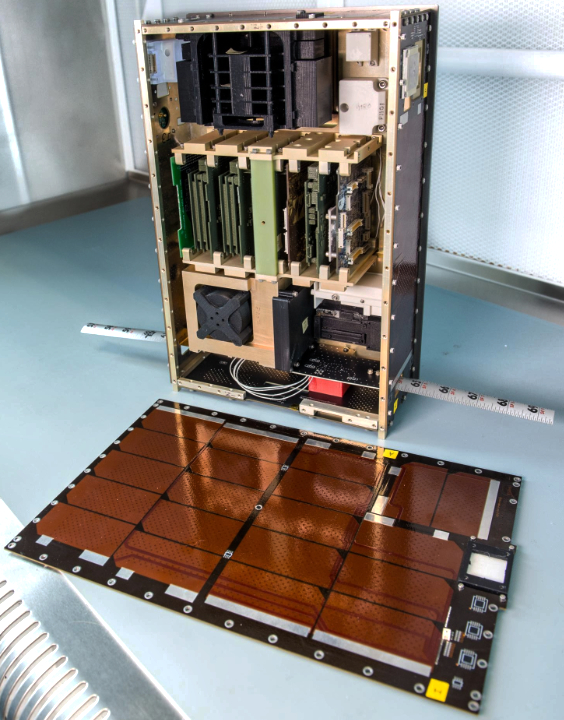
Delivered in less than 15 months by prime contractor Millennium Space Systems, a Boeing company, Tetra-1 is an experimental satellite designed for a variety of prototype missions in and around geostationary orbit, or GEO. The launch marks a new era for the Space Force, as it focuses on building and fielding new capabilities faster than in the past.

“The threat to our space systems is real. Speed is critical in developing advanced capabilities to stay ahead and, if necessary, defeat the threat.” said Col Joseph J. Roth, Innovation and Prototyping senior materiel leader for the U.S. Space Force Space Systems Command. “Tetra-1 is a great example of how a small company, and an innovative contracting approach, authorized by Congress, came together, and delivered an advanced satellite in record time.”

The small sat, about the size of a large dorm-room refrigerator, will help Space Force operators develop tactics, techniques, and procedures for Department of Defense missions.

Tetra-1 was the pacesetting first prototype awarded under Space Systems Command’s other transaction authority, or OTA, called the Space Enterprise Consortium (SpEC), that seeks to speed up procurements and diversify industry partnerships.

Building Smarter

To move fast on development and production of Tetra-1, Millennium Space Systems pulled its expertise from a variety of programs, including the GEO ALTAIR Pathfinder satellite that launched in 2017.

“It is important for SSC to deliver capabilities on time and within budget,” said Roth. “It is also important for the commercial space sector to continue to innovate and help drive down costs.”

“We’re known for delivering systems fast,” said Jason Kim, chief executive officer of Millennium Space Systems. “Our innovation is enabled by the fact that we build 80 percent of our components in-house. That lets us design, build and deliver a completely new satellite in a very short timeline.”

Such is the kind of innovation that Space Systems Command is looking for in procuring new capabilities, like Tetra-1 – working with partners that can take advantage of commercial best practices and existing satellite production. Photo Courtesy of Millennium Space Systems.

Small Sats, Layered Architecture

The Defense Department’s embrace of Tetra and other small satellites is being driven by the need to introduce resilient satellite systems and architectures to counter the Great Power competition. That’s because large, costly, exquisite satellite systems such as the Space Based Infrared System (SBIRS) — the fifth one was launched in mid-2021 and cost about $1 billion — are increasingly vulnerable to outright attack, which is a capability Russia demonstrated in November when it destroyed one of its own satellites with an anti-satellite missile.

“What we’re seeing is that some of the high-value asset missions that we’ve traditionally done in the past are being envisioned for large constellations of small satellites instead,” said Kim. “There are some benefits to the large constellations of small satellites in that the unit price point of each small satellite has gone down over the years. That lends itself to more affordability. And we’re now building these small satellites much faster and more efficiently, providing schedule savings.”

Use of small sats in a layered architecture spread across low-Earth orbit, medium-Earth orbit, and GEO will let the DoD quickly reconstitute capabilities should certain satellites become inoperative. For instance, loss of one SBIRS satellite in its five-satellite constellation could leave a major gap in missile-warning coverage. Conversely, loss of a few satellites in a larger constellation of dozens of satellites will only incrementally degrade capabilities and can be replaced in a faster fashion.

“Distributing the space architecture will help us build resiliency over time so that there’s not a single point of failure anywhere,” explained Roth. “We’re focused on making our systems and architectures more resilient and robust so if something happens, the Space Force can still perform the mission without fail.”

Filed Under: Featured, News

  • « Go to Previous Page
  • Page 1
  • Interim pages omitted …
  • Page 29
  • Page 30
  • Page 31
  • Page 32
  • Page 33
  • Interim pages omitted …
  • Page 60
  • Go to Next Page »

Primary Sidebar

WEEKLY NEWSLETTER

Archives

  • June 2026
  • May 2026
  • April 2026
  • March 2026
  • February 2026
  • January 2026
  • December 2025
  • November 2025
  • October 2025
  • September 2025
  • August 2025
  • July 2025
  • June 2025
  • May 2025
  • April 2025
  • March 2025
  • February 2025
  • January 2025
  • December 2024
  • November 2024
  • October 2024
  • September 2024
  • August 2024
  • July 2024
  • June 2024
  • May 2024
  • April 2024
  • March 2024
  • February 2024
  • January 2024
  • December 2023
  • November 2023
  • October 2023
  • September 2023
  • August 2023
  • July 2023
  • June 2023
  • May 2023
  • April 2023
  • March 2023
  • February 2023
  • January 2023
  • December 2022
  • November 2022
  • October 2022
  • September 2022
  • August 2022
  • July 2022
  • June 2022
  • May 2022
  • April 2022
  • March 2022
  • February 2022
  • January 2022
  • December 2021
  • November 2021
  • October 2021
  • September 2021
  • August 2021
  • July 2021
  • June 2021
  • May 2021
  • April 2021
  • March 2021
  • February 2021
  • January 2021
  • December 2020
  • November 2020
  • October 2020
  • September 2020
  • August 2020
  • July 2020
  • June 2020
  • May 2020
  • April 2020
  • March 2020
  • February 2020
  • January 2020
  • December 2019
  • November 2019
  • October 2019

© 2019–2026 SatNews

Insert/edit link

Enter the destination URL

Or link to existing content

    No search term specified. Showing recent items. Search or use up and down arrow keys to select an item.
      x
      Sign Up Now!

      Enjoy a free weekly newsletter with recent headlines from the global SmallSat industry.

      Invalid email address
      We promise not to spam you. You can unsubscribe at any time.
      Thanks for subscribing! You will now receive weekly SmallSat News updates.
      We love our advertisers.
      And you will too!

      Please disable Ad Blocker to continue... We promise to keep it unobtrusive.
      We promise not to spam you. You can unsubscribe at any time.
      Invalid email address
      Thanks for subscribing!