• Skip to main content
  • Skip to primary sidebar
  • Home
  • News
  • Featured
  • More News ⌄
    • SatNews
    • SatMagazine
    • MilSatMagazine
  • Events ⌄
    • MilSat Symposium
    • SmallSat Symposium
    • Satellite Innovation
  • Contacts
  • SUBSCRIPTION

SmallSat News

You are here: Home / Archives for Featured

Featured

China Launches Remote Sensing Satellite Via A Kuaizhou-1A Carrier Rocket

October 28, 2021 by editorial

A Kuaizhou-1A carrier rocket carrying the Jilin-1 Gaofen 02F satellite blasts off from the Jiuquan Satellite Launch Center in Northwest China’s Gansu province, Oct 27, 2021. Photo is courtesy of Xinhua.

On Wednesday, October 27, 2021, China successfully launched an optical remote sensing satellite from a low-cost small, solid-fuel carrier rocket named Kuaizhou-1A (KZ-1A).

The satellite was launched from the Jiuquan Satellite Launch Center in the northwestern Gansu Province, according to the state-run Xinhua news agency.

The Jilin-1 Gaofen 02F satellite was launched by a Kuaizhou-1A (KZ-1A) carrier rocket at 2:19 p.m. (Beijing Time) and entered the planned orbit. This is an optical remote sensing satellite that can provide high-resolution images and high-speed data transmission.

The Jilin-1 Gaofen 02F satellite.

Kuaizhou-1A, Chinese for ‘fast ship‘, is a low-cost, small, solid-fuel carrier rocket requires only a short preparation period. Developed by the China Aerospace Science and Industry Corporation, the rocket is designed to launch smallsats weighing under 300 kg, the report said.

China’s Kuaizhou-1A rocket.

Since the first commercial mission in 2017, KZ-1A rockets have sent 21 satellites into space.

Filed Under: Featured, News

Analytical Space To Become Hedron + Raises Million$$ In Series A Equity Funding

October 26, 2021 by editorial

Analytical Space (the “Company”) has closed a $17.8 million Series A equity funding round, enabling the firm to accelerate the development of the initial operating capability of the world’s first hybrid optical/RF data relay network.

In addition, the Company is officially rebranding to Hedron, effective immediately. Hedron represents a shortening of the polyhedron shape, a reference to the Company’s network topology and core optical communications technology design.

The round was led by Fine Structure Venture, joined by Lockheed Martin Ventures, Republic Labs, Lime Street, and Explorer 1 as well as existing investors: The Engine, Flybridge, Yard Ventures, NKM Capital, and Space Angels. These funds enable Hedron to expand its U.S. operations to support the company’s growing pipeline of government and commercial business.

The initial Network Operating Demonstration, scheduled to begin deployment in 2022, will serve as an operational service demonstration for Hedron’s resilient, low-latency connectivity service for satellites. Hedron will launch a series of data-relay backbone nodes, configured in multiple orbital planes, to provide near-constant connectivity to customer satellites, helping to deliver actionable insights about the Earth’s surface. The network will assist disaster response efforts, intelligence gathering, commercial applications, and climate monitoring. In addition, the network provides a capability to increase scientific return on NASA space missions as it is well-suited for supporting the future commercial architecture that is currently being created to replace the Tracking Data Relay Satellite System (TDRSS), which NASA plans to retire by the end of the decade.

Over the past three years, Hedron has successfully integrated and launched two technical demonstration satellites and proven out critical networking technologies that will enable customer connection to the network. In parallel with these efforts, Hedron has successfully demonstrated compatibility in a laboratory setting with leading remote sensing satellite operators in preparation for this initial network deployment.

Following the completion of this funding round and rebrand, Hedron will build upon these technical accomplishments by deploying additional orbital planes of data relay satellites, to provide broader network coverage for critical earth observation assets. These deployments will enable Hedron to rapidly scale the availability of data relay services for key government and commercial partners.

Fine Structure Ventures’ Senior Managing Director, Jennifer Uhrig, said, “We are excited to join Hedron as it strives to build a next-generation data network in space. The demand for satellite-generated data is growing rapidly and Hedron’s vision and technology will address the need to reduce latency and cost. We believe Hedron’s network has the potential to be a key driver of richer business and consumer applications here on Earth.”

“The availability of real-time space data will advance the art of the possible for customers and industry partners,” said Chris Moran, Vice President and General Manager of Lockheed Martin Ventures. “We invest in companies whose innovative technologies have the potential to benefit our core business and customers and Hedron’s planned data relay network which has the ability to provide critical insights to users meets this criteria.”

“It is an honor to be working with financing partners who have a track record of backing world-changing companies and we look forward to exploring potential commercial opportunities with them,” said Dan Nevius, CEO, and co-founder of Hedron. “Since our founding, our goal at Hedron has been to provide low latency access to space-borne data, paving the way for new sensor technologies and time-sensitive applications. Today, we are one step closer to reaching this goal. These additional resources will allow us to move even faster toward the deployment of our global data relay network, starting with our Network Operating Demonstration that will prove our novel network architecture and underlying technology while showcasing new applications with our remote sensing satellite operator and end-user partners.”

Hedron (formerly Analytical Space) is an on-orbit communications company on a mission to provide a more dynamic communications infrastructure that provides real-time access to the critical information that is collected on space platforms. The real-time connectivity enabled by the Hedron network creates a rapid commanding and data downlink capability that allows for data to be used for time-sensitive tactical applications (e.g., wildfires, disaster response, national security, etc.). Enabling this type of active intelligence provides a significant new tool in the world’s ability to understand and address major global challenges.

Filed Under: Featured, News

Forrester’s Digest: SES-17 Launch Delayed / EUTELSAT + UHD Importance / Intelsat’s Bankruptcy Exit Plan Hearing Delayed

October 23, 2021 by editorial

The launch of SES-17 has been delayed. Arianespace stated that investigations are ongoing in order to identify a new launch date from the Kourou spaceport.

The Ariane 5 launch vehicle and spacecraft SES-17 and fellow passenger SYRACUSE 4A are in stable and safe conditions on the launch pad, according to Arianespace. SYRACUSE-4A is a military satellite for the French defence ministry. Arianespace said that the flight, when it is rescheduled, will break previous records in terms of highest height, largest cumulative mass and heaviest payload ever carried on Ariane 5 missions.

The launch was due to take place at the Guiana Space Centre on the night of 22nd October (local time). Both satellites were built by Thales Alenia Space.

Eutelsat, in the company’s latest blog written prior to the announced departure of Rodolphe Belmer, stated that Ultra-high Definition (UHD) provides many advantages for content-makers and broadcasters and is important to the satellite industry.

One extremely important benefit in the need for UHD is in viewer retention, stated the blog. “While SDTV used to be the primary home entertainment, that quickly changed when HDTV hit the market. By 2016, only 37 per cent of US households were still watching in SD, which caused advertisers to reconsider their broadcasting choices.”

“Today,” said Eutelsat, “we’re beginning to see the same trend. According to Statista, HD TVs have been steadily losing global market share to UHD TVs since 2017. While high-resolution TV sets (4K or higher) held a 45.5 per cent market share in 2018, they accounted for over half of all TV sales worldwide in 2019. Indeed, in a recent study by Gfk, UHD TVs accounted for 75% per cent of the overall TV market in Germany.”

Broadcasters who do not want to lose viewers and protect their retention rate should seriously consider adopting UHD sooner, rather than later. This will help them avoid becoming irrelevant in much the same way as the switch from SD to HD, adds Eutelsat.

“According to a recent webinar with IABM & Christiano Benzi, UHD sets are well deployed in the market – but are not yet popular among broadcasters. Despite almost 50 per cent of TV sets in Europe and over 50 per cent in the US being UHD compatible, most channels are still broadcast in SD and HD formats. There is a clear reluctance on behalf of most broadcasters who see the investment to be too costly. However, this is sure to change – as more sets become enabled, consumer demand for quality rises. As observed with HD vs SD viewing, viewers naturally gravitate towards better quality and soon avoid other channels that cannot match their standards,” writes Eutelsat.

Indeed, Eutelsat is firmly of the view that UHD viewing as the standard is simply a matter of time.

“As most broadcasters are avoiding UHD, becoming an early adopter is an excellent opportunity for broadcasters seeking a key differentiator for their channels. This will make them more appealing to viewers and advertisers alike,” suggested Eutelsat, and continued, “As far back as 2012, advertisers have begun a mass exodus from lower-quality broadcasting. Advertisers in North America are already advertising on HD channels more than SD. The same is expected to happen with UHD. Eutelsat research has shown that early adoption of HD in developing markets has directly led to an increase in revenue for broadcasters who invest in them. The early migration in developing markets towards HD increased viewership, making broadcasters who invest in HD more attractive to advertisers.

“It’s no secret that quality attracts viewers and advertisers alike. In fact, better quality has been associated with an 18% higher retention rate, with higher quality channel advertising also outperforming the same adverts on lower-quality channels. This likely indicates that advertisers will eventually migrate to UHD for greater returns than stay on HD channels. Similar to how advertisers abandoned SD for HD. UHD is an opportunity for broadcasters to get ahead of the curve and become early adopters,” added the Eutelsat blog.

An Omnibus hearing on October 20th at the Intelsat bankruptcy court, under judge Keith Phillips, which itself had to postpone adjudicating on many of the matters scheduled to be heard, was told by the judge that Intelsat’s planned confirmation of its exit plan would likely have to be delayed.

Bankruptcy Judge Keith Phillips in Richmond, Virginia, said during a virtual hearing on Wednesday that he has “serious concerns about whether this can be accomplished in four days,” implying that the extensive evidence and testimony flowing around the case might take considerably longer that four days in front of the court.

The immediate suggestion from lawyers for Intelsat and other interested parties said they would discuss the judge’s suggested postponement of the hearing from the current November 8th start date to December 2nd. Intelsat needs approval of the plan, which is a key stage to the satellite operator wrapping up its bankruptcy, which has been ongoing since May 2020. Intelsat is looking to reduce its debt-burden of more than $15 billion to nearer $7 billion.

Filed Under: Featured, News

Rocket Lab’s Upcoming Launch Of BlackSky Constellation Smallsats To Also Attempt 1st Stage Electron Rocket Ocean Recovery

October 20, 2021 by editorial

Rocket Lab USA, Inc. will attempt a controlled, ocean splashdown and recovery of the first stage of an Electron rocket during the company’s next launch in November.

The mission will be Rocket Lab’s third ocean recovery of an Electron stage; however, it will be the first time a helicopter will be stationed in the recovery zone around 200 nautical miles offshore to track and visually observe a descending stage in preparation for future aerial capture attempts. The helicopter will not attempt a mid-air capture for this mission but will test communications and tracking to refine the concept of operations (CONOPS) for future Electron aerial capture.

The ‘Love At First Insight’ mission is scheduled to lift-off from Launch Complex 1 in New Zealand during a 14-day launch window that opens on November 11, 2021, UTC. The mission’s primary objective is to deploy two Earth Observation (EO) satellites for global monitoring company BlackSky, with the secondary objective to splash down and recover Electron’s first stage to further validate Rocket Lab’s recovery operations and hardware.

Rocket Lab will be tracking the stage’s descent from space and as it approaches 19,000 ft (5.7 km) from the ocean surface, a helicopter will be dispatched to conduct reconnaissance of the returning booster. The ‘Love At First Insight’ mission will also include new recovery hardware developments to Electron including an advanced parachute to be deployed from the first stage at a higher-altitude, allowing for a slower drift back to Earth to test communications and tracking for future aerial recovery.

Electron also features improvements to the first stage heat shield which protects the rocket’s nine Rutherford engines while they endure up to 2200 °C heat and incredible pressure on the descent back to Earth. A team of Rocket Lab engineers and technicians will again be stationed at sea with their purpose-built Ocean Recovery and Capture Apparatus (ORCA) to retrieve the stage from the ocean and return it to Rocket Lab’s production complex in New Zealand for analysis and inspection.

The rocket engine, named Rutherford after the famous New Zealand scientist Ernest Rutherford, is a Lox/Kerosene regenerative cooled pump fed engine that is intended to be the future workhorse for Rocket Lab orbital launcher program. Rutherford test firing photo is courtesy of the company.

“As one of only two companies to recover an orbital-class booster from space, we’ve proven it’s possible to make Electron the world’s first orbital-class reusable small launch vehicle,” said Peter Beck, Rocket Lab founder and CEO. “We’ve perfected Electron’s controlled descent, demonstrated flawless parachute deployment, and successfully plucked stages from the ocean. Now we’re gearing up for the next stage – preparing to use a helicopter to catch a rocket as it descends to Earth from space. It’s ambitious, but with each recovery mission we’ve iterated and refined the hardware and processes to make the impossible ordinary. I’m excited to take what we learn from this launch and put it into practice with aerial capture missions in future.”

The ‘Love At First Insight’ mission follows two previous ocean splashdown recovery missions; the ‘Return to Sender’ mission in November 2020, and the ‘Running Out of Toes’ mission in May 2021. A live stream of the launch and real-time updates of recovery operations for ‘Love At First Insight’ will be available on Rocket Lab’s social media channels and website.

Approximately two and a half minutes after lift-off, the nine Rutherford engines on Electron’s first stage will shut down and Electron’s first and second stages will separate. Electron’s second stage will continue with the customer’s payload to space, where the Kick Stage will separate and deploy the satellites. Following stage separation, Electron’s first stage will begin its descent. A cold-gas reaction control system will position the stage on an ideal angle to re-enter the atmosphere.

While descending, Electron’s first stage is expected to experience intense heat and pressure while traveling up to eight times the speed of sound before significantly decelerating to enable a drogue parachute to be deployed. At approximately seven and a half minutes into the mission, Electron’s drogue parachute will be deployed at around 43,000 ft (13 km) altitude. This drogue parachute both increases the booster’s drag and stabilizes its descent as it approaches the ocean.

Earlier and higher than on previous flights, the large main parachute will be deployed less than a minute after the drogue, at an altitude of 19,000 ft (5.7 km) to further slow the stage and enable a controlled splashdown. A key objective of this mission is to increase the drift-time of Electron’s first stage to test communications and tracking for future aerial recovery efforts.

Upon receiving the all-clear from the recovery team stationed at sea, a nearby helicopter will be deployed to sight the returning stage and observe its descent to record data that will help refine Electron aerial capture CONOPS. Once in the ocean, Rocket Lab engineers will attempt to retrieve the stage onboard their vessel with their purpose-built Ocean Recovery and Capture Apparatus (ORCA), a specialised cradle and winch system manufactured to Electron specifications and dimensions, before transporting the stage back to Rocket Lab’s production complex for analysis and inspection.

The ‘Love At First Insight’ mission is the latest in a multi-launch agreement signed earlier this year for BlackSky between Rocket Lab and Spaceflight Inc., which is providing integration and mission management services for BlackSky. This mission will deploy the eighth and ninth satellites of BlackSky’s planned constellation as part of that rapid-launch agreement, with another four Gen-2 smallsats across the two additional Electron dedicated missions to follow.

Filed Under: Featured, News

Fly Your Satellite! ESA’s Call for CubeSat Proposals Now Open To Uni Students

October 18, 2021 by editorial

University students can now get ready to fly their satellite by applying to the European Space Agency now.

The European Space Agency (ESA) is encouraging CubeSat student teams, who are working on one, two or three-unit CubeSats with educational scope, to apply for the fourth edition of the Fly Your Satellite! program.

This opportunity is open to University teams, composed of bachelor, master and PhD students from eligible states, who are close to integrating their satellite*.

Selected teams will have the unique opportunity of turning their spacecraft system into an operating CubeSat launched to space by receiving direct professional support from ESA, dedicated training sessions, and access to dedicated state-of-the-art facilities.

The ESA encourages students to join the list of other Fly Your Satellite! teams who have had the chance to learn from their participation in this unique hands-on spacecraft program and apply working methods from professional space programs to your own space project.

*Note: New opportunities are expected to open in spring 2022 for CubeSat student teams who would like to benefit from the support in the consolidation of their design, or to get access to the CubeSat Support Facility.

Proposal Submission Deadline: February 6, 2022, 23:59 CET

A shortlist of teams will be invited to the Selection Workshop expected to take place in March 2022, at ESA-ESTEC in Noordwijk, the Netherlands.

Filed Under: Featured, News

Arianespace’s Successful Soyuz Launch Ensures OneWeb’s Constellation Is Halfway To The Firm’s Constellation Deployment Goal

October 14, 2021 by editorial

Arianespace’s tenth launch of 2021 with the seventh Soyuz rocket launched this year will place the OneWeb satellite passengers into LEO — the launcher will be carrying a total payload of approximately 5,797 kg. The launch was performed at Vostochny, in Russia.

Flight ST36, the sixth commercial mission from Vostochny in Russia, placed 36 OneWeb satellites into orbit. That brings the total fleet number to 358 satellites in a near-polar orbit at an altitude of 450 kilometers. After separation, the satellites raised themselves to their operational orbit.

“Congratulations to all the teams who made this eleventh launch dedicated to OneWeb’s satellites a success,” said Stéphane Israël, CEO of Arianespace. “ST36 marks a new milestone in our common history. Precisely one hour and eighteen minutes after liftoff, during the first separation sequence, we officially crossed the halfway mark for OneWeb’s constellation deployment. By the end of 2022, we will proudly operate eight more Soyuz launches in order to complete full the deployment of the constellation.”

OneWeb’s mission is to deliver internet everywhere to everyone through the creation of a global connectivity platform via a next generation satellite constellation in LEO. OneWeb’s constellation of 648 satellites will deliver high-speed, low-latency enterprise grade connectivity services to a wide range of customer sectors including enterprise, government, maritime and aviation customers. Central to its purpose, OneWeb seeks to bring connectivity to every unconnected area where fiber cannot reach and, in so doing, bridge the digital divide.

The satellite prime contractor is OneWeb Satellites, a joint venture of OneWeb and Airbus Defence and Space. The satellites were produced in Florida, USA, in the company’s satellite manufacturing facilities that can build as many as two satellites per day on a series production line that is dedicated to spacecraft assembly, integration and testing.

This launch was operated by Arianespace and the firm’s Euro-Russian affiliate, Starsem, under contract with Glavkosmos, a subsidiary of Roscosmos, the Russian space agency. Arianespace is responsible for the overall mission and flight-worthiness, with the support of Starsem for launch campaign activities including management of their own launch facilities at the Baikonur Cosmodrome.

RKTs-Progress (the Samara Space Center) is responsible for the design, development, manufacture and integration of the Soyuz launch vehicle as well as for the 3-stage Soyuz flight. NPO Lavotchkin is responsible for the launch preparation operations and flight of the Fregat orbital vehicle.

Once deployed, the OneWeb constellation will enable user terminals that are capable of offering 3G, LTE, 5G and Wi-Fi coverage, providing high-speed access globally & by air, sea and land.

As OneWeb’s constellation will ultimately consist of 648 satellites — this launch hits the mark of more than half of the constellation being on-orbit. The 324th satellite, deployed during the first separation, marked this milestone.

Filed Under: Featured, News

Rocket Lab Acquires Advanced Solutions, Inc

October 12, 2021 by editorial

Rocket Lab USA, Inc. (Nasdaq: RKLB) (“Rocket Lab” or “the Company”) has completed their acquisition of Advanced Solutions, Inc. (ASI), a Colorado-based aerospace engineering firm delivering mission proven space software, mission simulation and test systems, and Guidance, Navigation, and Control (GNC) solutions, for $40 million, plus the potential for an additional $5.5 million performance earnout based on CY 2021 results.

ASI’s advances in flight software, mission simulation and GNC significantly strengthen Rocket Lab’s Space Systems portfolio, which encompasses the Photon spacecraft line and a growing suite of spacecraft hardware solutions, including those brought to the portfolio through the acquisition of Sinclair Interplanetary in April 2020.

ASI’s team of almost 60 people will continue to be led by John Cuseo in Colorado, enabling Rocket Lab to grow its presence within the nation’s second-largest aerospace economy and home to cutting-edge space programs, military commands and renowned research laboratories and universities. The ASI team will continue to serve its existing customer base, while leveraging the ability to scale by tapping into Rocket Lab’s resources, team, and technology.

Founded in 1995, ASI has developed an industry-leading suite of software and technology solutions for reliable space mission design and operation. It’s off-the-shelf spacecraft flight software, MAX, has been operating across more than 45 spacecraft for a cumulative 135 years in space. ASI’s customers include leading aerospace prime contractors, the U.S. Air Force, U.S. DOD organizations, NASA, and commercial spacecraft developers including several of the exciting new space start-ups.

The ASI team have supported some of the most ambitious Earth, interplanetary, and human spaceflight missions flown. These missions have explored distant planets, connected people on Earth, and pushed the boundaries of what is possible in space. Now, ASI’s engineers and space software products are enabling a wide variety of missions with speed, capability, and reliability.

“Both Rocket Lab and ASI have built leading space businesses with mission proven technology and have a shared vision of making it easier to get to space and do incredible things there, so we’re excited to welcome ASI aboard to further enhance our space systems portfolio and deliver enhanced end-to-end space solutions,” said Peter Beck, Rocket Lab Founder and Chief Executive Officer. “The ASI team revolutionized flight software and have enabled some of the most significant space exploration missions. For more than 20 years they have been delivering industry-first, off-the-shelf spacecraft flight software products that enable cost-effective and highly capable constellation and interplanetary missions. By joining forces, we believe it will have a transformative effect on the way spacecraft are designed, built, tested, launched, and operated, further unlocking space’s potential.”

“We’ve found a great fit with Rocket Lab and we’re thrilled to be teaming up with them to continue making space faster, easier and more affordable,” said John Cuseo, ASI Founder and Chief Executive Officer. “The two companies complement each other very well. By coming together, we will continue to serve our customers and innovate in our areas of expertise, including space software and GNC, but now with more rocket fuel in the tank to play with. We look forward to also becoming an integral part of Rocket Lab’s Space Systems business, supporting Photon missions, satellite components, and space and ground software.”

Filed Under: Featured, News

Arianespace To Launch Next Series Of OneWeb Satellites From Vostochny

October 11, 2021 by editorial

Arianespace’s Flight ST35 Soyuz launch. Photo is courtesy of the company.

Flight ST36, performed by Arianespace and its Starsem affiliate from the Vostochny Cosmodrome on October 14, 2021, at 6:40 p.m. local time (09:40 a.m. UTC), will put 36 of OneWeb’s satellites into a near-polar orbit at an altitude of 450 kilometers.

The mission will have a total duration of 3 hours and 51 minutes and will include nine separations of four satellites each, which will raise themselves to their operational orbit.

This 61st launch of Soyuz operated by Arianespace, the 11th for OneWeb, will raise to 358 the number of satellites deployed for the global telecommunications operator. The constellation, once complete, will include 648 satellites. Thus, ST36 will be the launch taking OneWeb more than halfway to the finish line, with 358 of its satellites being on-orbit.

OneWeb’s constellation is designed to deliver high-speed, low-latency connectivity services to a wide range of customer sectors, including aviation, maritime, backhaul services, as well as governments, emergency response services and more. Central to its purpose, OneWeb’s goal is to bring connectivity to every area on Earth where fiber cannot reach, and thereby bridge the digital divide.

Once deployed, the OneWeb constellation will enable user terminals that are capable of offering 3G, LTE, 5G and Wi-Fi coverage, providing high-speed access globally – by air, sea and land.

OneWeb Satellites, a joint venture between OneWeb and Airbus Defence and Space, is the constellation’s prime contractor. The satellites were built thanks to the company’s satellite manufacturing process that can build as many as two satellites a day on a series production line dedicated to the assembly, integration and testing of the satellites.

Filed Under: Featured, News

Launch Agreement Signed By EnduroSat With Exolaunch For 2022 Mission Via SpaceX

October 4, 2021 by editorial

EnduroSat and Exolaunch have signed a launch agreements for sending two EnduroSat smallsats into orbit aboard a SpaceX Falcon 9 launch vehicle. The 6U XL SharedSat smallsats, built by EnduroSat for customers, will be launched via Exolaunch in H1 2022 as part of SpaceX’s SmallSat Rideshare Program. 

The SharedSats are 6U XL smallsats with several multi-purpose payloads on a single bus.  By simplifying access to space services through shared missions for a range of commercial, exploration and science customers, EnduroSat aims to significantly lower the entry barrier of operations in orbit.

The two SharedSats are part of the commercial EnduroSat’s  Missions. They foresee integration, validation, and testing, launch and operations of the satellite and hosted payloads. Direct access to the payload data will be made available in the cloud through EnduroSat’s Digital Mission Control. The software-centric smallsat architecture allows for multiple payloads to operate together reliably on a single platform with access to on-demand processing, power and pointing capability.

Exolaunch will ensure comprehensive rideshare mission management, satellite integration and deployment services for both EnduroSat missions. The launches are arranged by Exolaunch under its Multi-Launch Agreement with SpaceX. The new launch agreements mark the expansion of EnduroSat’s Shared Satellite Service and pave the way to the continued cooperation between the companies on future launches.

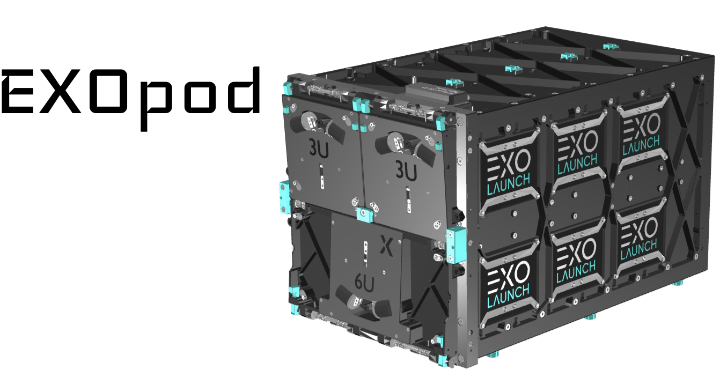
For both missions, Exolaunch will use their proprietary deployment  technologies — the EXOpod, a next-gen cubesat deployer with half a decade and 100+ of released satellites flight heritage, to deploy the EnduroSat’s satellites into their target SSO above 500 km, and the EXOport, a flexible, multi-satellite adapter designed to optimally accommodate several satellites on a single Falcon 9 port. 

Exolaunch’s EXOpod (l) and EXOport (r). Photos are courtesy of the company.

“We’re really pleased to have signed a launch agreement with Exolaunch, as it is another step in our mission to provide easy access to space. The Shared Satellite Service goal is to help drive innovation at the final frontier for visionary entrepreneurs, scientists, and technologists. At EnduroSat, we are eager to see the innovations that our customers will accomplish in space and are happy to support them every step of the way,” said EnduroSat’s Founder and CEO, Raycho Raychev.

“We’re proud to support EnduroSat with a variety of launch options and flexible mission management to address all their ongoing launch needs for the Shared Satellite Service program. Exolaunch has acquired outstanding flight heritage with Falcon 9 after signing a multi-launch agreement with SpaceX and is pleased to become a trusted launch partner for EnduroSat,” said Jeanne Medvedeva, VP of Launch Services at Exolaunch. “It’s our common vision to make space accessible for everyone and we are honored to contribute to EnduroSat’s mission.”

F

Filed Under: Featured, News

HawkEye 360 Secures Contracts With The Potential Of Million$$ As Their Smallsats Become Fully Operational

September 30, 2021 by editorial

HawkEye 360 Inc. has secured new contracts totaling more than $50 million in potential value since the start of the year as the firm’s next generation satellites have become operational.

Artistic rendition of HawkEye 360’s Cluster 3 smallsats on-orbit. Image is courtesy of the company.

HawkEye 360 successfully launched three satellites (Cluster 2) in January, introduced the Mission Space platform for analysis of RF geospatial intelligence in February, and launched three more satellites (Cluster 3) in June. The next launch is planned no earlier than January 2022 and will carry six satellites (both Clusters 4 and 5) into orbit, simultaneously. The company has 15 additional satellites under production for launch to reach a total of 30 satellites on-orbit, with average global revisit around 30 minutes.

The company’s formation-flying satellites can detect, characterize as well as geolocate devices such as radars and push-to-talk radios, which improves visibility of human activity and patterns of life. This new data produces actionable insights for national defense and homeland security operations, maritime domain awareness, environmental protection and a growing number of commercial applications.

“HawkEye 360 is experiencing an exceptional year, with record growth in customer engagements and bookings,” said HawkEye 360 CEO John Serafini. “We’re building depth of customers across the United States, Americas, Europe, Middle East, and Asia, including transitioning from pilot programs into programs of record. We are rapidly launching satellites to have sufficient capacity to meet our rapidly growing backlog of customer demand. And our team has demonstrated resiliency even during the challenges posed by the coronavirus pandemic. The company has been doubling revenue each year and we expect this year to be no different.”

Filed Under: Featured, News

  • « Go to Previous Page
  • Page 1
  • Interim pages omitted …
  • Page 37
  • Page 38
  • Page 39
  • Page 40
  • Page 41
  • Interim pages omitted …
  • Page 59
  • Go to Next Page »

Primary Sidebar

WEEKLY NEWSLETTER

Archives

  • May 2026
  • April 2026
  • March 2026
  • February 2026
  • January 2026
  • December 2025
  • November 2025
  • October 2025
  • September 2025
  • August 2025
  • July 2025
  • June 2025
  • May 2025
  • April 2025
  • March 2025
  • February 2025
  • January 2025
  • December 2024
  • November 2024
  • October 2024
  • September 2024
  • August 2024
  • July 2024
  • June 2024
  • May 2024
  • April 2024
  • March 2024
  • February 2024
  • January 2024
  • December 2023
  • November 2023
  • October 2023
  • September 2023
  • August 2023
  • July 2023
  • June 2023
  • May 2023
  • April 2023
  • March 2023
  • February 2023
  • January 2023
  • December 2022
  • November 2022
  • October 2022
  • September 2022
  • August 2022
  • July 2022
  • June 2022
  • May 2022
  • April 2022
  • March 2022
  • February 2022
  • January 2022
  • December 2021
  • November 2021
  • October 2021
  • September 2021
  • August 2021
  • July 2021
  • June 2021
  • May 2021
  • April 2021
  • March 2021
  • February 2021
  • January 2021
  • December 2020
  • November 2020
  • October 2020
  • September 2020
  • August 2020
  • July 2020
  • June 2020
  • May 2020
  • April 2020
  • March 2020
  • February 2020
  • January 2020
  • December 2019
  • November 2019
  • October 2019

© 2019–2026 SatNews

Insert/edit link

Enter the destination URL

Or link to existing content

    No search term specified. Showing recent items. Search or use up and down arrow keys to select an item.
      x
      Sign Up Now!

      Enjoy a free weekly newsletter with recent headlines from the global SmallSat industry.

      Invalid email address
      We promise not to spam you. You can unsubscribe at any time.
      Thanks for subscribing! You will now receive weekly SmallSat News updates.
      We love our advertisers.
      And you will too!

      Please disable Ad Blocker to continue... We promise to keep it unobtrusive.
      We promise not to spam you. You can unsubscribe at any time.
      Invalid email address
      Thanks for subscribing!