• Skip to main content
  • Skip to primary sidebar
  • Home
  • News
  • Featured
  • More News ⌄
    • SatNews
    • SatMagazine
    • MilSatMagazine
  • Events ⌄
    • MilSat Symposium
    • SmallSat Symposium
    • Satellite Innovation
  • Contacts
  • SUBSCRIPTION

SmallSat News

You are here: Home / Archives for News

News

Rocket Lab’s launch window for the next Capella Space mission announced

September 11, 2023 by editorial

Photo of a previous Electron launch, courtesy of Rocket Lab.

Rocket Lab USA, Inc. (Nasdaq: RKLB) has scheduled the next Electron launch during a window that opens on September 19, 2023 NZST/UTC.

The ‘We Will Never Desert You’ mission is scheduled to launch from Rocket Lab Launch Complex 1 on New Zealand’s Mahia Peninsula for Capella Space, a provider of commercial Synthetic Aperture Radar (SAR) imagery.

‘We Will Never Desert You’ will launch the second of Capella’s 3Gen SAR Acadia satellites to LEO. This will be Rocket Lab’s third launch for Capella in 2023, and second launch in a multi-launch contract of four missions. Capella’s highest quality, high resolution SAR imagery penetrates all weather conditions and captures clear imagery 24/7, day and night, anywhere on Earth, delivered through a fully-automated ordering and delivery platform.

Capella’s existing SAR capabilities includes long-dwell imaging and extended duty-cycle – which results in more images collected per orbit than any other SAR systems. Acadia will augment Capella’s existing constellation with increased bandwidth and power, faster downlink speeds, and reduced latency

As Capella’s sole launch provider in 2023 to build out the company’s Earth-imaging constellation, Rocket Lab’s most recent launch, ‘We Love The Nightlife,’ successfully deployed Capella’s first Acadia satellite to space on August 24, 2023. An earlier mission for Capella this year, ‘Stronger Together,’ successfully delivered two satellites to space for the company from Rocket Lab Launch Complex 2 in Wallops, Virginia, in March 2023.

Electron’s precise payload deployment record and ability to meet wide-ranging mission requirements enables operators like Capella to increase their constellation’s orbital diversity while at the same time grow quickly to meet customer demand. Rocket Lab is also supplying its own separation systems for each Capella mission that further maintains the Company’s vertical integration strategy.

“As the only commercial U.S. small launch vehicle providing regular and reliable dedicated access to orbit, Electron provides a unique service to satellite operators like Capella. When you’re a dedicated launch customer you can fly where you want and when you want to, and launching these two missions back-to-back for Capella demonstrates the value that brings to commercial constellation operators.” — Peter Beck, Founder and Chief Executive Officer, Rocket Lab

Filed Under: News

Terran Orbital’s Responsive Space Initiative lifts off

September 10, 2023 by editorial

Terran Orbital (NYSE: LLAP) has launched their Responsive Space Initiative. Under this initiative, the company is committed to providing customers with satellite buses within just 30 days and complete satellite systems with integrated payloads within 60 days — there are seven new satellite buses that will be participating in this program.

Terran Orbital’s advanced production capabilities through the implementation of automation and robotics find the firm standardizing common components that can be stocked and are interchangeable, depending on the bus configuration. The company proudly designs and manufactures 85% of all modules and components that go into a bus today.

With the Responsive Space Initiative, Terran Orbital will be able to deliver smallsats that are flexible, of high-quality, and reliable to military, civil, and commercial customers at a faster and more cost-effective rate. Satellites for critical missions will be delivered in days instead of requiring years to complete. The company recently introduced a new product line that is comprised of seven buses that are ready for quick delivery and can be immediately added to the firm’s inventory.

Terran Orbital will be partnering with best-of-breed payload suppliers to stock a wide range of payloads. This will allow the fulfillment of any customer requirements, whether Electro-Optical Imaging, Synthetic Aperture Radar, Communications, Hyperspectral, or any other payload with global demand.

There are currently more than 30 conflict zones across the globe and the demand for Intelligence, Surveillance, and Reconnaissance (ISR) capabilities to monitor these zones is increasing far faster than satellite manufacturers can currently address. Terran Orbital’s goal is to meet this demand and improve the availability of ISR capabilities in critical regions.

Terran Orbital is also building a new facility in Irvine, California, dedicated to the Responsive Space Initiative. The facility is scheduled to be operational in the summer of 2024 and the program will be launched in the Q4 of the same year.

“We recently announced our seven new stocking buses, today we are announcing how fast we can build them. These are exciting times not only for Terran Orbital but the industry as a whole.” — Marc Bell, Co-founder, Chairman and CEO, Terran Orbital

Filed Under: News

USSF awards Viasat contract for Proliferated Low Earth Orbit satellite services

September 8, 2023 by editorial

Viasat, Inc. (NASDAQ: VSAT) has announced that Inmarsat Government, now part of Viasat, was awarded a Proliferated Low Earth Orbit (PLEO) Satellite-Based Services (SBS) contract by the U.S. Defense Information Systems Agency (DISA) on behalf of the U.S. Space Force’s (USSF) Space Systems Command (SSC) — Inmarsat Government is one of 16 companies selected for the $900 million ceiling, 10 year, Indefinite Delivery, Indefinite Quantity (IDIQ) contract.

As the United States and its mission partners become increasingly reliant on space-based capabilities for national security, it is critical to have resilient constellations that include satellites in GEO and NGSO. Proliferated LEO (pLEO) constellations are part of a Department of Defense (DoD) strategy to provide additional resilience for satellite communications (SATCOM), remote sensing and other capabilities by diversifying orbits.

Under this contract, Viasat plans to leverage smallsat technology, reduced costs and increased launch service competition, facilitating the ability for pLEO constellations to provide persistent, global coverage with reduced transmission latency. The company will provide a suite of fully-managed pLEO satellite-based services and capabilities, to include space relay services, supplemented by GEO and NGSO satellites, supporting all domains – space, air, land, maritime and cyber.

Viasat will aim to achieve this with a reliable, resilient low latency global pLEO offering that flexibly supports the needs of combatant commands, defense agencies, other federal government organizations and international coalition partners. It will provide a comprehensive managed end-to-end SATCOM solution via a multi-band, multi-orbit constellation of satellites. Furthermore, its new, hyper-intelligent software-defined wide area network (SD-WAN) is designed to orchestrate and provide priority routing across mixed networks, enabling an automated primary, alternate, contingency and emergency (PACE) solution to deliver the flexibility and responsiveness required to meet customers’ needs today and in the future.

“Viasat has a proud history of providing integrated SATCOM solutions and service offerings across multiple bands and orbits to support government customers’ unique needs. Our team is committed to developing innovative, mission-focused solutions through our existing partnerships with satellite operators and extending opportunities with new partners. We eagerly look forward to using both our technologies and deep problem solving expertise to deliver resilient, robust and secure SATCOM capabilities to service members around the world.” — Susan Miller, President, Viasat Government

Filed Under: Featured, News

Solstar Space awarded million$+ USSF / AFWERX / AFVENTURES Phase II SBIR contract

September 8, 2023 by editorial

The contract continues R&D for a flight-ready satellite data relay transceiver prototype which will provide a bi-directional and persistent commercial satellite data connection to space-based assets.

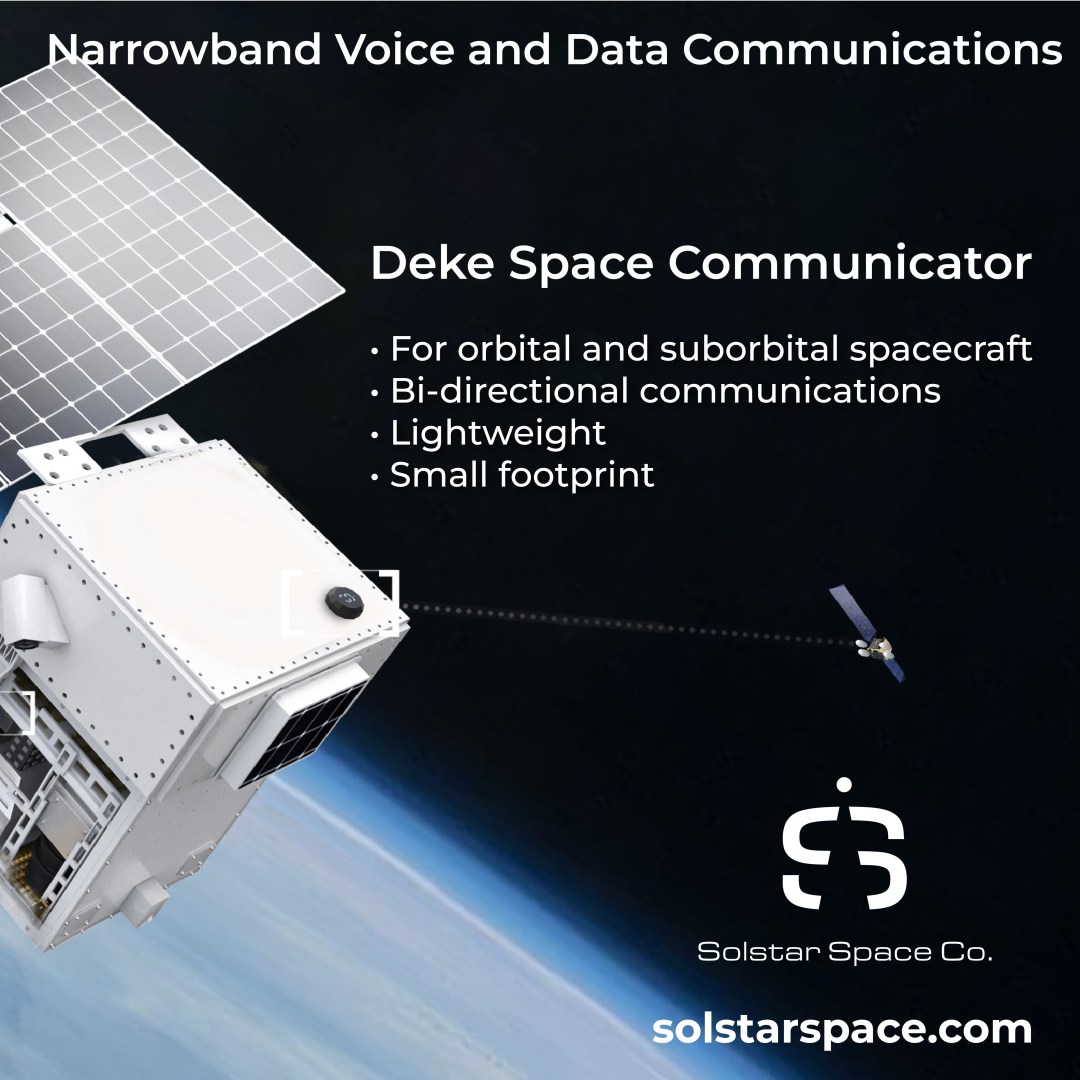
Solstar Space (Solstar) will continue the development of the company’s Critical Data Relay Spacecraft Operational Status (CritDR-SOS), also known as the Deke Space Communicator (Deke), under a Phase II Small Business Innovation Research (SBIR) contract valued at $1,249,269.

Solstar’s small form-factor Deke integrates with a spacecraft’s Telemetry, Tracking and Command (TT&C) system to provide bi-directional, continuous, internet-based, monitoring of the spacecraft’s bus, payload, and environment. It also allows for satellite connectivity with operators or end users using robust commercial communications paths which will help eliminate spacecraft situational awareness gaps.

“Monitoring an endlessly growing number of satellites including commercially owned and operated mega-constellations is a top priority for the U.S. Space Force. With Solstar’s Deke, the Department of Air Force (DAF) can connect space assets which makes the communications network more resilient. This effort has the extended benefit of aligning with the Federal Communications Commission (FCC) recent directive to have de-orbiting capability on-board all spacecraft which Deke facilitates. Deke enables narrowband communications for both uplink and downlink, decreasing the time it takes to download mission data or adjust on-orbit systems. It also enables 24/7 awareness of satellite health by combining the Solstar Deke along with New Mexico Tech’s Spacecraft Health Monitor.” — Brian Barnett, CEO, Solstar Space

“New Mexico Institute of Mining and Technology (NMT) is developing a Spacecraft Health Monitor (SHM) that will connect to the Deke to send and receive spacecraft data. This will provide detailed spacecraft operating data and provide proactive alerts so any faults can be addressed efficiently.” — Dr. Andrei Zagrai, Professor at New Mexico Tech.

Filed Under: News

Wyvern and Loft Orbital join forces to expand Dragonette satellite constellation

September 8, 2023 by editorial

Wyvem is teaming with Loft Orbital to expand the capacity of the Dragonette constellation.

Loft is unlocking the power of space for data collection with a deep understanding of how to develop, manage, launch, and operate the satellites that make up their infrastructure. This gives seamless access to on-orbit satellites that gather the hyperspectral data customers need.

Wyvern was founded because the company firmly believes in the power of hyperspectral data with its ability to reveal the hidden reality of Earth and drive positive change. When specific geochemical signatures can be identified, the ability to address planetary-scale problems is unlocked as well as a range of opportunities across industries. From mining and forestry to energy and climate change, hyperspectral data provides unparalleled visibility. That’s why the highest resolution hyperspectral imagery commercially available is offered from LEO.

Wyvem’s mission is set to fly on Loft’s 2Gen satellite platform, which consists of the Longbow bus, derived from the flight-proven OneWeb bus, and the Hub, a modular payload interface that allows for the turnkey accommodation of any customer mission. Wyvern will operate the mission using Cockpit, Loft’s mission operations software. With the ability to support 20-100x the downlink volume as a traditional cubesat, the expanded imaging capacity of Loft’s platform enables Wyvern to serve the growing demand for high-quality data.

Loft Orbit’s Cockpit.

Filed Under: News

Terran Orbital unveils new product line of seven satellite buses

September 7, 2023 by editorial

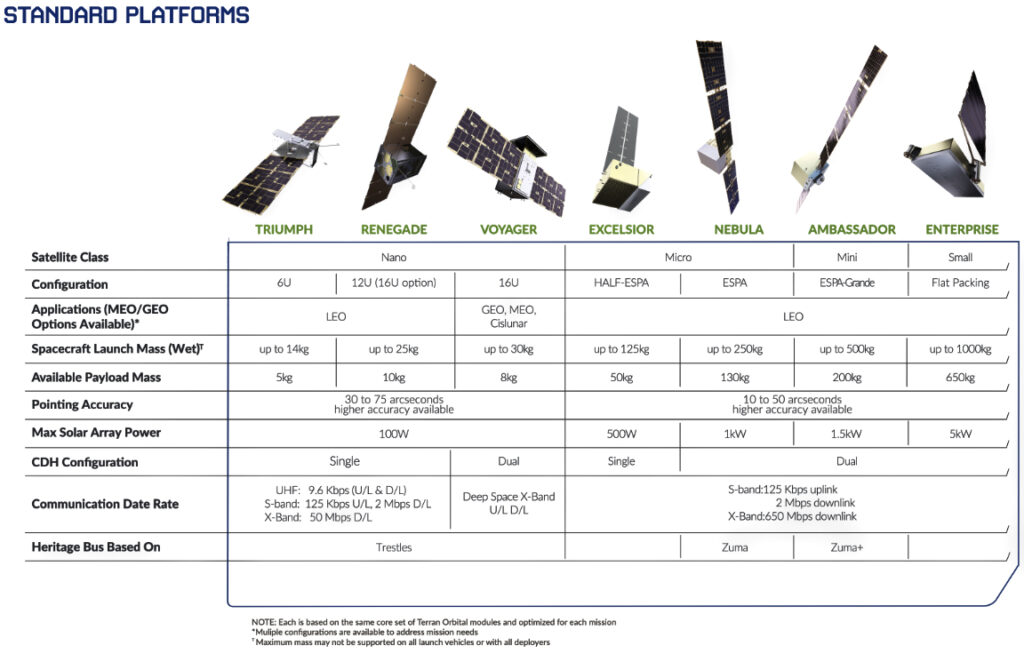
Terran Orbital (NYSE: LLAP) has rolled out a new lineup of seven, standard, satellite bus platforms.

More than a decade ago, Terran Orbital pioneered the creation of CubeSat standards — the firm is now establishing new benchmarks for satellite technology for the coming decade. These standards are built upon Terran Orbital’s manufacturing capabilities, featuring components and modules that can be readily swapped out to accommodate different bus sizes and configurations.

The seven bus platforms span the nano, micro, mini, and small classes. This new lineup of satellite configurations is derived from Terran Orbital’s long history of smallsats innovation and micro satellite bus designed and built for the U.S. Space Development Agency’s (SDA) recently launched Tranche 0 Transport Layer mission and the upcoming Tranche 1 mission. Terran Orbital’s full product line of seven, ITAR-compliant bus classes ranges from the largest, Enterprise, to the smallest, Triumph.

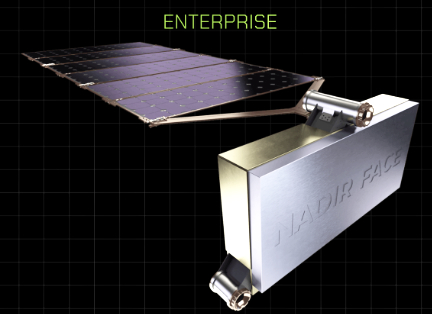
The Enterprise is specifically targeted to those customers who want a flat packing design to allow up to 24 vehicles per launch. It comes standard with Optical Inter Satellite Link and has a large, flat deck optimized for communications and RF payloads.

The Ambassador features the largest deck allowable by the ESPA-Grande standard for rideshare payloads. We expect it to be our top offering for the DoD/Intel community, allowing a large payload and optional
Type 1 encryption.

The Nebula is the commercialized version of the bus placed in orbit in last week’s SDA Transport Layer Tranche O launch in partnership with Lockheed Martin. It has an open deck plan to easily accommodate oddly shaped payloads with optional Type 1 encryption and can be configured for a 15 inch ESPA or 24 inch ESPA-Grande-capable launch vehicle.

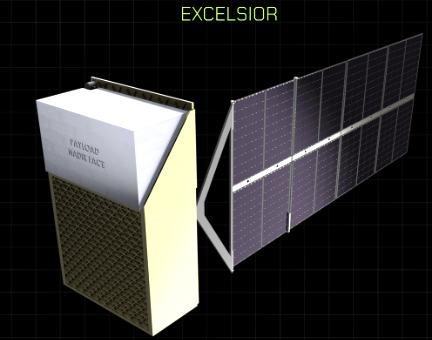
The Excelsior is the smallest microsatellite in the product line, having the advantage of delivering higher power to payload than any of the nano models while still having the budget-friendly ability to launch two per ESPA port.

The Voyager is built with component redundancy to reduce risk and extend its lifetime in harsh environments beyond LEO. It has both GEO and Cislunar heritage and the radios are designed for compatibility with NASA’s Deep Space network.

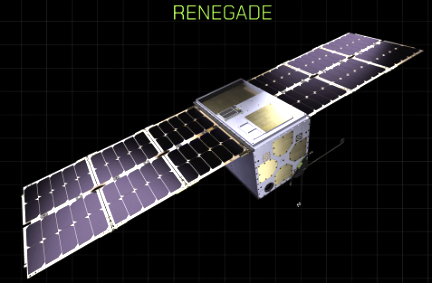
The Renegade is a smallsat that can be configured as 12U or 16U for exceptionally long payloads and can accommodate up to a 19 cm. diameter optical imager. It has the best payload volume-to-bus ratio of the platforms, making it an economical solution for larger, research missions.

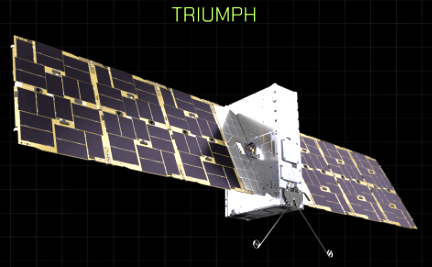
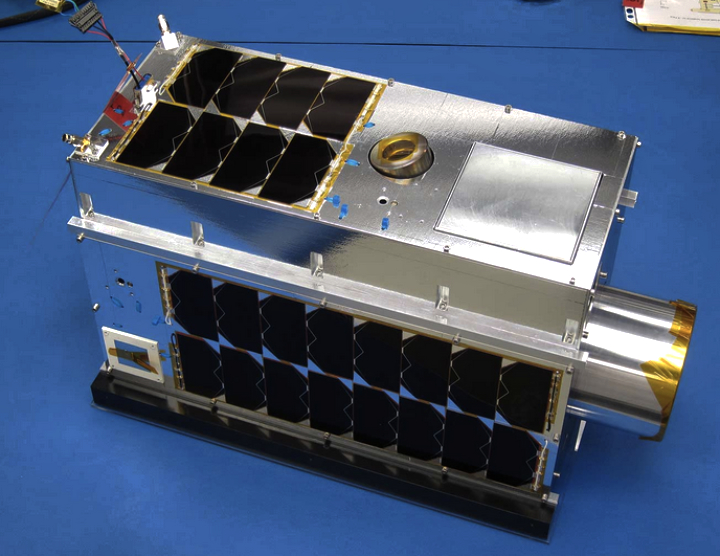
The Triumph is the smallest platform in the Terran Orbital standard bus lineup. It has unparalleled spacecraft agility, and with the most flight heritage of all platforms, it exemplifies the smaller, cheaper, faster mentality.

These reference platforms feature flexible architecture using common building blocks, allowing for wet launch masses of 14 to 1000 kg. They are based on designs with extensive flight heritage for various civil, defense, and commercial customers.

“With this announcement we are again setting the bar high with an industry leading product line. While we still offer fully custom platforms to meet unique specifications, we are creating new industry standards, and these standard platforms bring forth our vision to meet mission requirements at scale, drive down the cost of the satellite, and increase their functionality using standard components that roll up into configurations that quickly and effectively satisfy the needs of the DoD and research customer alike.” — Marc Bell, Co-Founder, Chairman and CEO, Terran Orbital

Filed Under: Featured, News

Space Flight Laboratory (SFL) performance milestone for GHGSat smallsats

September 7, 2023 by editorial

Space Flight Laboratory (SFL) has announced that the SFL-built GHGSat greenhouse gas monitoring smallsats have achieved sustained detection and measurement of methane emissions at double the design capacity of the satellites — under contract to GHGSat, SFL developed all nine, operational, 15 kilogram GHGSat spacecraft on the firm’s NEMO smallsat bus.

GHGSat’s constellation of greenhouse gas monitoring smallsats use advanced attitude control and stability technologies developed by Space Flight Laboratory (SFL)

In addition, the GHGSat-D demonstration satellite, CLAIRE, developed by SFL and launched in 2016, has exceeded operational design life by more than two years. The eight, commercial satellites, GHGSat-C1-C8, launched individually and in clusters since 2020, are in excellent health.

GHGSat’s CLAIRE smallsat, photo courtesy of SFL.

GHGSat detects and measures greenhouse gas emissions from industrial sources on the Earth’s surface from space. The Montreal company provides their monitoring services commercially to industries that include oil and gas, power generation, mining, waste management, and agriculture.

GHGSat selected SFL to develop the CLAIRE demo mission due in part to the company’s expertise in implementing advanced attitude control and stability technologies that enable smaller spacecraft to accurately point sensors at targets on the ground. With the demand of attitude and tracking performance that was rare in satellites of that size, this capability was crucial to GHGSat’s mission objectives.

Attitude control is just one of several technological factors contributing to the better-than-anticipated collection capacity of the GHGSat microsatellites, explained SFL director Dr. Zee. SFL incorporates robust design margins into every satellite, and these include the onboard power systems, data storage, and downlink capacities. These margins on-orbit translate into better operations and longer missions. 

SFL’s 25-year heritage includes 70 operational successes totaling 265 cumulative years in orbit, with an additional 26 satellites under development or awaiting launch. SFL offers a complete suite of nano-, micro- and small satellites – including high-performance, low-cost CubeSats – that satisfy the needs of a broad range of mission types from 3 to 500 kilograms. These missions relate to EO, atmospheric monitoring, ship tracking, communication, radio frequency (RF) geolocation, technology demonstration, space astronomy, solar physics, space plasma, and other scientific research.

“The SFL-built satellites have exceeded our expectations regarding technological performance. Each satellite is now making twice as many emission measurements per day as originally planned. This performance has enabled us to push our monitoring capability further, helping more clients better understand and reduce their emissions.” — Stephane Germain, President, GHGSat

“SFL is pleased to play an important role in GHGSat’s global success by developing its core company-owned satellite assets. At SFL, we take pride in building affordable small satellites that outperform – often exceeding operational specifications and outlasting their design lives.” — Dr. Robert E. Zee, Director, SFL

Filed Under: News

Firefly Aerospace awarded MLA with L3Harris

September 7, 2023 by editorial

Firefly’s Alpha vehicle will provide three dedicated launches in support of L3Harris’ Space Business. Photo is courtesy of the company.

Firefly Aerospace, Inc. has signed a multi-launch agreement (MLA) with L3Harris Technologies [NYSE:LHX] for three dedicated launches using Firefly’s Alpha vehicle in 2026.

This agreement further positions Firefly as a leader in small-lift launch services, as the company ramps up production of their Alpha vehicle to support the growing needs of government and commercial customers.

Firefly will provide rapid launch capabilities for L3Harris to achieve direct access to LEO at a lower cost and support the responsive space needs of the U.S. Government (USG). The three missions will launch from Firefly’s SLC-2 launch site at Vandenberg Space Force Base.

With the capability to launch more than 1,000 kg. to LEO, Firefly’s Alpha vehicle provides affordable, responsive, and reliable launch services for small satellites and spacecraft. Firefly is ramping up Alpha production at its rocket manufacturing and test site in Briggs, Texas, to support multiple government and commercial launches, while also doubling the size of its facilities to support the ongoing development of its medium launch vehicle that will first launch in 2025.

“Firefly is honored to support the ongoing mission needs of L3Harris as they continue to deliver satellite systems that advance our national security. Firefly’s team, facilities, and manufacturing capabilities are positioned to rapidly respond to industry demand for our small- and medium-lift launch services, ensuring mission success for each customer.” — Bill Weber, CEO, Firefly Aerospace

Filed Under: News

etherWhere partners with Xona Space Systems to develop low power PULSAR + GNSS receiver

September 6, 2023 by editorial

etherWhere has partnered with Xona Space Systems to develop a receiver capable of tracking Xona’s high-performance, multi-frequency PULSAR™ signals.

etherWhere’s PULSAR + dual-band GNSS receiver will be a one chip, low power solution that integrates all four GNSS constellations while receiving and processing the Xona PULSAR signal simultaneously. The single chip solution with single digit mW power consumption is intended to further enable IoT, asset tracking, mobile, precise timing, and secure geolocation applications.

etherWhere’s Hybrid Constellation solution, a mix of traditional GNSS receivers and LEO satellite receivers, integrated onto a single low power silicon, is the most comprehensive offering for applications requiring low power, redundancy, and security with anti-jamming and anti-spoofing technology.  etherWhere’s next generation small form factor GNSS products are adding support for Xona PULSAR signals.

Xona Space Systems is developing PULSAR, a nexgen position, navigation, and timing (PNT) service to address growing user demands for higher performance from satellite navigation technologies. PULSAR is provided by a constellation of small but powerful LEO satellites 20 times closer to Earth than existing GPS. This novel and patented architecture enables unprecedented benefits including enhanced multipath mitigation and higher accuracy, as well as stronger interference and spoofing protection. PULSAR can be easily integrated into a variety of solutions, including traditional GNSS receivers, to reduce customer engineering investment and enable quick time to market.

“We’re thrilled to work jointly with Xona Space Systems to provide unprecedented PNT performance to the end user with mass market user equipment. Integrating Xona PULSAR into our new products will empower users with PNT performance in the smallest form factor and lowest cost they’ve never witnessed before. There is tremendous value in what our PULSAR + dual-band GNSS receivers can achieve.” — Michael Raam, CEO, etherWhere CEO. “”

“We are thrilled to welcome etherWhere to the PULSAR ecosystem,” said . “etherWhere is on the cutting edge of developing high-performance PNT user equipment at very low power – Xona PULSAR will elevate the performance of their receivers to deliver even more value to their customers.” — Bryan Chan, Vice President of Business Development and Strategy, Xona

Filed Under: News

Umbra partners with EUSI to offer SAR Imagery to European remote sensing projects

September 6, 2023 by editorial

EUSI 30 cm. optical paired with Umbra 16 cm. SAR

Umbra has engaged in a strategic partnership with European Space Imaging (EUSI), a leading provider of Very High Resolution (VHR) optical satellite imagery — this partnership will allow customers to purchase Umbra’s industry-leading Synthetic Aperture Radar (SAR) data directly through EUSI.

This collaboration offers a significant benefit to remote sensing data users across Europe and North Africa, as they can now acquire the world’s highest resolution, space-based, optical and SAR imagery – 30 and 25 cm. resolutions, respectively – from a single, local source. EUSI now has the unique position on the market to coordinate SAR and optical tasking to guarantee acquisitions independently from the weather and ensure the continuity of monitoring requests.

Under the partnership agreement, EUSI will gain the ability to oversee global tasking and delivery of SAR imagery for its customers using Umbra’s advanced satellite constellation and tasking platform. Umbra currently operates six satellites, with plans to launch more throughout 2023 and 2024. Renowned for their agility, the satellites can efficiently collect data in various modes and deliver single and multi-look SAR imagery with resolutions ranging from an industry-leading unrivaled 16-cm resolution in the ground plane up to 1-m for wider-area monitoring.

The introduction of SAR products into EUSI’s portfolio will unlock a myriad of opportunities across diverse sectors, including emergency response, maritime and defense and intelligence. SAR imagery is particularly valuable in these areas due to its ability to capture imagery at night and penetrate clouds, enabling users to gather critical information even in adverse weather conditions. Umbra’s highest resolution commercially available SAR data, flexible tasking, competitive pricing, and straightforward licensing further enhance the appeal to EUSI’s customers.

“Through our partnership with Umbra, EUSI solidifies its commitment to providing our customers with the most advanced and comprehensive geospatial solutions available. The integration of SAR data into our offerings will enhance our ability to deliver unparalleled insights and empower organizations across Europe to make informed decisions with confidence.” — Adrian Zevenbergen, CEO, European Space Imaging

“EUSI is one of the most respected and trusted brands in Earth observation, and their choice to bring us into their portfolio speaks volumes,” said . “EUSI are relentlessly focused on what’s best for their customers, which is how they’ve built decades-long relationships with the largest users of Earth observation data across the markets they serve. It’s an honor to be working closely with them, and another huge vote of confidence not only in our technology but in our whole service offering.” — Joe Morrison, VP of Commercial Experience, Umbra

Filed Under: News

  • « Go to Previous Page
  • Page 1
  • Interim pages omitted …
  • Page 101
  • Page 102
  • Page 103
  • Page 104
  • Page 105
  • Interim pages omitted …
  • Page 339
  • Go to Next Page »

Primary Sidebar

WEEKLY NEWSLETTER

Archives

  • September 2026
  • August 2026
  • July 2026
  • June 2026
  • May 2026
  • April 2026
  • March 2026
  • February 2026
  • January 2026
  • December 2025
  • November 2025
  • October 2025
  • September 2025
  • August 2025
  • July 2025
  • June 2025
  • May 2025
  • April 2025
  • March 2025
  • February 2025
  • January 2025
  • December 2024
  • November 2024
  • October 2024
  • September 2024
  • August 2024
  • July 2024
  • June 2024
  • May 2024
  • April 2024
  • March 2024
  • February 2024
  • January 2024
  • December 2023
  • November 2023
  • October 2023
  • September 2023
  • August 2023
  • July 2023
  • June 2023
  • May 2023
  • April 2023
  • March 2023
  • February 2023
  • January 2023
  • December 2022
  • November 2022
  • October 2022
  • September 2022
  • August 2022
  • July 2022
  • June 2022
  • May 2022
  • April 2022
  • March 2022
  • February 2022
  • January 2022
  • December 2021
  • November 2021
  • October 2021
  • September 2021
  • August 2021
  • July 2021
  • June 2021
  • May 2021
  • April 2021
  • March 2021
  • February 2021
  • January 2021
  • December 2020
  • November 2020
  • October 2020
  • September 2020
  • August 2020
  • July 2020
  • June 2020
  • May 2020
  • April 2020
  • March 2020
  • February 2020
  • January 2020
  • December 2019
  • November 2019
  • October 2019

© 2019–2026 SatNews

Insert/edit link

Enter the destination URL

Or link to existing content

    No search term specified. Showing recent items. Search or use up and down arrow keys to select an item.
      x
      Sign Up Now!

      Enjoy a free weekly newsletter with recent headlines from the global SmallSat industry.

      Invalid email address
      We promise not to spam you. You can unsubscribe at any time.
      Thanks for subscribing! You will now receive weekly SmallSat News updates.
      We love our advertisers.
      And you will too!

      Please disable Ad Blocker to continue... We promise to keep it unobtrusive.
      We promise not to spam you. You can unsubscribe at any time.
      Invalid email address
      Thanks for subscribing!