
• Skip to main content
  • Skip to primary sidebar
  • Home
  • News
  • Featured
  • More News ⌄
    • SatNews
    • SatMagazine
    • MilSatMagazine
  • Events ⌄
    • MilSat Symposium
    • SmallSat Symposium
    • Satellite Innovation
  • Contacts
  • SUBSCRIPTION

SmallSat News

You are here: Home / Archives for 2026

Archives for 2026

Meridian Space and Kongsberg NanoAvionics Activate First Customer Link Communications Payload in Low Earth Orbit

October 5, 2026 by donmcgee

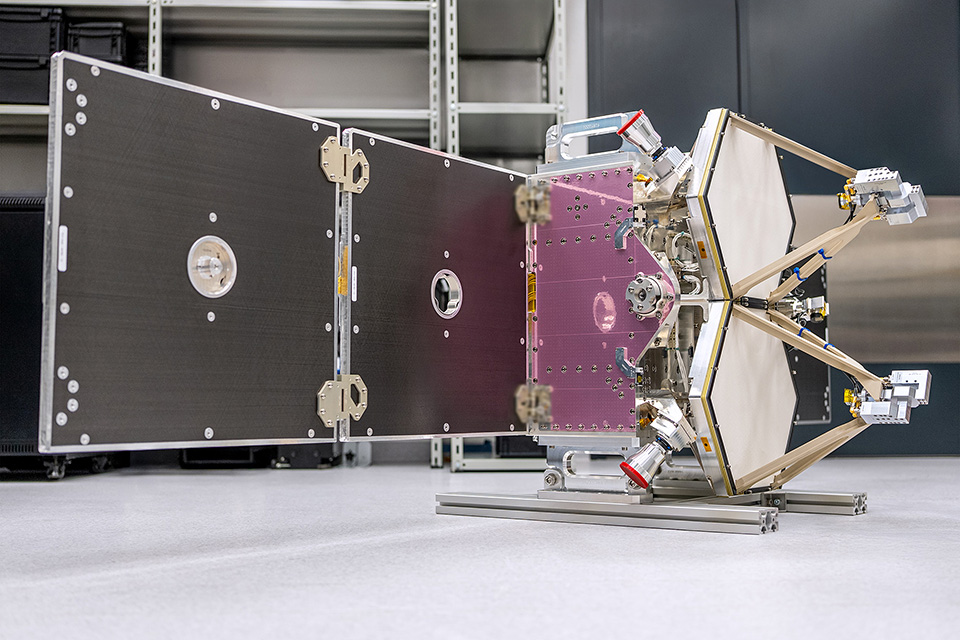
On October 5, 2026, space infrastructure company Meridian Space and satellite manufacturer Kongsberg NanoAvionics announced the successful initial activation of Meridian’s First Customer Link (FCL) communications payload in low Earth orbit.

Launched aboard SpaceX’s Transporter-18 rideshare mission from Vandenberg Space Force Base on October 1, the deployment marks the orbital debut of Meridian’s proprietary reflectarray antenna technology following a five-year engineering and qualification cycle.

Constellation Architecture and Contract Heritage

The spacecraft serves as the initial unit delivered under a 122.5 million EUR ($140 million) contract awarded to Kongsberg NanoAvionics to manufacture 280 constellation-optimized satellites. The FCL mission follows Meridian’s recent corporate spin-out to operate as an independent entity focused on marketing dedicated, customer-owned low Earth orbit (LEO) constellations. This business model allows sovereign governments and commercial entities to retain full control over their network infrastructure, data routing, and prioritization, rather than leasing bandwidth from third-party satellite operators.
Spacecraft Specifications and Operational Status

The FCL payload is integrated into a Kongsberg NanoAvionics MP42 microsatellite bus. The core payload architecture relies on a lightweight, electronically reconfigurable reflectarray antenna. This hardware is engineered to lower satellite mass, reduce thermal dissipation, and decrease overall power requirements while maintaining high-throughput broadband performance.

During the first available ground station pass, telemetry confirmed all primary subsystems and the communications payload successfully powered on and remained responsive. Kongsberg NanoAvionics completed the initial satellite build, payload integration, and orbital deployment in just over 12 months from the program’s kickoff.

Executive Perspective

“Seeing our technology successfully deployed and powered on in orbit is a tremendous achievement for Meridian and our team,” said Massimiliano Ladovaz, Chief Executive Officer of Meridian Space. “We’re building a fundamentally different model for satellite connectivity, one where customers own their networks rather than lease capacity from someone else. FCL brings us one step closer to making that vision a commercial reality.”

Timeline to Commercial Rollout

The telemetry and operational data gathered from the FCL demonstrator will validate the reflectarray hardware in the space environment ahead of the Meridian Express program. Meridian expects to begin delivering standardized, rapidly deployable satellite architectures for secure defense and commercial applications starting in 2027. To support the constellation’s scaling phase, Kongsberg NanoAvionics will transition manufacturing to its serial production facility, which is designed to produce hundreds of custom satellite buses annually.

Filed Under: Uncategorized

SpaceX Unveils 250 kW Starlink Gen3 AI Satellites Featuring 10 Tbps Throughput and Onboard Edge Compute

October 4, 2026 by donmcgee

On October 1, 2026, technical specifications were disclosed for SpaceX’s next-generation Starlink “Gen3” satellite architecture, featuring a 250-kilowatt (kW) power payload and a bidirectional data capacity of 10 terabits per second (Tbps) per spacecraft.

Designed to deliver multi-gigabit broadband and high-density space-based 5G direct-to-device (D2D) connectivity, each satellite generates more electrical power than the International Space Station, which produces between 120 and 240 kW across its solar array.

Technical Specifications & Onboard Compute Architecture

Each Gen3 platform is engineered around a 250 kW solar array and power distribution system, marking a fourfold power capacity increase compared to earlier Starlink constellation iterations. To handle real-time signal processing and direct routing across dense user networks, the satellite incorporates an onboard SpaceX-designed compute system featuring Nvidia Vera Rubin NVL72 hardware.

This onboard edge processing architecture allows the satellite to conduct orbital data processing, digital beamforming, and dynamically allocate RF power across steerable spot beams without routing all compute tasks through ground stations. The baseline design supports 10 Tbps of bidirectional bandwidth, with system architecture capable of scaling beyond 100 Tbps per satellite in future hardware iterations.

Spectrum Assets and Direct-to-Cell Strategy

The power scaling addresses key link-budget constraints inherent in delivering satellite-to-cellular connectivity directly to unmodified consumer devices. By generating higher effective isotropic radiated power (EIRP) from low Earth orbit, the satellites can penetrate building structures and serve high-density urban environments where signal attenuation poses operational challenges.

This technical advancement supports SpaceX’s commercial telecommunications roadmap following its $17 billion acquisition of AWS-4 and H-Block mid-band spectrum licenses from EchoStar. The strategy builds upon SpaceX’s Q2 direct mobile telco roadmap, which established dedicated 50MHz spectrum blocks to deliver non-terrestrial 5G service, and aligns with broader satellite network scaling to enable direct satellite connectivity across large-format mobile form factors.

Executive Perspective

SpaceX leadership emphasized that the hardware architecture combines high-power solar generation with customized artificial intelligence processing units in orbit.

“Connectivity per sat will be more like 10Tb in both directions and there is a path to 100+Tb,” said Elon Musk, Chief Executive Officer of SpaceX. “Each sat is 250kW and will have a SpaceX-designed Nvidia Vera Rubin NVL72 computer.”

Deployment Roadmap and Regulatory Hurdles

Deployment of the 250 kW Starlink platforms is directly tied to the operational launch cadence of SpaceX’s Starship launch vehicle. Starship’s payload bay capacity and mass-to-orbit capabilities are required to loft the heavier, high-power Gen3 spacecraft into low Earth orbit.

Before commercial service rollout, SpaceX must secure modified orbital authorizations and spectrum coordination approvals from the Federal Communications Commission (FCC) and international regulatory bodies. Initial orbital testing will focus on validating power distribution, thermal management for the Nvidia compute payload, and inter-satellite optical laser link throughput.

Filed Under: Uncategorized

Planet Labs Emerges as Cost-Effective Satellite Investment Amid High Multiples for Launch Peers

October 4, 2026 by donmcgee

On October 3, 2026, financial analysis highlighted Planet Labs PBC as a lower-multiple investment alternative within the commercial space sector, trading at significantly lower revenue valuation metrics than launch-focused peers SpaceX and Rocket Lab.

While launch providers command premium valuations, Earth observation operator Planet Labs presents a financial profile driven by expanding defense backlog and positive free cash flow generation.

Valuation Metrics and Comparative Analysis

Planet Labs currently trades at a price-to-sales ratio of 14.6x, compared to multiples of 96x for SpaceX and 55x for Rocket Lab. For its second fiscal quarter, Planet Labs reported revenue of $116.1 million—a 58% year-over-year increase—alongside a 57% gross margin and an adjusted earnings per share (EPS) of $0.02. Supported by an $815 million contract backlog, the company maintained positive free cash flow while launch operators continue to absorb significant capital expenditures for constellation and launch vehicle expansion.

Defense Segment Momentum and Market Context

The primary engine of Planet Labs’ financial trajectory remains high-margin government demand, with defense and intelligence sector revenue surging over 90% year-over-year. Despite this top-line acceleration—which follows record fiscal performance logged earlier in the year—Planet Labs shares have declined 18.15% year-to-date in 2026. By comparison, SpaceX equity is down 8% and Rocket Lab has gained 1% over the same timeframe.

Sector Outlook and Analyst Consensus

Wall Street equity analysts maintain a consensus “Strong Buy” rating on Planet Labs stock, with an average price target of $34.78, representing an estimated 99% upside potential. Financial analysts note that as launch costs decline across the broader industry, downstream satellite software and analytics providers with established constellations stand to benefit from recurring annual contract value and operational operating leverage.

Filed Under: Uncategorized

GomSpace Prepares 8U CubeSat GOMX-5 for SpaceX Transporter-18 Launch to Demonstrate Satellite Communications Technology

October 4, 2026 by donmcgee

On October 1, 2026, satellite developer GomSpace announced the upcoming launch of its GOMX-5 technology demonstration mission aboard SpaceX’s Transporter-18 rideshare mission.

Supported by the European Space Agency (ESA), the 8U CubeSat is designed to validate next-generation satellite communications technologies, operational concepts, and mission procedures in low Earth orbit.

Technical Specifications & Platform Architecture

Built on GomSpace’s modular CubeSat platform, the 8U spacecraft integrates hardware and software systems designed to evaluate advanced communications payloads and sensing capabilities. The satellite serves as an in-orbit testbed to generate flight heritage, performance data, and operational experience for future commercial and institutional satellite programs across the full mission lifecycle—from spacecraft design and integration to in-orbit operations.

Operational Heritage and Leadership Perspective

The spacecraft expands on previous technology demonstrations conducted by the manufacturer, including the GOMX-4A and GOMX-4B missions launched in 2018 to perform maritime and aerial traffic surveillance across Greenland and the Arctic region.

“GOMX-5 is more than a technology demonstration mission,” said Morten Bisgaard, GomSpace Co-Founder and Chief Technology Officer. “It builds on the legacy of pioneering missions such as GOMX-4A and GOMX-4B launched in 2018, where GomSpace demonstrated how small satellites could deliver valuable operational services, including maritime and air traffic surveillance across the Arctic and over Greenland. With GOMX-5, we are taking the next step by validating advanced communications and sensing technologies that will enable future satellite systems and customer missions.”

Space Sustainability and Operational Lifecycle

In addition to validating communications capabilities, the GOMX-5 mission incorporates operational capabilities supporting space sustainability. The satellite will demonstrate collision avoidance maneuvers and responsible end-of-life disposal protocols aligned with ESA’s Zero Debris initiative to mitigate orbital debris during mission closeout.

Filed Under: Uncategorized

AT&T, T-Mobile, and Verizon Form Joint Venture to Standardize Satellite Direct-to-Device Connectivity

October 4, 2026 by donmcgee

Dallas, Texas — On Friday, October 2, 2026, major U.S. mobile network operators AT&T, T-Mobile, and Verizon announced the formation of a joint venture to pool industry resources and streamline direct-to-device (D2D) satellite connectivity across the United States.

The joint initiative establishes a shared framework designed to eliminate terrestrial cellular dead zones, standardize operating interfaces, and accelerate feature rollouts for consumer smartphones operating in remote or underserved areas.

Wireless industry veteran Paul Roth has been named interim chief executive officer of the joint venture while the board conducts an executive search for a permanent leader. Roth previously held leadership roles across AT&T, Cingular Wireless, and Ameritech.

Joint Venture Structure and Existing Operator Partnerships

The joint venture operates as a collaborative platform rather than an independent satellite provider, allowing all three founding carriers to maintain their existing, separate commercial space agreements. Participating carriers can continue building out independent satellite connectivity services while utilizing the joint venture to harmonize consumer access, device registration, and cross-network functionality.

The consortium integrates existing space segment partnerships across the domestic telecom market. AT&T and Verizon continue their commercial deployments with AST SpaceMobile, while T-Mobile maintains its direct-to-cell beta deployment with SpaceX’s Starlink constellation. By pooling technical specifications through a single corporate entity, the carriers aim to simplify how mobile devices transition between terrestrial towers and orbiting satellite payloads.

Standards-Based Integration and Technical Roadmap

To ensure consistent performance across diverse mobile hardware, the joint venture is developing a standardized approach to satellite integration in coordination with mobile operating system developers, original equipment manufacturers (OEMs), and mobile application creators. This unified layer focuses on optimizing supplemental coverage from space (SCS) protocols, expanding text, voice, and data capabilities, and reducing latency during satellite handoffs.

Through joint investment, the consortium intends to lower technical friction for software developers and chipmakers, establishing uniform standards for satellite-directed messaging and emergency alerting. The shared approach provides consumers with more consistent performance across different mobile operating systems without requiring hardware modifications or proprietary satellite accessories.

Consortium Perspective on Market Competition

“Through combined investment by the three JV partners, provider options will expand, and, as a first step, direct-to-device (D2D) access will improve,” the three carrier partners said in a joint statement. “This will enhance competition as consumer choices grow in satellite service. Emerging communications technologies can be more easily and quickly developed and launched to enhance customer experience.”

Industry Outlook and D2D Service Expansion

The creation of the joint venture marks a structural shift in the U.S. mobile satellite landscape, transitioning direct-to-device connectivity from isolated carrier trials into a standardized telecommunications service layer. As AST SpaceMobile and SpaceX continue scaling their respective low Earth orbit constellations through 2026 and 2027, the joint venture will manag

Filed Under: Uncategorized

Sateliot Launches Five Alén Space-Built CubeSats for Draconis 5G NTN IoT Mission

October 3, 2026 by donmcgee

Vandenberg Space Force Base, California — On Friday, October 2, 2026, European satellite telecommunications operator Sateliot successfully deployed five new 6U CubeSats into low Earth orbit aboard a SpaceX Falcon 9 rocket during the Transporter-18 rideshare mission.

Manufactured by Spanish aerospace developer Alén Space, the five spacecraft expand the capacity of Sateliot’s Draconis mission and bring the operator’s total orbital fleet count to eleven satellites.

The mission integration and launch logistics were managed by Exolaunch, with ground station tracking and telemetry supported by technology partners KSAT and Leaf Space, alongside Comfone providing IPX connectivity services to link Sateliot’s space segment with commercial mobile network operators.

Network Expansion and Orbital Constellation Scale

Positioned at an orbital altitude of 510 kilometers, the five newly deployed satellites act as orbiting cell towers that connect directly with standard 3GPP Release 17 Narrowband IoT (NB-IoT) ground endpoints. By doubling the active satellite presence within the Draconis constellation layer, the deployment halves ground revisit times and doubles average daily pass opportunities for remote industrial devices operating beyond terrestrial cellular coverage.

The expanded space segment serves wholesale telecommunications partners, allowing terrestrial mobile network operators to extend seamless IoT connectivity into remote maritime, agricultural, energy, and transportation sectors without requiring custom ground hardware or proprietary terminals.

Spacecraft Design and Bus Specifications

The five 6U CubeSats reflect an upgraded hardware architecture produced in half the development time required for Sateliot’s four precursor satellites launched in 2024. Each satellite measures 20 by 10 by 35 centimeters, weighs 10 kilograms, and carries a design operational lifespan of five years.

Alén Space integrated reinforced memory components with enhanced radiation resistance to protect onboard systems from high-energy space environment effects. Additional technical upgrades include a modernized onboard computer, an optimized store-and-forward payload, and an improved attitude determination and control system (ADCS) engineered for enhanced operational stability and orbital maneuvering.

Executive Perspectives on Scaling European Space Infrastructure

“The Draconis mission reflects very clearly where the company stands today,” said Jaume Sanpera, CEO and co-founder of Sateliot. “We have validated the technology, and we are now increasing capacity and service frequency to scale the service together with mobile operators. Our goal is to make satellite connectivity a natural extension of their networks wherever terrestrial coverage cannot reach and, on that same standardized and interoperable 5G infrastructure, evolve towards increasingly critical and resilient services. We are building a European telecommunications infrastructure based on proprietary technology and the 3GPP standard, with global ambitions.”

“This mission is another key step in our close collaboration with Sateliot and in the development of the European 5G NTN ecosystem,” said Guillermo Lamelas, CEO of Alén Space. “Seeing these five satellites reach orbit confirms our ability to take on increasingly complex challenges and deliver the quality and reliability required by the most demanding satellite missions.”

Constellation Roadmap and Next-Generation Technology Transition

The Draconis expansion represents an intermediate phase toward Sateliot’s long-term plan of operating a constellation of more than 500 satellites. Beginning in 2027, the operator plans to introduce its next-generation Tritó satellite series, which will implement 3GPP Release 19 5G NR NTN technology, enhanced store-and-forward capabilities, and an advanced multibeam phased-array digital antenna architecture designed to support high-capacity payload routing and direct-to-device (D2D) services.

Filed Under: Uncategorized

FCC Votes to Exempt Satellite Licensing from NEPA Environmental Reviews and Opens 1,000 MHz of Spectrum

October 1, 2026 by donmcgee

Washington, D.C. — On Wednesday, September 30, 2026, the Federal Communications Commission (FCC) voted 2-1 to codify an order confirming that satellite licensing operations are categorically excluded from environmental review under the National Environmental Policy Act (NEPA).

The ruling formally establishes that licensing commercial space systems does not constitute a major federal action requiring environmental impact assessments.

The regulatory update applies broadly across the commercial satellite lifecycle. Under the newly approved order, the environmental exclusion covers spacecraft manufacturing launch authorizations, orbital deployment, on-orbit operations, spectrum authorizations, and ground station earth terminals.

Codification of Categorical Exclusion Practice

The decision codifies the FCC’s long-standing administrative practice of granting categorical exclusions to satellite constellation operators. Environmental groups and industry organizations had previously questioned whether expanding low Earth orbit (LEO) mega-constellations required formal NEPA review due to concerns over upper-atmosphere chemical pollution from spacecraft re-entry and optical light pollution affecting astronomical observation.

By formalizing the rule, the commission removes environmental litigation vulnerability for satellite operators applying for U.S. market access or constellation modification licenses. The agency maintained that space launch and re-entry environmental impacts remain under the primary regulatory oversight of the Federal Aviation Administration (FAA).

Expansion of Satellite Spectrum Allocations

In a separate action approved during the same meeting, the commission voted to open more than 1,000 MHz of additional radio frequency spectrum for commercial satellite communication services. The newly designated spectrum bands aim to support growing bandwidth demands for direct-to-device connectivity, broadband constellation links, and enterprise earth station terminals.

The reallocation provides satellite operators with expanded spectrum capacity to deploy next-generation non-geostationary orbit (NGSO) services without facing immediate spectrum clearing delays or complex inter-service sharing restrictions.

Implementation and Regulatory Outlook

The order taking satellite licensing out of NEPA review will take effect 30 days after publication in the Federal Register. The ruling streamlines the application pipeline for domestic and international satellite operators seeking FCC spectrum authorizations, accelerating deployment schedules for commercial constellations and ground infrastructure across the United States.

Filed Under: Uncategorized

ICEYE and Nokia Partner to Develop Sovereign LEO Satellite Communications Systems for Defense

October 1, 2026 by donmcgee

Helsinki, Finland — On Thursday, October 1, 2026, Finnish satellite manufacturer ICEYE and telecommunications infrastructure provider Nokia announced a strategic partnership to develop sovereign, high-performance broadband low Earth orbit (LEO) satellite communications systems tailored for defense, civil protection, and emergency management customers.

The joint initiative expands ICEYE’s established model of selling nationally owned space infrastructure into the satellite communications market, allowing government clients to acquire, possess, and operate dedicated spaceborne communications networks rather than depending on commercial lease arrangements.

The systems will combine ICEYE’s spacecraft manufacturing and mission operations capabilities with Nokia’s secure IP, optical, and core networking technologies. Under the agreement, purchasing nations will maintain complete ownership and control over the space segment, ground stations, and end-user terminals.

Expansion of the Sovereign Space Procurement Model

The joint venture adapts the procurement template ICEYE created within the synthetic aperture radar (SAR) Earth observation sector, where governments purchase turnkey hardware constellations operated directly by national defense authorities. The approach follows ICEYE’s delivery of the four-satellite POLSARIS constellation to the Polish Armed Forces in under twelve months, establishing a precedent for rapid hardware transfers to European defense ministries.

By extending this framework into LEO communications, ICEYE and Nokia target a growing requirement among defense organizations for assured, low-latency data links that operate independently of third-party commercial network providers or foreign regulatory jurisdictions. The systems are engineered to complement existing military communications networks and commercial satcom services, adding dedicated transmission capacity and network resilience over high-priority operational theaters.

Hardware Integration and Core Infrastructure Specifications

The joint architecture integrates ICEYE’s small satellite design and manufacturing capabilities with Nokia’s network security software and defense hardware portfolio. The platform will deliver high-throughput, low-latency connectivity to ruggedized end-user terminals designed for multi-domain deployment across land, maritime, and aerial forces.

The spaceborne payloads and ground infrastructure will utilize Nokia’s secure networking protocols to ensure end-to-end data encryption and resilience against jamming or signal interception. The combined platform aims to maintain critical command-and-control (C2) pathways and real-time situational awareness feeds when terrestrial fiber or mobile networks are disrupted by military action or natural disasters.

Defense Leadership Perspectives on Operational Autonomy

“Together with Nokia, we are building on our proven space intelligence expertise and delivering sovereign, high-performance satellite communications,” said Rafal Modrzewski, CEO and Co-founder of ICEYE. “Nations must be able to fully own and control their communications, without dependency on a foreign commercial operator’s terms of service. We delivered Poland its own radar satellite system in under a year. Partnering with Nokia lets us move at a similar speed for satellite communications, on the timelines nations need.”

“Sovereign operations depend on the ability to sense, decide and act in real time,” said Justin Hotard, President and CEO of Nokia. “Physical AI makes that possible, but only with secure, resilient connectivity across land, sea, air and space. By bringing together Nokia’s trusted networks with ICEYE’s proven sovereign space capabilities, we will deliver a satellite communications capability—complementing existing terrestrial networks, and giving nations the situational awareness, connectivity, and control they need to operate with confidence in contested environments across all domains.”

Platform Deployment Schedule and Industry Public Appearance

Initial launch activities for the sovereign satcom constellation are planned to begin in 2028, following joint hardware integration testing and system validation. Executive leadership from both companies, including Modrzewski and Hotard, are scheduled to present the operational scope of the partnership at the Helsinki Security Forum on October 2, during a policy panel focused on European technological sovereignty.

Filed Under: Uncategorized

BEC Technologies Launches MX-340-IRD Hybrid Cellular and Satellite Gateway for Remote Infrastructure

October 1, 2026 by donmcgee

Richardson, Texas — In September 2026, wireless WAN equipment developer BEC Technologies introduced the MX-340-IRD, a hybrid IoT gateway combining LTE-M cellular network connectivity with Iridium Short Burst Data satellite communications.

The gateway keeps remote monitoring networks operational during cellular outages, coverage gaps, and off-grid deployments by providing a dual-path data link for critical field infrastructure.

Edge Processing and Space Segment Optimization

The MX-340-IRD integrates application-aware edge logic to manage data flow between terrestrial and orbital paths. Rather than mirroring full cellular data streams across satellite capacity during a failover, the system’s edge logic identifies, buffers, and prioritizes essential payloads before routing them across the Iridium satellite network.

This selective transmission mechanism filters for high-priority operational metrics, including equipment exception alarms, status changes, telemetry feeds, GNSS location updates, and specific Modbus or DNP3 industrial protocol payloads. By restricting satellite usage to mission-critical operational data, the unit maintains visibility over remote assets without burdening satellite bandwidth.

Executive Perspective on Operations Continuity

“The data that matters most is the data that gets through,” said D’Andre Ladson, Vice President of Marketing at BEC Technologies. “The MX-340-IRD combines cellular, satellite, and edge intelligence to help organizations maintain critical visibility when terrestrial connectivity is unavailable.”

Target Markets and Infrastructure Deployment

Designed for heavy industrial environments, the MX-340-IRD targets mission-critical applications across public utilities, oil and gas monitoring, transportation management systems, and remote industrial automation. The hybrid gateway is available immediately through BEC Technologies and its network of commercial distribution partners.

Filed Under: Uncategorized

Astro Digital to Go Public via $587 Million SPAC Merger with Proem Acquisition Corp I

September 30, 2026 by donmcgee

Denver, Colorado — On Monday, September 28, 2026, satellite manufacturer Astro Digital entered into a definitive business combination agreement to go public through a merger with special purpose acquisition company (SPAC) Proem Acquisition Corp I. The transaction values the combined entity at an enterprise value of $587 million.

Upon closing, the business combination is expected to generate up to $180 million in gross proceeds. Capital from the transaction includes funds held in Proem Acquisition Corp I’s trust account along with private financing commitments co-led by Proem Asset Management and Leon Capital Group.

Transaction Structure and Capital Allocation

The transaction proceeds will fund expansion of Astro Digital’s satellite bus manufacturing facilities, scale payload integration capabilities, and support working capital for ongoing commercial and government spacecraft production lines.

  • Enterprise Value: $587 million
  • Gross Transaction Proceeds: Up to $180 million
  • Sponsoring Financing Leads: Proem Asset Management and Leon Capital Group
  • Public Vehicle: Proem Acquisition Corp I

Spacecraft Delivery Track Record and Customer Base

Founded as a developer of standardized satellite buses and custom space systems, Denver-headquartered Astro Digital specializes in modular SmallSat platforms and hosted payload services. The company has manufactured and delivered nearly 40 satellites into orbit across multiple orbital regimes.

Astro Digital’s customer portfolio spans defense, civil space, and commercial aerospace organizations, including key spacecraft deployments for NASA, the U.S. Department of Defense, Boeing, and Sony.

Transaction Approval and Closing Timeline

The board of directors for both Astro Digital and Proem Acquisition Corp I have unanimously approved the business combination agreement. Closing of the transaction is targeted for the first quarter of 2027, subject to customary closing conditions, regulatory clearances, and approval by Proem Acquisition Corp I shareholders.

Filed Under: Uncategorized

  • « Go to Previous Page
  • Page 1
  • Interim pages omitted …
  • Page 10
  • Page 11
  • Page 12
  • Page 13
  • Page 14
  • Interim pages omitted …
  • Page 32
  • Go to Next Page »

Primary Sidebar

WEEKLY NEWSLETTER

Archives

  • November 2026
  • October 2026
  • September 2026
  • August 2026
  • July 2026
  • June 2026
  • May 2026
  • April 2026
  • March 2026
  • February 2026
  • January 2026
  • December 2025
  • November 2025
  • October 2025
  • September 2025
  • August 2025
  • July 2025
  • June 2025
  • May 2025
  • April 2025
  • March 2025
  • February 2025
  • January 2025
  • December 2024
  • November 2024
  • October 2024
  • September 2024
  • August 2024
  • July 2024
  • June 2024
  • May 2024
  • April 2024
  • March 2024
  • February 2024
  • January 2024
  • December 2023
  • November 2023
  • October 2023
  • September 2023
  • August 2023
  • July 2023
  • June 2023
  • May 2023
  • April 2023
  • March 2023
  • February 2023
  • January 2023
  • December 2022
  • November 2022
  • October 2022
  • September 2022
  • August 2022
  • July 2022
  • June 2022
  • May 2022
  • April 2022
  • March 2022
  • February 2022
  • January 2022
  • December 2021
  • November 2021
  • October 2021
  • September 2021
  • August 2021
  • July 2021
  • June 2021
  • May 2021
  • April 2021
  • March 2021
  • February 2021
  • January 2021
  • December 2020
  • November 2020
  • October 2020
  • September 2020
  • August 2020
  • July 2020
  • June 2020
  • May 2020
  • April 2020
  • March 2020
  • February 2020
  • January 2020
  • December 2019
  • November 2019
  • October 2019

© 2019–2026 SatNews

Insert/edit link

Enter the destination URL

Or link to existing content

    No search term specified. Showing recent items. Search or use up and down arrow keys to select an item.
      x
      Sign Up Now!

      Enjoy a free weekly newsletter with recent headlines from the global SmallSat industry.

      Invalid email address
      We promise not to spam you. You can unsubscribe at any time.
      Thanks for subscribing! You will now receive weekly SmallSat News updates.
      We love our advertisers.
      And you will too!

      Please disable Ad Blocker to continue... We promise to keep it unobtrusive.
      We promise not to spam you. You can unsubscribe at any time.
      Invalid email address
      Thanks for subscribing!