• Skip to main content
  • Skip to primary sidebar
  • Home
  • News
  • Featured
  • More News ⌄
    • SatNews
    • SatMagazine
    • MilSatMagazine
  • Events ⌄
    • MilSat Symposium
    • SmallSat Symposium
    • Satellite Innovation
  • Contacts
  • SUBSCRIPTION

SmallSat News

You are here: Home / Archives for 2026

Archives for 2026

Momentus to Demonstrate Multispectral Sensor for Space Force, With NASA Support

February 9, 2026 by editorial

On February 9, 2026, Momentus Inc. announced it has entered into a Space Act Agreement with NASA to execute a groundbreaking in-orbit servicing and rendezvous demonstration mission. Scheduled for launch no earlier than March 2026 aboard a SpaceX Transporter mission, the flight will feature the Vigoride 7 Orbital Service Vehicle (OSV) performing complex maneuvers in Low Earth Orbit (LEO).
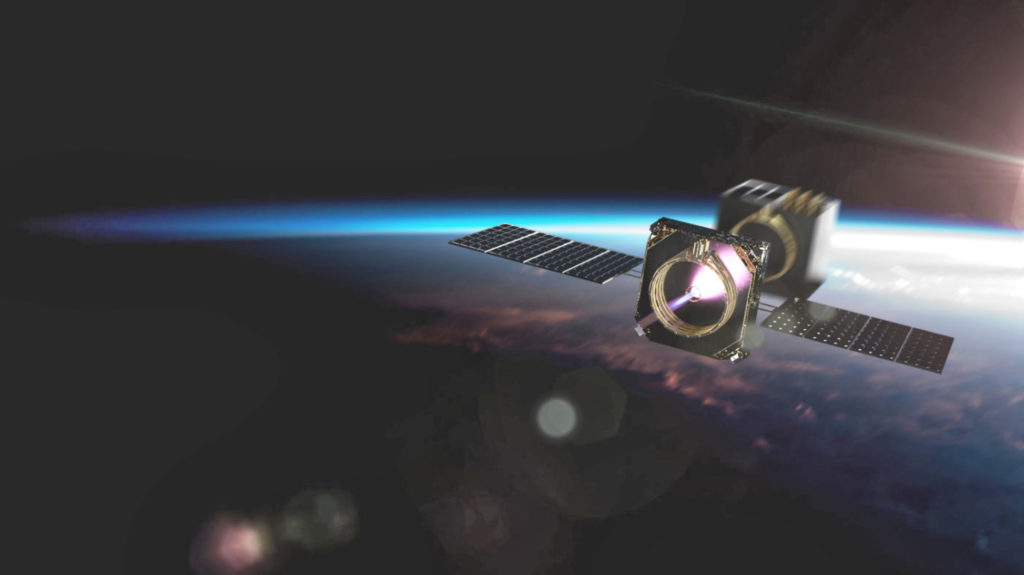
This mission fulfills a $1.86 million contract with SpaceWERX, the innovation arm of the U.S. Space Force, and represents a critical step toward operationalizing autonomous space infrastructure.

Multispectral Sensors for Enhanced Situational Awareness

The centerpiece of the March mission is the flight demonstration of Momentus’ internally developed Low-Cost Multispectral RPO Sensor (LCMRS) suite. This system integrates optical, infrared, and lidar sensors with advanced machine vision algorithms and data fusion techniques. Designed to enhance Space Situational Awareness (SSA), the sensor suite allows a spacecraft to autonomously approach, characterize, and navigate around “uncharacterized” objects in orbit. This capability is fundamental for the militarization of LEO, providing the Space Force with the tools needed for dynamic operations such as satellite inspection, refueling, and space debris management.

NASA Support and the R5-S10 CubeSat Imager

Under the new Space Act Agreement, NASA is providing critical mission support through the delivery of the R5 Spacecraft 10 (R5-S10) CubeSat. Funded by NASA’s Small Spacecraft Technology (SST) program and managed by the Johnson Space Center, the R5-S10 will function as a “free-flying imager.” During the mission, it will detach from the Vigoride 7 to capture high-resolution imagery of the host vehicle, assessing its health and performance in real-time. This joint effort is designed to refine In-Space Assembly and Manufacturing (ISAM) capabilities, moving the industry closer to a future where structures can be built and repaired entirely in orbit.

WiFi-Based Inter-Satellite Link Demonstrations

A secondary objective of the mission is the demonstration of advanced inter-satellite link (ISL) capabilities using WiFi-based data transmission. The R5-S10 CubeSat will attempt to transfer large files directly to the Vigoride 7 platform while in flight. These files will then be downlinked to the Momentus Operations Center and NASA Johnson, proving the viability of high-speed, real-time space communication. This “Space WiFi” approach is seen as a cost-effective way to enable complex formation flying and data sharing between swarms of small satellites, a key component of the Space Force’s proliferated LEO architecture.

Vigoride 7: A Fully Manifested Orbital Platform

The March 2026 launch marks a significant milestone for the Vigoride platform, which is currently fully booked with hosted payloads. In addition to the LCMRS and NASA R5-S10 missions, the Vigoride 7 will feature a 3D-printed fuel tank developed in collaboration with Velo3D, showcasing advanced metal additive manufacturing. The mission highlights the advantages of Momentus’ multi-manifest approach, where hosting multiple payloads on a single vehicle increases the data fidelity and operational results for all participants. This mission not only serves defense and research needs but also solidifies Momentus’ role as a primary provider of in-space transportation and infrastructure services.

Mission Component Momentus Vigoride 7 Mission Details (March 2026)
Primary Customer U.S. Space Force (via SpaceWERX)
NASA Partner Johnson Space Center / SST Program
Core Technology Multispectral RPO Sensor Suite (Optical/IR/Lidar)
Companion Craft R5-S10 CubeSat (Free-flying imager)
Launch Vehicle SpaceX Transporter (March 2026)
Innovation Focus ISAM, Autonomous RPO, and WiFi Inter-Satellite Links

Filed Under: News

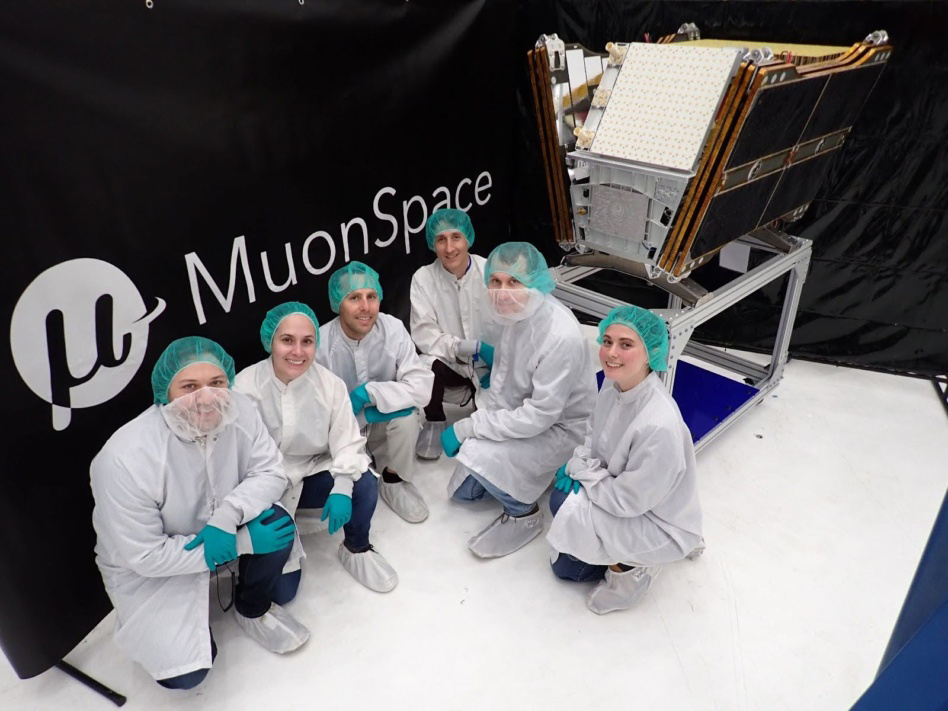
Muon Space ramps up multi-mission satellite constellations

February 4, 2026 by editorial

On February 4, 2026, Muon Space announced a major transition from executing discrete satellite missions to the sustained deployment of multi-mission constellations.

This strategic shift follows a period of rapid growth for the Silicon Valley startup, which reported a 100 percent year-over-year revenue increase for the second consecutive year. To support this operational scale-up, Muon Space has expanded its production capacity by ten times, now capable of manufacturing up to 500 satellites per year at its 130,000-square-foot facility in San Jose.

Multi-Mission Strategy and Government Contracts

The company is moving away from one-off missions toward a “Mission Foundry” model, providing end-to-end satellite solutions that prioritize operational outcomes over hardware delivery. This approach has proven successful in securing high-value government agreements.

Muon secured a $44.6 million SBIR Phase III contract from U.S. Space Force to develop a dual-use space-based environmental monitoring (SBEM) capability. This project involves a three-satellite prototype demonstration focused on cloud characterization and theater weather imagery to support military planning in contested environments.

National Reconnaissance Office (NRO): The company was awarded Stage II of an National Reconnaissance Office (NRO) contract in 2025 to advance commercial electro-optical capabilities, providing multispectral data for national security assessment.

Missile Defense Agency (MDA): Muon was selected for the SHIELD IDIQ program, from the Missile Defense Agency (MDA), which has a massive $151 billion ceiling, contributing commercial space-based sensing to next-generation missile defense architectures.

Vertical Integration and Technological Milestones

Muon Space is aggressively pursuing vertical integration to reduce costs and accelerate deployment speeds. A key part of this strategy was the acquisition of propulsion startup Starlight Engines, which brings in-house zinc-based thruster technology designed for improved stability and lower costs compared to traditional xenon systems. Additionally, Muon recently closed a $146 million Series B financing round, led by Congruent Ventures and Activate Capital, to fuel its infrastructure expansion and staff growth.

Technologically, the company has launched its new XL spacecraft platform to accommodate larger payloads and higher-performance sensors. In an industry-first move, Muon also signed an agreement with SpaceX to integrate Starlink mini laser terminals onto its satellites. This integration, scheduled to begin in the third quarter of 2026, will enable persistent optical connectivity in orbit, significantly enhancing real-time data delivery across its global constellations.

Upcoming Launch Manifest

Over the next 20 months, Muon Space has 20 satellites manifested for launch, including:

  • SNC Vindlér 2.0: Deployment of the first three satellites for Sierra Nevada Corporation’s RF collection and analytics constellation in Q1 2026.
  • Earth Fire Alliance: Three additional FireSats are scheduled for mid-2026 to enhance global wildfire detection and monitoring.
  • Commercial Awards: New missions for 2026 will span hyperspectral mapping, radio frequency sensing, and thermal infrared sensing for a variety of logistics and agricultural customers.

Filed Under: News

Musk’s Orbital Gambit: SpaceX Files for Mega Satellite Data Centers

February 1, 2026 by editorial

In a move that fundamentally reimagines the relationship between orbital infrastructure and artificial intelligence, SpaceX submitted a staggering application to the Federal Communications Commission (FCC) late Friday, January 30, 2026.

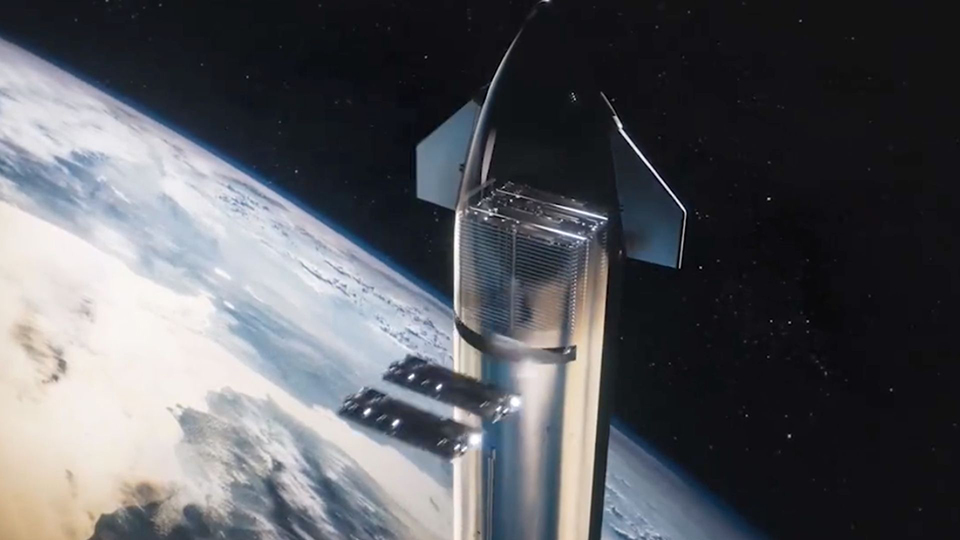
The filing seeks authority to launch and operate up to one million satellites designed to function as the world’s first large-scale Orbital Data Center network.

Escalating Terrestrial Energy and Cooling Crisis

The proposal is a direct response to the “energy wall” facing terrestrial AI development. On Earth, high-performance data centers consume unsustainable volumes of electricity and water for cooling; by 2027, global AI is projected to consume as much electricity as the nation of Argentina. SpaceX argues that moving computation to space provides an “unlimited” solar energy source and effortless radiative cooling in the vacuum of space, eliminating the environmental footprint and grid bottlenecks of ground-based server farms.

Rationale: Toward a Kardashev Type II Civilization

SpaceX’s filing describes the initiative as a “first step toward becoming a Kardashev II-level civilization”—one capable of harnessing the full power of its star. Beyond civilizational ambitions, the move serves as a strategic geopolitical counter to China, which recently filed paperwork with the ITU for two constellations totaling approximately 200,000 satellites for its own “gigawatt-class space digital infrastructure”.

“The satellites will be so far apart that it will be hard to see one from another,” Musk posted on X on January 31, 2026, attempting to address concerns over Kessler Syndrome and orbital congestion. “Space is so vast as to be beyond comprehension“.

Technical Specifications: The “Space Brain”

The system is designed to handle the heaviest AI inference and training workloads in layered orbits between 500 km and 2,000 km. Key technical goals include:

  • Power Density: Achieving roughly 100 kilowatts of compute power per tonne of satellite mass.
  • Energy Scale: Aiming for 100 gigawatts of solar-powered AI satellites produced annually, a feat Musk notes will require an equal 100 GW of AI compute production on Earth first.
  • Connectivity: Utilization of high-speed optical laser links to transfer petabytes of data between orbital nodes and the existing Starlink mesh network.

Strategic Integration and Funding Outlook

Analysts note the filing appears to justify a rumored merger between SpaceX and Musk’s AI firm, xAI, ahead of a potential Initial Public Offering (IPO) later this year. The IPO could seek to raise in excess of $30 billion to fund the “proliferation at scale” required for the one-million-satellite fleet, potentially valuing SpaceX at $1.5 trillion.

The FCC, which has historically been conservative regarding large constellation sizes—granting only 7,500 of a previous 22,488 Starlink satellite request—is expected to subject this unprecedented filing to extreme scrutiny regarding collision risks and night sky interference.

Filed Under: News

Midnight and Spacecoin Partner to Secure Global Communications via Decentralized Satellite Network

January 29, 2026 by editorial

Targeting the growing gap between encrypted application layers and vulnerable terrestrial infrastructure, Spacecoin and the Midnight Foundation announced a partnership on January 29, 2026, to develop a private peer-to-peer (P2P) messaging platform.

Screenshot

The collaboration aims to bypass traditional internet gateways prone to censorship, surveillance, and nationwide blackouts by leveraging a decentralized network of low-Earth orbit (LEO) small satellites.

Infrastructure Resilience Against Global Censorship

The initiative responds to increasing instances of internet shutdowns used to mask political crackdowns, such as those recently documented in Uganda and Iran. By utilizing Spacecoin’s satellite constellation, the platform seeks to provide permissionless connectivity that remains operational even when terrestrial networks are compromised or intentionally severed.

Unlike centralized messaging services that may expose metadata—revealing identity, location, and communication frequency—the proposed platform integrates Midnight’s zero-knowledge proof (ZKP) technology. This allows users to verify their authorization to communicate without disclosing sensitive personal data.

“Privacy is not a feature or a privilege—it is a fundamental human right,” stated Fahmi Syed, President of the Midnight Foundation. “To protect this right, we need to think beyond the application layer. If the underlying infrastructure itself is exploitable, true privacy does not exist”.

Technical Stack: Satellites, Blockchain, and ZK-Proofs

The partnership explores a multi-layered privacy stack designed to eliminate central points of failure:

  • Connectivity Layer: Spacecoin’s LEO small satellites provide a direct-to-device link that reduces reliance on local ISPs.
  • Coordination Layer: A blockchain protocol manages the satellite network via smart contracts, ensuring no single entity can shut down the service.
  • Privacy Layer: Midnight’s cryptographic proofs enable selective disclosure, protecting transaction and communication metadata.

Beyond Messaging: Privacy as Infrastructure

While the initial focus is on secure messaging, the partners envision the infrastructure supporting broader privacy-critical applications. This includes confidential healthcare consultations in remote regions, secure coordination for journalists, and private financial transactions over satellite networks.

“The real opportunity here is privacy as infrastructure, not as a feature,” said Tae Oh, Founder of Spacecoin. “The same stack that protects a message protects a financial transaction or a medical consultation“.

Filed Under: News

York Space Systems Raises $629M in Upsized IPO to Scale Defense Production

January 29, 2026 by editorial

On January 29, 2026, York Space Systems (NYSE: YSS) made its trading debut on the New York Stock Exchange, successfully raising $629 million in an upsized initial public offering.

Dirk Wallinger, York founder & CEO, ringing the Opening Bell

Pricing at $34 per share—the top of its target range—the Denver-based satellite manufacturer achieved a market capitalization of approximately $4.75 billion, signaling robust investor appetite for pure-play defense space firms capable of mass-manufacturing.

Dominance in the Proliferated Warfighter Space Architecture

The IPO marks a major transition for York, moving from a venture-backed disruptor to a Tier 1 defense prime. As of late 2025, York is the primary provider for the Space Development Agency’s (SDA) Proliferated Warfighter Space Architecture (PWSA), with 33 spacecraft currently operational in orbit across six distinct contracts.

York’s mission success was highlighted in September 2025, when it became the first prime contractor to launch and deploy 21 satellites for the SDA’s Tranche 1 Transport Layer mission within hours of launch.

Rationale: “Space as Procurement” vs. Science

The company’s value proposition centers on “proliferation at scale,” advocating for a shift from “space as a science project” to a standardized procurement model. By utilizing its standardized S-CLASS and M-CLASS satellite buses, York claims to manufacture spacecraft at approximately half the cost of traditional defense competitors.

“Historically, people kind of view us solely as a spacecraft manufacturer, but we’re really a complete, holistic solution,” stated Dirk Wallinger, CEO and Founder, speaking from the NYSE floor. “That kind of turnkey solution is really what national defense needs“.

Strategic Targets: The Golden Dome and M&A

Proceeds from the IPO are earmarked for immediate expansion of manufacturing inventory and research and development. York is also positioning itself as a critical player for the proposed “Golden Dome” missile defense project, a national security initiative aimed at creating a multi-layered, space-based interceptor and tracking network.

Furthermore, the company has confirmed it is conducting due diligence for a potential $120 million acquisition of a key supplier to further vertically integrate its supply chain. Following the IPO, AE Industrial Partners remains the majority shareholder, retaining over 50% of the voting power.

Filed Under: News

SSTL and Oxford Space Systems Achieve Successful In-Orbit Deployment of CarbSAR Antenna

January 29, 2026 by editorial

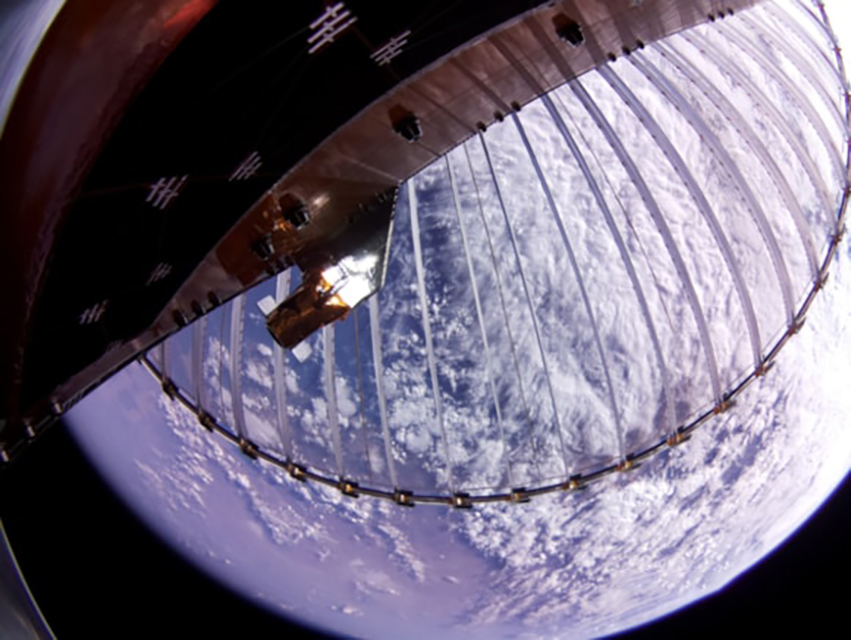
On January 29, 2026, Surrey Satellite Technology Limited (SSTL) and Oxford Space Systems (OSS) confirmed the successful in-orbit deployment of the Wrapped Rib Antenna aboard the CarbSAR In-Orbit Demonstration mission.

This milestone marks the first flight heritage for the OSS large deployable reflector, validating a multi-year development program funded through UK space industrialization initiatives.

Validating a High-Performance SAR Architecture

The CarbSAR mission was launched on January 11, 2026, via a SpaceX Falcon 9. Following initial commissioning, the antenna underwent a critical two-stage deployment sequence to reach its operational focal point. The success of this deployment demonstrates the maturity of the OSS deployable architecture, which is engineered to provide high-performance X-band Synthetic Aperture Radar (SAR) from a stowage-efficient small satellite platform.

“The successful deployment is a major technical milestone,” stated Pete Ashworth, CTO of Oxford Space Systems. “It validates our engineering approach and demonstrates our ability to industrialize advanced deployable antenna technologies in the UK“.

Two-Stage Deployment Mechanics

The Wrapped Rib Antenna is designed to overcome the “stowage-to-performance” gap inherent in small satellite SAR missions. The deployment process consists of two distinct phases:

  • Primary Reflector: The deployment of the metal mesh surface, which provides the large aperture necessary for high-resolution imaging.
  • Secondary Mast: The extension of the secondary reflector mast to the precise focal point of the primary reflector.

This dual-deployment design allows the antenna to remain extremely compact during launch, fitting within the restricted volume of small satellite fairings while expanding to a size that rivals much larger traditional spacecraft once in orbit.

Strengthening the UK Space Industrial Base

The achievement reinforces the UK’s position as a leader in sovereign space technology. The antenna was entirely designed and manufactured at the Oxford Space Systems facilities in Oxfordshire, utilizing custom composite and metal mesh production lines.

“We’re proud to have partnered with Oxford Space Systems to flight-qualify this innovative technology,” said Andrew Cawthorne, Managing Director at SSTL. “This mission is a clear demonstration of the performance that can be achieved from compact satellite platforms”.

Path to Constellation Production

With flight heritage secured, Oxford Space Systems is poised to scale production of the Wrapped Rib Antenna for future commercial and government constellations. The performance data gathered from the CarbSAR mission will underpin the company’s ability to reliably produce batches of antennas for global satellite operators seeking advanced Earth observation capabilities.

Filed Under: News

Astroscale France and Exotrail Join Forces to Build Deorbiting Capability for LEO

January 29, 2026 by editorial

On January 28, 2026, Astroscale France and Exotrail announced a strategic partnership to develop and demonstrate controlled deorbiting capabilities for satellites in Low Earth Orbit (LEO).

The collaboration aims to address increasing orbital congestion by providing a repeatable, sovereign European solution for satellite end-of-life management and debris mitigation.

Building on the CNES France 2030 Study

The partnership follows a successful study phase led by Exotrail under a France 2030 contract with the French space agency, CNES. During this phase, the two companies evaluated a deorbiting mission for a constellation satellite, laying the groundwork for the current operational roadmap. The initiative is closely aligned with European space priorities regarding technological sovereignty and the “circular space economy”.

“By combining Exotrail’s mission leadership on vehicles and maneuvers with Astroscale’s proven capture and close-proximity operations expertise, we are helping to position France and Europe at the forefront of in-orbit servicing,” stated Philippe Blatt, Managing Director of Astroscale France.

Integration of spacevan™ and RPO Technology

The technical core of the partnership relies on merging Exotrail’s mobility platforms with Astroscale’s specialized servicing hardware:

  • Exotrail spacevan™: A high-mobility orbital transfer vehicle (OTV) capable of significant altitude and inclination changes. The spacevan™ LEO offers a delta-V of 500 m/s and is designed to act as a mission integrator and “last mile” delivery vector.
  • Astroscale RPO & Capture: Drawing on flight heritage from missions like ADRAS-J and ELSA-d, Astroscale France provides the critical Rendezvous and Proximity Operations (RPO) algorithms and docking mechanisms required to safely secure a target.

Rationale: Resilience of European Space Architecture

The move to operationalize deorbiting services reflects a shift in how satellite operators and governments view the life cycle of space assets. As LEO becomes more congested with mega-constellations, the ability to actively remove non-functional hardware is transitioning from a research interest to a regulatory and operational necessity.

“Controlled deorbiting and on-orbit rendezvous capabilities are now recognized as critical technological building blocks, for both civilian applications and the future of defense endeavors,” added Jean-Luc Maria, CEO of Exotrail. “We add more capabilities to strengthen the resilience of European space architectures”.

Timeline to 2030 Demonstration

The partners intend to execute their first joint demonstration mission before 2030, which will target the removal of a commercial satellite currently in orbit. Beyond this initial proof-of-concept, the collaboration includes a long-term shared roadmap to establish permanent European rendezvous and docking infrastructure, supporting future in-orbit assembly, refueling, and maintenance missions.

Filed Under: Featured, News

GAO Report Warns of Technological and Schedule Risks in SDA Missile Tracking Program

January 28, 2026 by editorial

On January 28, 2026, the Government Accountability Office (GAO) released a critical report titled “Missile Warning Satellites: Space Development Agency Should Be More Realistic and Transparent About Risks to Capability Delivery” (GAO-26-107085).

The congressional watchdog warned that the Space Development Agency (SDA) is overestimating the technology readiness of critical elements within its Tracking Layer constellation, potentially jeopardizing its ability to field hypersonic missile defense capabilities on schedule.

Acting Director Dr. Gurpartap “GP” Sandhoo remains the official head of the Space Development Agency (SDA) as of January 28, 2026, and he is navigating a period of significant institutional pressure. This newly released Government Accountability Office (GAO) report (GAO-26-107085) has flagged critical risks in the agency’s flagship missile-tracking program, placing the SDA’s rapid acquisition model—and by extension, its current leadership—under intense federal oversight.

Technological Maturity and Contractor Delays

According to the GAO, the SDA’s current strategy of rapid, biennial “tranches” has led to unplanned work as contractors struggle to modify commercial spacecraft for specialized military missions. While the agency has reported achieving early milestones for the Proliferated Warfighter Space Architecture (PWSA), the GAO asserts these reports fail to reflect underlying schedule risks.

Perhaps most significantly, the report highlights that the SDA and its partners have yet to fully demonstrate the generation of timely, three-dimensional tracks on the ground—a baseline requirement for countering hypersonic glide vehicles.

Budgetary Scale and Contractual Scope

The Tracking Layer is a massive procurement effort aimed at deploying hundreds of satellites in Low Earth Orbit (LEO). As of January 2026:

  • Total Investment: The PWSA is projected to cost nearly $35 billion through fiscal year 2029.
  • Active Contracts: Over $4.7 billion has been awarded for the first 101 satellites.
  • Key Primes: Major contractors including Lockheed Martin, Northrop Grumman, and L3Harris are currently developing satellites for Tranches 1 and 2 of the Tracking Layer.

Criticism of the Requirements Process

The GAO report also flagged a lack of transparency between the SDA and the combatant commands that will ultimately use the data. Combatant commanders reported having “insufficient insight” into how the SDA defines requirements or whether the planned capabilities will meet operational needs for missile warning and tracking (MW/MT).

Under the leadership of Dr. Gurpartap “GP” Sandhoo, who assumed the role in September 2025, the agency has maintained its “constructive disruptor” status, awarding contracts every two years regardless of previous satellite performance. The GAO recommends moving toward an “architecture-level schedule” to better understand how delays in individual tranches impact the overall delivery of global missile defense.

Path Forward and Air Force Oversight

The GAO has recommended that the Secretary of the Air Force ensure the SDA follows a more collaborative process with warfighter participants to define and prioritize requirements. Additionally, the report urges the Department of Defense to create a reliable life-cycle cost estimate, noting that limited cost data was collected for Tranches 1 and 2.

The Tracking Layer is intended to provide global “stereo” coverage for missile defense, replacing legacy systems like SBIRS with a more resilient, proliferated mesh network by the end of the decade.

Filed Under: News

Silicon Sensing Expands into South Korea with Exclusive Bizmile Distribution Agreement

January 28, 2026 by editorial

On January 28, 2026, Silicon Sensing Systems Ltd announced the appointment of Bizmile Co. Ltd as its exclusive distributor in South Korea, marking the company’s first official entry into the Asia-Pacific (APAC) market.

The agreement expands Silicon Sensing’s global footprint to 15 countries and increases its total distributor network to 21 partners.

Strategic APAC Expansion

Based in Plymouth, UK, Silicon Sensing is a joint venture between Collins Aerospace and Sumitomo Precision Products. The partnership with Bizmile is designed to capitalize on the rapid growth of South Korea’s aerospace and defense sectors, where there is a rising requirement for high-precision inertial solutions.

Bizmile already maintains a robust presence within the Korean defense market, representing several international component manufacturers. Under the new contract, the firm will provide local manufacturing, integration, and marketing services for Silicon Sensing’s product line.

The Silicon Sensing family of inertial products includes gyros, IMU’s, accelerometers and combi-sensors.  

“As global demand for inertial solutions continues to grow, we’re strengthening our distributor network to ensure customers worldwide have easy, reliable access to our products,” stated David Somerville, General Manager of Silicon Sensing Systems Ltd.

High-Precision MEMS Technology

Silicon Sensing specializes in Micro Electro-Mechanical Systems (MEMS) technology, specifically for navigation and stabilization applications. The company has supplied millions of units globally since its inception in 1999.

  • Key Product Focus: MEMS gyroscopes and accelerometers designed for high-precision motion sensing.
  • Form Factor: Solutions are engineered in compact, robust packages suitable for integration into complex aerospace platforms.
  • Market Applications: Targeted toward leading programs in South Korea requiring stabilized navigation in challenging environments.

Growth Outlook for South Korean Defense

The appointment comes as South Korea continues to invest heavily in indigenous aerospace programs and defense modernization. By establishing a local representative in the region, Silicon Sensing aims to streamline the procurement process for Korean businesses and government entities seeking ITAR-free or high-reliability inertial components.

“South Korea’s aerospace and defense sectors are growing rapidly and we see a strong demand for our inertial products in these markets,” added Somerville.

Filed Under: Featured, News

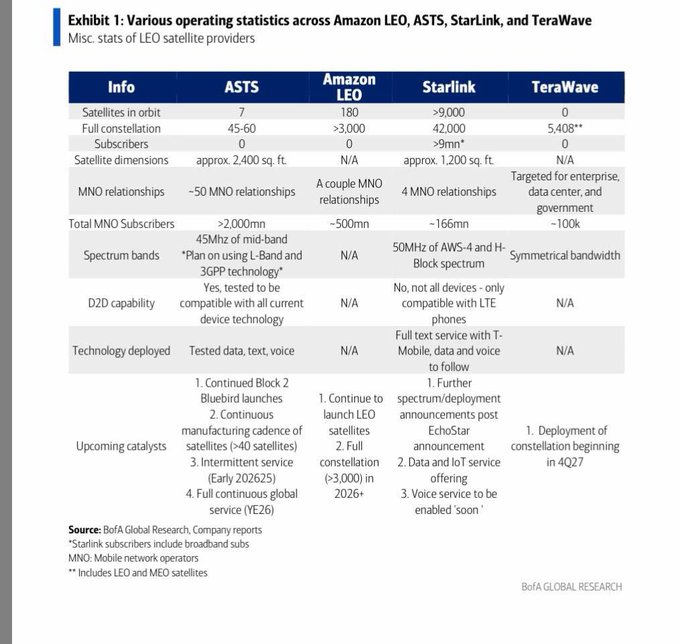
Starlink vs AST SpaceMobile: Will the winner take it all?

January 25, 2026 by editorial

Chris Forrester — CE Noticias Financieras (CENF), a well-regarded university-backed financial publication which focuses on Latino and Iberian financial news, suggests in a Jan 19 feature story that “Elon Musk has lost the space mobile race before it has even begun.”  The report says bluntly: “The fiercest space race isn’t about returning to the moon.

It’s about allowing you to make a TikTok or watch Netflix on your phone anywhere on the planet, from the salt flats of Atacama to the dunes of Khongor in the Gobi Desert. To make this happen, two radically different design philosophies are at war, and several companies are building the infrastructure needed to ensure that every phone on the planet is permanently connected to the Internet.”

CENF compares and contrasts the two very active players, saying correctly that on the one hand there’s Elon Musk’s SpaceX and its Starlink system, and the other being AST SpaceMobile (AST), and the other wannabee Chinese players along with Amazon’s LEO and a handful of much smaller would-be operators.

But since the story was published we’ve had Jeff Bezos and his Blue Origin rocket company announce their TeraWave mega-constellation. Some observers are wondering why Bezos/Blue Origin is backing TeraWave, and sister business Amazon is backing its Amazon Leo broadband system, which would also impact the Starlink vs AST argument.

The focus on AST is justified. While Starlink has its direct relationship with consumers (currently more than 9 million, and probably well on its way to 10 million by February). But AST wants to supply its dozens of telco partners with barely 100 satellites in orbit (Elon currently has more than 9000 in orbit and wants 34,400). AST is not looking for its own relationship with consumers, depending on revenue shares with the likes of AT&T, Verizon, Vodafone, Rakuten and its many other telco friends around the world.

The eventual prize is cellular freedom and connectivity for users, or to repeat the old Martini advert: “Anytime, any place, anywhere” on the planet.

Four investment banks (Bank of America, Goldman Sachs, JPMorgan Chase, and Morgan Stanley according to the Financial Times) are drooling with the prospects of mounting an IPO this year for SpaceX, but AST is already publicly quoted and bankers are deep in their fiscal examinations and due diligence on what AST might deliver as the next year or two unfolds.

Deutsche Bank, for example, on January 20 suggests it’s important that AST launch at least 4 out of its planned 5 launches by the end of March to demonstrate launch acceleration. There’s an unconfirmed launch pending with Blue Origin’s New Glenn, probably in February. They are already 6 satellites late (from December 2025), says the bank’s report or equal to two launches, so it’s almost a certainty this initial target has been missed.

“To be clear, we don’t think it matters if the timeline slips a little (eg 1 of the 5 launches scheduled by end of 1Q slips into 2Q and/or one of the 2026 planned launches spills into early 2027). The point is that AST needs to show that it can accelerate the launch cadence and deliver a 24-hour continuous service to its MNO partners in late 2026/1H27,” stated Deutsche Bank. The bank also expects new “premium service tiers” to emerge from AST’s partners and for meaningful revenues to begin flowing next year.

“We believe that AST has the MNO partnerships in place to be successful and scale its D2D business, while also adding incremental revenue in government and potentially enterprise over time,” says the bank, which has resulted in the bank upping its price target for AST from $81 to $137 per share and reiterating a “BUY” rating.

Deutsche Bank is forecasting 3 New Glenn launches and 5 Falcon 9 launches with each carrying multiple satellites.

Other bankers are also not shy in jumping into the AST prediction business. Capital market business Clear Street, for example, has also tipped AST at $137 (from $87) and repeated a “BUY” rating and its optimism helped by the US government’s award of Golden Dome contracts to AST, saying: “We remain bullish on the direct-to-cellular market, as rising competition from SpaceX/Starlink (private) is likely to push mobile network operators to rely more heavily on AST partnerships to defend subscriber bases.”

However, CE Noticias Financieras is persuaded that fewer satellites are better for humanity than more. It quotes Jonathan McDowell, an astrophysicist and acknowledged expert at the Harvard-Smithsonian Center for Astrophysics, who says: “Personally, I prefer a smaller number of larger satellites. One reason is the risk of space collisions. If you have 10 times more satellites, you have 100 times more near misses. So, just from that point of view, consolidating into a smaller number of satellites seems more sensible.”

But that view, however, sensible, has already been lost with SpaceX’s “brute force” and proliferation of satellites. Amazon’s Project Leo plans to launch more than 3,200 satellites.  Chinese companies are planning two separate mega-constellations, Guowang and G60 Starlink, with a total of nearly 26,000 satellites, and talking of 200,000+ satellites. “We are only at the beginning of this, ” warns McDowell. “And that becomes very worrying because now it’s not just one company, it’s a lot of companies.”

Which makes any sensible forecast near-impossible. China might completely upset the apple cart, while smaller players such as Canada’s Lightspeed might also play a disruptive role, as could the likes of Lynk Global, Apple/Globalstar or Abu Dhabi’s Space42/Viasat combination. However, the laser-linked TeraWave might eliminate Rivada Space Network from the potential mix.

Filed Under: News

  • « Go to Previous Page
  • Page 1
  • Interim pages omitted …
  • Page 12
  • Page 13
  • Page 14
  • Page 15
  • Page 16
  • Go to Next Page »

Primary Sidebar

WEEKLY NEWSLETTER

Archives

  • September 2026
  • August 2026
  • July 2026
  • June 2026
  • May 2026
  • April 2026
  • March 2026
  • February 2026
  • January 2026
  • December 2025
  • November 2025
  • October 2025
  • September 2025
  • August 2025
  • July 2025
  • June 2025
  • May 2025
  • April 2025
  • March 2025
  • February 2025
  • January 2025
  • December 2024
  • November 2024
  • October 2024
  • September 2024
  • August 2024
  • July 2024
  • June 2024
  • May 2024
  • April 2024
  • March 2024
  • February 2024
  • January 2024
  • December 2023
  • November 2023
  • October 2023
  • September 2023
  • August 2023
  • July 2023
  • June 2023
  • May 2023
  • April 2023
  • March 2023
  • February 2023
  • January 2023
  • December 2022
  • November 2022
  • October 2022
  • September 2022
  • August 2022
  • July 2022
  • June 2022
  • May 2022
  • April 2022
  • March 2022
  • February 2022
  • January 2022
  • December 2021
  • November 2021
  • October 2021
  • September 2021
  • August 2021
  • July 2021
  • June 2021
  • May 2021
  • April 2021
  • March 2021
  • February 2021
  • January 2021
  • December 2020
  • November 2020
  • October 2020
  • September 2020
  • August 2020
  • July 2020
  • June 2020
  • May 2020
  • April 2020
  • March 2020
  • February 2020
  • January 2020
  • December 2019
  • November 2019
  • October 2019

© 2019–2026 SatNews

Insert/edit link

Enter the destination URL

Or link to existing content

    No search term specified. Showing recent items. Search or use up and down arrow keys to select an item.
      x
      Sign Up Now!

      Enjoy a free weekly newsletter with recent headlines from the global SmallSat industry.

      Invalid email address
      We promise not to spam you. You can unsubscribe at any time.
      Thanks for subscribing! You will now receive weekly SmallSat News updates.
      We love our advertisers.
      And you will too!

      Please disable Ad Blocker to continue... We promise to keep it unobtrusive.
      We promise not to spam you. You can unsubscribe at any time.
      Invalid email address
      Thanks for subscribing!