• Skip to main content
  • Skip to primary sidebar
  • Home
  • News
  • Featured
  • More News ⌄
    • SatNews
    • SatMagazine
    • MilSatMagazine
  • Events ⌄
    • MilSat Symposium
    • SmallSat Symposium
    • Satellite Innovation
  • Contacts
  • SUBSCRIPTION

SmallSat News

You are here: Home / Archives for News

News

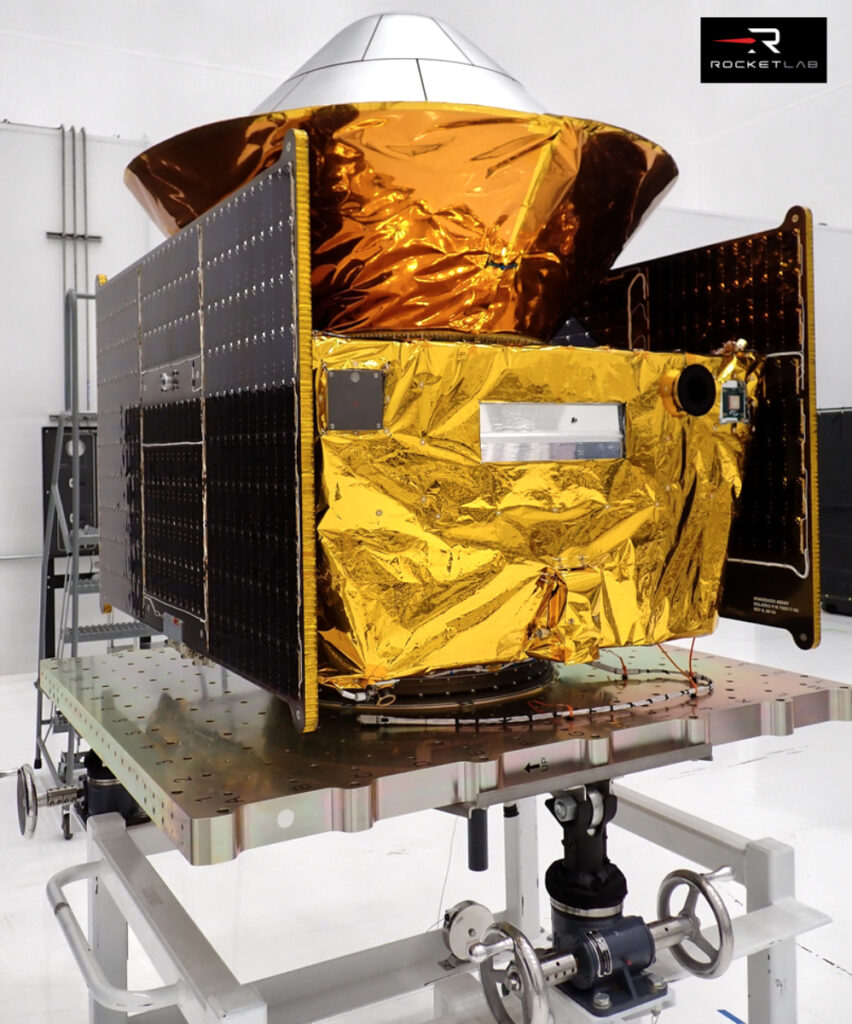
Rocket Lab’s 2nd reentry class spacecraft for Varda operating on-orbit supporting payloads for AFRL + NASA

January 17, 2025 by editorial

Rocket Lab USA, Inc. (Nasdaq: RKLB) has announced its second Pioneer spacecraft for Varda Space Industries, Inc. is successfully operating on orbit — the mission launched on January 14, from Vandenberg Space Force Base.

Varda’s W-2 mission includes a Rocket Lab Pioneer spacecraft and a Varda a re-entry capsule carrying a spectrometer from the Air Force Research Laboratory (AFRL). The capsule employs a heatshield with a Thermal Protection System (TPS) developed in collaboration with NASA’s Ames Research Center in California’s Silicon Valley.

These payloads are in addition to Varda’s expanded pharmaceutical reactor which will expand capability and capacity for pharmaceutical processing. The W-2 mission follows on from Rocket Lab’s first mission for Varda, which operated on-orbit for eight months before returning to Earth in early 2024 in a successful demonstration of the world’s first orbital manufacturing mission conducted outside of the International Space Station.
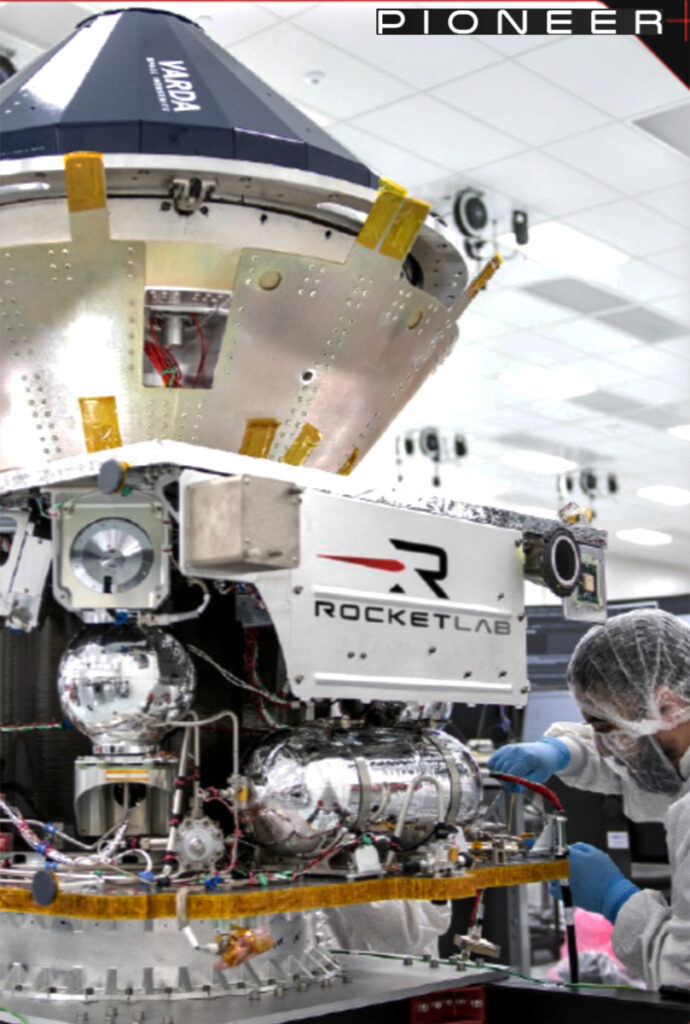
Like the first Pioneer spacecraft for Varda, the W-2 Pioneer is delivering critical mission functions for Varda’s 120 kg capsule including power, communications, propulsion, and attitude control.

Following the payload processing phase on-orbit, Rocket Lab’s spacecraft will guide and position Varda’s capsule for deorbit, enabling a hypersonic re-entry and recovery at the Koonibba Test Range in South Australia, operated by Southern Launch.

The Pioneer spacecraft was designed, built, and tested at Rocket Lab’s Spacecraft Production Complex and headquarters in Long Beach, California. It integrates Rocket Lab’s vertically developed components and systems, including star trackers, propulsion systems, reaction wheels, solar panels, flight software, radios, composite structures, tanks, separation systems, and more.

The W-2 mission is the second of four spacecraft ordered by Varda to support orbital processing, with the third spacecraft complete and awaiting shipment for launch.

“Another Rocket Lab spacecraft is in orbit, performing well, and supporting innovative new space capabilities for our mission partners Varda Space Industries,” said Rocket Lab founder and CEO, Sir Peter Beck. “We’ve built a deep expertise in guidance, navigation, and control, allowing us to precisely manage spacecraft operations in some of the most demanding environments, ensuring that our customers, like Varda, can rely on us to safely and accurately deliver their mission goals, from on orbit operations to capsule re-entry.”

“Varda and its partners are building a foundation layer for the orbital economy. The W-2 mission is in service of this goal,” said Varda CEO and co-founder, Will Bruey. “We are looking forward to many more successful missions, and a world where products made in orbit are seen as common place.


Filed Under: News

Exolaunch delivers 34 satellites to orbit during the Transporter-12 Rideshare Mission with SpaceX

January 17, 2025 by editorial

Exolaunch successfully delivered 34 satellites for its global customers across 17 countries.
Artistic rendition of the smallsats on-orbit is courtesy of SpaceX.

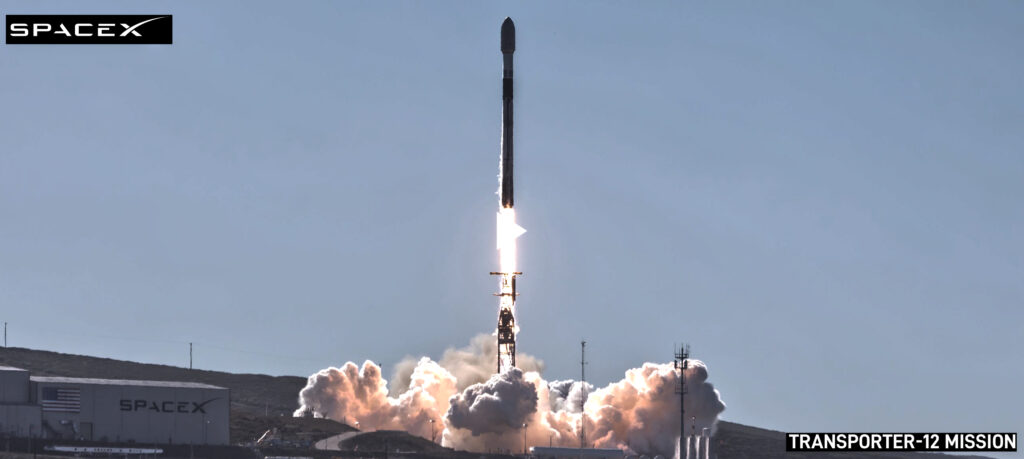
Exolaunch has successfully delivered 34 satellites into orbit during the Transporter-12 rideshare mission with SpaceX which launched from Vandenberg Space Force Base in California on January 14, 2025 at 11:09 am PT.

This event marks Exolaunch’s first launch of 2025 and the company’s 32nd mission overall, continuing the company’s track record of providing reliable and precise satellite integration and deployment services.

Exolaunch’s satellites on the mission included 20 cubesats and 14 microsats for its customers across 17 countries. These satellites represent a wide range of missions, including Earth observation, climate monitoring, connectivity, and scientific research.

Using its flight-proven CarboNIX separation rings and EXOpod Nova deployers, Exolaunch successfully deployed over 1,500 kg of satellite mass into orbit, each on a mission to improve life on Earth. Additionally, multiple other deployments are planned in the weeks following launch.

Photo is courtesy of SpaceX

“Our first mission of 2025 sets the stage for another active year at Exolaunch,” said Jeanne Allarie, chief commercial officer at Exolaunch.

“Transporter-12 is a testament to the trust our customers place in us and the strength of our partnership with SpaceX. We are proud to support the success of such a diverse group of missions.”

Payload positions

Exolaunch provided its end-to-end services in launch procurement, mission management, global shipping and logistics, integration, and hardware to the following customers:

  • AlainSat-1 (United Arab Emirates University)
  • Balkan-1 (EnduroSat)
  • BRO-16 (Unseenlabs)
  • BUZZZER-1 (Unseenlabs)
  • constellr SkyBee 1 (Constellr)
  • EDISON-1 (Space Inventor)
  • Firefly-1, Firefly-2, Firefly-3 (Pixxel)
  • Fledgling Veery “Barb” (Care Weather)
  • GARAI-A (Satlantis)
  • GESat GEN1 (Kongsberg NanoAvionics, Absolut Sensing)
  • HCT-SAT1 (Mohammed Bin Rashid Space Centre)
  • ICEYE 2 (ICEYE)
  • ICEYE 3 (ICEYE)
  • ICEYE 4 (ICEYE)
  • InnoCube (TU Berlin)
  • IRIS-F2, IRIS-F3 (Satoro)
  • LEMUR 2 WILSON, LEMUR 2 ALISIA, LEMUR 2 ROUNDTRIPPER, LEMUR 2 MYNAMEISJEFF (Spire)
  • OroraTech FOREST-3 (Ororatech)
  • SCOT (OrbAstro)
  • TROLL (TRL Space)

In addition, Exolaunch provided hardware and integration services for the following satellites:

  • FGN-100-d1 (Fergani)
  • HEO-01 (Argotec)
  • NewSat-45 (Satellogic)
  • Pelican-1.5 (Planet)
  • SIGI (Reflex Aerospace)
  • TATO, BlueBon (via Impulse Space’s Orbital Transfer Vehicle)
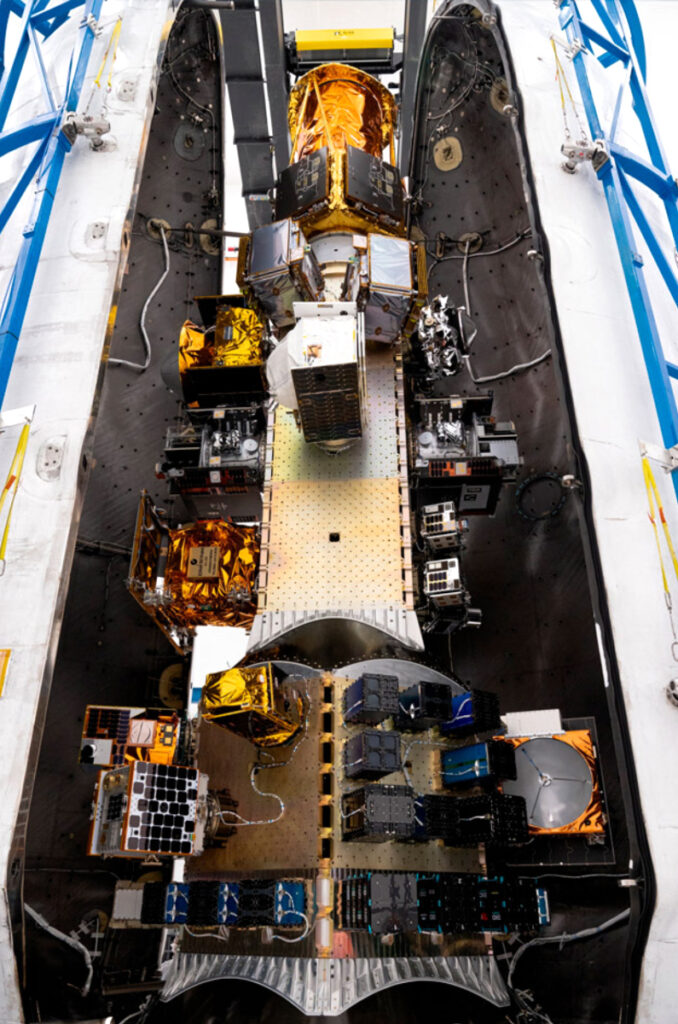
Photo of the EXOpod deployers aboard the Transporter-12 mission. Photo is courtesy of SpaceX.

Transporter-12 continues Exolaunch’s long-standing collaboration with SpaceX, with the company launching on every Transporter mission since the program’s inception.

With its first mission of the year successfully completed, Exolaunch is poised to deliver multiple launches in 2025, further advancing its mission to enable access to space for a wide range of customers worldwide.

Filed Under: Featured, News

Planet launches high-resolution Pelican-2 satellite plus 36 SuperDoves

January 16, 2025 by editorial

Artistic rendition of Planet’s Pelican-2 satellite, courtesy of the company.

Planet Labs PBC (NYSE:PL) has announced the company’s high-resolution Pelican-2 satellite and 36 SuperDoves of Flock 4G were successfully launched to orbit on SpaceX’s Transporter-12 Rideshare mission from Vandenberg Space Force Base in California — the Planet team has successfully made contact with Pelican-2 and has started its commissioning process.

Pelican-2 joins Pelican-1 (a smallsat platform tech demonstration launched last year ) as part of Planet’s next-generation, high-resolution fleet, to support and expand its existing SkySat capabilities. Planet plans to launch additional Pelicans this year.

Pelican-2 is designed to provide up to 40 cm class resolution imagery across 6 multispectral bands optimized for cross-sensor analysis. Planet has collaborated with NVIDIA to equip Pelican-2 with the NVIDIA Jetson platform to power on-orbit computing—with the aim of vastly reducing the time between data capture and value for customers.

The Jetson family of modules all use the same NVIDIA CUDA-X™ software, and support cloud-native technologies like containerization and orchestration to build, deploy, and manage AI at the edge.

Filed Under: News

Varda’s W-2 spacecraft launched to orbit with SpaceX with Koonibba Test Range up next

January 15, 2025 by editorial

Varda Space Industries has announced the successful launch of the company’s second orbital processing spacecraft and re-entry capsule, W-2, which lifted off aboard the Transporter-12 rideshare mission with SpaceX from Vandenberg Space Force Base in California.

The W-2 capsule will orbit Earth for the next few weeks before re-entering the Earth’s atmosphere and landing at the Koonibba Test Range in South Australia. This will be Australia’s first ever commercial spacecraft re-entry and marks an exciting new chapter in our nation’s spacefaring history.

The W-2 capsule carries payloads from Varda partners, including a spectrometer from the Air Force Research Laboratory (AFRL), and employs a heat shield with a Thermal Protection System (TPS) developed in collaboration with NASA’s Ames Research Center in California’s Silicon Valley. These payloads are in addition to Varda’s expanded pharmaceutical reactor.

Southern Launch was responsible for securing all required Australian approvals for the mission and has coordinated an end-to-end service for managing the re-entry process and retrieval of the capsule from the Australian desert once it lands back on Earth.

Photo of the Koonibba Test Ranger, courtesy of Southern Launch

Varda Space Industries are pioneers in developing orbital manufacturing capsules and have selected Southern Launch for their next three W-Series missions. The natural advantages of the space environment, in particular microgravity, enables the production of improved pharmaceutical formulations that cannot be produced anywhere on Earth.

The W-2 capsule carries payloads from Varda partners, including a spectrometer from the Air Force Research Laboratory (AFRL), and employs a heat shield with a Thermal Protection System (TPS) developed in collaboration with NASA’s Ames Research Center in California’s Silicon Valley. These payloads are in addition to Varda’s expanded pharmaceutical reactor. Southern Launch operates the Koonibba Test Range in partnership with the Koonibba Community Aboriginal Corporation.

The Koonibba Test Range offers the greatest return flexibility given the low airspace and uninhabited land. Until the first Varda mission in 2023, all in-space manufacturing was carried out on the International Space Station. The W-Series missions will usher in a new era of commercial in-space manufacturing.

The return authorization for the mission was granted by the Australian Government in October 2024 and was the first authorization approved for a domestically returning spacecraft under the amended Space (Launches and Returns) Act 2018.

Lloyd Damp, CEO, Southern Launch, said, “The successful launch of the W-2 capsule is only the beginning of this incredibly exciting mission. Our team is now focused on the safe return and recovery of the capsule to the Koonibba Test Range.’ ‘By the end of this decade, it is predicted that we will all be using items that contain some element that is produced off Earth we are incredibly proud to bring this industry to South Australia.’ ‘In-space manufacturing is the next evolution of our industry capacity as humans. We are so proud to bring this mission to Australia and this first mission signals a new wave of excitement as to what is possible both here on Earth and in space.“

Will Bruey, CEO, Varda Space Industries, said, “Varda is honored to perform Australia’s first commercial space re-entry, and we’re excited to partner with our friends at Southern Launch to support the development of a thriving Australian space sector. Australia is clear-eyed about the promise of orbital pharmaceutical processing, and Southern Launch have led the way for the future of space infrastructure on Earth.”

Corey McLennan, CEO, Koonibba Community Aboriginal Corporation, said, “The Koonibba Test Range offers more than 41,000 square kilometres of uninhabited land to accept the re-entry of in-space manufacturing capsules,’ says Corey. ‘This open space is essential to accept spacecraft returns and for low-earth orbit to be the genesis of a new era of advanced manufacturing in Australia.”

About Southern Launch
Southern Launch is a launch and range service provider, headquartered in Adelaide, South Australia. Southern Launch operates the Koonibba Test Range and Whalers Way Orbital Launch Complex. The Koonibba Test Range is one of the largest commercial rocket testing facilities in the world. The range is used to launch sub-orbital missions and accept re-entries of space technology. The Whalers Way Orbital Launch Complex at the tip of the Eyre Peninsula in South Australia supports high-cadence orbital launches into the highly sought after polar and sun synchronous orbits. Southern Launch expands space exploration from the Southern Hemisphere with end-to-end launch services for every space mission.

Filed Under: News

Digantara launches India’s 1st homegrown space surveillance mission via SpaceX’s Transporter-12

January 14, 2025 by editorial

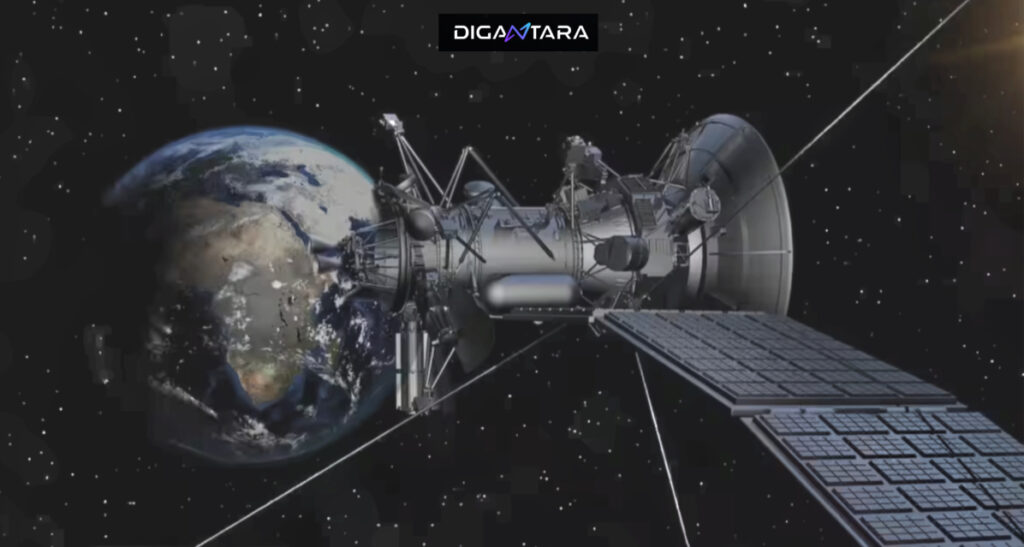
Digantara has announced the launch of the company’s SCOT (Space Camera for Object Tracking), inaugural mission that is dedicated to space surveillance and was launched aboard SpaceX’s Transporter-12 mission—SCOT aims to enhance space safety, optimize traffic management, and bolster national security initiatives.

As one of the world’s first commercial Space Situational Awareness (SSA) satellites, SCOT is engineered to track Resident Space Objects (RSOs) with unmatched frequency and precision. In an era where space is becoming increasingly crowded and competitive, SCOT is purpose-built to monitor smaller RSOs, deliver higher revisit rates, and provide enhanced tracking accuracy—filling a crucial gap left by current systems.

SCOT will be deployed in SSO, enabling it to track objects in LEO with greater efficiency than existing sensors, which are constrained by weather conditions, geographic limitations, and restricted fields of view (FoV). Unlike these traditional systems, SCOT offers persistent monitoring of Resident Space Objects (RSOs), detecting and tracking objects as small as 5 cm. This capability significantly minimizes data gaps and enhances the precision of space surveillance. The satellite forms a key part of Digantara’s mission to establish a hybrid network of surveillance systems, delivering persistent monitoring of the near-Earth environment to ensure improved safety and the long-term sustainability of space operations.

The launch of SCOT comes at a pivotal time when space is increasingly recognized as a critical component of national security, having sovereign capabilities is more essential than ever. As space operations become more complex—exemplified by missions such as ISRO‘s ongoing SpaDeX mission, actively tracked by Digantara—a comprehensive and continuous understanding of the space environment is crucial. This ensures safer spacecraft operations while providing a strategic advantage in an increasingly contested domain.

“Satellites serve as the backbone of the global economy, and any disruptions to their operations can trigger cascading impacts on Earth, affecting both economic stability and strategic security,” said Anirudh Sharma, CEO of Digantara. “With SCOT, we are taking a crucial step in achieving surveillance superiority, ensuring not only a safer and more sustainable space environment but also towards safeguarding sovereign assets in the face of an increasingly contested space domain.”

About Digantara
Digantara is a Space Surveillance and Intelligence company, specializing in Space Situational Awareness (SSA) with a focus on ensuring the safety, sustainability, and long-term viability of orbital operations. Leveraging advanced capabilities in space-based detection, tracking, identification, and monitoring, Digantara delivers comprehensive domain awareness across all orbital regimes. Through its unified platform, the company equips end-users with actionable intelligence, integrating critical data and insights for real-time decision-making.

Filed Under: News

Forrester’s Digest: UAE’s Space42 wants to build LEO constellation

January 14, 2025 by editorial

Artistic rendition of Space42’s Thuraya 4 satellite on-orbit.

Space42 is the newly-established combination of Abu Dhabi’s Al Yah (YahSat) and Bayanat AI, which operates the Thuraya fleet of satellites. Its latest, Thuraya 4, was launched on January 3rd into its transfer orbit and is on its way to a location at 44 degrees East. The company says that Thuraya 4 has a firm backlog of $799 million the company states they are looking to launch Direct-to-Device services with a new LEO constellation.

Space42 will enjoy an overall commitment from the UAE government worth almost $800 million
over a 15-year period.

The new craft will replace Thuraya 2 which was launched in 2003 and still remains in service. However, Thuraya 3, launched in 2008, suffered a power anomaly which has meant lower revenues from the craft.

Ali Al Hashemi, chief executive of Space42’s Yahsat Space Services division, said the company’s ambition is to become a global, non-terrestrial leader and to establish direct-to-device and IoT connections.

Initially these services would be simple Text and short-message services using the company’s geostationary satellites, and tap into 20 MHz of spectrum for D2D. Al Hashemi has said Space42 will move cautiously into the market but is convinced the business case is valid.

Filed Under: Featured, News

BlackSky wins USSF rapid procurement contracts to support TacSRT missions

January 13, 2025 by editorial

BlackSky Technology Inc. (NYSE: BKSY) has won multiple rapid procurement contracts for its high-margin, core analytics services through the U.S. Space Force’s online Global Data Marketplace (GDM) supporting a variety of Tactical Surveillance, Reconnaissance and Tracking (TacSRT) missions.

The GDM has supported Space Systems Command’s TacSRT pilot program and is designed to rapidly provide U.S. military combatant commands with access to insights for critical areas of interest worldwide.

The competitive, short duration TacSRT contracts team up multiple commercial data providers to cover specific requests for real-time operational planning products offering insight into global trends and events from violent extremism to humanitarian and disaster response as well as identification of potential threats.

“One year in operation, this novel marketplace increases speed and accessibility to BlackSky’s reliable high-cadence, low-latency dynamic monitoring capabilities,” said Brian O’Toole, BlackSky CEO. “BlackSky’s momentum with these quick-turn contracts represents a significant structural demand signal from a key customer for operationally relevant space-based products. BlackSky has demonstrated repeated success in delivering tailored products featuring our automated AI-driven analytics to meet a diverse set of complex, time-sensitive civil and military tactical SRT missions around the world,” said O’Toole. “The fast-paced, short period of performance aligns with our strengths: rapidly delivering actionable insights from our core product offerings that require minimal integration, lowering customer acquisition costs and accelerating development of new technology.”

About BlackSky
BlackSky is a real-time, space-based intelligence company that delivers on-demand, high frequency imagery, analytics, and high-frequency monitoring of the most critical and strategic locations, economic assets, and events in the world. BlackSky owns and operates one of the industry’s most advanced, purpose-built commercial, real-time intelligence systems that combines the power of the BlackSky Spectra® tasking and analytics software platform and our proprietary low earth orbit satellite constellation. With BlackSky, customers can see, understand and anticipate changes for a decisive strategic advantage at the tactical edge, and act not just fast, but first. BlackSky is trusted by some of the most demanding U.S. and international government agencies, commercial businesses, and organizations around the world. BlackSky is headquartered in Herndon, VA, and is publicly traded on the New York Stock Exchange as BKSY.

Filed Under: News

SageNet is now a Starlink authorized reseller

January 12, 2025 by editorial

SageNet is now an authorized reseller of Starlink by Space X to deliver high-speed, low-latency internet connectivity across the United States.

This reseller agreement integrates SpaceX’s Starlink LEO technology with SageNet’s comprehensive managed network services portfolio, which includes terrestrial, cellular and satellite solutions. As an authorized Starlink reseller, SageNet will provide complete turnkey satellite services—from installation and management to monitoring and maintenance—enabling enterprise and certain government clients to access secure, cost-effective and reliable high-speed connectivity.

The agreement offers several key advantages:

  • Enterprise and high-performance packages with fixed and mobility plans
  • Seamless integration with SageNet’s managed services model
  • Professional services and consolidated billing
  • Advanced API integrations for enhanced control and monitoring

SageNet is integrating Starlink’s capabilities into its proprietary SageVision platform, providing customers with unprecedented visibility into network performance, including real-time latency monitoring, site status and configuration management.

The company projects installation or support of more than 2,000 LEO satellite Earth station sites in the coming year, serving diverse clients from major retailers and pipeline companies to convenience store chains and government agencies. SageNet’s multi-orbit SD-WAN solutions offer rapid deployment capabilities and seamlessly fill gaps in terrestrial service coverage, providing a comprehensive connectivity solution for modern enterprises.

“After four decades of satellite service excellence, we’re thrilled to enhance our offerings with Starlink’s industry-leading LEO technology,” said John Brader, SageNet’s Executive Vice President of Satellite Services. “In this landmark year for non-geostationary satellite orbit services, we’re uniquely positioned to deliver multi-orbit, software-defined wide area network solutions nationwide. While SpaceX’s Starlink excels in rural connectivity, its applications extend far beyond remote locations. We’re seeing significant demand in urban and suburban areas where traditional broadband installation is cost-prohibitive or time-intensive.”

Filed Under: News

Rocket Lab on track in development of spacecraft constellation for SDA

January 10, 2025 by editorial

Rocket Lab National Security LLC has successfully completed the company’s Preliminary Design Review (PDR) for the Space Development Agency’s (SDA) Tranche 2 Transport Layer-Beta (T2TL-Beta) program — this milestone marks a critical step in Rocket Lab’s mission as a prime contractor to deliver 18 advanced, data transport satellites for the U.S. Department of Defense’s Proliferated Warfighter Space Architecture (PWSA).

The milestone positions Rocket Lab to move into the detailed design phase of the $515 million firm-fixed-price contract awarded in early 2024. Under this agreement, Rocket Lab will design, integrate, test, and commission the 18 T2TL-Beta satellites. Rocket Lab leads a capable team of payload providers to provide vital capacity to the PWSA, a cutting-edge low-Earth orbit (LEO) satellite constellation designed to provide secure, low-latency communications and missile tracking to the warfighter.

The PDR is a comprehensive multi-day milestone that ensures the satellite design meets rigorous mission requirements and establishes a solid foundation for production, testing, and operations. The review covered the mission architecture, the space vehicle, launch, operations, and ground systems, along with planned integration and test activities, requirements, technology maturity plans, and overall operational concept.

All 18 satellites will use Rocket Lab’s vertically integrated subsystems and components, including solar panels, composite structures, star trackers, reaction wheels, radios, flight & ground software, avionics, launch dispensers, and more. This high degree of vertical integration gives Rocket Lab a unique level of control over its supply chain, enabling efficiencies and certainty on cost, schedule, and quality.

“This milestone underscores Rocket Lab’s commitment to delivering world-class satellite solutions for national defense,” said President and CEO of Rocket Lab National Security, Brad Clevenger. “Our vertically integrated approach and innovative technologies enable us to meet demanding requirements with precision and efficiency. With this achievement, we are one step closer to deploying advanced satellite systems that will strengthen U.S. defense capabilities in space.”

Filed Under: Featured, News

Spire to launch LEMUR satellites via SpaceX

January 10, 2025 by editorial

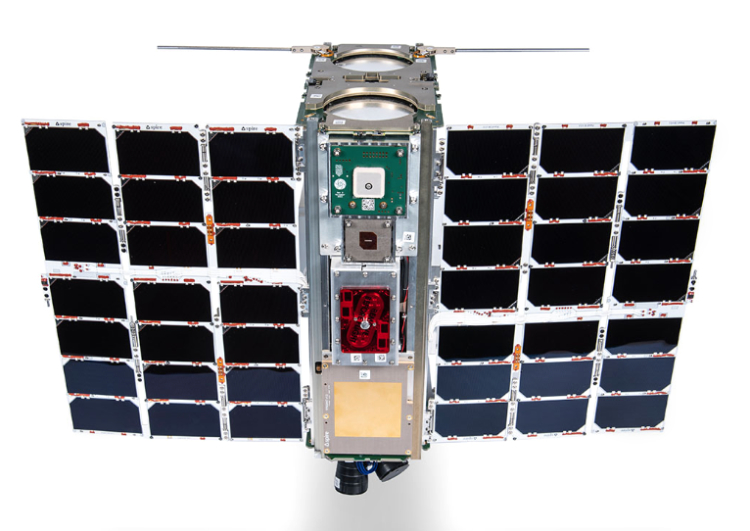
A Spire Global LEMUR satellite image, courtesy of the company.

Spire Global will be launching six LEMUR satellites aboard the SpaceX Transporter-12 mission, advancing IoT connectivity, weather forecasting, and maritime monitoring. 

Two LEMUR 3 satellites, developed in collaboration with Myriota, will expand global IoT coverage with cutting-edge direct-to-orbit communications, enabling Myriota’s IoT solutions to operate seamlessly and more effectively.

This network will enhance connectivity for critical sectors such as agriculture, defense, and logistics across regions like the US, Europe, and Latin America, promoting sustainability and efficient resource management.

Additionally, three satellites equipped with advanced atmospheric sensors and AIS systems will elevate Spire’s weather forecasting and maritime traffic monitoring, providing essential data for aviation and reconnaissance. These innovations underscore the transformative role of space technology in addressing global challenges, from resource management to environmental conservation.

Spire Global appoints new CEO and industry vets for executive team

Spire Global (NYSE: SPIR) has also recently announced that Theresa Condor, who currently serves as Chief Operating Officer and a board member, has been appointed as the new Chief Executive Officer of the company. Condor assumed the role on January 1, 2025, and Founder and CEO Peter Platzer will become Executive Chairman as part of a planned leadership transition.

Spire Global LEMUR small satellite.

After 12 years at the helm of the Company, Platzer’s tenure as CEO was marked with several milestones that he set out to achieve before transitioning into the Executive Chairman role, including rapidly scaling the Company from $10 million to more than $100 million in revenue and taking it public. He also oversaw the Company’s recent agreement to sell its maritime business for approximately $241 million, which Spire intends to use to retire all outstanding debt and invest in near-term growth opportunities.

As Executive Chairman, Platzer will guide Spire’s vision and lead the Board of Directors, as well as focus on securing major opportunities to drive the Company’s growth strategy. He will remain involved in select investor engagements and speak at events about the burgeoning commercial space opportunity.

Condor, who was part of the Company’s founding team, has led the expansion of Spire’s solution offerings and business lines, growing the Company’s customer base to more than 745 customers across 65 countries. As CEO, she intends to lead Spire into its next phase of growth with a focus on streamlining operations and strong execution at scale.

“Peter has an incredible vision for how satellite technology and space can improve our lives here on Earth, and that vision has guided the growth of Spire since the company was founded,” said Will Porteous, Spire Board Member. “Theresa has been instrumental in turning that vision into reality. She has a deep understanding of Spire’s customers, the business, and its operations that will be transformational for the company as it enters this next phase of growth as an increasingly profitable company.”

The Company has also appointed two aerospace industry veterans to join its executive bench. Celia Pelaz, a former Airbus executive, will serve as Chief Operating Officer, assuming responsibility for the Company’s revenue and operations. And Gabriel Oehme will serve as Chief Transformation Officer following spent 22 years at Airbus in roles including operations, business development, procurement and sales. Pelaz and Oehme assumed their positions on January 6, 2025.

“Celia and Gabriel bring invaluable institutional knowledge of the aerospace industry and a wealth of expertise in operations, having effectively managed businesses centered on manufacturing and engineering,” said Condor. “With our recent agreement to sell our maritime business, we are at a transformational point as we seek to become a debt-free company with proven space infrastructure and technology. We are in a strong position to capitalize on significant near-term opportunities that generate long-term value. Celia and Gabriel’s experience will be integral in helping us seize these opportunities through focused execution and operational excellence at scale.”

Leo Basola has informed the Company that he will step down from his role as Chief Financial Officer once the Company completes its previously disclosed review of certain accounting practices and the related restatement of prior period financial statements. Thomas Krywe, Spire’s former CFO, will assume an interim role while the Company searches for Basola’s replacement. Krywe has worked as a consultant for the Company since August 2024 and was instrumental in signing the agreement to sell Spire’s maritime business.

Filed Under: News

  • « Go to Previous Page
  • Page 1
  • Interim pages omitted …
  • Page 44
  • Page 45
  • Page 46
  • Page 47
  • Page 48
  • Interim pages omitted …
  • Page 339
  • Go to Next Page »

Primary Sidebar

WEEKLY NEWSLETTER

Archives

  • August 2026
  • July 2026
  • June 2026
  • May 2026
  • April 2026
  • March 2026
  • February 2026
  • January 2026
  • December 2025
  • November 2025
  • October 2025
  • September 2025
  • August 2025
  • July 2025
  • June 2025
  • May 2025
  • April 2025
  • March 2025
  • February 2025
  • January 2025
  • December 2024
  • November 2024
  • October 2024
  • September 2024
  • August 2024
  • July 2024
  • June 2024
  • May 2024
  • April 2024
  • March 2024
  • February 2024
  • January 2024
  • December 2023
  • November 2023
  • October 2023
  • September 2023
  • August 2023
  • July 2023
  • June 2023
  • May 2023
  • April 2023
  • March 2023
  • February 2023
  • January 2023
  • December 2022
  • November 2022
  • October 2022
  • September 2022
  • August 2022
  • July 2022
  • June 2022
  • May 2022
  • April 2022
  • March 2022
  • February 2022
  • January 2022
  • December 2021
  • November 2021
  • October 2021
  • September 2021
  • August 2021
  • July 2021
  • June 2021
  • May 2021
  • April 2021
  • March 2021
  • February 2021
  • January 2021
  • December 2020
  • November 2020
  • October 2020
  • September 2020
  • August 2020
  • July 2020
  • June 2020
  • May 2020
  • April 2020
  • March 2020
  • February 2020
  • January 2020
  • December 2019
  • November 2019
  • October 2019

© 2019–2026 SatNews

Insert/edit link

Enter the destination URL

Or link to existing content

    No search term specified. Showing recent items. Search or use up and down arrow keys to select an item.
      x
      Sign Up Now!

      Enjoy a free weekly newsletter with recent headlines from the global SmallSat industry.

      Invalid email address
      We promise not to spam you. You can unsubscribe at any time.
      Thanks for subscribing! You will now receive weekly SmallSat News updates.
      We love our advertisers.
      And you will too!

      Please disable Ad Blocker to continue... We promise to keep it unobtrusive.
      We promise not to spam you. You can unsubscribe at any time.
      Invalid email address
      Thanks for subscribing!