

• Skip to main content
  • Skip to primary sidebar
  • Home
  • News
  • Featured
  • More News ⌄
    • SatNews
    • SatMagazine
    • MilSatMagazine
  • Events ⌄
    • MilSat Symposium
    • SmallSat Symposium
    • Satellite Innovation
  • Contacts
  • SUBSCRIPTION

SmallSat News

You are here: Home / Archives for News

News

Eutelsat America Corp. + OneWeb Technologies partner with Hughes to deliver LEO capability to the L3Harris multi-mission RASOR ecosystem

February 11, 2025 by editorial

Eutelsat America Corp. and OneWeb Technologies Inc (EACOWT), operating in combination as a wholly owned independent U.S. proxy company and subsidiary of Eutelsat Group, have announced a contract with Hughes Network Systems, LLC (Hughes), an EchoStar company (Nasdaq: SATS), to develop an enterprise-grade OneWeb capable LEO modem transceiver Circuit Card Assembly (CCA) that will support EACOWT’s contract with L3Harris Technologies (NYSE:LHX) for the Air Force Research Laboratory’s (AFRL) Defense Experimentation Using Commercial Space Internet (DEUCSI) Call 003 program.

RASOR

This hybrid SATCOM technology will deliver resilient Eutelsat OneWeb LEO broadband connectivity to the L3Harris RASOR Ecosystem, a scalable and configurable waveform solution that unifies multiple line-of-sight and beyond line-of-sight capabilities into a single unit. It will provide military users with flexible software-defined multi-orbit connectivity for critical Comms on the Pause (COTP), Comms on the Move (COTM) and Aero applications through the AFRL’s DEUCSI Call 003 program. The partners will deliver this future-proof Eutelsat OneWeb LEO capability, helping to augment military communications by leveraging agile, commercial satellite innovation, beginning in 2025.

As a Eutelsat OneWeb and EACOWT distribution partner, Hughes has delivered and developed the OneWeb gateway electronics and core modules that enable military users to access OneWeb LEO broadband connectivity.

EACOWT is a leading provider of satellite services for the U.S. government and its allies, committed to ensuring customers’ access to the most reliable SATCOM capabilities available. Together, EACOWT and Hughes have delivered OneWeb LEO capabilities in the Arctic region for AFRL since 2021.

“Hughes is developing this solution leveraging its deep expertise in the OneWeb gateway electronics, Satellite Subscriber Module (SSM) and systems architecture,” said Ian Canning, CEO of EACOWT. “In addition to its engineering capabilities, Hughes is a long-standing distribution and technology partner. They are well placed to support EACOWT to deliver seamless and innovative connectivity solutions to address military users’ multi-orbit mobility needs.”

“Hughes looks forward to developing this critical, multi-orbit solution, which will integrate Eutelsat OneWeb’s resilient LEO broadband connectivity into L3Harris’ innovative RASOR Ecosystem,” said Raghunandan Janardhan, vice president at Hughes Defense and Government Systems. “By collaborating with EACOWT, we are meeting military requirements for innovative, resilient satellite communications worldwide.”

Filed Under: News

Rocket Lab schedules the launch for 1st of multiple missions for BlackSky

February 11, 2025 by editorial

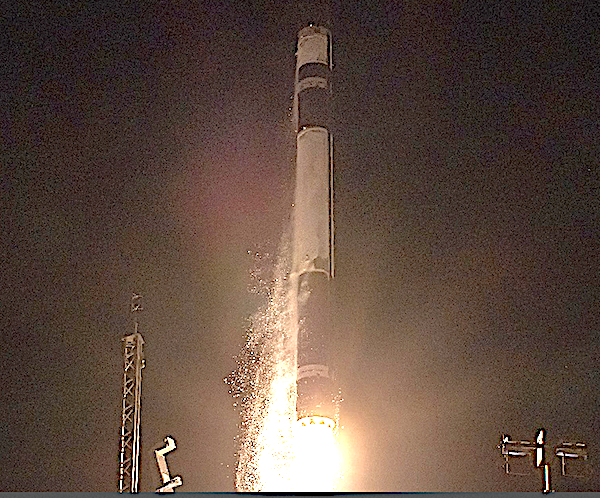
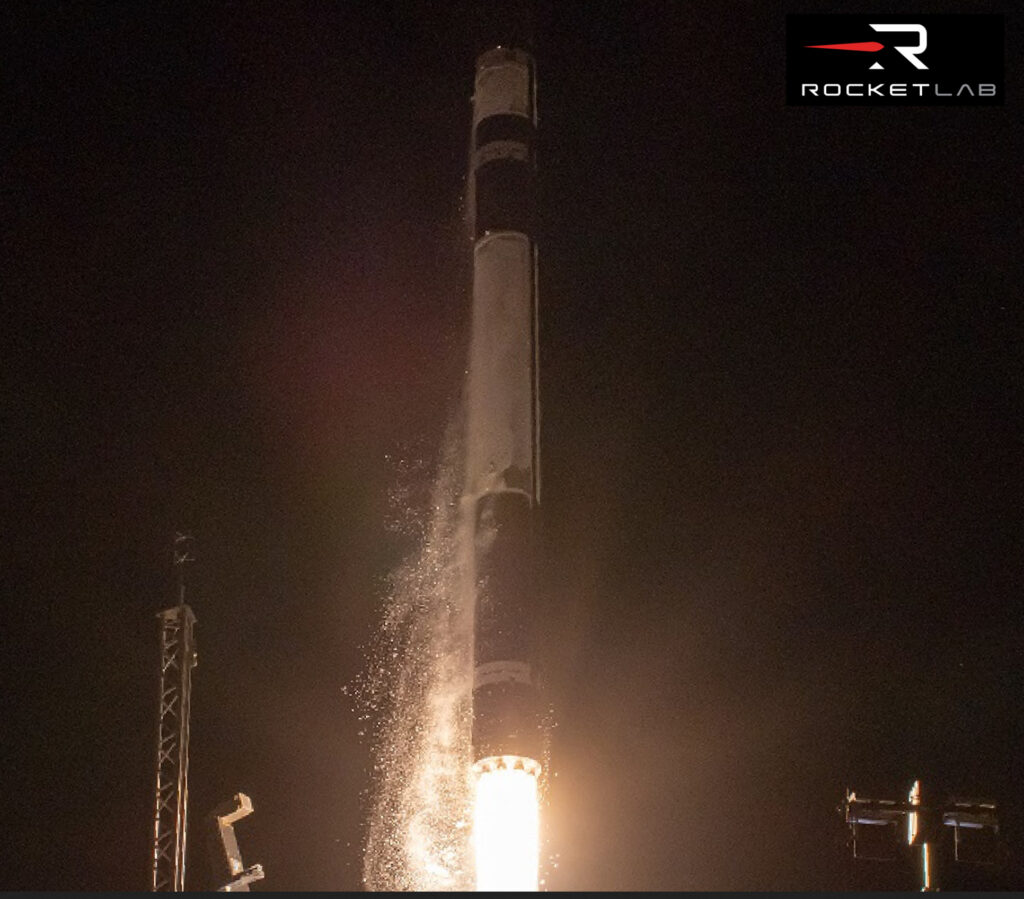
Photo of an Electron launch, courtesy of Rocket Lab.

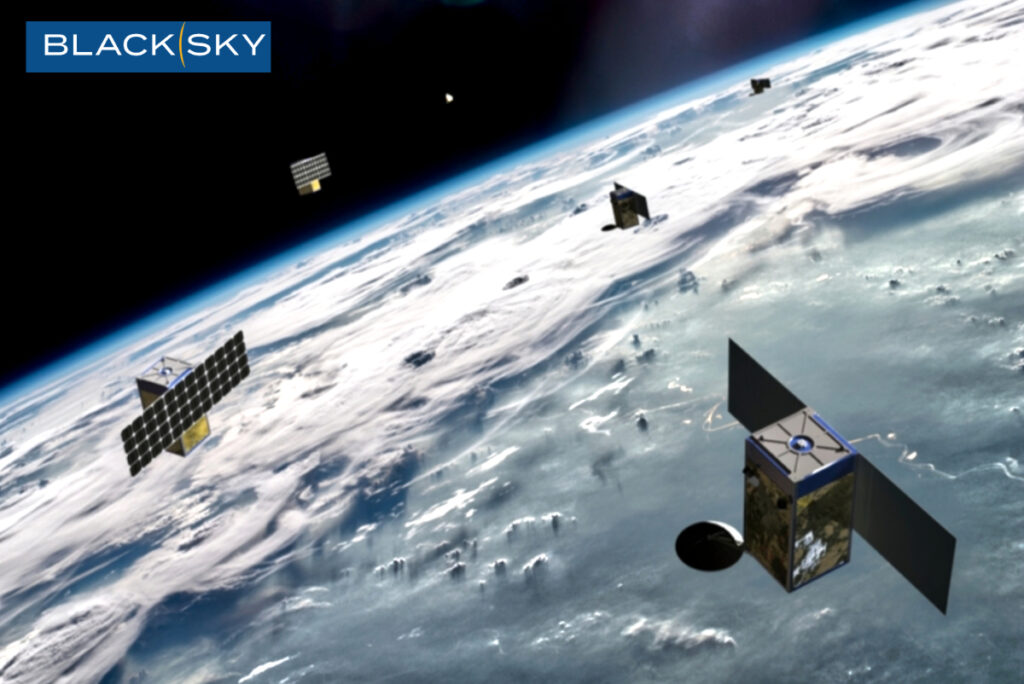
Rocket Lab USA, Inc. (Nasdaq: RKLB) will soon launch a satellite on a dedicated Electron mission, the first of a bulk order of multiple new missions for real-time space-based intelligence company BlackSky (NYSE: BSKY).

The mission, named “Fasten Your Space Belts”, will launch from Rocket Lab’s private orbital launch site, Rocket Lab Launch Complex 1, in New Zealand during a launch window that opens on February 18th UTC. The mission will launch the first Gen-3 satellite in BlackSky’s mid-inclination, Earth-imaging constellation to a circular 470 km orbit. The mission is the ninth launch for BlackSky since 2019, making Rocket Lab the most prolific launch provider for BlackSky’s constellation to date.

The mission will bring the total number of satellites delivered to space by Rocket Lab to 210 and follows a record year of 16 successful launches 2024. Each mission for BlackSky includes a Rocket Lab Motorized Lightband separation system for BlackSky’s satellites, demonstrating Rocket Lab’s vertical integration strategy and ability to provide commercial launch, satellite, and spacecraft components solutions across the mission spectrum.

“Fasten Your Space Belts” will be Rocket Lab’s second mission of 2025 and its 60th Electron launch overall. Rocket Lab’s 2025 launch manifest includes Electron missions for commercial and government customers, as well as HASTE missions from Launch Complex 2. Launch windows for each will be announced in due course.

Rocket Lab founder and CEO, Sir Peter Beck, said, “Electron is a trusted and reliable constellation builder for companies like BlackSky, allowing them to be in control of how, when, and where to deploy their constellation. BlackSky is one of our earliest and longest-standing commercial satellite customers, and it’s great to be heading back to the pad with them once again to continue to advance and expand their constellation.”

“This launch represents a major inflection point for our global defense and intelligence customer base as BlackSky introduces low-latency, very high-resolution Gen-3 satellite to our dynamic, high-frequency monitoring constellation,” said Brian O’Toole, BlackSky CEO. “As more Gen-3 satellites complete production, we expect a regular cadence of additional launches over the coming year.”

Filed Under: News

NASA awards launch service task order for the Pandora mission  

February 10, 2025 by editorial

NASA has selected SpaceX of Starbase, Texas, to provide the launch service for the agency’s Pandora mission, which will study at least 20 known exoplanets and their host stars to find out how changes in stars affect our observations of exoplanet atmospheres.

The selection is part of NASA’s Venture-Class Acquisition of Dedicated and Rideshare (VADR) launch services contract. This contract allows the agency to make fixed-price indefinite-delivery/indefinite-quantity awards during VADR’s five-year ordering period, with a maximum total value of $300 million across all contracts.

During its one-year primary mission, Pandora will observe each exoplanet 10 times, observing for 24 hours each visit. It will capture critical data about the planet and its host star during transits, an event where a planet crosses in front of the star it orbits.

The satellite will use an innovative 17-inch (45-centimeter)-wide all-aluminum telescope to simultaneously measure the visible and near-infrared brightness of the host star and obtain near-infrared spectra of the transiting planet. This will allow scientists to cleanly separate star and planetary signals, knowledge that will enhance observations from NASA’s James Webb Space Telescope and future missions searching for habitable worlds, like the agency’s Habitable Worlds Observatory.

Pandora is a joint effort between NASA’s Goddard Space Flight Center in Greenbelt, Maryland, and Lawrence Livermore National Laboratory in California. The Astrophysics Pioneers program, from the Astrophysics Division at NASA Headquarters in Washington, funds Pandora and other astrophysics science missions using smaller, lower cost hardware and payloads. NASA’s Launch Services Program, based at the agency’s Kennedy Space Center in Florida, manages the VADR contract.

Filed Under: Featured, News

ICEYE + SATIM enter partnership for new, AI-powered SAR imagery analysis product

February 10, 2025 by editorial

ICEYE, the global leader in Synthetic Aperture Radar (SAR) satellite operations for high-fidelity Earth Observation (EO), and SATIM, a world-leading provider of AI-based solutions for Automatic Target Recognition (ATR) on SAR imagery, have signed a partnership agreement for joint product development.

The companies will combine ICEYE’s industry-leading satellite imagery with SATIM’s cutting-edge AI-powered imagery analytics solutions into new products enabling prompt, high-confidence detection and classification of vessels, aircraft, and land vehicles. After an initial pilot phase, the partners plan to release a series of generally-available products in 2025. 

ICEYE owns and operates the world’s largest SAR satellite constellation, providing customers unprecedented access to 25 cm high-resolution imagery of any location on Earth, regardless of the weather conditions or day/night conditions. ICEYE’s unique, innovative satellites provide imagery with the industry’s highest resolution and scene sizes up to 840 km2, and hourly revisit rates for points around the globe. ICEYE has launched 44 satellites for its own and its customers’ use since 2018 and plans to launch more than 20 new satellites annually in 2025, 2026, and beyond.

SATIM is a world-leading AI technology company specializing in Automatic Target Recognition (ATR) using Synthetic Aperture Radar (SAR) imagery.  Harnessing the power of AI and SAR imagery, SATIM offers three highly accurate AI-based solutions that enable fast, highly accurate detection, classification, and identification of targets —anywhere, anytime. These advanced solutions are data-agnostic, near real-time, and cover a wide catalog of objects.

Rafal Modrzewski, CEO and Co-founder of ICEYE, said, “Our partnership with SATIM is an important step on our journey towards becoming the global source of truth. By combining our world-leading SAR imagery and capabilities with SATIM’s powerful AI-driven SAR image analytics, we will be able to serve our customers with easy, direct access to actionable intelligence and insights. Improving situational awareness with satellite-based intelligence will enable informed and rapid decision-making where it is needed the most.”

Jacek Strzelczyk, CEO and Co-founder of SATIM, said, ”At SATIM, we continue to set the standards in AI-powered SAR analytics, and our collaboration with ICEYE, a leading SAR imagery provider, is an important milestone in our pursuit of excellence. This partnership marks a significant step in our commitment to advancing space-based solutions that provide critical insights for those on Earth. As we continue to explore new ways to advance the field, this partnership represents an exciting step ahead, and we look forward to what lies ahead in this evolving landscape.”

Filed Under: News

Oxford Space Systems selected for UK EO mission

February 10, 2025 by editorial

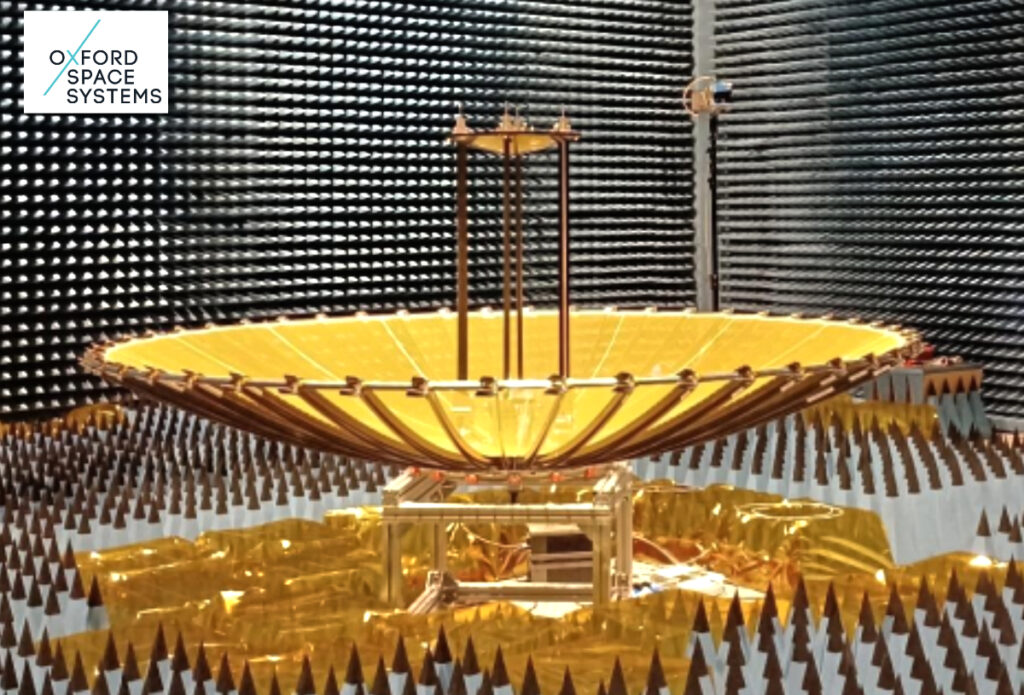
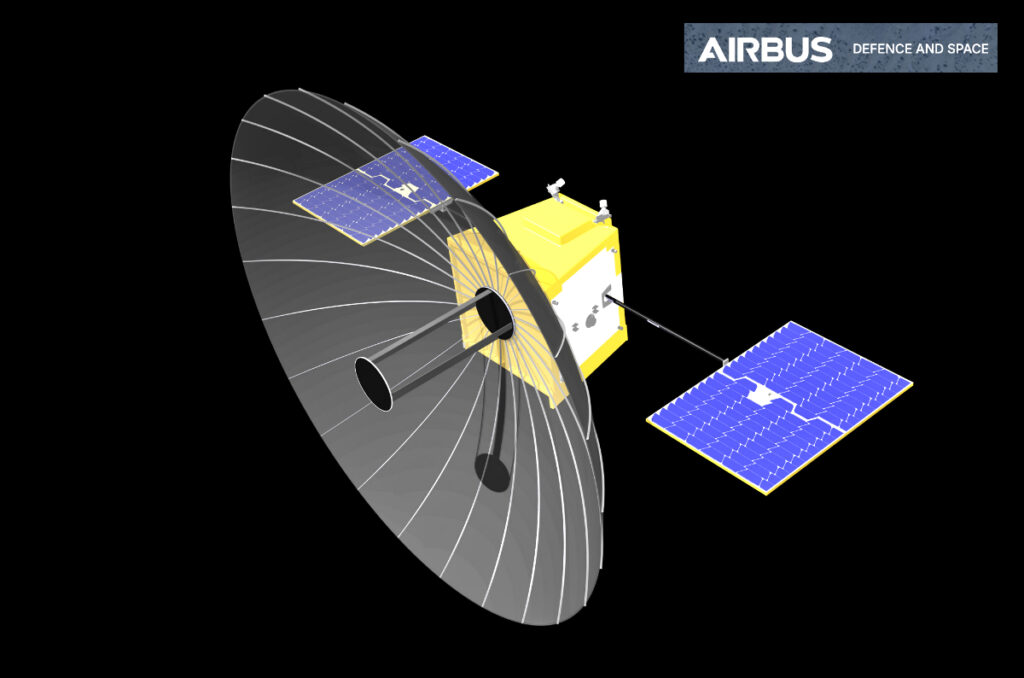
The above image illustrates the 3 meter version of the Wrapped Rib Antenna which is being incorporated into an in-orbit demonstration mission (separate from the Oberon mission) due for launch in 2025 as a collaboration between Oxford Space Systems, SSTL and NSSIF, with additional support from Innovate UK and Airbus Defence and Space.
Artistic rendition of the Oberon SAR satellite, courtesy of Airbus Defence and Space.

The UK Ministry of Defence has announced that the Oberon Earth Observation (EO) synthetic aperture radar (SAR) satellite mission has been awarded to Airbus Defence and Space, with Oxford Space Systems as a key supplier.

The program will be using the innovative Wrapped Rib Antenna developed by Oxford Space Systems, enabling the deployment of both a primary reflector and secondary surface from a uniquely compact launch configuration. The Wrapped Rib Antenna incorporates carbon fiber and knitted gold-plated metal mesh components built in house at Oxford Space Systems facilities in Harwell and Abingdon, UK, together with manufactured parts from a predominantly UK supply chain, to form a large parabolic dish on deployment.

For this application, the Wrapped Rib Antenna is being used to provide Synthetic Aperture Radar (SAR) capabilities and is part of a family of Wrapped Rib Antenna products which have both government and commercial use capabilities covering radar, communications and frequency monitoring applications over a range of radio frequencies, and with strong potential sales in selected export markets.

The Wrapped Rib Antenna development program has been supported over more than 7 years from inception by government programs including those from Innovate UK, National Security Strategic Investment Fund (NSSIF), DSTL, DASA, ESA and UKSA; through commercial collaboration including with Surrey Satellite Technology Limited (SSTL) and Airbus Defence and Space, and through Oxford Space Systems equity investment.

Sean Sutcliffe, Chief Executive at Oxford Space Systems, said, “We are delighted to be part of the consortium selected to deliver the next generation intelligence, surveillance and reconnaissance radar spacecraft for the UK. Oxford Space Systems is supplying the deployable antenna for this mission and is therefore a key enabler for this high performance capability at a competitive cost. The selection of Oxford Space Systems technology for this demanding and critical application is a testament to the many years of work that we and our partners have put into extensive development and testing of our innovative wrapped rib design, to be able to deliver and assure its performance and reliability. This success has been enabled by the support for the technology development and capability building given by our equity partners as well as by Government programs.”

Filed Under: News

SpaceX’s California launch of Starlink Group 11-10 smallsats now for Monday

February 10, 2025 by editorial

SpaceX is targeting Monday, February 10 for a Falcon 9 launch of 23 Starlink satellites to low-Earth orbit from Space Launch Complex 4 East (SLC-4E) at Vandenberg Space Force Base in California. Liftoff is targeted for 3:46 p.m. PT. If needed, additional launch opportunities are also available on Tuesday, February 11 starting at 3:19 p.m. PT.

A live webcast of this mission will begin about five minutes prior to liftoff, which you can watch on X @SpaceX. You can also watch the webcast on the new X TV app.

This is the 23rd flight for the first stage booster supporting this mission, which previously launched NROL-153, NROL-87, NROL-85, SARah-1, SWOT, Transporter-8, Transporter-9, NROL-146, Bandwagon-2, and 13 Starlink missions. Following stage separation, the first stage will land on the Of Course I Still Love You droneship, which will be stationed in the Pacific Ocean.

There is the possibility that residents of Santa Barbara, San Luis Obispo, and Ventura counties may hear one or more sonic booms during the launch, but what residents experience will depend on weather and other conditions.

SpaceX’s Starlink Group 11-10 to launch 22 smallsats from California on Sunday

This image has an empty alt attribute; its file name is Screen-Shot-2025-02-06-at-7.04.37-PM.png

Brightline, an eco-friendly commuter rail company with routes in South Florida became the first passenger train service in the world to adopt Starlink internet for its customers.

SpaceX’s Falcon 9 is scheduled to launch Starlink Group 11-10’s 22 smallsats from Vandenberg Space Force Base in California on Sunday, February 9 at 4:03 PM PST.

The Starlink 11-10 payload will transport the 22 v2-mini satellites for their second-generation high-speed low Earth orbit internet satellite constellation.

Filed Under: News

MEASAT partners with SPACESAIL to advance LEO satellite services

February 9, 2025 by editorial

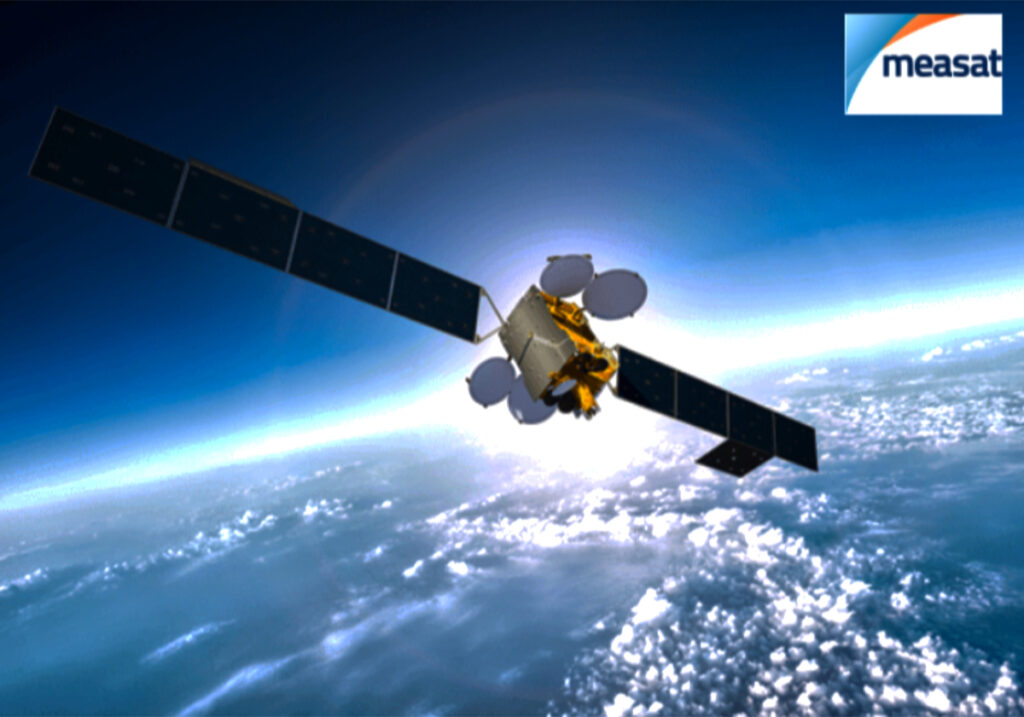
MEASAT has signed a Memorandum of Understanding (“MoU”) with Shanghai Spacesail Technologies Co. Ltd. (“SPACESAIL”), formerly Shanghai Spacecom Satellite Technology.

The MoU exchange ceremony, held recently in Shanghai, saw MEASAT represented by Chief Operating Officer Yau Chyong Lim and SPACESAIL represented by President Dr. Jason Zheng.

(Left) Racy Tsai, Vice President of Business Development & Sales of SPACESAIL, Dr Jasong Zheng, President of SPACESAIL, Yau Chyong Lim, Chief Operating Officer of MEASAT, Dr Edmund Kong, Chief Technology Officer of MEASAT.

The MoU is aimed at facilitating potential collaboration between the two companies, including provision of SPACESAIL’s LEO broadband services and solutions with their Thousand Sails mega-constellation (also known as “Qianfan”), emerging technologies such as Direct-to-Device (D2D) communications, satellite-based IoT capabilities and EO services; in Malaysia and markets in Asia where MEASAT is present, and, additionally, a joint rain fade study on Q-/V-band high frequency transmission.

Commenting on the MoU, Communications Minister YB Fahmi Fadzil, said, “In 2024, Malaysia marked the 50th anniversary of our diplomatic relations with the People’s Republic of China, celebrating the many positive outcomes of this cordial friendship. Looking forward, there are abundant opportunities for deeper collaboration, especially in harnessing advanced technologies to enhance people’s lives. These innovations have the potential to drive a wide array of benefits, from improving the delivery of government services to fostering economic growth through industrial and commercial applications. Additionally, with Malaysia serving as Chairman of ASEAN this year, we hope to showcase the country’s technological capabilities and explore new opportunities across the region.”

Yau Chyong Lim, Chief Operating Officer of MEASAT, said, “MEASAT is excited to begin this partnership with SPACESAIL to advance LEO satellite services across our markets. We firmly believe in a multi-orbit satellite network to achieve progress in society and are pleased to have the opportunity to integrate the capabilities of SPACESAIL’s Thousand Sails megaconstellation with MEASAT’s fleet of Geostationary Orbit (“GSO”) satellites. In regions where MEASAT operates, satellites have immense potential in further bridging the digital divide and overcoming geographical challenges. We look forward to realising this multi-orbit potential – from expanding the reach of established use-cases like satellite broadband in remote areas to advancing cutting- edge satellite solutions such as D2D connectivity and satellite-based IoT.”

Dr. Jason Zheng, President of SPACESAIL, said, “For SPACESAIL, this partnership with MEASAT is another milestone in delivering global broadband connectivity and driving innovation in the satellite industry by synergising our respective strengths. China and Malaysia are two nations that value the role of technology in empowering businesses and improving lives, and I look forward to achieving technological progress by tapping on MEASAT’s local expertise while strengthening bilateral ties – including in upcoming fields like the integration of terrestrial and non-terrestrial network communications. I thank the Government of Malaysia, particularly the Malaysian Communications and Multimedia Commission for welcoming SPACESAIL’s interest to offer our services in the country in collaboration with local industry leaders such as MEASAT.”

SPACESAIL’s Thousand Sails mega-constellation, which has already launched 72 satellites to date, seeks to provide low-latency, high-speed and ultra-reliable satellite broadband internet services worldwide. The mega-constellation is targeted to consist of more than 15,000 satellites in the future.

Filed Under: News

Thales Alenia Space + NIBE sign a satellite supply contract for NIBE’s EO constellation project

February 9, 2025 by editorial

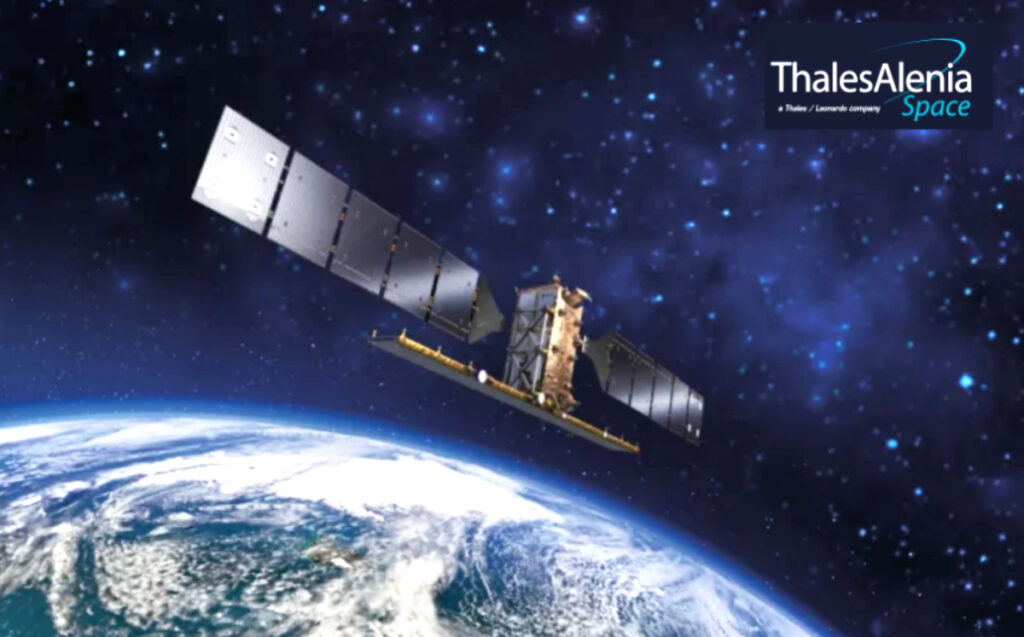
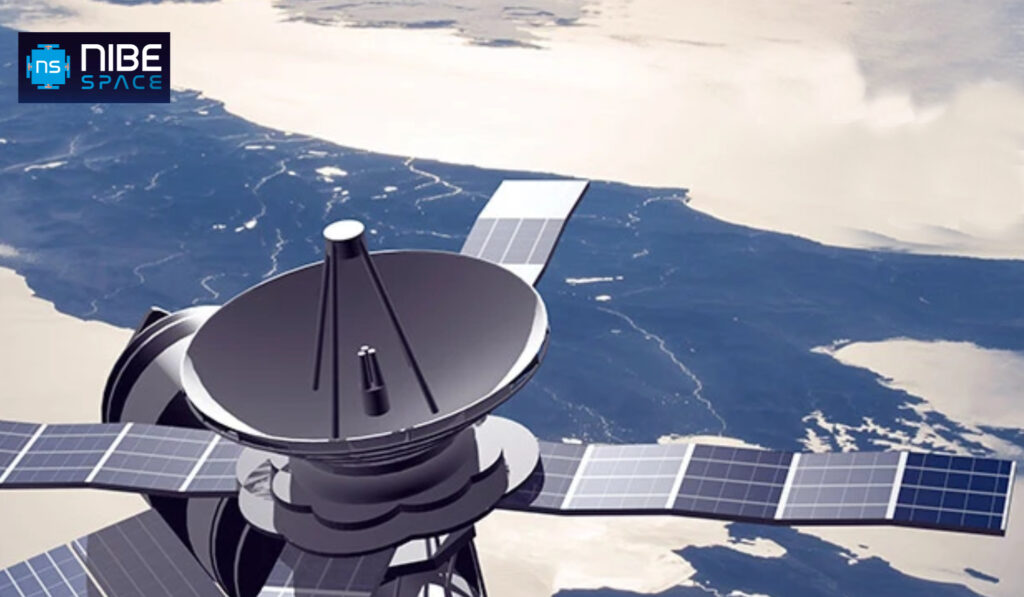
Thales Alenia Space, the joint venture between Thales (67%) and Leonardo (33%), has signed a contract with NIBE Space (a subsidiary of NIBE Limited) concerning the supply of a high-resolution optical satellite, marking the first step in NIBE’s Earth Observation constellation project— this initial contract aims to establish the first operational Earth Observation’s (EO) capabilities for NIBE in India by 2025.

This achievement reinforces the partnership initiated in 2024 between Thales Alenia Space and NIBE for the deployment of India’s first private EO constellation.

The contract was recently signed during a ceremony with the Honorable Chief Minister of Maharashtra Shri Devendra Fadnavis present. BlackSky also signed a service agreement for subscription-based imagery and analytics to deliver space-based monitoring services supporting NIBE’s various Indian customers.

“I am extremely pleased that Thales Alenia Space will contribute to developing sovereign Earth Observation capabilities in India,” said Hervé Derrey, CEO of Thales Alenia Space. “Supporting the deployment of India’s first private Earth observation constellation means a lot to our company as this is Thales Alenia Space’s first cooperation on an Indian space program. I would like to thank NIBE for putting its trust in our company. We look forward to making available our long-standing expertise and industrial capabilities in optical and radar sensors and start a promising Space cooperation with India.”

“We are proud to see our partnership with Thales Alenia Space take another concrete step forward with the signing of the contract for a high-resolution optical satellite. This is part of our larger national endeavor, aligned with the Aatmanirbhar Bharat vision, to bolster India’s position as a leader in space technology and applications,” said Ganesh Nibe, Chairman & Managing Director of NIBE Limited. “With Thales Alenia Space’s vast global expertise and experience, we look forward to taking India’s space capabilities to newer heights.”

About NIBE Limited
Established in 2021 under the leadership of Mr. Ganesh Ramesh Nibe, the company and its subsidiaries specialise in manufacturing a wide spectrum of Critical Components catering to the Defence industry such as fabrication of structures and sub-assemblies for programmes such as Modular Bridge, Rudder blade assembly, Pinaka launcher and MRSAM launcher for tri-services of Indian defence, to components of Electronic systems, Small arms (such as assault rifles and LMGs), and Space projects for domestic as well as international applications.
NIBE Limited along with its subsidiaries is committed towards continuously refining and adapting its approach, positioning itself as a leader in the defence industry. Moreover, in alignment with the vision of Atmanirbhar Bharat, NIBE Limited extends its commitment to fostering self-reliance in the defence sector.

About THALES ALENIA SPACE
Drawing on over 40 years of experience and a unique combination of skills, expertise and cultures, Thales Alenia Space delivers cost-effective solutions for telecommunications, navigation, Earth observation, environmental management, exploration, science and orbital infrastructures. Governments and private industry alike count on Thales Alenia Space to design satellite-based systems that provide anytime, anywhere connections and positioning, monitor our planet, enhance management of its resources, and explore our Solar System and beyond. Thales Alenia Space sees space as a new horizon, helping to build a better, more sustainable life on Earth. A joint venture between Thales (67%) and Leonardo (33%), Thales Alenia Space also teams up with Telespazio to form the parent companies’ Space Alliance, which offers a complete range of services. Thales Alenia Space posted consolidated revenues of approximately €2.2 billion in 2023 and has around 8,600 employees in 8 countries, with 16 sites in Europe.

Filed Under: News

SpaceX Saturday launch of 21 Starlink Group 12-9 smallsats including 13 Direct to Cell

February 9, 2025 by editorial

On Saturday, February 8 at 2:18 p.m. ET, Falcon 9 launched 21 Starlink satellites, including 13 with Direct to Cell capabilities, to low-Earth orbit from Space Launch Complex 40 (SLC-40) at Cape Canaveral Space Force Station in Florida.

This was the 17th flight for the first stage booster supporting this mission, which previously launched Crew-6, O3b mPOWER, Bluebird 1-5, USSF-124, and now 13 Starlink missions.

SpaceX’s Starlink Group 12-9 to launch smallsats on Friday

Internet from Space for Humans on Earth. Celebrating people using Starlink in interesting ways — epic and everyday.

On Friday, February 7th, Falcon 9 will launch a batch of smallsats for the Starlink mega-constellation into low Earth orbit. SpaceX’s project for a space-based internet communication system will be launched from Space Launch Complex 40, Cape Canaveral, Florida. The launch costs $52 million.

The forecast calls for a temperature of 72°F, clear skies, 0% cloud cover and a wind speed of 4mph.

Filed Under: News

Rocket Lab is back and scheduled to launch IoT 4 You on Sunday

February 6, 2025 by editorial

Rocket lab has rescheduled the IoT 4 you to Sunday, February 8/9 from Rocket Lab’s private orbital launch site, Launch Complex 1, in New Zealand on Saturday at 12:43 PM PST or Sunday, K09:43 am NZDT (20:43 UTC).

“IOT 4 You and Me” is Rocket Lab’s first scheduled launch of 2025, with the company expecting this year to exceed its record-breaking launch cadence of 16 launches across Electron and HASTE achieved in 2024.

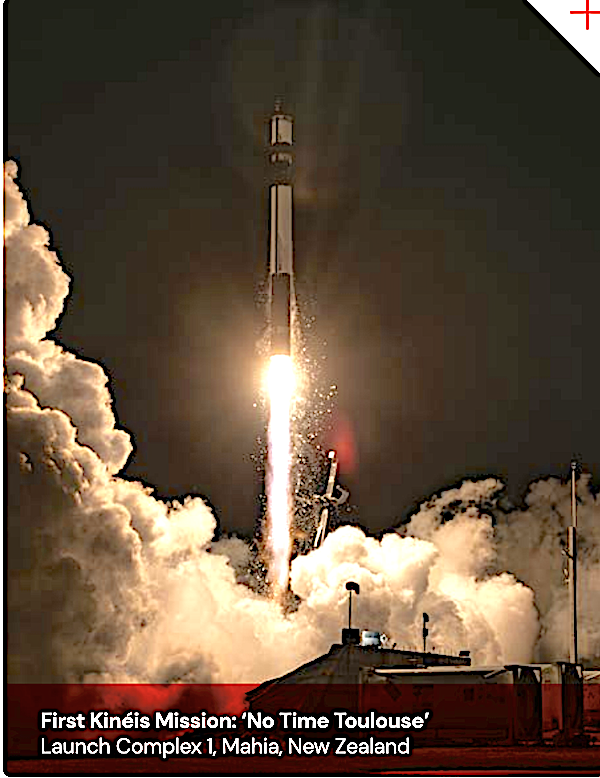
The mission is the fourth of five dedicated Electron launches booked by Kinéis in a multi-launch contract that will see Rocket Lab deploy an entire constellation of 25 IoT satellites.  The first three missions were successfully launched by Electron in June, September and November 2024. K09:43 am NZDT (20:43 UTC) Kinéis is a satellite operator and global connectivity provider. The first three missions were successfully launched by Electron in June, September and November 2024.

Electron is a two-stage orbital expendable launch vehicle (with an optional third stage) developed by the American aerospace company Rocket Lab. Electron is a small-lift launch vehicle designed to launch small satellites and cubesats to sun-synchronous orbit and low earth orbit. The Electron is the first orbital class rocket to use electric-pump-fed engines, powered by the 9 Rutherford engines on the first stage. It is also used as a suborbital testbed (called HASTE) for hypersonics research.

Rocket Lab’s Tuesday launch of IoT 4 You and Me is scrubbed with concerns of collision with ISS and others

This image has an empty alt attribute; its file name is Screen-Shot-2025-01-30-at-2.17.18-PM.png

Rocket Lab’s Tuesday launch is also scrubbed with an explaination indicating that: Rocket Lab has delayed the launch of the IOT 4 You and Me mission in order to ensure the mission does not interfere with “space traffic from other satellites and the ISS,” according to a company statement on X see below. A new launch date has not yet been set.

What is COLA? Collision On Launch Avoidance/Assessment — a process that assesses space traffic from other satellites and the ISS to determine when a rocket can be launched safely. It essentially it tells us when it’s safe to merge onto the space highway. Because the position of spacecraft are always changing relative to each other and the Earth, COLA reports are most accurate a few hours out from launch, which is why sometimes they’ll cause a shift in launch date or time fairly close to the planned T-0.

Rocket Lab ready to launch IoT 4 You and Me Kinéis 16-20 on Tuesday but weather presents challenge

Rocket Lab is scheduled to launch its fourth batch of five satellites for the French Kinéis IoT constellation designed to operate with 25 nanosatellites of 30 kg each at a cost of $6 Million.

The launch will take place at 12:43 pm PST from Rocket Lab’s private orbital launch site, Launch Complex 1, in New Zealand. The mission is the fourth of five dedicated Electron launches booked by Kinéis in a multi-launch contract that will see Rocket Lab deploy an entire constellation of 25 IoT satellites.  The first three missions were successfully launched by Electron in June, September and November 2024.

Weather is a challenge with a forecast that calls for a temperature of 63°F, overcast clouds, 99% cloud cover and a wind speed of 7mph.

Thanks to its constellation of 25 nanosatellites, Kinéis can connect any object from anywhere in the world and transmit useful data from these objects to users in near real time. This data is a decision-making tool that can be used to optimize activities while reducing risks, thanks to three essential functions: tracking, monitoring and alerting.

Kinéis’ space connectivity applications are used in a number of fields that represent major challenges for humankind: natural risk prevention (detection of forest fires, floods, pollution, etc.), monitoring of infrastructure and energy networks (detection of anomalies, predictive maintenance, etc.), transport and logistics monitoring agriculture, traceability of wild and farmed animals, and monitoring of agriculture activities.

The Kinéis constellation also integrates the AIS (Automatic Identification System), a maritime automatic identification system for ships operating on VHF (Very High Frequency) radio frequencies, which enables ship and surveillance systems to know the identity, position, direction and status of ships at sea.

Kinéis’ satellite-based AIS (S-AIS) is a high-performance system (requiring no ground infrastructure) that complements terrestrial AIS, enabling ships to be monitored worldwide, even in international waters not accessible by terrestrial AIS.

Rocket Lab’s launch of IoT 4 You and Me Kinéis 16-20 Monday

This image has an empty alt attribute; its file name is Screen-Shot-2025-02-02-at-7.20.57-PM.png

IOT 4 You and Me Rocket Lab is scheduled to launch Fourth batch of five satellites for the French Kinéis IoT constellation designed to operate with 25 nanosatellites of 30 kg each on Monday, February 3, at 12:43 pm PST.

The launch will take place from Rocket Lab’s private orbital launch site, Launch Complex 1, in New Zealand. The forecast calls for a temperature of 64°F, clear skies, 8% cloud cover and a wind speed of 16mph.

This image has an empty alt attribute; its file name is Screen-Shot-2025-01-30-at-2.17.40-PM.png

The mission is the fourth of five dedicated Electron launches booked by Kinéis in a multi-launch contract that will see Rocket Lab deploy an entire constellation of 25 IoT satellites.  The first three missions were successfully launched by Electron in June, September and November 2024.

“IOT 4 You and Me” is Rocket Lab’s first scheduled launch of 2025, with the company expecting this year to exceed its record-breaking launch cadence of 16 launches across Electron and HASTE achieved in 2024.

Created in 2018, Kinéis is a satellite operator and global connectivity provider. It inherited 40 years of expertise in the Argos system, founded by CNES (French space agency) and historically operated by CLS (Collecte Localisation Satellites). Its mission is to develop reliable technology that provides easy access to useful satellite data.

Thanks to its constellation of 25 nanosatellites, Kinéis can connect any object from anywhere in the world and transmit useful data from these objects to users in near real time. This data is a decision-making tool that can be used to optimize activities while reducing risks, thanks to three essential functions: tracking, monitoring and alerting.

Rocket Lab’s launch of IoT 4 You and Me (Kinéis 16-20) scheduled February 4

This image has an empty alt attribute; its file name is Screen-Shot-2025-01-30-at-2.17.18-PM.png
This image has an empty alt attribute; its file name is Screen-Shot-2025-01-30-at-2.17.40-PM.png

The “IOT 4 You and Me” mission is scheduled to launch during window that opens on February 4th NZDT. Within the multi-day window, there is an instantaneous launch opportunity daily at 09:43 am NZDT (20:43 UTC).

The launch will take place from Rocket Lab’s private orbital launch site, Launch Complex 1, in New Zealand. The mission is the fourth of five dedicated Electron launches booked by Kinéis in a multi-launch contract that will see Rocket Lab deploy an entire constellation of 25 IoT satellites.  The first three missions were successfully launched by Electron in June, September and November 2024.

“IOT 4 You and Me” is Rocket Lab’s first scheduled launch of 2025, with the company expecting this year to exceed its record-breaking launch cadence of 16 launches across Electron and HASTE achieved in 2024.

Created in 2018, Kinéis is a satellite operator and global connectivity provider. It inherited 40 years of expertise in the Argos system, founded by CNES (French space agency) and historically operated by CLS (Collecte Localisation Satellites). Its mission is to develop reliable technology that provides easy access to useful satellite data.

Thanks to its constellation of 25 nanosatellites, Kinéis can connect any object from anywhere in the world and transmit useful data from these objects to users in near real time. This data is a decision-making tool that can be used to optimize activities while reducing risks, thanks to three essential functions: tracking, monitoring and alerting.

Kinéis’ space connectivity applications are used in a number of fields that represent major challenges for mankind, its activities and its environment today: natural risk prevention (detection of forest fires, floods, pollution, etc.), monitoring of infrastructures and energy networks (detection of anomalies, predictive maintenance, etc.), transport and logistics monitoring, agriculture, traceability of wild and farmed animals, and monitoring of commercial and leisure maritime activities.

The Kinéis constellation also integrates the AIS (Automatic Identification System), a maritime automatic identification system for ships operating on VHF (Very High Frequency) radio frequencies, which enables ships and surveillance systems to know the identity, position, direction and status of ships at sea.

Kinéis’ satellite-based AIS (S-AIS) is a high-performance system (requiring no ground infrastructure) that complements terrestrial AIS, enabling ships to be monitored worldwide, even in international waters not accessible by terrestrial AIS.

Filed Under: News

  • « Go to Previous Page
  • Page 1
  • Interim pages omitted …
  • Page 42
  • Page 43
  • Page 44
  • Page 45
  • Page 46
  • Interim pages omitted …
  • Page 339
  • Go to Next Page »

Primary Sidebar

WEEKLY NEWSLETTER

Archives

  • August 2026
  • July 2026
  • June 2026
  • May 2026
  • April 2026
  • March 2026
  • February 2026
  • January 2026
  • December 2025
  • November 2025
  • October 2025
  • September 2025
  • August 2025
  • July 2025
  • June 2025
  • May 2025
  • April 2025
  • March 2025
  • February 2025
  • January 2025
  • December 2024
  • November 2024
  • October 2024
  • September 2024
  • August 2024
  • July 2024
  • June 2024
  • May 2024
  • April 2024
  • March 2024
  • February 2024
  • January 2024
  • December 2023
  • November 2023
  • October 2023
  • September 2023
  • August 2023
  • July 2023
  • June 2023
  • May 2023
  • April 2023
  • March 2023
  • February 2023
  • January 2023
  • December 2022
  • November 2022
  • October 2022
  • September 2022
  • August 2022
  • July 2022
  • June 2022
  • May 2022
  • April 2022
  • March 2022
  • February 2022
  • January 2022
  • December 2021
  • November 2021
  • October 2021
  • September 2021
  • August 2021
  • July 2021
  • June 2021
  • May 2021
  • April 2021
  • March 2021
  • February 2021
  • January 2021
  • December 2020
  • November 2020
  • October 2020
  • September 2020
  • August 2020
  • July 2020
  • June 2020
  • May 2020
  • April 2020
  • March 2020
  • February 2020
  • January 2020
  • December 2019
  • November 2019
  • October 2019

© 2019–2026 SatNews

Insert/edit link

Enter the destination URL

Or link to existing content

    No search term specified. Showing recent items. Search or use up and down arrow keys to select an item.
      x
      Sign Up Now!

      Enjoy a free weekly newsletter with recent headlines from the global SmallSat industry.

      Invalid email address
      We promise not to spam you. You can unsubscribe at any time.
      Thanks for subscribing! You will now receive weekly SmallSat News updates.
      We love our advertisers.
      And you will too!

      Please disable Ad Blocker to continue... We promise to keep it unobtrusive.
      We promise not to spam you. You can unsubscribe at any time.
      Invalid email address
      Thanks for subscribing!