Rivada Space Networks has secured market access to its Outernet constellation in 33 countries and every continent, with Belgium, the Czech Republic, Sweden, and Costa Rica among the latest nations to soon offer next-generation communications capabilities.
This goes hand in hand with communications service agreements signed with nations, governments, and corporations worth more than $16 billion for Outernet connectivity, with initial tests set for 2026.
Resilient, secure communications are increasingly vital to businesses and governments in an evolving digital economy. These new markets are part of Rivada’s Outernet roadmap to ensure a robust infrastructure, and the advantages of ubiquitous coverage, low latency, resiliency, and flexibility support digital development and security across the globe.
The Outernet is the first unified global communications platform, a unique next-generation constellation of 600 laser-linked LEO satellites that provide a ubiquitous, highly secure optical mesh network in space.
Rivada has embarked on a global initiative to bring the Outernet to every corner of the globe,” said Ann Vandenbroucke, Chief Regulatory Officer for Rivada Space Networks. “We are thrilled to announce we’ve secured market access in 33 nations and counting as we prepare to introduce the Outernet and ensure that investors, distributors, and users know with certainty this powerful constellation is on the way. Market access processes can take time to negotiate, and we greatly appreciate the regulators who have officially endorsed and supported the planned rollout of the Outernet.”
Declan Ganley, Rivada Space Networks CEO, said, “We are committed to ensuring that the Outernet is available globally to help solve essential connectivity and networking challenges and open up new business opportunities around the world. Businesses and governments across the globe have signed connectivity agreements worth more than $16 billion to date, underlining the demand and need for the secure communications capabilities of the Outernet, which is now poised to provide access in 33 countries and across every continent.”
Screenshot
About the Rivada Outernet The Outernet is the first unified global communications network. Rivada’s global low-latency gateway-less network of 600 low earth orbit (LEO) satellites is a unique next-generation constellation combining inter-satellite laser links with advanced onboard processing and routing to create a ubiquitous optical mesh network in space. This “orbital network,” in which data stays in space from origin to destination, creates an ultra-secure satellite network with pole-to-pole coverage, offering end-to-end latencies much lower than terrestrial fiber over long distances. By routing traffic on a physically separated network, it provides a layer of defense for any organization that needs to securely share data between widely distributed sites. The first satellite launch is set for 2025, with global service available in 2026.
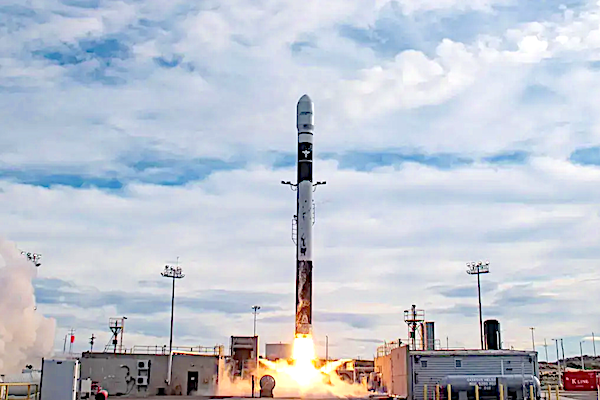
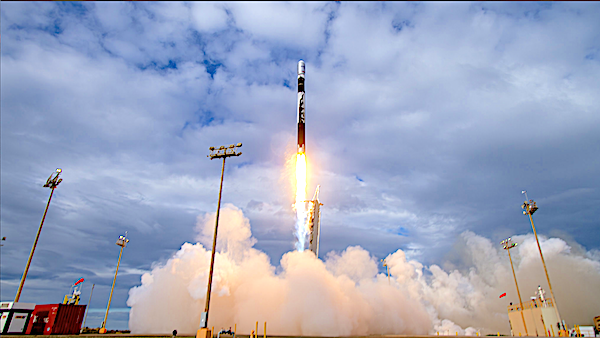
Firefly Alpha rocket experienced a launch anomaly that left a Lockheed Martin satellite in a significantly “lower than planned orbit”, and the “stage and its payload reentered over the South Pacific near Antarctica,” the aerospace company said on Tuesday, April 29. The mission originally planned for Monday was scrubbed due to unresolved ground support equipment issues.
A camera on the upper stage revealed debris falling away from the rocket seconds after separation, and the nozzle for the single Lightning engine in the upper stage appeared to be seriously damaged, or possible entirely gone.
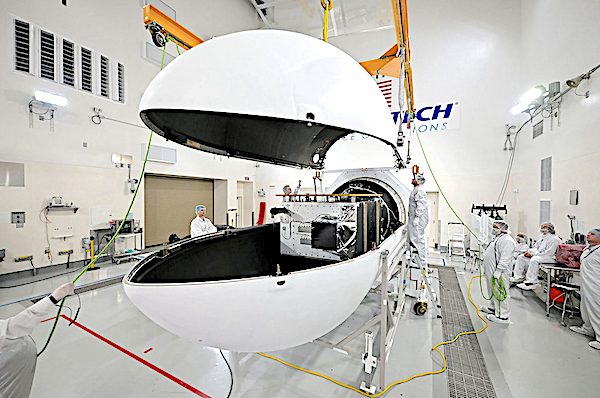
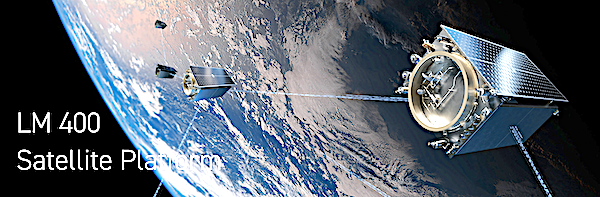
This was the sixth flight of the Firefly Alpha small satellite launcher, launching the demonstration mission for Lockheed Martin’s new LM400 satellite bus, which carried a communications payload. The satellite bus is customizable to support different missions, including remote sensing, communications, imagery and radar Earth observations. It can also support different kinds of orbits and launch configurations.
In a statement four and a half hours after launch, Firefly confirmed that the upper stage and its payload failed to reach orbit because of the stage separation issue. “The rocket then experienced a mishap between stage separation and second stage ignition that led to the loss of the Lightning engine nozzle extension, substantially reducing the engine’s thrust,” the company stated.
The upper stage reached a peak altitude of 320 kilometers but did not achieve orbital velocity. The stage and its payload reentered over the South Pacific near Antarctica. “The team is working closely with our customers and the FAA to conduct an investigation and determine root cause of the anomaly,” the company stated.
Firefly’s statement:
April 29, 2025, 11 am PDT: Today, Firefly’s Alpha FLTA006 launch began with a nominal liftoff and progressed through first stage flight, reaching target separation velocity. The rocket then experienced a mishap between stage separation and second stage ignition that led to the loss of the Lightning engine nozzle extension, substantially reducing the engine’s thrust.
Initial indications showed Alpha’s upper stage reached 320 km in altitude. However, upon further assessment, the team learned the upper stage did not reach orbital velocity, and the stage and payload have now safely impacted the Pacific Ocean in a cleared zone north of Antarctica.
Firefly recognizes the hard work that went into payload development and would like to thank our mission partners at Lockheed Martin for their continued support. The team is working closely with our customers and the FAA to conduct an investigation and determine root cause of the anomaly. We will provide more information on our mission page after the investigation is completed.
April 29, 2025, 8 am PDT: Following a nominal liftoff of Firefly’s Alpha rocket, there was a mishap during first stage separation for the FLTA006 mission that impacted the Stage 2 Lightning engine nozzle. We are working with our Lockheed Martin customer, the Space Force, and FAA to conduct a thorough investigation and determine the root cause. As more information is available, we will be providing updates here.s.
Orbit off the mark
While liftoff and initial ascent appeared normal, trouble emerged roughly 2 minutes and 35 seconds into flight during stage separation.
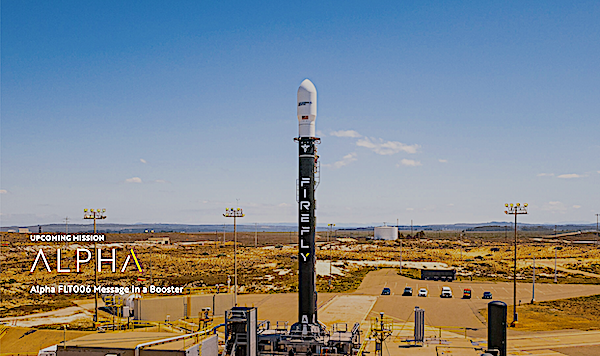
Firefly Aerospace ready for Monday launch of Lockheed Martin’s FLTA006 Message in a Booster mission
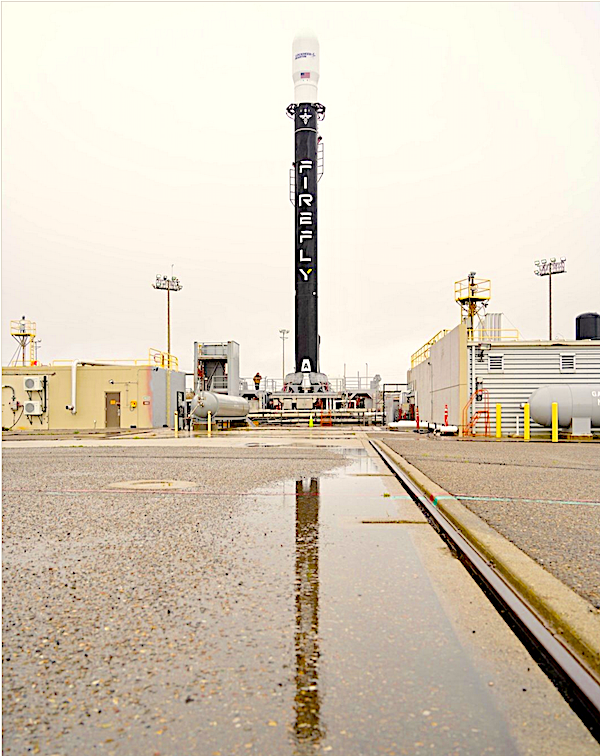
Firefly Aerospace’s launch of Lockheed Martin’s FLTA006 has now been scheduled for Monday, April 28th, at 6:37 AM -7:29 AM PDT from Vandenberg. Space Launch Complex 2W has launched 97 rockets, including 97 orbital launch attempts. While Vandenberg SFB, California, has been the site for 802 rocket launches.
Vandenberg Space Force Base is a United States Space Force Base in Santa Barbara County, California. Established in 1941, Vandenberg Space Force Base is a space launch base, launching spacecraft from the estern Range, and also performs missile testing.
This will be the sixth flight of the Firefly Alpha small satellite launcher, launching the demonstration mission for Lockheed Martin’s new LM400 satellite bus, which will carry a communications payload. The satellite bus is customizable to support different missions, including remote sensing, communications, imagery and radar Earth observations. It can also support different kinds of orbits and launch configurations.
Weather Forecast During Launch
The forecast calls for a temperature of 51°F, scattered clouds, 38% cloud cover and a wind speed of 12mph.
Firefly Aerospace now plans a Sunday launch of Lockheed Martin’s FLTA006 Message in a Booster mission
Firefly Aerospace’s launch of Lockheed Martin’s FLTA006 has been scheduled for Sunday, April 27th, at 6:37 AM – 8:17 AM PDT from Vandenberg.
This is the sixth flight of the Firefly Alpha small satellite launcher, launching the demonstration mission for Lockheed Martin’s new LM400 satellite bus that will carry a communications payload. The satellite bus is customizable to support different missions, including remote sensing, communications, imagery and radar Earth observations. It can also support different kinds of orbits and launch configurations.
Vandenberg Space Force Base is a United States Space Force Base in Santa Barbara County, California. Established in 1941, Vandenberg Space Force Base is a space launch base, launching spacecraft from the Western Range, and also performs missile testing. The United States Space Force’s Space Launch Delta 30 serves as the host delta for the base, equivalent to an Air Force air base wing. In addition to its military space launch mission, Vandenberg Space Force Base also hosts space launches for civil and commercial space entities, such as NASA and SpaceX.
The forecast calls for a temperature of 53°F, overcast clouds, 86% cloud cover and a wind speed of 9mph.
Firefly Aerospace’s launch of Lockheed Martin’s FLTA006 Message in a Booster mission is ‘to be determined’
Firefly Aerospace’s launch of Lockheed Martin’s FLTA006 (Message in a Booster) from Space Launch Complex 2W, Vandenberg SFB, California, is yet to be determined.
Alpha FLTA006 is the second mission Firefly is launching for Lockheed Martin and the first of Firefly’s multi-launch agreement with Lockheed Martin that includes up to 25 missions over the next five years. This mission will launch Lockheed Martin’s LM 400 tech demo to prove out the risk-reduction and pathfinding efforts the company has done for its multi-mission satellite bus. Launching the mid-size satellite to low Earth orbit, FLTA006 will further validate Alpha’s robust performance to take customers directly to their preferred orbits as the only operational 1 metric ton rocket.
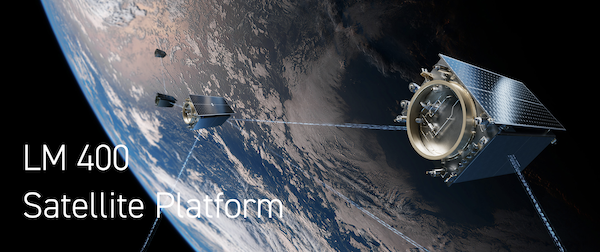
The LM 400 is Lockheed Martin’s most flexible and capable satellite platform with multi-mission capabilities that can be tailored for almost any mission, including remote sensing, communications, imaging and radar.
Firefly Aerospace’s Firefly Alpha to launch Lockheed Martin’s FLTA006 Message in a Booster mission on Friday
On Friday, April 18 Firefly Aerospace will launch FLTA006 (Message in a Booster) between 6:37 AM – 8:17 AM PDT Space Launch Complex 2W, Vandenberg SFB, California, at a cost of $15Million.
Firefly Aerospace is an American private aerospace firm based in Austin, Texas, that develops small and medium-sized launch vehicles for commercial launches to orbit.
The forecast calls for a temperature of 51°F, clear skies, 0% cloud cover and a wind speed of 14mph.
This launch will be the sixth flight of the Firefly Alpha small satellite launcher, launching the demonstration mission for Lockheed Martin’s new LM400 satellite bus, which will carry a communications payload. The satellite bus is customizable to support different missions, including remote sensing, communications, imagery and radar Earth observations. It can also support different kinds of orbits and launch configurations.
Alpha FLTA006 is the second mission Firefly is launching for Lockheed Martin and the first of Firefly’s multi-launch agreement with Lockheed Martin that includes up to 25 missions over the next five years. This mission will launch Lockheed Martin’s LM 400 tech demo to prove out the risk-reduction and pathfinding efforts the company has done for its multi-mission satellite bus. Launching the mid-size satellite to low Earth orbit, FLTA006 will further validate Alpha’s robust performance to take customers directly to their preferred orbits as the only operational 1 metric ton rocket.
The LM 400 is Lockheed Martin’s most flexible and capable satellite platform with multi-mission capabilities that can be tailored for almost any mission, including remote sensing, communications, imaging and radar.
Approximately the volume of an average home refrigerator and accommodating payloads up to 1,100kg, this mid-sized bus features exceptional propulsion and optimal operability in low Earth orbit (LEO), medium Earth orbit (MEO) and geosynchronous Earth orbit (GEO) compared to others in its class.
The demand for LM 400 plays an important role in the evolving Space industry. Space missions are adopting proliferated network architectures that use a multitude of smaller satellites in differing orbits to form a robust constellation, offering greater resilience in the face of threats or unforeseen anomalies. The LM 400 satellite platform provides a highly flexible bus foundation, resulting in rapid deployment at lower price points to help achieve the connectivity for data transport and missile warning and tracking operations.
FireFly Alpha Message in a Booster on hold launch to be determined
The projection of a Sunday launch of FireFly Alpha’s Message in a Booster has come and gone with no statement issued as to a new date. There is a possibility that April may be the month.
This will be the sixth flight of the Firefly Alpha small satellite launcher as a demonstration mission for Lockheed Martin’s new LM400 satellite bus, which will carry a communications payload.
Firefly Alpha’s Message in a Booster now booked for Sunday launch
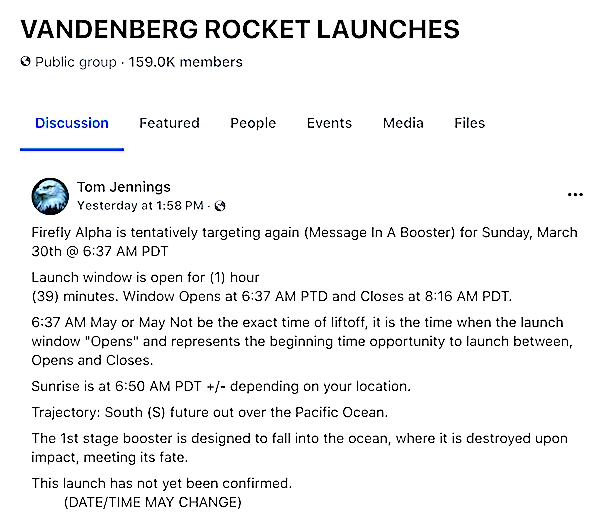
The following is a statement issued on Vandenberg Rocket Launches Facebook page.
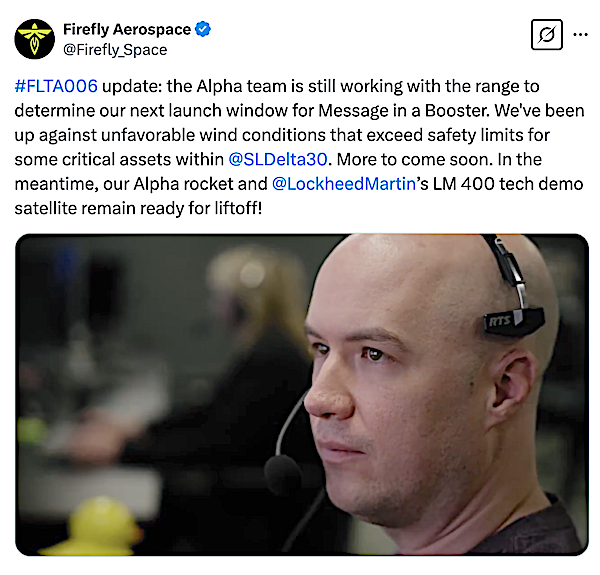
Firefly Alpha’s delay due to strong winds still waiting for window to launch
Firefly Alpha from Firefly Aerospace is scheduled to launch on March 26 from Space Launch Complex 2W at Vandenberg SFB at 6:37 – 8:17 am PDT, at a cost of $15 million, however….
Firefly Alpha is ready to launch FLTA006 (Message in a Booster) on Wednesday
Firefly Alpha from Firefly Aerospace will launch on March 26 from Space Launch Complex 2W at Vandenberg SFB at 6:37 – 8:17 am PDT, at a cost of $15 million.
This is the sixth flight of the Firefly Alpha small satellite launcher, launching the demonstration mission for Lockheed Martin’s new LM400 satellite bus, which will carry a communications payload.
OroraTech has opened their U.S. headquarters in Denver, Colorado—based in Munich, Germany, the company’s expansion to the United States marks an important milestone in its mission to support wildfire resilience in America.
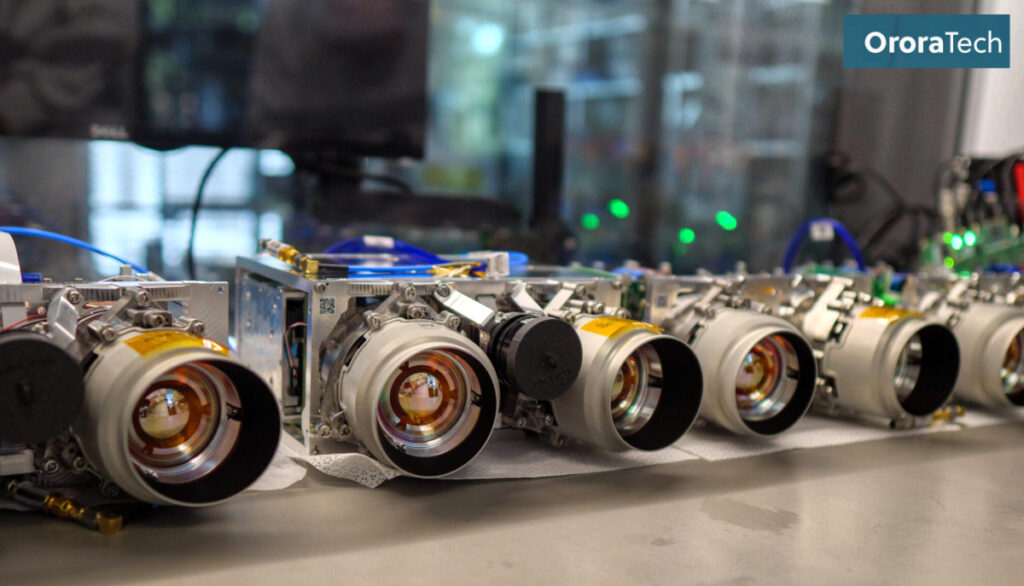
OroraTech’s thermal sensors are purpose-built for wildfire detection and management—the OTC-P1 satellite was launched on March 27th by Rocket Lab—OTC-P2 will launch later this year.
The Denver office will serve as a central hub connecting U.S. wildfire emergency services, utility providers and government agencies with OroraTech’s state-of-the-art space technology.
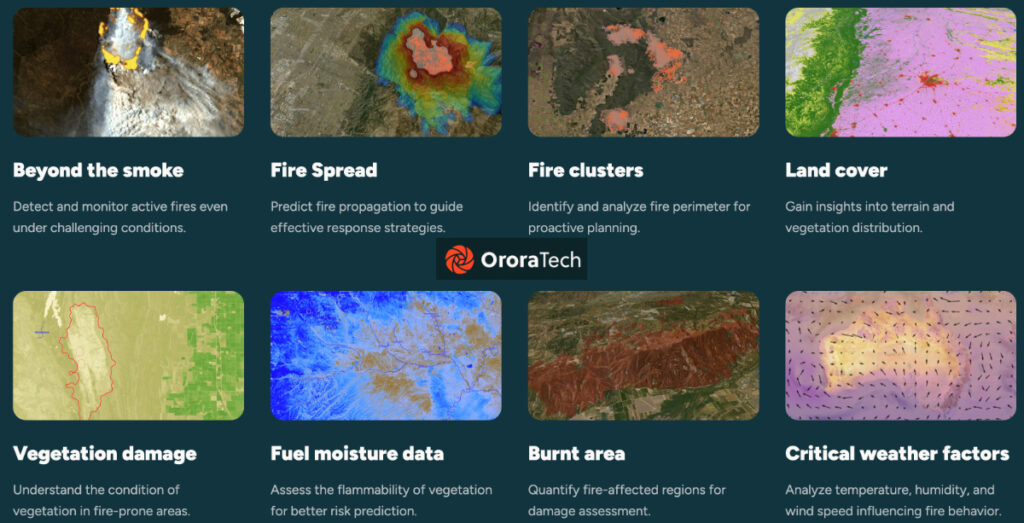
OroraTech’s Wildfire Solution platform combines the world’s largest constellation of dedicated wildfire satellites with predictive modeling, advanced thermal imaging and real-time data analytics. The system comprises 10 proprietary satellites and data from numerous additional public satellites, forming a network of 40+ that operate in LEO and GEO orbit. The constellation can detect heat anomalies and emerging fires as they erupt, mapping their location, severity and speed of spread. This creates unmatched situational awareness for fire management, faster response capabilities and year-round readiness.
The expansion to the United States, and specifically to Denver, is already generating positive momentum. Larimer County, Colorado—a region highly vulnerable to wildfire risk—recently signed as one of OroraTech USA’s first customers in its Wildfire Solution Coop program.
OroraTech began establishing its comprehensive global satellite network in 2022. In addition to the U.S. expansion, the company recently entered a contract with the Greek government to develop a €20 million ($22.7 million) national satellite-based wildfire early warning system, making Greece the first country to implement such a system.
Wildfires are one of the most devastating natural disasters facing the United States today, with the 2025 LA fires costing about $135 billion in damages alone,” said Thomas Gruebler, president and CEO of OroraTech USA and co-founder of OroraTech. “We are deeply committed to introducing American firefighters and emergency responders to our satellite technology that will give them a new layer of situational awareness to make faster, smarter decisions when every minute counts.”
Proactive preparation is the key to reducing wildfire risk and protecting our communities,” said Justin Whitesell, emergency services director for the Larimer County Sheriff’s Office.“However, tools for wildfire intelligence and situational awareness are still critical. The synergy between OroraTech’s cutting-edge technology and the Larimer County Sheriff’s Office of Emergency Services’ local initiatives exemplifies a comprehensive approach to wildfire resilience, setting a precedent for other regions facing similar challenges.”
Adriana, a thanatologist in Merida, Yucatan with her family to embrace a coastal lifestyle.
SpaceX is targeting Monday, April 28 for a Falcon 9 launch of 27 Starlink satellites to low-Earth orbit, that will build a smallsat constellation, from Space Launch Complex 4 East (SLC-4E) at Vandenberg Space Force Base in California. Liftoff is targeted for 1:39 p.m. PT, with backup opportunities available until 5:25 p.m. PT. If needed, additional launch opportunities are also available on Tuesday, April 29 starting at 1:11 p.m. PT.
A live webcast of this mission will begin about five minutes prior to liftoff, which you can watch here and on X @SpaceX. You can also watch the webcast on the new X TV app.
This will be the 25th flight for the first stage booster supporting this mission, which previously launched Sentinel-6 Michael Freilich, DART, Transporter-7, Iridium OneWeb, SDA-0B, NROL-113, NROL-167, NROL-149, and 16 Starlink missions. Following stage separation, the first stage will land on the Of Course I Still Love You droneship, which will be stationed in the Pacific Ocean.
There is the possibility that residents of Santa Barbara, San Luis Obispo, and Ventura counties may hear one or more sonic booms during the launch, but what residents experience will depend on weather and other conditions.
Spire Global, Inc. (NYSE: SPIR) has completed the previously announced sale of the firm’s maritime business to Kpler for approximately $233.5 million, before adjustments, plus a $7.5 million agreement for services over a 12 month period, post close.
Spire used these proceeds of the sale to retire all outstanding debt. The remaining proceeds will be used to invest in near-term growth opportunities.
Planet Labs PBC (NYSE: PL) has signed a multi-year contract with EMDYN, a European-based company that provides agile intelligence-led solutions and security services.
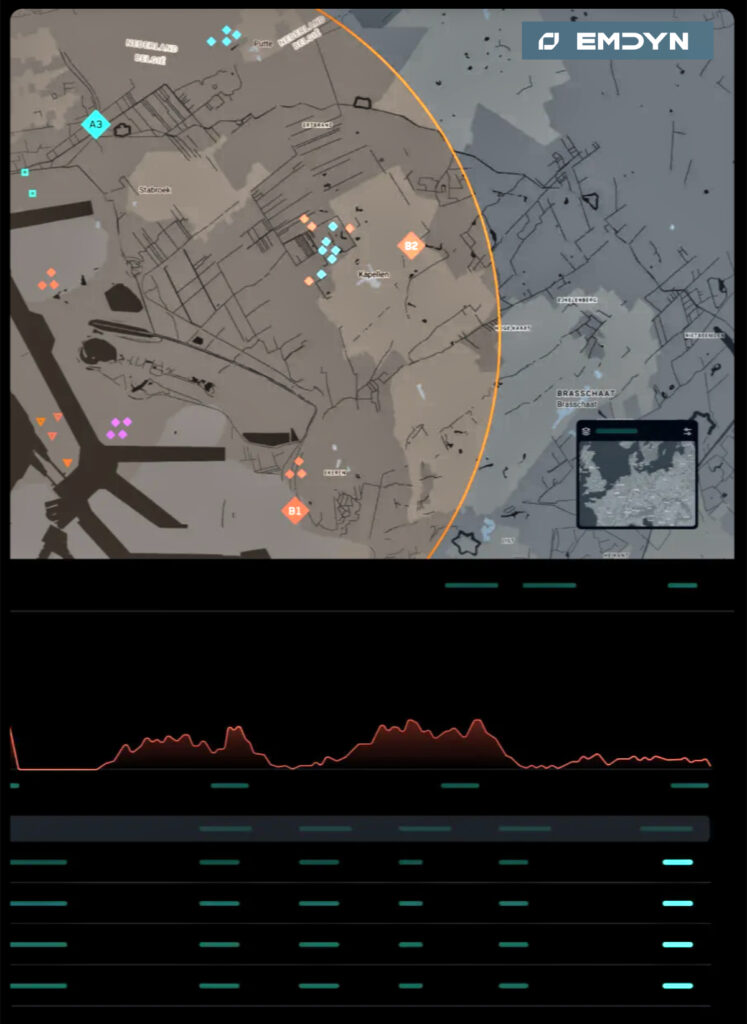
EMDYN’s bespoke geospatial intelligence fusion Platform draws together location intelligence data from an array of sources in a single application to provide unparalleled insights into situations, events or patterns of movement.
Through this relationship, EMDYN will use Planet’s near-daily, global satellite imagery and taskable high resolution SkySat satellites to monitor subtle activity across large geographical regions—such as border movements, infrastructure development, or maritime patterns—and capture fleeting, high-resolution imagery of events as they unfold.
Planet’s global satellite network provides unmatched commercial coverage and revisit frequency, offering a continual view of Earth’s surface. EMDYN integrates this imagery with additional critical intelligence data streams—including signals intelligence, ground-based sensors, and open-source data—all within its proprietary Platform.
EMDYN’s multi-source geospatial data fusion transforms raw imagery into operational insight, powering real-time early warning systems, situational awareness, and anomaly detection across domains such as defence operations, national infrastructure monitoring, counter-terrorism, and risk mitigation.
By combining Planet’s high-cadence Earth observation capabilities with EMDYN’s advanced analytics and mission-tailored intelligence Platform, EMDYN’s product delivers a powerful solution for organisations that operate in high-stakes environments—where informed decisions must be made with speed, clarity, and confidence.
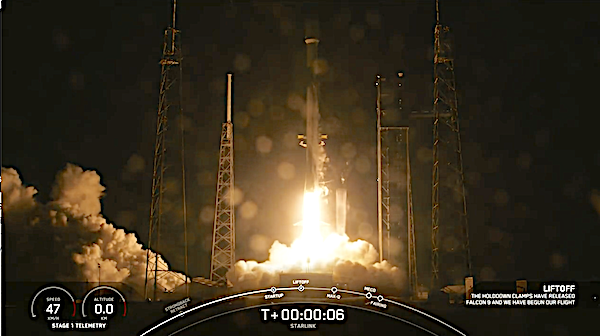
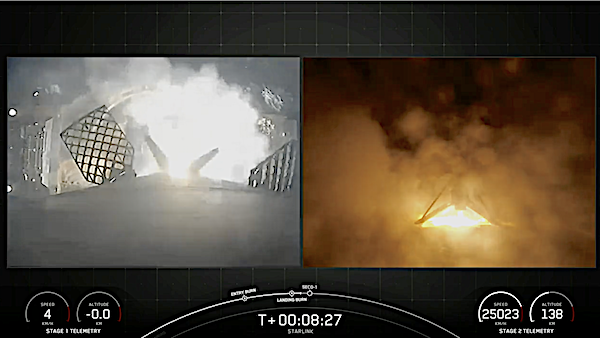
SpaceX’s Falcon 9 on Thursday, April 24 launched 28ofStarlink’s Group 6-74 Starlink smallsats to low-Earth orbit from Space Launch Complex 40 (SLC-40) at Cape Canaveral Space Force Station in Florida.The satellites will become a part of the Starlink constellation.Photos by Satnews.
The forecast was 76°F, scattered clouds, 40% cloud cover and a wind speed of 12mph.
The Falcon 9 1st stage B1069 landed on ASDS ASOG barge in the Atlantic Ocean after its 23rd flight. Booster B1069 last launched 03/13/2025 and has seen 22 successful launches and landings. Falcon 9 Block 5 booster first used for the CRS-24 mission.
SpaceX to launch Starlink Group 6-74 smallsats on Thursday
SpaceX is targeting Thursday, April 24 for a Falcon 9 launch of 28 Starlink smallsats to low-Earth orbit from Space Launch Complex 40 (SLC-40) at Cape Canaveral Space Force Station in Florida. Launch is targeted for 9:52 p.m. ET, with backup opportunities available until 1:28 a.m. ET on Friday, April 25. If needed, additional opportunities are also available on Friday, April 25 starting at 9:55 p.m. ET.
The smallsats will be launched into the largest shell of its Starlink constellation.
A live webcast of this mission will begin about five minutes prior to liftoff, which you can watch on X @SpaceX. You can also watch the webcast on the new X TV app.
This is the 23rd flight for the first stage booster supporting this mission, which previously launched CRS-24, Eutelsat HOTBIRD 13F, OneWeb 1, SES-18 and SES-19, and 18 Starlink missions. Following stage separation, the first stage will land on the A Shortfall of Gravitas droneship, which will be stationed in the Atlantic Ocean.
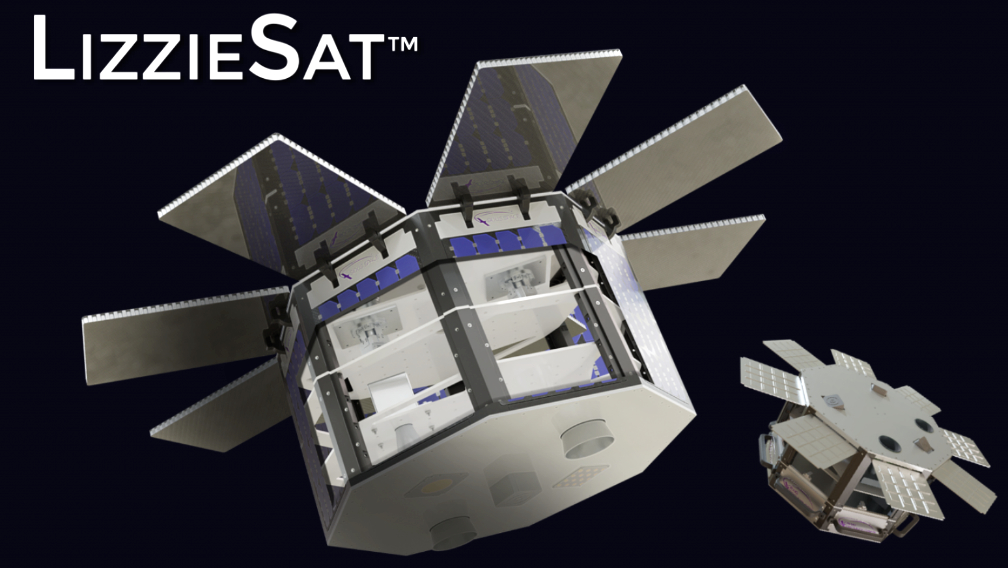
Sidus Space (NASDAQ: SIDU) has received a Notice of Allowance of U.S. Patent Application Serial No. 17/828,233, titled System for a Modular Satellite Testing Platform. This patent application is directed to the structural elements of the LizzieSat® satellite, of which Sidus Space has successfully launched three satellites that are currently on-orbit. This patent reflects Sidus Space’s continued innovation in satellite technology, enhancing mission flexibility and scalability across government, defense, intelligence and commercial applications.
The system introduces a modular approach to satellite command and data processing, allowing operators to configure and reconfigure system components based on specific mission needs. This innovation improves processing efficiency, enhances redundancy, and simplifies the integration of new payloads—key advantages for space missions requiring adaptability and cost-effective operations.
With a heritage of spaceflight-proven technology and vertically integrated capabilities, Sidus Space delivers end-to-end satellite solutions, from design and manufacturing to launch and on-orbit operations. The company holds a robust intellectual property portfolio, with 13 granted U.S. patents, 1 patent application that has been allowed, but not yet granted, 6 additional pending U.S. patent applications, and 5 patent applications pending in foreign jurisdictions to support international growth of Sidus Space.
This patent represents a significant milestone in our mission to deliver innovative and adaptable solutions for the space industry,” said Carol Craig, CEO of Sidus Space. “This advancement aligns with our commitment to delivering scalable and customizable solutions, from satellites to technology to data, that meet the evolving demands of the space industry and our customers.
HawkEye 360 Inc. has partnered with General Atomics – GA-Integrated Intelligence, Inc. (GA-i3) to integrate its advanced RF data capabilities into GA-i3’s Optix platform—this collaboration establishes HawkEye 360 as a channel partner and value-added reseller of the Optix platform. This groundbreaking solution delivers HawkEye 360’s all-domain RF data out of the box, while enabling correlation with other disparate, intelligence sources.
Integrating HawkEye 360’s evolving suite of RF analytics, including archived RF data and analytics, augments the Optix platform to fill critical gaps in situational awareness. Optix enhances workflows by providing a combined multi-INT data picture, enabling users to ingest, visualize, and analyze multi-domain activity with unparalleled efficiency and insight. Optix supports advanced analytics for identifying suspicious behavior, such as dark activity and rendezvous patterns, providing a more comprehensive understanding of operations in complex environments.
The collaboration reflects HawkEye 360’s commitment to innovation in RF data capabilities. Optix enhances global domain awareness and supports more effective ISR planning by cueing assets based on RF emissions, improving the effectiveness of manned patrol and UAV missions, and reducing operational costs. This data-as-a-service model provides scalable, user-friendly solutions for defense, intelligence, and commercial customers, allowing them to streamline workflows and focus on actionable insights.
This partnership positions HawkEye 360’s RF data as an integral layer within the Optix platform, empowering a broader range of users to access its advanced capabilities. By making RF data more accessible and actionable, HawkEye 360 and GA-i3 are redefining how maritime and ISR challenges are addressed globally.
HawkEye 360 is advancing commercial signals intelligence by making RF data more accessible and actionable for a broader range of users,” said Patrick Zeitouni, Chief Strategy Officer of HawkEye 360. “Through our partnership with GA-i3, we are integrating our RF analytics into the OPTIX platform, enabling customers to seamlessly fuse multi-INT data, enhance workflows, and drive more informed decision-making across defense, security, and commercial sectors.”
Our customers have critical mission needs that require additional knowledge to reduce uncertainty about objects of interest,” said Brian Ralston, President of GA-i3. “With HawkEye 360’s commercial capabilities, we can better enrich their view of the world.”
SpaceX is targeting Thursday, April 24 for a Falcon 9 launch of 28 Starlink smallsats to low-Earth orbit from Space Launch Complex 40 (SLC-40) at Cape Canaveral Space Force Station in Florida. Launch is targeted for 9:52 p.m. ET, with backup opportunities available until 1:28 a.m. ET on Friday, April 25. If needed, additional opportunities are also available on Friday, April 25 starting at 9:55 p.m. ET.
The smallsats will be launched into the largest shell of its Starlink constellation.
A live webcast of this mission will begin about five minutes prior to liftoff, which you can watch on X @SpaceX. You can also watch the webcast on the new X TV app.
This is the 23rd flight for the first stage booster supporting this mission, which previously launched CRS-24, Eutelsat HOTBIRD 13F, OneWeb 1, SES-18 and SES-19, and 18 Starlink missions. Following stage separation, the first stage will land on the A Shortfall of Gravitas droneship, which will be stationed in the Atlantic Ocean.