• Skip to main content
  • Skip to primary sidebar
  • Home
  • News
  • Featured
  • More News ⌄
    • SatNews
    • SatMagazine
    • MilSatMagazine
  • Events ⌄
    • MilSat Symposium
    • SmallSat Symposium
    • Satellite Innovation
  • Contacts
  • SUBSCRIPTION

SmallSat News

You are here: Home / Archives for 2020

Archives for 2020

Virgin Orbit and Medical Experts Design a New, Mass-Producible, Ventilator for COVID-19 Patients

March 30, 2020 by editorial

Virgin Orbit has developed a new mass-producible bridge ventilator to help in the fight against the coronavirus (COVID-19) pandemic.
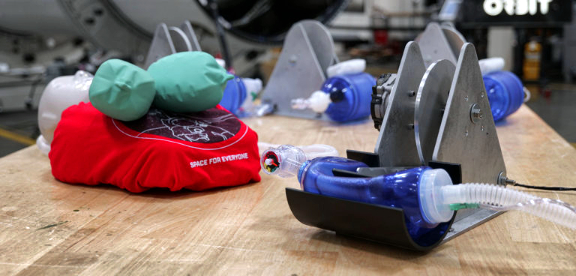
The Virgin Orbit team has been consulting with the Bridge Ventilator Consortium (BVC), led by the University of California Irvine (UCI) and the University of Texas at Austin (UT Austin), a group formed to spawn and nurture efforts to build producible, simple ventilators to aid in the current COVID-19 crisis.

Pending clearance by the Food and Drug Administration (FDA), Virgin Orbit aims to commence production at its Long Beach manufacturing facility in early April, sprinting to deliver units into the hands of first responders and healthcare professionals as soon as possible.

As the COVID-19 crisis worsens and the paucity of medical equipment becomes more and more clear, the Virgin Orbit team is strongly motivated to do all that we can to help. On a normal day, the firm is building rockets and other equipment for space launch; the company’s teams are not medical doctors nor is Virgin Orbit usually a manufacturer of medical devices. However, the company does have a team of incredibly innovative and agile thinkers — experts in designing, fabricating, programming, testing — who are eager to lend a hand.

After contacting Governor Gavin Newsom last week, Virgin Orbit was directed by his office to the California Emergency Medical Services Authority (CEMSA) and put in contact with the BVC. The BVC is a team of brilliant doctors, medical device experts, and researchers at UCI and UT Austin who are working around the clock, sharing ideas across a broad national and international network to share best practices and design insights and to accelerate progress on solutions to this equipment shortage.

Today, complex, high-end, ICU-capable ventilators are sometimes the only option available for moderate cases — for people who don’t necessarily need intensive care or have partially recovered. By supplying “bridge” ventilators, Virgin Orbit’s device can free up those critical resources for the most ill.

Virgin Orbit engineers have taken rapid scaling into account from the beginning of the design process, taking advantage of the most common and robust manufacturing and assembly processes. The company’s aim is to have a functioning, deployable bridge ventilator in production in early April. Virgin Orbit would continue on to rapidly scale up to mass production in its Long Beach facility, in addition to potentially activating other manufacturers as soon as the new device is reproducible and production-ready.

Dr. Brian J.F. Wong, Assistant Chairman of Otolaryngology at UCI, said the nation faces a slow-motion Dunkirk, and getting ventilators out there is very important to save lives. The demand outstrips supply, so it is important the government, industry, academia, non-profits, and the community work together to identify solutions, and design and construct them as fast as possible.

Virgin Orbit CEO Dan Hart added that the company is heartbroken each night as the news is turned on and see the predicament facing doctors and nurses as they heroically work to save lives. Dan has never seen the company’s team working harder and has also never seen ideas moving quicker from design to prototype. Virgin Orbit is hopeful that this device can help as all prepare for the challenges ahead.


Filed Under: Featured, News

Forrester Reports: Who’d Be A Constellation Provider? The OneWeb Declaration of Bankruptcy

March 30, 2020 by editorial


Chris Forrester

OneWeb’s Chapter 11 bankruptcy (under the SEC’s ‘debtor in possession’ rules) on Friday, March 27, was shocking, given that the company had just launched an extra 34 satellites into orbit on March 21.

One can only imagine the nightmare – and no doubt deep depression — taking place at OneWeb’s various offices during the intervening six days.


Adrian Steckel

Following the Baikonur launch, OneWeb’s CEO Adrian Steckel said, “In these unprecedented times following the global outbreak of Covid-19, people around the world find themselves trying to continue their lives and work online. We see the need for OneWeb, greater now more than ever before.”

Steckel also spoke optimistically of more launches during the year, saying, “We think it is inevitable that there will be delays to our launch schedule and satellite manufacturing due to increasing travel restrictions and the disruption of supply chains globally. Therefore, we made the difficult decision to eliminate some roles and responsibilities as we work to focus on core operations.  We are sorry to have had to take this step and we’re doing everything we can to support those affected.”

Now the company, with its ‘debtor in possession’ bankruptcy, is actively seeking a buyer for its 74 orbiting assets and what’s left of the tarnished dream of founder Greg Wyler.

One investment banker, speaking on March 30, suggested that a potential buyer could be Eutelsat, given that the Paris-based geo-operator has no LEO plans.

However, its tough imagining how any satellite player would want the challenge of launching another 600 satellites, with the massive manufacturing obligations and with the even bigger challenge of mounting a sales and marketing campaign.

In a note on March 30, investment bank Exane/BNPP’s Sami Kassab said, “We note that Eutelsat has no broadband LEO constellation project and believe it might find an interest in looking at OneWeb for its orbital rights and market access licenses could be of value for the French operator.”

Of course, while OneWeb’s principle backer, Japan’s SoftBank, was instrumental in bringing OneWeb to its knees by declining further bail-outs, there are other investors in OneWeb who might have the deep pockets to mount a rescue, not the least if which is chip-developer Qualcomm (Q1/2020 revenues $5.07 billion) or even India’s Bharti Airtel (2020 revenues expected to be above $1 billion).

However, the challenges ahead are huge. A year ago, SES CEO Steve Collar was blunt, saying he doubted whether any of the would-be mega-constellation operators could fund the cost of finding subscribers.

Plus, the current debts are significant.  Examining the OneWeb Chapter 11 ‘debtor in possession’ documents, it is Arianespace that is the company’s top creditor and is owed $238 million in unsecured claims. OneWeb signed a contract worth $1.1 billion back in 2015 for a total of 21 launches using Ariane’s Soyuz rocket.  Three of those launches have happened, the most recent at the beginning of March when 34 satellites were orbited.

However, OneWeb also has contracts in place with Arianespace for the maiden flight of its all-new Ariane 6 rocket and has also signed options for two further Ariane 6 launches.

The company is understood to have laid off some 85 percent of its staff and has some $1.7 billion of debt.

OneWeb’s Chapter 11 bankruptcy petition to the Court seeks a “Restructuring to execute sale process.” The company, in its statement, stated, “OneWeb is actively negotiating debtor-in-possession financing, which, if acquired and approved by the Bankruptcy Court, will ensure OneWeb is able to fund additional financial commitments as it conducts a sale process under Section 363 of the US Bankruptcy Code. Together, these actions will allow OneWeb to meet post-petition obligations to its remaining employees and certain vendors in the ordinary course.”

Should a buyer not come forward and a full bankruptcy follow, then the 74 satellites already orbiting could fall into the hands of the UK government, along with the licenses held by OneWeb/WorldVu.

OneWeb’s shareholders are listed as:

  • Softbank: 37.41%
  • Qualcomm: 15.93%
  • Greg Wyler*: 11.94%
  • Airbus: 8.5%

*Greg Wyler 1110 Ventures LLC


OneWeb’s main backer, SoftBank, saw its share price plunging 10 percent in trading on March 30. Other investors, in addition to the listed shareholders, include Coca-Cola, Bharti Airtel, Virgin Group and others.

OneWeb’s Associated companies, also in Ch 11 bankruptcy, include…

•    Network Access Associates Limited
•    OneWeb ApS
•    OneWeb Chile SpA
•    OneWeb Communications Limited
•    OneWeb G.K.
•    OneWeb Global Limited
•    OneWeb Holdings LLC
•    OneWeb Limited
•    OneWeb Ltd
•    OneWeb Network Access Holdings Limited
•    OneWeb Norway AS
•    WorldVu Australia Pty Ltd.
•    WorldVu Development LLC
•    WorldVu JV Holdings LLC
•    WorldVu Mexico, S. DE R. L. DE C.V.
•    WorldVu Satellites Limited
•    WorldVu South Africa (Pty) Ltd.
•    WorldVu Unipessoal Lda  1021823 B.C. LTD


Not specifically itemized is OneWeb’s Florida joint-venture (OneWeb Satellites) with Airbus, which is building the company’s satellites.

In addition to Arianespace, other key creditors include…

  • Qualcomm: $8.0m
  • Deloittes: $6.8m
  • Hughes Network Sys.: $5.3m
  • Deutsche Bank:  $5.2m*
  • Wipro: $2.5m
  • Willis Towers: $1.9m
  • Viasat: $1.2m
  • Nokia: $988,000
  • Redapt: $662,275
  • Rockwell Collins: $596,775

*Disputed claim


It is expected that Chapter 11 will affect OneWeb’s London-based parent company (OneWeb Communications Ltd.) and its Jersey (Channel Islands) businesses OneWeb Ltd. and WorldVu Satellites Ltd.  The company’s latest Consolidated Financial Statements were filed in London on October 10 of  last year (for the year to December 31, 2018, the financials show that OneWeb had secured about $3.3 billion in equity and debt financing.) KPMG are the company’s auditors.

There are numerous formal Financial Charges listed against the company, notably with SoftBank Group Corp. on March 18, 2019, which granted SoftBank a Charge over the entire issued share capital of the company (both ordinary and preferred shares).

This failure is a major body-blow to the satellite industry and it will take time to unravel the complexities of the business. There is also a joint-venture in place with Airbus for a satellite-building facility in Florida near the Kennedy Space Centre.

More details will emerge as the bankruptcy process rolls on. CEO Steckel’s statement on March 27, which accompanied the liquidation announcement, was candid, but hopeful. He said, “OneWeb has been building a truly global communications network to provide high-speed low latency broadband everywhere. Our current situation is a consequence of the economic impact of the COVID-19 crisis. We remain convinced of the social and economic value of our mission to connect everyone everywhere. Today is a difficult day for us at OneWeb. So many people have dedicated so much energy, effort, and passion to this company and our mission. Our hope is that this process will allow us to carve a path forward that leads to the completion of our mission, building on the years of effort and the billions of invested capital. It is with a very heavy heart that we have been forced to reduce our workforce and enter the Chapter 11 process while the Company’s remaining employees are focused on responsibly managing our nascent constellation and working with the Court and investors.”

One might say that the two remaining major mega-constellation operators, SpaceX’s Starlink and Jeff Bezos’ Project Kuiper, both have very deep pockets. They’ll need them!

Note: Additional information about OneWeb’s Chapter 11 cases can be found at this direct infolink…

Filed Under: Featured, News

Bankruptcy at OneWeb

March 30, 2020 by editorial

The RT infosite has filed a report that OneWeb filed for bankruptcy less than a week after launching another batch of internet satellites, as the company failed to raise more funds for their program amid the Covid-19 pandemic.

The London-based venture, as well its affiliates, filed for Chapter 11 bankruptcy on Friday, March 27, saying that the proceedings are aimed at pursuing “a sale of its business in order to maximize the value of the company.”

Since the beginning of the year, OneWeb had been trying to obtain more investments. The company says that it was close to obtaining the necessary financial support, but talks failed due to market turbulence that was triggered by the coronavirus outbreak.

While the statement does not directly point at any particular investor that turned its back on the satellite internet provider, earlier reports said its largest backer, Softbank, which had already invested $2 billion in the company, refused to provide more capital. Market rout has apparently spooked other investors, such as Qualcomm, Airbus, Virgin Group, Coca-Cola, and Intelsat among others.

Bankruptcy filings reveal that OneWeb owes their launch partner Arianespace, by far, the most money (more than $238 million). Qualcomm, Deloitte and Deutsche Bank are also among top five largest creditors with unsecured claims.

Russian state space corporation, Roscosmos, is one of OneWeb’s contractors. OneWeb has already put 74 satellites in LEO, a small portion of the company’s hundreds-strong network to provide global internet coverage, with the last two launches occurring from the Baikonur Cosmodrome. The latest mission, carrying 34 satellites aboard a Russian Soyuz rocket, was successfully launched on March 21.

“Our current situation is a consequence of the economic impact of the Covid-19 crisis,” OneWeb CEO Adrian Steckel said.

Filed Under: News

ICEYE Unveils 25 cm. SAR Imaging Capability with Current SAR Smallsat Constellation

March 27, 2020 by editorial


A compressed preview image of ICEYE radar satellite imagery,
originally acquired at 25 cm resolution, showing oil tanks
in Rotterdam, Netherlands.

ICEYE has unveiled their latest capability of 25 cm. resolution imaging with synthetic-aperture radar (SAR) smallsats, using the company’s current on-orbit, commercial SAR satellite constellation.

With this very high resolution imaging capability, ICEYE SAR data achieves the same resolution class provided by larger, conventional commercial SAR satellites operating at their highest performance.

ICEYE successfully launched its first SAR satellite in January of 2018, ICEYE-X1, which achieved 10×10 meter resolution data capabilities, while also becoming the World’s first SAR satellite mission under 100 kilograms (220 pounds) in launch mass. With the company’s latest development of 25 cm. imaging from its current commercial SAR satellite constellation of three spacecraft, ICEYE data achieves the finest classification of resolution in the commercial SAR market.

Following standard industry definitions, the native slant plane resolution of the newly unveiled SAR data is 25 cm. in the azimuth direction, and 50 cm. in the range direction, before ground-plane adjustments are applied. The finest resolution data will be provided to customers in ICEYE’s standard product formats that are accessible with standard Geographic Information System (GIS) tools.

Pekka Laurila, CSO and Co-founder, ICEYE, stated that before, these resolutions have been exclusively reserved for the larger, traditional SAR spacecraft. This resolution is operationally expected to be available for ICEYE customers mid-2020 from the current on-orbit constellation.

Dr. Mark Matossian, CEO of the US subsidiary of ICEYE, noted that site activity monitoring based on very high resolution SAR data enables the firm’s customers to unlock new insights in virtually all use cases that use ICEYE’s current 1-meter resolution imaging.” — 25 cm. resolution SAR imaging is ground-breaking to come from the world’s smallest SAR satellites. Commercial and government SAR customers will be able to achieve very detailed change detection, perform improved object classification, and track ever smaller objects from orbit.

Filed Under: Featured, News

Kleos Space Names New Senior Business Developer

March 26, 2020 by editorial

Kleos Space (ASX: KSS, Frankfurt: KS1), a space-powered Radio Frequency Reconnaissance data-as-a-service (DaaS) company, has appointed Sean McKay as senior business developer for US and Middle East operations.


Sean McKay

Sean McKay is a retired Colonel and a graduated Senior Materiel Leader with more than 22 years’ experience in program management for various Department of Defense (DoD), Foreign Military Sales, and Intelligence Community activities in command and control, intelligence, surveillance, reconnaissance, space, cyber, ground integration, operational systems and operational test.


Artistic rendition of Kleos Scouting Mission satellites on orbit. Image is courtesy of the company.

McKay is joint qualified with several years of experience in resource management, legislative affairs, as well as an extended deployment to Afghanistan in support of the joint service and coalition build-up of the Afghan National Army. Mr. McKay will engage with a large network of defense specialists in the US Air Force and Saudi Arabia.

Karyn Hayes-Ryan, Kleos Space Inc. Director said that Sean joins the Kleos team at a time of international crisis, where governments are acutely aware of the need for enhanced border security. The company has seen an increasing interest in Kleos’ data offerings and he is well equipped to develop business opportunities in the US and Saudi Arabia.

The Kleos Scouting Mission satellites are in Chennai, India, awaiting launch on Indian Space Research Organisation (ISRO) PSLV C49. The multi-satellite Scouting Mission system will form the foundation of a constellation that delivers a global picture of hidden maritime activity, enhancing the intelligence capability of government and commercial entities when AIS (Automatic Identification System) is defeated, imagery is unclear, or targets are out of patrol range. The first scouting mission is comprised of 4 smallsats that are flown in formation.

Filed Under: News

Rocket Lab Postpones Their Next Mission Launch

March 25, 2020 by editorial

Rocket Lab has postponed the launch of its next mission in response to the COVID-19 situation. The company has posted the following…

In response to the evolving COVID-19 situation, we have paused launch preparations for our next mission to protect the health and safety of Rocket Lab team members, our families, and the wider community.

The mission was scheduled to lift off from Launch Complex 1 in New Zealand on 30 March UTC. Launch preparations have been paused, however, following the New Zealand Government’s announcement on 23 March NZDT to implement the Level 4 COVID-19 response which requires most businesses to close and instructs people to stay at home. We commend the government for taking this drastic but necessary step to limit the spread of COVID-19.

We have the full support of our customers in pausing operations and we are grateful for their understanding in these challenging times. We are working with the government, health officials, and our customers to determine when launch operations can resume. The launch vehicle and ground systems will remain in a state of readiness for launch as the evolving situation allows it. The majority of our team is working from home with the exception of a few essential personnel who are monitoring and maintaining critical systems.

In recent years, we have placed an increased emphasis on delivering responsive launch capability for our customers, which means having launch vehicles and pads ready for rapid call-up launch capability. As a result of this approach, we’re fortunate to have enough launch vehicles ready that we can effectively manage a pause in production and still have vehicles available for launch as soon as conditions allow.

In the days, weeks, and months to come, we’ll be following the advice of the government and health authorities to protect our teams in the United States and New Zealand.

Our deepest thanks go to the medical professionals, scientists and researchers, supermarket workers, and all those providing essential services in these trying times. We are grateful for all that you do.

Be safe and look out for each other.

Filed Under: Featured, News

An Out of this World Programming Opportunity… Quite Literally…

March 25, 2020 by editorial

Orbital Space, in collaboration with the Space Challenges Program and EnduroSat, is announcing “Code in Space,” an international online programming opportunity for students.

For the first time, students from around the world can send and execute their own code in space (Low Earth Orbit).

Students may submit proposals and the selected submissions will be uploaded to a smallsat orbiting Earth.

The code will be executed by the satellite’s onboard computer and will be tested under real space environment conditions. The code executions test results will be transmitted back to Earth via a satellite ground station.

New Space (or Space 2.0) is enabling the production of low-cost satellites in shorter periods of time.

Smallsats offer versatile applications in Earth Observation (EO), geolocation and logistics, signal monitoring, communications and Internet of Things (IoT) as well as general scientific applications and have demonstrated the potential of distributed satellite networks (constellations). That is, a group of low-cost, miniature satellites that communicate with each other to perform tasks.

Satellite constellations are beneficial to humanity, enabling a safer, more connected, more secure world as they allow for a better EO, timing, navigation, and communication. They also connect many overlooked communities and remote areas and offer redundancy and granularity of services. However, despite the many benefits of satellite technology, there are still many challenges to overcome.

Goals

  • To increase awareness about current opportunities and challenges in the satellite industry To encourage solutions to current challenges faced by the satellite industry To encourage and empower students to design and develop new concepts that could contribute to the advancement of satellite technology To increase awareness about new space (space 2.0) revolution and its potential impact on humanity
  • The code will be uploaded to the nanosatellite from a ground station operating in UHF frequency range. The code will be executed by EnduroSat’s Onboard Computer Type I (high-performance and low-power computing platform). Code executions test results will be received by a ground station operating in UHF frequency range. Who is eligible?
  • Code in Space is open to all students from all schools and universities around the world.


How can you participate?

  • Participation can be individual, or team based and should include a mentor (teacher/ university faculty member or scientist affiliated with a school or academic/ research institution)
  • Enroll in Spaceport Platform (https://spaceport.academy/en/login). For team based participation, each member of the team should create his/her own profile.
  • Join “Space Challenge: Kuwait Edition” by using the code: 7c17a2c4
  • Complete educational units to earn a minimum of 20 points
  • Come up with a solution for current challenge or limitation in the satellite industry or new concept that could be of value to satellite technology
  • Submit your proposal electronically to info@orbital-space.com


Important Dates

  • Deadline to earn minimum of 20 points on Spaceport Platform: July 31, 2020
  • ​Deadline to submit proposals: October 30


2020 TOPICS

Topics should be new concepts addressing current challenges and limitations of satellite technology. Proposed topics could be within the following tracks…

Satellite Communications

  • M2M and IoT
  • Digital Broadcasting
  • Broadband Communication
  • Spectrum Sharing and Frequency Reuse
  • Multi-casting and Frame Clustering
  • Modulation and Signal Processing
  • Carrier Phase/Time Coherency and Calibration Techniques


Satellite Operating System (Flight Software)

  • Data Processing and Storage
  • Guidance, Navigation and Control
  • Re-configurability and Modularity of Payload/System
  • High Throughput and Service Efficiency
  • Flight Software and Reliability and Resource Allocation (power, bandwidth, stability, etc.)


Ground Operations

  • Ground and On-Orbit Tracking of Satellites
  • Ground-based Satellite Position Determination
  • Ground Station Networks


Others

  • Scientific investigations (based on onboard sensor readings, such as temperature, magnetic field, acceleration, and light)
  • Games using Satellite Signals or Data


Evaluation

Proposals will be evaluated based on various criteria such as:

  • Solution/concept objective and justification
  • Clarity and critical thinking
  • Creativity
  • Practicality/feasibility of executing the code by the satellite onboard computer
  • Impact on society

Filed Under: News

RUAG Space Dispenses and Insulates OneWeb’s Latest Covey of Satellites

March 24, 2020 by editorial

When 34 Airbus OneWeb Satellites (OneWeb) launched onboard a Soyuz rocket from the Baikonur Cosmodrome, Kazakhstan, on March 21, RUAG Space had critical mission products onboard that were customized for the mega satellite constellation.

This launch was the second time that OneWeb launched 34 of its satellites.

In February of 2020, the first 34 satellites had been launched and now, on Saturday, March 21, the next 34 satellites. In February 2019, OneWeb successfully launched the first six broadband satellites.

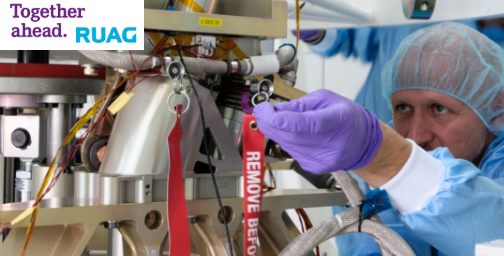
As a key OneWeb supplier, RUAG Space built the satellite dispenser, which functions as an interface between the Soyuz rocket and satellites. The dispenser is tailored to the need of a constellation like OneWeb, being able to deposit up to 36 satellites safely into space.

The RUAG built OneWeb dispenser includes a conical top structure, a “hat”, that has the capability to host up to four additional OneWeb satellites per mission. RUAG has developed a unique and cost effective solution that enables OneWeb to maximize the number of satellites per Soyuz launch. The top structure was developed within the contract with Arianespace for the OneWeb program.

RUAG dispensers, produced in Sweden, are especially suitable for spacecraft constellations such as OneWeb, where a high number of spacecraft need to be placed in orbit within a short time frame. At its lower interface the dispenser structure is bolted to the launch vehicle upper stage. Each satellite is attached to the dispenser in separation nodes. The RUAG dispenser provides a stiff connection in each node during launch, a safe release and an accurate separation provided by the four separation nuts and spring units.

Structures for satellites RUAG Space manufactures the satellite panels used by OneWeb Satellites in Titusville, Florida. The OneWeb structures (satellite back-bone) are manufactured using the Automated Potting Process (APM). The APM process—developed by RUAG Space—is a revolutionary production method that uses a pick and place machine to rapidly position special inserts filled with adhesive into the satellite structure’s sandwich panels.

In Austria, RUAG Space produced the multi-layer thermal insulation which protects the OneWeb satellites against the cold and heat in space from approx. minus 150°C to plus 150°C (-238 degrees F to 302 degrees F). The insulation consists of several layers of metal-evaporated polyimide film.

RUAG Space in Austria also built handle equipment and containers that OneWeb uses to transport the assembled satellites to the different launch sites as well as the corresponding handling at the launch sites. The high-tech, custom satellite containers are used to transport the satellites to the worldwide rocket launch centers. The containers are equipped with a specifically designed damping systems and climate-control.

RUAG Space EVP Peter Guggenbach said the company’s dispenser is super-light and includes state-of the art technology to safely place the satellites on orbit. With RUAG products, the company is contributing to this important project, which will enhance communication around the world.

A video of the RUAG Space Dispenser is available for viewing at this direct link…

Filed Under: News

Smallsat Launcher Suffers an Anomaly in Alaska

March 24, 2020 by editorial

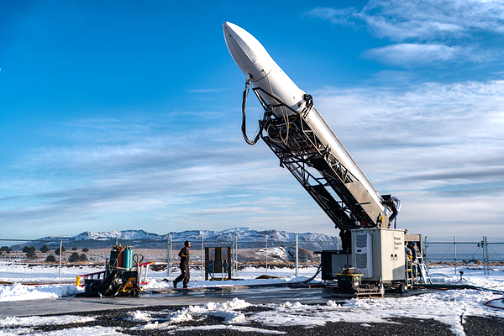
A smallsat launcher built by Astra “experienced an anomaly” Monday, March 23, on a launch pad at Kodiak Island, Alaska, forcing the cancellation of a planned orbital launch attempt this week, according to the company’s co-founder and CEO and reported at the KC4MCQ infosite.


An Astra rocket being prepared for launch. Photo is courtesy of the company.

The incident at the Pacific Spaceport Complex on Kodiak Island occurred during a pre-launch countdown dress rehearsal, and was first reported by KMXT, a local public radio station.

“I can confirm that the vehicle experienced an anomaly after an otherwise very successful day of testing in preparation for the launch,” said Chris Kemp, Astra’s co-founder and CEO, in an emailed statement late Monday. “Fortunately, our hardware was the only thing harmed, and the team is already working hard to understand the root cause so we can improve the design.”

Officials from Astra and the Pacific Spaceport Complex, which is run by the Alaska Aerospace Corp., said no one was injured during the mishap. Astra’s rocket was damaged, although the extent of the damage was unclear.

Astra was planning a launch attempt as soon as Tuesday to place a small payload into LEO. Astra’s first orbital launcher, named Rocket 3 or Rocket 3.0, is designed to carry up to 55 pounds (25 kilograms) of payload into a SSO polar orbit. Those plans were canceled after Monday’s anomaly, Kemp said.

“Unfortunately, we will not be attempting a launch this week,” he said. “We intend to wait until conditions with coronavirus improve before making another attempt.”

“I can confirm we had an anomaly on the launch pad,” said Mark Lester, CEO of Alaska Aerospace Corp., an agency of the state of Alaska. “We are executing our emergency checklist. We request everyone stay clear of the area to allow our crew to address the situation,” he told KMXT.

To read the entire article at the KC4MCQ infosite, please access this direct infolink…

Filed Under: News

Forrester Reports: Layoffs @ OneWeb + NigComSat Remains Unprofitable

March 23, 2020 by editorial


Chris Forrester

OneWeb has reportedly laid off 10 percent of its workforce due to reported – but unconfirmed – company plans that include Chapter 11 bankruptcy, reports journalist Chris Forrester, filing at the Advanced Television infosite.

The news comes as OneWeb reported the successful orbiting of 34 satellites from the Baikonur cosmodrome in Kazakhstan on March 21st on a Soyuz rocket organised by Arianespace. The success means that OneWeb now has 74 craft in LEO.

Referring to the layoffs, a company statement stated, “The OneWeb launch is going ahead on Saturday with more launches planned later in the year; however, like others, we are impacted by the global health and economic crisis and we need to dynamically adjust our workforce. Unfortunately, we think it is inevitable that there will be delays to our launch schedule and satellite manufacturing due to increasing travel restrictions and the disruption of supply chains globally. Therefore, we made the difficult decision to eliminate some roles and responsibilities as we work to focus on core operations. We are sorry to have had to take this step and we’re doing everything we can to support those affected.”

There are at least four key OneWeb locations. Officially the company is domiciled in West London, although it also has management offices in Mountain View, California, and near Washington DC (in McLean Virginia). The firm has a satellite manufacturing joint-venture with Airbus in Florida, near the Kennedy Space Center. Staff at any of these locations might be affected.

After Saturday’s launch, OneWeb focused on the positive news. In a statement, CEO Adrian Steckel said: “In these unprecedented times following the global outbreak of Covid-19, people around the world find themselves trying to continue their lives and work online. We see the need for OneWeb, greater now more than ever before.
     “High-quality connectivity is the lifeline to enabling people to work, continue their education, stay up to date on important healthcare information and stay meaningfully connected to one another. The crisis has demonstrated the imperative need for connectivity everywhere and has exposed urgent shortcomings in many organizations’ connectivity capabilities. Our satellite network is poised to fill in many of these critical gaps in the global communications infrastructure.


Chris is also reporting at the Advanced Television infosite that a report from the International Center for Investigative Reporting (ICIR), which focuses on Nigeria’s troubled satellite operator NigComSat, states the organization is “still not profitable 14 years after launch.”


Artistic rendition of Nigeria’s NigComSat-1R.

ICIR stated that NigComSat’s first working satellite (NigComSat-1R), that was launched in 2011, has barely six years of life remaining. Meanwhile, the organization has – since 2009 – received funding totaling more than $117 million (at current rates), although in Nigerian Naira it is N43.5 billion, of which just N13 billion was spent on capital items and N26.2 billion on staff salaries.

ICIR adds that during the period 2011-2014, NigComSat’s revenues from satellite operations were just 3 percent of its expenses during the period.

The recently appointed (August 2019) Minister of Communications and Digital Economy in Nigeria, Isa Ali Pantami, admitted the business was not “very viable.” In December of 2019, a new Board and executive directors were appointed.

An earlier Chinese-built satellite was launched in 2008 which cost $340 million (about Naira 40 billion at the time) but failed in orbit.

ICIR said, “NigComSat’s) wage bill, which started as N747 million in 2009, has jumped to N2.6 billion. With 397 employees as of 2016 and a personnel cost of N2.3 billion that year, the Federal Government must have paid the workers an average of N5.8 million per annum (or N480,000 a month/$1300).”

NigComSat is owned by Nigeria’s government. In 2018 it was announced that two new satellites would be purchased from China at an expected cost of $550 million.

A recent report from Nigeria’s parliament accused NigComSat’s senior management of incompetence. Chairman of Nigeria’s House Committee on Finance, James Falake, told NigComSat’s Managing Director, Abimbola Alale, in February, that, “We have to rescue this agency from you. In fact, if I had my way, I would recommend your [dismissal].”

Filed Under: News

  • « Go to Previous Page
  • Page 1
  • Interim pages omitted …
  • Page 42
  • Page 43
  • Page 44
  • Page 45
  • Page 46
  • Interim pages omitted …
  • Page 57
  • Go to Next Page »

Primary Sidebar

WEEKLY NEWSLETTER

Archives

  • August 2026
  • July 2026
  • June 2026
  • May 2026
  • April 2026
  • March 2026
  • February 2026
  • January 2026
  • December 2025
  • November 2025
  • October 2025
  • September 2025
  • August 2025
  • July 2025
  • June 2025
  • May 2025
  • April 2025
  • March 2025
  • February 2025
  • January 2025
  • December 2024
  • November 2024
  • October 2024
  • September 2024
  • August 2024
  • July 2024
  • June 2024
  • May 2024
  • April 2024
  • March 2024
  • February 2024
  • January 2024
  • December 2023
  • November 2023
  • October 2023
  • September 2023
  • August 2023
  • July 2023
  • June 2023
  • May 2023
  • April 2023
  • March 2023
  • February 2023
  • January 2023
  • December 2022
  • November 2022
  • October 2022
  • September 2022
  • August 2022
  • July 2022
  • June 2022
  • May 2022
  • April 2022
  • March 2022
  • February 2022
  • January 2022
  • December 2021
  • November 2021
  • October 2021
  • September 2021
  • August 2021
  • July 2021
  • June 2021
  • May 2021
  • April 2021
  • March 2021
  • February 2021
  • January 2021
  • December 2020
  • November 2020
  • October 2020
  • September 2020
  • August 2020
  • July 2020
  • June 2020
  • May 2020
  • April 2020
  • March 2020
  • February 2020
  • January 2020
  • December 2019
  • November 2019
  • October 2019

© 2019–2026 SatNews

Insert/edit link

Enter the destination URL

Or link to existing content

    No search term specified. Showing recent items. Search or use up and down arrow keys to select an item.
      x
      Sign Up Now!

      Enjoy a free weekly newsletter with recent headlines from the global SmallSat industry.

      Invalid email address
      We promise not to spam you. You can unsubscribe at any time.
      Thanks for subscribing! You will now receive weekly SmallSat News updates.
      We love our advertisers.
      And you will too!

      Please disable Ad Blocker to continue... We promise to keep it unobtrusive.
      We promise not to spam you. You can unsubscribe at any time.
      Invalid email address
      Thanks for subscribing!